A CBD label is a short document with a lot to say: how much CBD is in the pack, what kind of extract it is, who it is (and is not) suitable for, and how to trace it to a lab report. The big number on the front is usually the total CBD in the container, not what you take in one go, and the most reliable proof of quality is a batch-specific certificate of analysis (COA), not the wording on the box. This guide walks through every term you are likely to meet, in the order you would read them.
TL;DR
- The large milligram figure on the front is normally the total CBD in the whole bottle or pack. Work out the per-serving amount yourself.
- “Full spectrum”, “broad spectrum” and “isolate” describe the type of extract, and they are not quality grades.
- The Food Standards Agency (FSA) advises healthy adults to limit CBD to 10 mg a day from all sources, and its proposed labelling rules centre on that figure.
- A batch number on the pack should match a COA from an accredited lab. If it does not, the lab report tells you nothing about your product.
- Be wary of any label that promises to treat pain, anxiety or sleep problems. Food labels are not allowed to make those claims.
Table of Contents
- Start with the front of the pack: total mg versus per-serving mg
- Spectrum terms: full, broad and isolate
- THC on the label: “0%”, “THC-free” and “non-detect”
- The 10 mg figure: what “ADI” means
- Warnings you should expect to see
- Claims: what a CBD food label cannot say
- The ingredients list
- Other cannabinoids on the label
- Batch numbers: your link to the lab report
- How to read a certificate of analysis (COA)
- Does the label tell you a product is legal?
- A quick glossary of CBD label terms
- Our perspective: what we think a good label looks like
- Where to find our products
- FAQ
- Sources
Start with the front of the pack: total mg versus per-serving mg
The first thing most of us see is a large number: 500 mg, 1000 mg, 1500 mg. That figure normally describes the whole container, not a single dose. Mistaking one for the other is the most common way people end up taking far more, or far less, than they meant to.
The sums are simple:
- Tinctures and drops: divide the total CBD (mg) by the bottle volume (ml) to get mg per millilitre. Then check how many millilitres one dropper or one drop delivers, as stated on the pack.
- Gummies: divide the total CBD by the number of gummies. A 10-count pack with 250 mg in total, for example, works out at 25 mg per gummy.
- Soft gels and capsules: divide the total by the number of capsules, or read the per-capsule figure directly.
A worked example. A 10 ml bottle labelled 1000 mg contains 100 mg of CBD per millilitre. If the label says one millilitre is about 20 drops, each drop is roughly 5 mg. Two drops is already the 10 mg the FSA suggests as a daily ceiling (more on that below).
The per-serving figure is the one that matters, and a clear label states it. If you have to do heavy arithmetic to find it, that is worth noticing.
Spectrum terms: full, broad and isolate
These three words describe what else, if anything, travels alongside the CBD in the extract.
| Term | What it means | THC |
|---|---|---|
| Full spectrum | CBD plus other naturally occurring hemp compounds, such as minor cannabinoids and terpenes | Trace amounts of THC are usually present |
| Broad spectrum | A range of hemp compounds alongside CBD, with THC removed or reduced | Intended to be absent or below detection |
| Isolate | CBD on its own, purified | None expected |
Two points are worth holding on to. First, none of these terms is regulated as a quality mark, so a brand can use them freely. Only a lab report shows what is actually in the product. Second, the Home Office and FSA point out that while pure, isolated CBD is not a controlled substance, most extracts contain trace amounts of other cannabinoids, which is why the legal status of a CBD product depends on what the product is.
If you are comparing “zero THC” claims against “under 0.2% THC” claims, our piece on why UK buyers are checking the wrong number goes into the detail.
THC on the label: “0%”, “THC-free” and “non-detect”
“Zero THC” sounds absolute, but it is only as good as the test behind it. Labs have a limit of detection, so a result of “ND” (not detected) means any THC present is below what that method can measure. It does not mean a molecule-by-molecule absence.
When you read a lab report, look for total THC. This matters because THCA, the raw form in the plant, converts to THC when heated. As OpenCOA’s guide explains, total THC counts both THCA and delta-9 THC. A report that lists only delta-9 may flatter the product.
If you are subject to workplace drug testing, the label alone is not enough to rely on. We cover the practical steps in our guide to avoiding a positive drug test.
The 10 mg figure: what “ADI” means
You may now see the abbreviation ADI, short for acceptable daily intake. The FSA’s advice is that healthy adults should limit CBD consumption to 10 mg per day, and that vulnerable groups such as under-18s, people who are pregnant, breastfeeding or trying to conceive, and people taking medication should avoid CBD.
This is moving into labelling. The FSA’s September 2026 Board paper records that its risk-management proposals set out that products should be labelled with the provisional ADI of 10 mg a day and warnings for under-18s and other groups. The FSA has also proposed a shorter, clearer version of the ADI wording after stakeholder feedback.
Be precise about where this stands. At the time of writing, these are recommendations heading to Ministers for the first authorisations, not a finished rulebook covering every product on the shelf. So a label that carries the 10 mg advice and the vulnerable-group warnings is a good sign of a brand following the direction of travel, and a label that says nothing about either deserves a closer look.
Our explainers on the UK CBD age limit and the 10 mg ADI and on what the daily limit means for hemp extract products cover the background.

Warnings you should expect to see
A responsible UK label typically carries wording along these lines:
- Not suitable for people under 18.
- Not suitable during pregnancy or breastfeeding, or when trying to conceive.
- Speak to a doctor or pharmacist first if you take any medication.
- A reminder of the 10 mg daily advice.
The reasoning is set out by the FSA: its safety assessments only cover healthy adults, and there is some evidence that CBD poses a risk to certain groups. If you are in one of those groups, or you are unsure, ask your GP or pharmacist before using any CBD product.
Warnings are not decoration. A pack that skips them is telling you something about how carefully it was put together.
Claims: what a CBD food label cannot say
This one catches people out. A label or product page that says a gummy or oil will treat pain, ease anxiety or fix your sleep is making a medical claim. The FSA’s own fact check says that such claims are not permitted on food and that they can indicate a product operating outside established safety rules. A medicinal claim can also reclassify a product as an unauthorised medicine, which brings the MHRA into play rather than just the FSA.
So when you read a label, treat a cure-style promise as a warning sign, not a selling point. Look instead for plain statements: the type of extract, the amount per serving, the ingredients, the warnings and the batch number.
The same reasoning applies to us. We describe what our products contain and how they are tested. We do not make promises about treating a condition, and neither should any CBD retailer selling food supplements.
The ingredients list
Ingredients appear in descending order by weight. For CBD products, check the following:
- The carrier: in tinctures this is often an oil such as MCT (from coconut) or hemp seed oil. Check it against any allergies.
- The extract: “hemp extract”, “CBD isolate” or “broad-spectrum hemp extract”. A vague label such as “hemp oil” alone can mean hemp seed oil, which contains little or no CBD.
- Sweeteners, flavourings and gelatine or pectin in gummies, which matter if you are vegan, avoiding sugar or have dietary restrictions.
- Capsule shell materials in soft gels.
- Extraction method, where the brand tells you. CO2 extraction is one common method, and we explain why a COA matters more than the extraction claim.
The hemp seed oil trap deserves a second mention. A bottle can say “hemp” in large letters and still contain almost no CBD. The mg figure, tied to a named extract, is what counts.
Other cannabinoids on the label
Some labels name additional compounds such as CBG, CBN or CBDA. These are different molecules with different evidence behind them, and the FSA’s advice relates to CBD. If you want to see how they differ, we have written about CBDA versus CBD and CBD versus CBN and the 10 mg limit. The label rule of thumb is simple: if a minor cannabinoid is named, you should be able to find its measured amount on the COA.
Batch numbers: your link to the lab report
A batch (or lot) number is a code printed on the bottle, box or base of the pack. It identifies one production run. The lab test belongs to that run.
Here is why this matters. Industry commentary notes that labelling inaccuracies are common and that many products have been found to contain significantly more or less CBD than claimed, so the reliable check is to match your batch number to the COA, ideally through a QR code or a download link on the brand’s site.
A quick routine:
- Find the batch number on your pack.
- Open the brand’s lab reports page or scan the QR code.
- Confirm the same batch number appears on the report.
- Check the test date is before your best-before date, and that the product name matches.
If the report is generic, covers a different product, or has no batch number, treat it as marketing rather than proof.
How to read a certificate of analysis (COA)
A COA is a third-party lab report showing what is in a product, covering potency, purity and safety. It looks technical, but the useful parts are few. Cannetics’ guide to reading COAs lists the elements a reliable one should include, and the checklist below draws on it.
| What to check | What good looks like |
|---|---|
| Lab accreditation | An independent lab accredited to ISO 17025 |
| Batch number | Matches the one on your pack |
| Cannabinoid profile | CBD amount, THC (and total THC) and any other named cannabinoids |
| Contaminant tests | Heavy metals, pesticides, residual solvents and microbes |
| Date and lab details | Recent, with the lab’s name and contact details |
Reading the potency section
Potency results are often given in mg per gram, mg per millilitre, mg per unit or as a percentage. Convert them to the same unit as the label before you compare. Industry guidance suggests a variance of around ±10% is normal, and that if the measured CBD is more than 20% below the claim, the labelling is likely inaccurate.
Reading the safety section
A “PASS” next to heavy metals or pesticides means the result is within the stated limits. It does not mean nothing at all was detected. Look at the numbers and limits, not only the word.
Red flags
- No batch number, or one that does not match your pack.
- A lab that is not named, or is owned by the brand with no independent accreditation.
- Only a potency page, with no contaminant results.
- THC reported as delta-9 only, with no total THC.
- Results that are years old for a product that is made in fresh batches.
Does the label tell you a product is legal?
Not by itself. CBD food products in the UK sit under novel food rules, and the FSA keeps a public list of products that can stay on the market while applications are assessed. The FSA’s consumer advice is to check the FSA register of CBD products before you buy and to check the label to confirm how much CBD you are consuming. For the broader picture, see our overview of CBD regulation in the UK.
Also remember that CBD can be relevant to driving and workplace rules. Our answer on driving after CBD in the UK sets that out.
A quick glossary of CBD label terms
- Cannabinoid: a compound found in hemp and cannabis, of which CBD and THC are the best known.
- Endocannabinoid system: the signalling network in the body that cannabinoids interact with. Research is ongoing, and a label is not the place for claims about it.
- Terpenes: aromatic compounds in hemp that give flavour and scent.
- Carrier oil: the oil that CBD extract is mixed into, such as MCT.
- Bioavailability: how much of what you take reaches the bloodstream. Labels rarely quantify it, so treat any big promise with caution.
- Third-party tested: tested by a lab independent of the brand. Ask for the report.
- COA: certificate of analysis, the batch-specific lab report.
- ADI: acceptable daily intake, currently 10 mg of CBD a day for healthy adults in the FSA’s advice.
- Novel food: a food without a significant history of consumption in the UK before May 1997, which needs authorisation before sale.
For more definitions, see our own CBD terminology guide.
Our perspective: what we think a good label looks like
We make broad-spectrum tinctures, gummy bears and soft gels in the UK, using organically grown hemp extract sourced from the USA, and we have the products independently lab tested for zero THC. That shapes how we look at labels.
Our view is that a label should do three jobs. It should make the per-serving amount obvious, so nobody needs a calculator at the kitchen counter. It should carry the warnings for people who should not use CBD, in plain words. And it should point to a lab report that belongs to that exact batch, because a claim you cannot check is only a claim.

We would also say, gently, that the number to trust is the one on the COA. A pack can say anything. A named, accredited lab with a batch number matching your bottle is far harder to fake or fudge, which is why we encourage everyone, including our own customers, to check.
And we keep our wording on the safe side of the rules: we do not tell anyone a product will fix a condition. If you are managing pain, low mood or poor sleep, a GP is the right first call, and CBD should never replace advice or treatment from them.
— Mike
Where to find our products
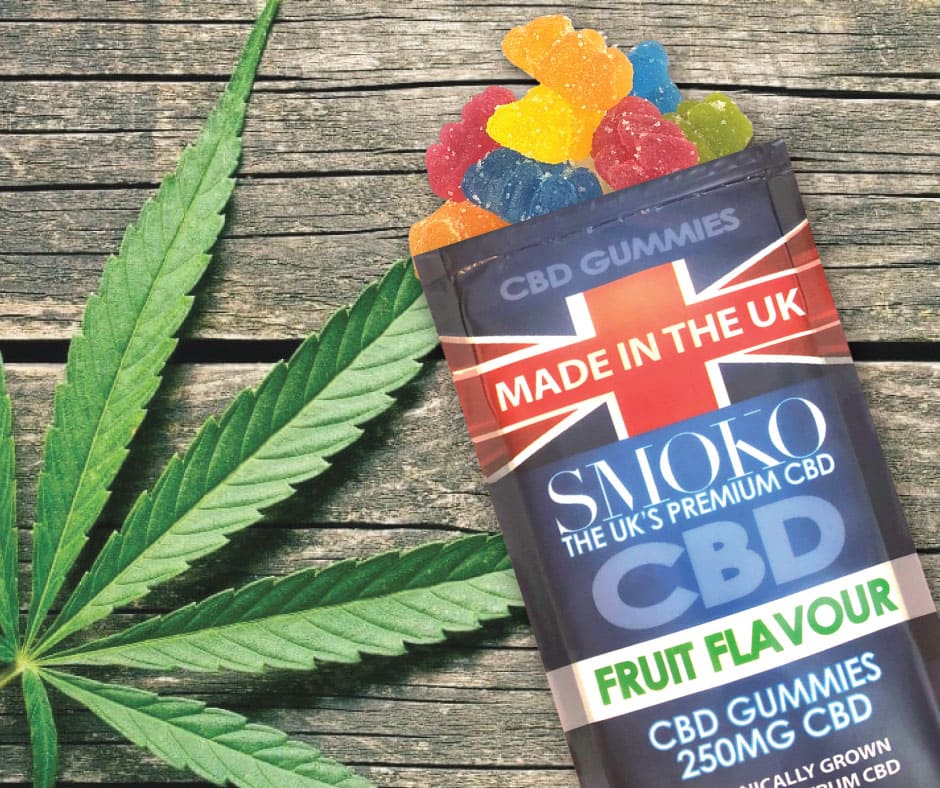
If you would like to see these label principles in practice, browse our CBD tinctures, gummy bears and soft gels. Our 250 mg broad-spectrum gummy bears are a good place to start, since the pack size makes the per-gummy sum easy. Orders over £30 ship free within the UK.
FAQ
What does “mg” mean on a CBD label?
It is milligrams of CBD. On the front of a bottle it is usually the total in the entire container, so divide by the number of servings (or by the millilitres, then the dropper size) to get your per-serving amount. The FSA’s advice for healthy adults is no more than 10 mg of CBD a day from all sources.
What is the difference between broad spectrum and full spectrum?
Both contain a range of hemp compounds alongside CBD. Full spectrum products typically retain trace THC, while broad spectrum products are made with THC removed or reduced. Neither term guarantees quality, so check the COA for the actual THC result.
Where do I find a batch number and COA?
The batch number is printed on the bottle, box or pack. The matching COA should be on the brand’s website or behind a QR code. Check that the batch number on the report is identical to the one on your product, and that the lab is independent and accredited.
Can a CBD label say it helps with pain, anxiety or sleep?
Not if it is sold as a food. The FSA says health and medical claims are not permitted on CBD food labelling. A product making them may be operating outside the rules, so treat them as a red flag.
Is a “PASS” on a lab report enough?
It is a start. A pass means results are within the stated limits, not that nothing was detected. Read the figures for cannabinoids and contaminants, confirm the batch number and note the lab’s accreditation.
Sources
- FSA Food Fact Check: CBD safety and health claims
- GOV.UK: CBD novel food applications, recommendations to ministers on first authorisations
- GOV.UK: Policy considerations and proposed recommendations, CBD novel food consultation
- Home Office: Cannabis, CBD and other cannabinoids factsheet
- Cannetics: How to read CBD COAs
- OpenCOA: Learn about COAs
- LiveGood Blog: How to read CBD labels
- Healthline: Reading a CBD label