TL;DR:
- CBD products in the UK vary widely in formulation, spectrum type, and legal classification, affecting safety and effectiveness. Understanding terminology like isolate, broad-spectrum, full-spectrum, and the importance of bioavailability guides informed, safe choices. Transparency through lab testing, proper sourcing, and realistic expectations is essential for responsible CBD use.
Two products sitting side by side on a shelf, both labelled “500mg CBD,” can work very differently in your body. One might use an oil-based isolate with low absorption; the other a broad-spectrum emulsion that delivers a noticeably stronger effect. Add terms like “novel food,” “full spectrum,” and “entourage effect” into the mix, and it’s easy to see why UK shoppers feel genuinely confused about what they’re actually buying. Getting to grips with CBD terminology is not just about sounding knowledgeable; it directly affects your safety, your legal peace of mind, and whether the product you choose actually delivers real wellness value.
Table of Contents
- Decoding CBD on UK product labels
- Understanding spectrum types: Isolate, broad-spectrum, full-spectrum
- Bioavailability and formulation: Why “mg per serving” is only half the story
- Evidence and expectations: Separating fact from wishful thinking
- A fresh perspective: The real art and science of CBD choices in the UK
- Explore trusted CBD options with confidence
- Frequently asked questions
Key Takeaways
| Point | Details |
|---|---|
| Label terms have real meaning | UK law distinguishes CBD foods from medicines and sets strict rules for health claims. |
| Formulation affects effectiveness | How CBD is delivered can significantly change how much your body absorbs, regardless of dose. |
| Evidence for benefits is selective | CBD helps with some symptoms but not all; avoid assuming broad health claims are proven. |
| Spectrum types matter | Understanding isolate, broad-spectrum, and full-spectrum helps you choose products best suited to your needs and legal status. |
Decoding CBD on UK product labels
With the confusion around product labels established, let’s break down what the most important terminology actually means for UK consumers.
The first thing to understand is that CBD products in the UK do not all sit under the same regulatory umbrella. CBD-containing products taken orally are regulated differently depending on whether they are positioned as foods or medicines. Most CBD tinctures, gummies, and capsules on the UK market are sold as food supplements, which means they fall under novel food rules overseen by the Food Standards Agency (FSA). Medicinal CBD, such as the prescription drug Epidyolex, goes through the Medicines and Healthcare products Regulatory Agency (MHRA) and requires formal clinical evidence and licensing. This distinction is enormous. A food supplement cannot legally claim to treat, cure, or prevent any disease. When you see a product promising to “cure your anxiety” or “treat inflammation,” that is a medicinal claim, and it should ring an immediate alarm bell.
Understanding CBD regulations in the UK is genuinely empowering for anyone exploring wellness options. Here is a quick guide to the terms you will most commonly encounter on product labels:
| Term | What it means | Why it matters |
|---|---|---|
| CBD isolate | Pure cannabidiol only, no other cannabinoids | Predictable, THC-free, simpler profile |
| Broad-spectrum | Multiple cannabinoids, typically zero THC | Balance of plant compounds without THC risk |
| Full-spectrum | All plant compounds including trace THC (up to 0.2%) | Widest cannabinoid range; THC present |
| Novel food | Regulatory status for new food ingredients | Confirms product should hold FSA authorisation |
| Third-party tested | Lab results from an independent facility | Verifies what is actually in the product |
Red flags to watch for on labels:
- Medicinal claims such as “treats,” “cures,” or “prevents” any condition
- No batch number or Certificate of Analysis (COA) reference
- Vague “hemp extract” descriptions with no stated CBD concentration
- No allergen or ingredients list
- Missing manufacturer address or contact details
Confidence boosters to look for:
- Clear mg of CBD per serving and per container
- QR code linking to a third-party lab report
- FSA novel food authorisation status
- Transparent sourcing information (country of origin for hemp)
- Safety advisories such as daily intake limits
Pro Tip: Always scan or search for the product’s Certificate of Analysis before purchasing. A reputable brand will make this easy to find, not buried in fine print.
Defining CBD terminology accurately is genuinely the foundation of making confident, safe choices. Once you understand what these labels mean, the market becomes far less intimidating.
Understanding spectrum types: Isolate, broad-spectrum, full-spectrum
While label categories set the stage, understanding CBD’s “spectrum” terms is central to choosing the right product for your goals.
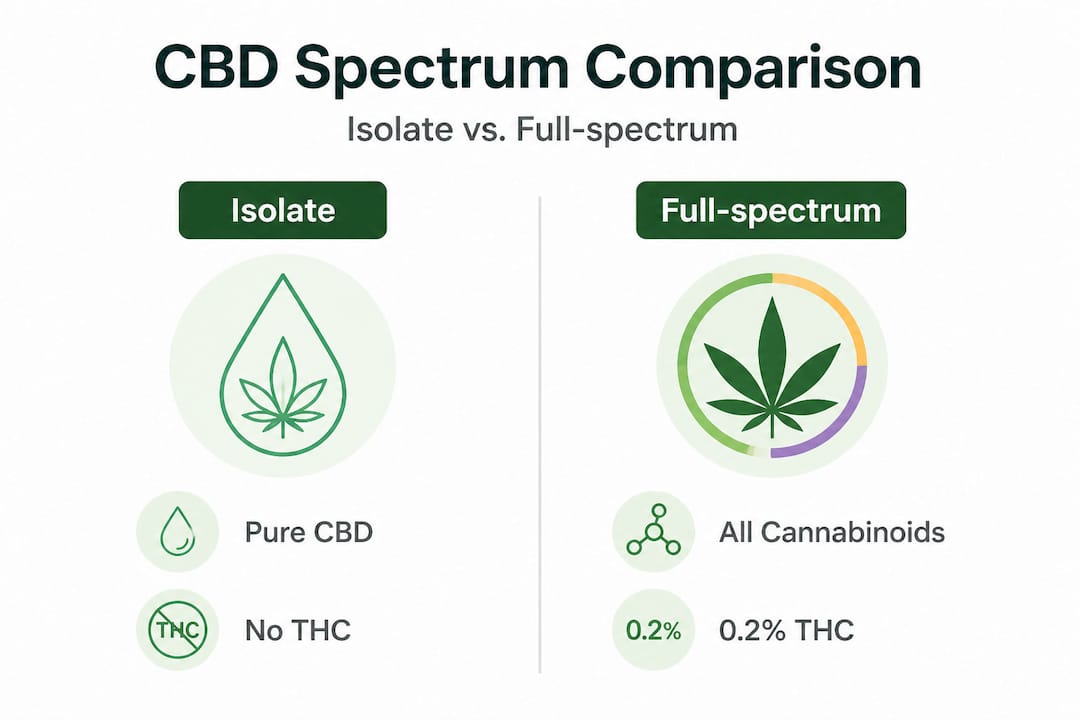
CBD isolate is exactly what it sounds like: cannabidiol in its purest, most refined form, stripped of all other plant compounds. It typically appears as a white powder or a clear oil. There is no THC, no terpenes, and no other cannabinoids present. For people who are drug tested at work, or who simply prefer a product with a completely predictable, single-compound profile, isolate can be a very practical choice. The trade-off is that isolate lacks the broader plant chemistry that some researchers believe contributes to CBD’s effects.

Broad-spectrum CBD sits in the middle ground. It retains multiple cannabinoids, terpenes, and other plant compounds found in the hemp plant, but processing removes THC to non-detectable levels. This is the category that SMOKO CBD uses across its product range, which makes it a popular choice for UK consumers who want more of the plant’s natural profile without any concern about THC. You can explore the full picture in our broad-spectrum CBD guide.
Full-spectrum CBD includes the complete range of cannabinoids, including up to 0.2% THC (the legal limit in the UK). The trace amount of THC in a compliant full-spectrum product is not enough to produce a psychoactive effect, but it is detectable by laboratory testing and, importantly, may show up on workplace drug screens.
The difference between cannabinoid oil and hemp oil is another area of frequent confusion worth clarifying: hemp seed oil contains minimal cannabinoids and is primarily a nutritional oil, while cannabinoid oil is extracted from the flowers and leaves of the hemp plant and carries meaningful CBD content.
Now for the term that marketing teams love and scientists approach with considerably more caution: the “entourage effect.” This idea suggests that cannabinoids, terpenes, and other plant compounds work together in a kind of synergy, each making the others more effective. It is an appealing concept. However, the entourage effect refers to the synergy among cannabis constituents, but supporting human evidence is limited, with most data coming from small, non-standardised studies rather than robust clinical trials. This does not mean the effect does not exist; it means we should hold it as an interesting hypothesis rather than an established fact.
“Choosing a product based on spectrum type is a genuine, practical decision. But be cautious of any brand that sells the entourage effect as though it were proven medicine. The science simply is not there yet to back those claims fully.”
Here is a quick-reference comparison of spectrum types:
| Spectrum type | THC present? | Other cannabinoids? | Best for |
|---|---|---|---|
| Isolate | No | No | Simplicity, drug testing concerns |
| Broad-spectrum | No (non-detectable) | Yes | Wider plant profile, THC-free |
| Full-spectrum | Trace (up to 0.2%) | Yes | Full plant chemistry |
Understanding the difference between CBD and THC is equally important here, because the two compounds behave very differently in the body and under UK law.
Bioavailability and formulation: Why “mg per serving” is only half the story
Once you know what kind of CBD you are getting, it is essential to consider how formulation and delivery affect how your body absorbs it, and what that means for effective use.
Bioavailability is the proportion of a substance that actually reaches your bloodstream and becomes available for your body to use. Think of it like this: if you swallow a 50mg CBD capsule but your body only absorbs 10% of it, you are effectively getting 5mg of active CBD. The label told you 50mg; your body received far less.
CBD’s oral bioavailability varies significantly by formulation, with emulsions and particle size properties substantially altering absorption rates. A study comparing oral CBD formulations found meaningful differences in how much CBD reached the bloodstream depending on how the product was made, not just how much CBD was in it.
Here is how different formulation variables affect what you actually absorb:
| Formulation type | Approximate bioavailability | Notes |
|---|---|---|
| Standard oil capsule | 6 to 19% | Absorption aided by fatty meal |
| Nano-emulsion (water-soluble) | Up to 50%+ | Smaller particles, faster uptake |
| Sublingual oil (held under tongue) | 20 to 35% | Faster than swallowing; bypasses digestion partially |
| Edible gummies | 6 to 15% | Convenient but slower onset |
What to look for beyond milligrams on the label:
- Is the oil carrier specified? MCT (medium-chain triglyceride) oil, for example, is known to improve CBD absorption compared to cheaper carrier oils.
- Does the product describe nano-emulsification or liposomal delivery? These formulation methods genuinely improve bioavailability.
- Is there guidance on when to take it, such as with food? Fat helps absorb CBD.
- Does the label describe the particle size or emulsion type?
Understanding CBD bioavailability is genuinely one of the most underappreciated aspects of choosing an effective product. A 1000mg tincture from a quality brand using MCT oil and optimal formulation will, in practice, outperform a poorly made 2000mg product every single time.
Pro Tip: Take your CBD oil or capsule with a meal that contains healthy fats (avocado, nuts, olive oil) to noticeably improve absorption. This simple habit can make a significant difference to the results you experience.
Looking at CBD quality standards helps you identify which brands invest in formulation science rather than simply loading up milligrams on a label.
Evidence and expectations: Separating fact from wishful thinking
Understanding products is only half the journey; what does the science actually say about real benefits and safe use?
The honest answer is: CBD research is genuinely promising in certain specific areas, but it is frequently over-simplified in marketing. Here is a grounded summary of what systematic reviews and meta-analyses have actually found:
- Pain and inflammation: Some studies show modest benefits, particularly for neuropathic pain, but effect sizes are often small and study populations varied.
- Anxiety: Early clinical data is encouraging, particularly for social anxiety, though most studies are short-term and involve small samples.
- Sleep: CBD may help people fall asleep, particularly when anxiety or pain is a contributing factor, but it is not a guaranteed sleep aid.
- Skin conditions: Meta-analyses show modest benefit for specific symptoms in certain conditions, with no significant effect on other endpoints. In dermatology, for instance, results vary considerably depending on the condition studied.
- Epilepsy: This is where the clearest clinical evidence sits. Epidyolex (pharmaceutical-grade CBD) is an approved treatment for specific rare epilepsy syndromes.
“The nuance matters enormously here. ‘CBD helps with anxiety’ is a statement that needs unpacking every single time. Which type of anxiety? At what dose? In what formulation? For how long? These questions separate responsible wellness guidance from marketing hype.”
The honest dos and don’ts of CBD health claims:
- Do look for products that cite specific studies or lab results.
- Do manage your expectations. CBD is a wellness supplement, not a pharmaceutical drug.
- Do consult your GP if you take prescription medications, as CBD can interact with certain drugs.
- Don’t accept sweeping claims without evidence.
- Don’t assume a higher price automatically means higher quality or stronger evidence.
Pro Tip: Search for organic CBD certification when evaluating brands. Certified organic hemp means fewer pesticides and contaminants in the final product, which matters for both safety and quality.
A fresh perspective: The real art and science of CBD choices in the UK
Here is something most CBD articles will not tell you plainly: the majority of the confusion in this market is not accidental. It serves brands that benefit from keeping consumers uncertain and dazzled by terminology. “Nano-CBD,” “quantum absorption,” “proprietary terpene blend” — these phrases can mean everything or nothing, depending entirely on whether there is verified science behind them.
The genuinely wise approach to CBD in the UK right now is to treat it like any other wellness supplement. That means demanding the same standards you would from a reputable vitamin brand: transparent sourcing, independent lab verification, clear dosing information, and no exaggerated claims.
CBD law and compliance in the UK is clearer than many consumers realise. Products sold as food supplements cannot make medicinal claims. If a brand is making those claims and operating in the UK, they are either uninformed or deliberately sidestepping the rules. Neither is a good sign.
One of the most common expensive mistakes is chasing bigger milligram counts without considering formulation quality. A 3000mg isolate oil in a cheap carrier at low bioavailability will likely underdeliver compared to a well-formulated 1000mg broad-spectrum product using MCT oil and proper extraction. “Bigger” is not “better” in CBD. “Better made” is better.
The most satisfied CBD users we hear from are those who set realistic goals, start with a modest dose, stay consistent, and use products from brands willing to share everything: their lab reports, their sourcing, their formulation details. That transparency is the most reliable signal of quality in a market that still has too many gaps.
Explore trusted CBD options with confidence
Armed with these insights, your next step is to choose products that live up to both the letter and spirit of UK regulations and true wellness values.
At SMOKO CBD, we believe transparency is not optional. Every product we make uses broad-spectrum hemp extract, organically grown in the USA, with zero detectable THC confirmed through independent third-party lab testing. Whether you prefer the measured simplicity of our CBD Mint Tincture 1000mg, blended with MCT oil for optimal absorption, or the daily convenience of our CBD Soft Gel Capsules, you get honest labelling, verified results, and products designed for real UK wellness needs. No guesswork. No inflated claims. Just quality CBD you can trust.
Frequently asked questions
What does “broad-spectrum” mean on a CBD label?
Broad-spectrum CBD contains multiple cannabinoids and plant compounds from the hemp plant but has THC removed to non-detectable levels, giving you a wider plant profile without any THC risk.
Are CBD foods and medicinal CBD products treated the same in the UK?
No. CBD oral products sold as food supplements and those sold as medicines are regulated under entirely separate frameworks, with medicinal CBD requiring formal MHRA licensing and clinical evidence.
Is there scientific proof for the “entourage effect”?
Human evidence supporting the entourage effect remains limited, with most supporting data coming from preclinical or small, non-standardised studies rather than robust clinical trials.
Does a higher milligram dose always mean better results?
Not at all. CBD oral bioavailability varies considerably with formulation, meaning that how a product is made often determines how much CBD your body actually absorbs and uses.
Has CBD been clinically proven to help all symptoms it is marketed for?
No. Meta-analyses find modest benefits for a limited number of specific conditions, while many of the broader claims seen in CBD marketing are not currently supported by strong clinical evidence.
Recommended
- Defining CBD Terminology: Your UK Guide to Confident Choices – SMOKO CBD
- Why CBD is Legal in the UK: Regulation and Safety Explained – SMOKO CBD
- What is Organic CBD? Your Guide to Origins and Labels – SMOKO CBD
- CBD vs THC Explained: Choosing the Right Option for UK Wellness – SMOKO CBD
- How to Read Product Labels: Navigate Cannabis Choices Wisely ~ Green Society Blog