TL;DR:
- Many UK CBD products lack proper regulation, risking contamination and inaccurate labeling.
- The FSA mandates a maximum safe daily intake of 10mg CBD for adults.
- Consumers should verify products via third-party lab tests and FSA-approved lists for safety.
Not all CBD products sold on UK shelves are created equal, and that assumption catches thousands of shoppers off guard every year. Despite growing consumer demand, the regulatory landscape remains a patchwork of approved, pending, and non-compliant products sitting side by side on the same shelf. Some contain contaminants. Some overstate their CBD content. And others make bold health claims with little evidence to back them up. This guide cuts through that confusion, explaining what UK regulations actually require, how to read labels properly, what daily intake limits mean for you, and the key warning signs that separate trustworthy CBD from the rest.
Table of Contents
- Why quality matters with CBD products
- Understanding UK CBD regulations and Novel Food rules
- How to spot high-quality, compliant CBD in shops
- Dosing and safety: Trusted guidance versus industry claims
- The uncomfortable truth about UK CBD quality standards
- High-quality, compliant CBD: A smarter way to shop
- Frequently asked questions
Key Takeaways
| Point | Details |
|---|---|
| Not all CBD is equal | UK regulations set a high bar, but many products remain poorly tested or unapproved. |
| Check for FSA compliance | Safe CBD products must be on the FSA list with transparent labelling and certificates. |
| Follow official dosing | Stick to 10mg of CBD isolate per day unless advised otherwise by a professional. |
| Be a smart shopper | Demand clear safety evidence and avoid misleading claims when choosing CBD products. |
Why quality matters with CBD products
With common misconceptions in mind, let’s understand why CBD quality is more than a regulatory tick-box.
When you’re turning to CBD to help manage pain, anxiety, or sleep, product quality directly shapes whether it works at all. A poorly produced CBD oil might contain trace heavy metals, residual pesticides, or even unlawful levels of THC (tetrahydrocannabinol, the psychoactive compound in cannabis). These aren’t hypothetical risks. They are documented concerns that regulators and researchers have flagged repeatedly.
Here are the key quality risks linked to substandard CBD products:
- Heavy metals such as lead or cadmium, absorbed from contaminated soil during hemp cultivation
- Pesticide residues from non-organic growing practices, which can accumulate in concentrated extracts
- Unlawful THC levels that exceed the 0.2% legal threshold, potentially causing psychoactive effects
- Inaccurate CBD concentration, where the actual content differs significantly from what’s on the label
- Microbial contamination, particularly in products without adequate processing controls
The effects of CBD on pain, anxiety, and sleep are genuinely promising, but they are only reliable when the product itself is verified and properly regulated. If you’re using an adulterated product, you may be getting very little CBD at all, and potentially exposing yourself to substances you didn’t sign up for.
“The safety of a CBD product is only as strong as the evidence behind it. Products lacking rigorous toxicology data cannot be considered safe by default.”
This point is reinforced by the Food Standards Agency (FSA), whose safety assessment findings confirm that some CBD products have failed to meet safety requirements precisely because they lacked sufficient toxicology data. Approval is not automatic. It must be earned through evidence.
Pro Tip: Always look for a Certificate of Analysis (COA) from an independent, third-party laboratory before buying any CBD product. This document confirms exactly what’s in the bottle, including cannabinoid profile and contaminant testing.
Choosing premium CBD quality means selecting products where every batch has been tested, the results are published, and the manufacturing process is transparent. That’s the standard that genuinely supports your health goals.
Understanding UK CBD regulations and Novel Food rules
A focus on high-quality CBD means knowing exactly what UK rules demand.
Since January 2021, CBD food products sold in the UK have been classified as Novel Foods by the FSA. This classification means any CBD product intended for human consumption, including tinctures, capsules, and gummies, must receive pre-market authorisation before it can be legally sold. The Novel Food regulations require manufacturers to submit robust safety dossiers covering toxicology, composition, and intended use.
Here’s how the authorisation process works in practice:
- Application submission: Manufacturers submit a detailed safety dossier to the FSA
- Scientific review: Independent experts assess the evidence for safety and composition
- Public consultation: The FSA opens the assessment to public and industry feedback
- Provisional listing: Products meeting initial criteria appear on the FSA’s validated list while full review continues
- Full authorisation: Only granted when the complete safety profile is confirmed
As of 2026, very few CBD products have achieved full authorisation. Many remain in the pending phase, meaning they may still be sold but have not yet passed the complete safety review. The FSA maintains a public list of validated products, and checking this list before you buy is one of the simplest safeguards available.
| Regulatory status | What it means for shoppers |
|---|---|
| Fully authorised | Highest confidence, complete safety review passed |
| Validated/pending | On FSA list, review ongoing, lower certainty |
| Not listed | No regulatory oversight, buy with caution |
| Rejected | Failed safety review, do not purchase |
Key statistic: The FSA’s provisional Acceptable Daily Intake for CBD isolate is set at 10mg per day for healthy adults. This is the official safety threshold, though many industry brands suggest doses of up to 70mg daily. That gap matters, and we’ll address it shortly.
For a full breakdown of what these rules mean for your daily CBD intake, it’s worth reviewing the FSA’s published guidance directly. And if you want to understand the broader legal context, the UK CBD regulations overview covers everything from licensing to labelling requirements.
How to spot high-quality, compliant CBD in shops
Knowing the law is one thing, but making the right choice on the high street takes practical skills.
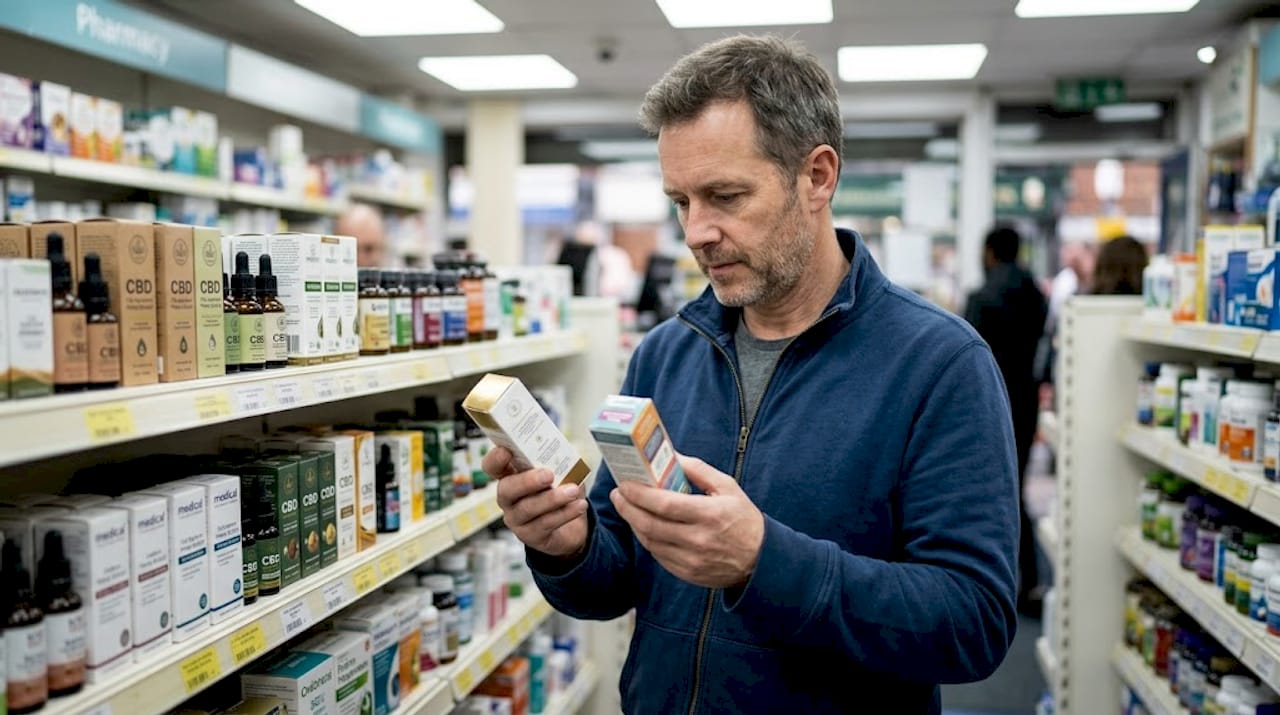
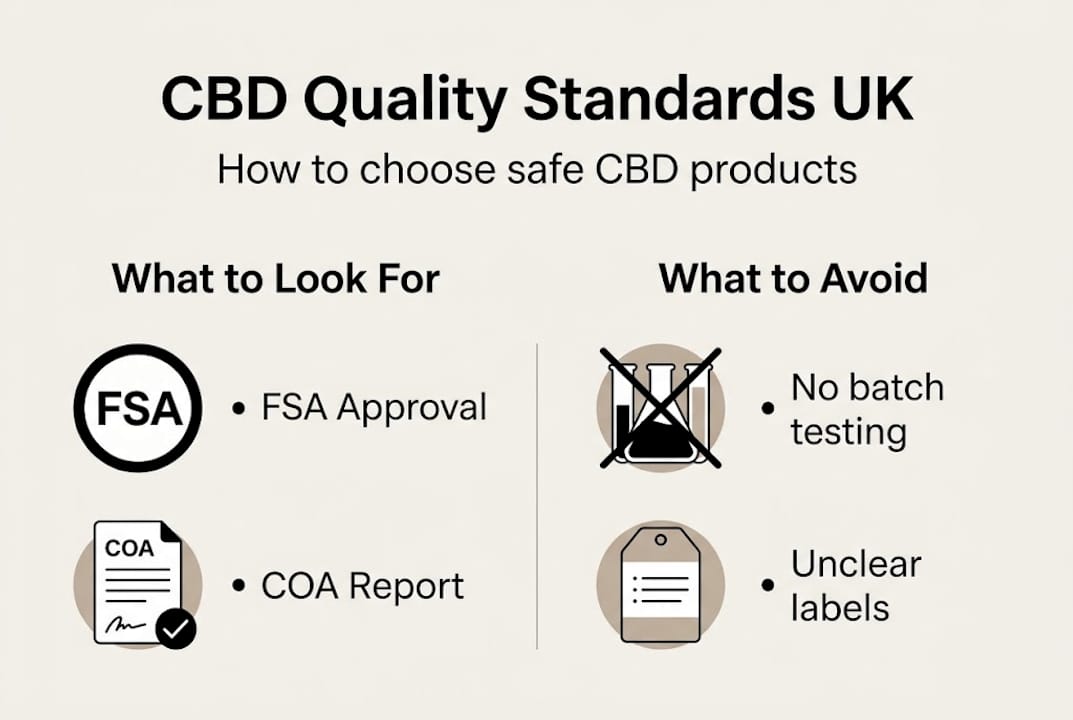
Labels can be deceiving. A product with an elegant design, bold claims, and impressive-sounding ingredient names may have no regulatory backing whatsoever. Here’s what to look for and what to avoid.
Green flags on a CBD label:
- Batch number: Allows you to trace that specific product to its lab test results
- Certificate of Analysis (COA): A QR code or web link pointing to third-party test results
- Exact CBD concentration: Milligrams per serving and per bottle, not vague percentages alone
- FSA compliance statement: Confirmation the product is on the validated novel food list
- Manufacturer contact details: A real address and means of contact, not just a website
Red flags to walk away from:
- Extreme health claims such as “cures anxiety” or “eliminates chronic pain” (these are not permitted)
- No batch number or lab test reference anywhere on the packaging
- Unusually high CBD content at a very low price point
- Missing ingredient list or carrier oil information
- No information about country of origin for the hemp
You can also verify FSA compliance directly using the FSA’s public validated product list. It takes two minutes and gives you genuine peace of mind.
| Feature | Quality product | Low-quality product |
|---|---|---|
| Third-party COA | Publicly available, batch-specific | Absent or generic |
| CBD content accuracy | Within 10% of label claim | Often significantly lower |
| THC level | Confirmed zero or trace | Unknown or unlisted |
| Contaminant testing | Full panel including pesticides | Not conducted |
Pro Tip: Search for the product name on the FSA’s validated CBD list before purchasing. If it’s not there, that’s a significant warning sign, especially for products making strong health claims. For a deeper look at what sets products apart, the organic CBD certification guide is a useful resource.
Dosing and safety: Trusted guidance versus industry claims
After learning to spot quality in the shop, it’s crucial to know how much CBD is safe to consume.
The FSA’s official position is clear: healthy adults should consume no more than 10mg of CBD per day. Yet walk into any health shop or browse most CBD websites, and you’ll find brands suggesting 25mg, 50mg, or even 70mg daily doses. That gap between official guidance and industry practice can feel confusing, even alarming.
Here’s how to navigate it sensibly:
- Start with the FSA’s 10mg limit as your baseline, especially if you are new to CBD or have any underlying health conditions
- Check the product’s per-serving dose, not just the total bottle strength, to calculate your actual daily intake accurately
- Use a dropper or measured capsule to avoid accidental overconsumption, particularly with oils
- Keep a simple log of your dose and any effects for the first two to four weeks
- Consult your GP before increasing beyond the FSA’s recommended limit, particularly if you take other medications
The safety concern behind the 10mg limit is real. The FSA’s provisional daily intake was set following emerging evidence of potential liver and thyroid effects at higher doses, particularly with long-term use. Industry brands often cite studies suggesting 70mg is well tolerated, but those studies typically involve short-term use in specific populations, not the general UK public using CBD daily over months or years.
“The FSA set the 10mg/day ADI based on available safety data, acknowledging uncertainty and the need for ongoing monitoring as more evidence emerges.”
For a practical, up-to-date breakdown of what this means for your routine, the CBD dosage guide covers real-world scenarios and how to measure your intake with confidence.
Vulnerable groups must exercise particular caution. Pregnant and breastfeeding women, children under 18, and anyone with a suppressed immune system should avoid CBD products entirely unless advised otherwise by a medical professional. These groups were explicitly excluded from the FSA’s ADI assessment, meaning there is no established safe dose for them.
The uncomfortable truth about UK CBD quality standards
Here’s something most CBD brands won’t tell you openly. Many products currently sitting on UK shelves made it there not because they fully passed the FSA’s quality standards, but because the regulatory backlog is so large that full enforcement simply hasn’t caught up yet. The Novel Food framework was introduced in 2021, yet as of 2026, the vast majority of applications are still pending. That’s not a quality stamp. That’s a queue.
This is where shoppers have to become their own investigators. A validated listing on the FSA’s public register is helpful, but it is not the same as a fully authorised product. It means the application is progressing, not that every safety question has been answered. The real gold standard is batch-level evidence: a COA that matches the actual product you’re holding, produced by an accredited laboratory, with results covering cannabinoid content, contaminants, and THC levels.
Buyer vigilance has become the practical substitute for full regulatory enforcement, at least for now. Until the FSA completes its review pipeline and begins actively removing non-compliant products from sale, the burden falls on you to cross-reference labels with evidence. That means using the FSA list, requesting COAs, and choosing brands that make this information easy to find, not hidden behind a website form. For a clearer picture of what separates genuinely premium products from the rest, our expert view on CBD quality lays it out without the marketing gloss.
High-quality, compliant CBD: A smarter way to shop
If you’re ready to take charge of quality for your own health, here’s where to start.
At SMOKO CBD, every product in the range is made from organically grown, broad-spectrum hemp extract sourced from the USA, with zero THC confirmed through independent third-party lab testing. Whether you’re managing pain, working through anxious periods, or looking for better sleep, you’ll find clear labelling, batch-specific COAs, and transparent sourcing on every item.
The mint 1000mg CBD tincture is a firm favourite for those who want flexibility in dosing, while the CBD soft gel capsules offer a pre-measured, no-fuss option for daily use. Explore the full SMOKO CBD range to find the right format for your lifestyle, backed by the quality standards and transparency you deserve.
Frequently asked questions
How do I check if a CBD product is FSA-approved?
Look for the product on the FSA’s public list of validated CBD novel foods and verify the batch or authorisation number against your product packaging.
What is the official safe daily dose of CBD for adults in the UK?
The FSA recommends no more than 10mg per day of CBD isolate for healthy adults, based on current safety evidence.
Are organic CBD oils held to stricter quality standards?
Organic CBD oils must meet additional certification requirements for cultivation and processing, providing an extra layer of reassurance beyond standard Novel Food compliance.
Can CBD help with pain, anxiety, or sleep problems if it’s not from an approved source?
Unapproved products carry real risks, as insufficient toxicology data means their safety cannot be confirmed, making FSA-validated products the only reliable choice for consistent results.
Who should avoid CBD products entirely?
Pregnant women, children under 18, and immunosuppressed individuals should not use CBD without medical advice, as the FSA’s daily intake guidance explicitly excludes these groups from its safety assessment.