The UK CBD market is flooded with products claiming to be premium, yet empirical studies show frequent label inaccuracy with over-dosing, under-dosing, and undeclared contaminants. This isn’t just about wasted money. It’s about your health, safety, and whether the CBD you’re taking actually delivers relief for pain, anxiety, or sleep issues. Premium quality CBD goes far beyond fancy packaging and marketing buzzwords. This guide arms you with expert-backed knowledge to distinguish genuinely high-grade CBD from substandard products, ensuring you get real benefits without compromising your wellbeing.
Table of Contents
- Why CBD quality matters for your health
- What defines premium quality CBD?
- How to spot genuine premium CBD on the UK market
- Premium CBD extraction: CO2 and beyond
- Summing up: What to look for in premium UK CBD
- Discover SMOKO’s premium quality CBD range
- Frequently asked questions
Key Takeaways
| Point | Details |
|---|---|
| Lab testing is vital | Independent batch analysis prevents mislabelling and ensures your CBD is pure, safe, and effective. |
| Sourcing affects quality | Organic, non-GMO hemp from strict regulatory regions guarantees fewer contaminants and higher-grade CBD. |
| UK compliance matters | The UK’s Novel Foods rules and daily intake limits keep you safe—look for legal, traceable UK-approved products. |
| Extraction impacts wellness | CO2 and innovative green extraction methods preserve more beneficial compounds and avoid harmful residues. |
| Check before you buy | Always review labels, batch certificates, and lab results—don’t assume branding equals quality. |
Why CBD quality matters for your health
CBD’s effectiveness for pain relief, anxiety management, and improved sleep hinges entirely on product quality. Impurities, incorrect dosing, or contaminated hemp can undermine benefits and pose genuine safety risks. When you’re seeking natural wellness solutions, the last thing you need is a product that fails to deliver or, worse, introduces harmful substances into your body.
The UK regulatory landscape reflects these concerns. The UK FSA sets provisional ADI at 10mg CBD per day (0.15mg/kg body weight) for products containing at least 98% pure CBD isolate, classified as novel foods. This guideline emphasises safety and purity for supplements, protecting consumers from excessive intake and ensuring manufacturers meet strict standards.
“Premium CBD isn’t a luxury. It’s a necessity for anyone serious about natural wellness and safety.”
Consider these critical quality factors:
- Purity standards: High-grade CBD contains no heavy metals, pesticides, or residual solvents
- Accurate labelling: What’s on the label matches what’s in the bottle
- Legal compliance: Products meet UK Novel Foods regulations and FSA guidelines
- Third-party verification: Independent labs confirm cannabinoid content and safety
For health-conscious adults seeking genuine relief, premium standards aren’t optional. They’re the foundation of trust between you and the products you choose. Understanding what separates premium CBD from inferior alternatives empowers you to make informed decisions that protect both your health and your investment. Explore our CBD oil guide for the UK to learn more about quality indicators, or review lab-tested CBD oil standards. The FSA safety standards provide additional regulatory context.
What defines premium quality CBD?
Now that you know why quality matters, let’s break down exactly what makes a CBD product truly premium. The journey from hemp plant to finished product involves multiple stages, each influencing final quality and effectiveness.
Hemp sourcing and cultivation
Premium quality CBD starts with organic, non-GMO hemp sourced from regulated regions like the EU or US to minimise contaminants, as hemp is a bioaccumulator. This means the plant absorbs whatever’s in the soil, including heavy metals, pesticides, and other toxins. Organic certification ensures the hemp grows in clean conditions without synthetic chemicals.
Extraction methods
CO2 extraction preserves beneficial plant compounds without introducing harmful solvents. This method uses pressurised carbon dioxide to pull cannabinoids and terpenes from hemp, leaving behind unwanted materials. Green extraction technologies like ultrasound-assisted extraction and deep eutectic solvents are emerging as eco-friendly alternatives, though CO2 remains the gold standard for premium products.

Purity and testing
Independent laboratory certificates are non-negotiable for premium CBD. These batch-specific reports verify cannabinoid concentrations, confirm THC levels stay below legal limits (0.2% in the UK), and screen for contaminants. Look for certificates of analysis (COAs) that test for:
- Cannabinoid profile (CBD, CBG, CBN, THC)
- Heavy metals (lead, mercury, arsenic, cadmium)
- Pesticides and herbicides
- Residual solvents
- Microbial contaminants (bacteria, mould, fungi)
UK regulatory compliance
UK health-conscious users should prioritise Novel Foods-authorised CBD isolates with at least 98% purity, compliant with the FSA 10mg per day limit. This regulatory framework protects consumers by ensuring products meet safety standards before reaching the market.
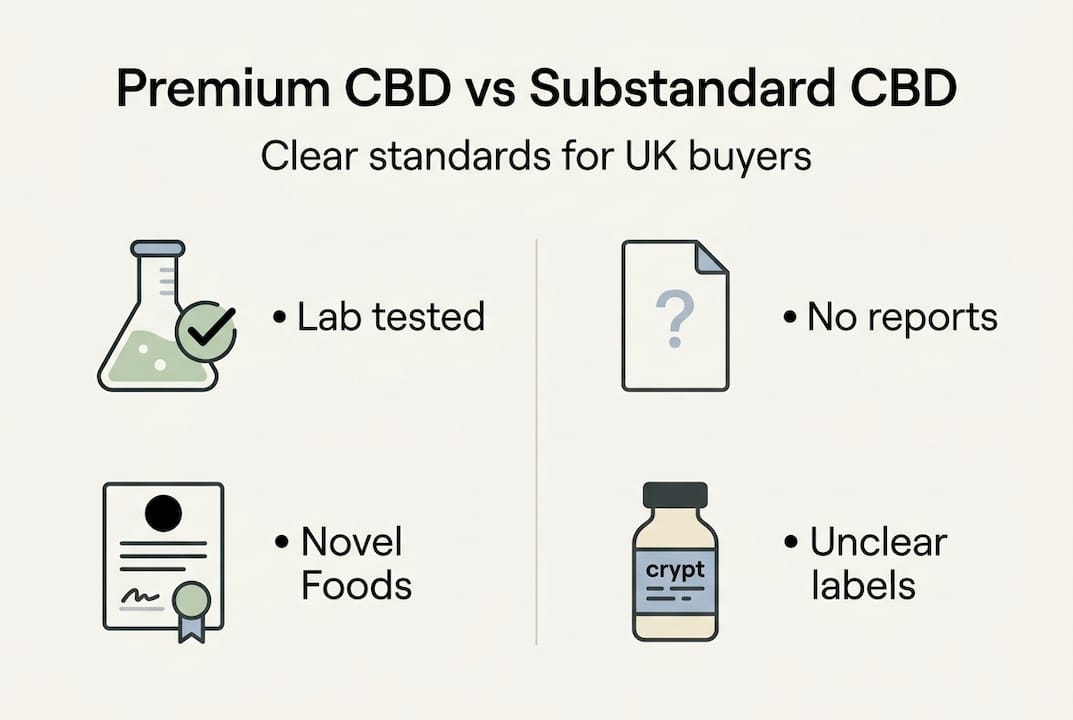
| Quality indicator | Premium standard | Substandard product |
|---|---|---|
| Hemp source | Organic, EU/US regulated farms | Unknown origin, non-organic |
| Extraction | CO2 or advanced green methods | Solvent-based, undisclosed |
| Lab testing | Independent, batch-specific COAs | No testing or in-house only |
| THC content | <0.2%, verified | Undeclared or exceeds limits |
| Regulatory status | Novel Foods authorised | No authorisation |
Pro Tip: Avoid products with ‘proprietary blends’ or vague labelling that don’t specify exact CBD content per serving. Transparency is a hallmark of premium quality.
Our CBD wellness checklist provides additional guidance on selecting quality products, whilst CBD testing certificates demonstrate what proper verification looks like. For deeper insights, review this CBD oil quality guide.
How to spot genuine premium CBD on the UK market
Once you know what to look for, use these actionable steps next time you shop for CBD. The difference between marketing claims and factual evidence becomes clear when you know which questions to ask and which documents to verify.
Verify independent laboratory certificates
Every premium CBD product should provide access to third-party lab reports showing cannabinoid levels and contaminant screening. These certificates must be batch-specific, meaning the test results correspond to the exact product you’re purchasing. Generic or outdated lab reports are red flags.
Check Novel Foods authorisation
The UK maintains a list of registered CBD brands with Novel Foods authorisation. This legal requirement ensures products meet safety standards and contain what they claim. Brands without this authorisation operate outside regulatory frameworks, putting your health at risk.
Understand labelling accuracy
Empirical studies show frequent label inaccuracy with over-dosing, under-dosing CBD, and undeclared THC or contaminants in commercial products. Premium brands provide precise information about CBD content per serving, total cannabinoids, and recommended usage.
Verification checklist
- Request the certificate of analysis for your specific batch number
- Confirm the lab is independent (not affiliated with the manufacturer)
- Verify the test date is recent (within the past year)
- Check that cannabinoid percentages match label claims
- Ensure contaminant screening shows ‘non-detect’ or levels below safety thresholds
- Cross-reference batch numbers on the product with the COA
- Confirm expiry dates align with stability testing
| Warning sign | What it means | Action to take |
|---|---|---|
| No lab reports available | Untested or failed testing | Avoid the product |
| Vague dosing information | Inconsistent manufacturing | Choose transparent brands |
| Missing batch numbers | No traceability | Cannot verify quality |
| Imported non-compliant brands | Regulatory violations | Check Novel Foods list |
| Unrealistic health claims | Marketing over science | Seek evidence-based products |
Pro Tip: Cross-check batch numbers and expiry dates on lab reports against your product packaging. Mismatches indicate the COA doesn’t correspond to what you’re buying.
Red flags include vague dosing information, absence of third-party test results, or imported brands that don’t comply with UK regulations. Premium CBD manufacturers welcome scrutiny and make verification easy. Review batch testing certificates to see what proper documentation looks like, and explore CBD labelling compliance requirements. This UK mislabelling research highlights why verification matters.
Premium CBD extraction: CO2 and beyond
By knowing how extraction influences quality, you can choose products with the best standards for your health and the environment. Extraction methods determine which compounds make it into your final product and whether any harmful residues tag along.
CO2 extraction advantages
CO2 extraction is tunable for full-spectrum preservation, whilst emerging green methods like ultrasound-assisted extraction and deep eutectic solvents show promise but aren’t yet standard for premium products. This method uses temperature and pressure adjustments to selectively extract different cannabinoids and terpenes, preserving the plant’s natural profile without introducing solvents like butane or ethanol.
Key benefits include:
- Solvent-free: No chemical residues in the final product
- Selective extraction: Targets specific compounds whilst leaving unwanted materials behind
- Full-spectrum capability: Preserves the complete cannabinoid and terpene profile
- Consistent results: Produces uniform batches with predictable potency
Emerging green technologies
New extraction methods promise greater efficiency and environmental sustainability. Ultrasound-assisted extraction uses sound waves to break down plant cell walls, reducing processing time and energy consumption. Deep eutectic solvents offer a biodegradable alternative to traditional solvents, though these technologies are still being refined for commercial CBD production.
Keep an eye out for brands investing in eco-friendly production. These companies lead innovation and demonstrate commitment to both product quality and environmental responsibility.
“Full-spectrum formulations retain synergistic hemp compounds, creating what’s known as the ‘entourage effect’ where cannabinoids work together for enhanced benefits.”
The entourage effect suggests that CBD works more effectively when accompanied by other hemp compounds like CBG, CBN, and terpenes. This synergy may explain why full-spectrum products often deliver superior results compared to CBD isolates, though individual responses vary.
Learn more about full spectrum benefits and explore natural wellness with full spectrum CBD. For technical details, review emerging extraction technologies.
Summing up: What to look for in premium UK CBD
With the facts and steps above, you’re ready to spot and choose superior CBD with total confidence. Premium quality isn’t about paying more for the sake of it. It’s about ensuring the product you choose delivers genuine benefits whilst meeting rigorous safety standards.
Your premium CBD checklist
- Organic sourcing: Hemp grown without pesticides or synthetic chemicals in regulated regions
- Independent lab tests: Batch-specific certificates of analysis from accredited third-party laboratories
- Legal compliance: Novel Foods authorisation and adherence to FSA guidelines
- Clear dosing: Precise CBD content per serving with usage recommendations
- Ethical extraction: CO2 or advanced green methods that preserve beneficial compounds
- Transparent labelling: Complete ingredient lists with no proprietary blends or vague claims
- Traceability: Batch numbers that match lab reports and allow you to verify quality
Empowered UK buyers demand real evidence, not just marketing. The CBD industry has matured significantly, and regulatory frameworks now protect consumers from substandard products. However, vigilance remains essential. Not all brands meet premium standards, and some actively mislead consumers with false claims or inadequate testing.
Quality equals both effectiveness and trust. Don’t settle for less when your health and wellbeing are at stake. The difference between premium and inferior CBD isn’t subtle. It’s the difference between genuine relief and wasted money, between safe supplementation and potential harm.
Explore our UK CBD compliance guide for regulatory details, or visit our CBD FAQ for answers to common questions.
Discover SMOKO’s premium quality CBD range
If you’re looking for trusted options, these offers match the standards discussed above. SMOKO CBD products are sourced from high-grade hemp, independently lab-tested, and FSA-compliant, giving you complete peace of mind. We understand that choosing CBD can feel overwhelming, especially with so many brands making bold claims. That’s why we’ve built our range on transparency, quality, and genuine care for your wellness journey.
Our broad-spectrum options deliver the benefits of multiple hemp compounds without THC, perfect for those seeking the entourage effect whilst maintaining zero THC intake. Whether you prefer the convenience of CBD gummies, the precision of our mint CBD tincture, or the refreshing taste of citrus CBD tincture, each product meets the premium standards outlined in this guide. Take the next step in your health journey with CBD you can trust.
Frequently asked questions
How can I verify if my CBD oil is premium quality?
Check for independent lab certificates with clear batch numbers, legally compliant labelling, and Novel Foods authorisation. Premium quality CBD is defined by organic, non-GMO hemp sourcing from regulated regions to minimise contaminants.
Why is lab testing important for CBD products?
Lab testing confirms cannabinoid content, purity, and absence of dangerous contaminants, protecting your safety. Empirical studies show frequent label inaccuracy with over-dosing, under-dosing CBD, and undeclared THC or contaminants in commercial products.
What does full-spectrum mean in premium CBD?
Full-spectrum means the product contains a wide range of hemp plant compounds, not just CBD, creating synergistic effects for enhanced wellness benefits. This includes cannabinoids like CBG and CBN, plus beneficial terpenes.
What is the UK’s safe daily limit for CBD?
The UK Food Standards Agency recommends a maximum intake of 10mg CBD per day (0.15mg/kg body weight) for products containing at least 98% pure CBD isolate, classified as novel foods.
Does organic hemp matter for CBD quality?
Yes, organic non-GMO hemp reduces risk of contaminants, ensuring a purer and safer CBD product. Hemp is a bioaccumulator, meaning it absorbs whatever’s in the soil, making organic cultivation essential for premium quality.