TL;DR:
- Genuine organic CBD must be certified by an approved control body like the Soil Association.
- Certification involves rigorous audits, annual inspections, and transparent supply chain documentation.
- Always verify certifier codes and batch-specific COAs to ensure authenticity and product quality.
Walk into any health shop or browse online, and you’ll find CBD products plastered with the word ‘organic.’ It sounds reassuring, doesn’t it? But here’s the uncomfortable truth: in the UK CBD market, ‘organic’ is sometimes little more than a marketing word with no verified backing. Knowing how to separate genuine certified organic CBD from products that simply borrow the language is one of the most valuable skills you can develop as a health-conscious shopper. This guide breaks down exactly what organic certification means, how the process works, which labels to trust, and the practical steps you should take before spending a penny.
Table of Contents
- What does organic really mean for CBD?
- The UK organic CBD certification process explained
- Comparing certified organic vs ‘organic’ CBD: what’s the difference?
- How organic certification fits with CBD law, safety, and wellness
- What most UK CBD shoppers miss about organic certification
- Explore trusted, quality-assured CBD options
- Frequently asked questions
Key Takeaways
| Point | Details |
|---|---|
| Check for authentic certification | Always look for Soil Association logos and cert codes on UK organic CBD products. |
| Ignore unverified organic claims | If a CBD item claims to be organic but has no certifier and test results, treat it with caution. |
| Certification means higher safety, not ‘better’ effects | Organic CBD’s main advantage is purity and stricter checks, not increased potency or efficacy. |
| Legal CBD needs more than just ‘organic’ status | Ensure every CBD product meets FSA and THC requirements with a valid Certificate of Analysis. |
What does organic really mean for CBD?
The word ‘organic’ carries real legal weight in the UK, but only when it’s applied correctly. Post-Brexit, the UK retained EU organic regulations under what is now known as the GB Organic Regulation. Under this framework, a product can only be labelled ‘organic’ if it has been certified by an approved control body. This isn’t a voluntary badge of honour; it’s a legal requirement. Slapping ‘organic’ on a label without certification is a trading standards offence.
For CBD specifically, this means the hemp plant from which the extract is derived must be grown without synthetic pesticides, artificial fertilisers, or genetically modified organisms. The farming practices, processing methods, and supply chain all fall under scrutiny. It is not enough for a brand to claim their hemp is ‘naturally grown’ or ‘pesticide-free’ without the paperwork to prove it.
The Soil Association is the primary UK certifier for organic products, including hemp-derived items like CBD oils, using GB Organic Regulation standards retained post-Brexit. Alongside the Soil Association, OF&G (Organic Farmers and Growers) also operates as an accredited certifying body in the UK. Both organisations conduct rigorous assessments before granting certification.
“Organic certification is not just about what goes into the soil. It’s about the entire system of production, from seed to shelf, being verifiable and transparent.”
So what’s actually different between organic and non-organic CBD from a health and safety perspective? Here’s a quick breakdown:
- Pesticide residues: Organic hemp is grown without synthetic pesticides, reducing the risk of chemical residues in the final extract.
- Soil quality: Organic farming builds healthier soil, which can influence the phytochemical profile of the plant.
- Traceability: Certified organic products come with documented supply chains, making it easier to verify what you’re consuming.
- Consumer trust: Certification provides an independent, third-party assurance that no shortcuts were taken.
If you’re still getting to grips with what CBD oil actually is, our CBD oil guide is a solid starting point before going deeper into certifications.
The UK organic CBD certification process explained
With those definitions in mind, here’s exactly how a CBD product becomes officially ‘organic’ labelled in the UK. The process is more involved than most shoppers realise, and understanding it helps you spot brands that have genuinely done the work.
According to organic certification rules, producers must contract with accredited bodies like Soil Association Certification, undergo annual inspections, maintain records, ensure no synthetic pesticides, fertilisers, or GMOs are used, and display the certifier code GB-ORG-05 on labels alongside the Soil Association symbol.
Here is the step-by-step route a UK CBD brand must follow:
- Apply to an accredited certifying body such as the Soil Association or OF&G.
- Submit detailed records covering farming inputs, processing methods, and supply chain documentation.
- Undergo an initial inspection where auditors assess the farm or facility against GB Organic Regulation standards.
- Receive certification if all standards are met, along with a unique certifier code (e.g., GB-ORG-05 for Soil Association certified products).
- Display the certifier code and logo on product labels in a clear, verifiable manner.
- Renew annually through repeat inspections and updated documentation.
Annual renewals are not a formality. They exist because farming conditions, suppliers, and processing methods can change. A brand certified this year must prove the same standards next year. This ongoing accountability is what separates genuine certification from a one-off audit.
| Certification element | What it means for you |
|---|---|
| Certifier code (e.g., GB-ORG-05) | Verifiable proof of which body certified the product |
| Annual inspection | Standards are checked every year, not just once |
| No synthetic inputs | Hemp grown without artificial pesticides or fertilisers |
| Logo on label | Visual confirmation of certification status |
One real-world pitfall worth knowing: some brands use imagery that resembles organic certification logos without actually holding certification. Green leaves, earthy tones, and vague ‘natural’ language can mimic the look of official certification without the substance. Always check for the specific certifier code on the label.
Pro Tip: Before buying, search the Soil Association’s online directory using the certifier code shown on the product. If it doesn’t appear, the certification claim may not be legitimate. You can also review CBD testing certificates to understand what verified documentation actually looks like. And if you’re curious about the legal landscape, our guide on CBD legality in the UK covers the regulatory framework in plain language.
Comparing certified organic vs ‘organic’ CBD: what’s the difference?
Understanding the process is useful, but what really sets a genuinely organic CBD product apart from one that just claims to be ‘organic’? The answer lies in documentation and verifiability, not design or language.
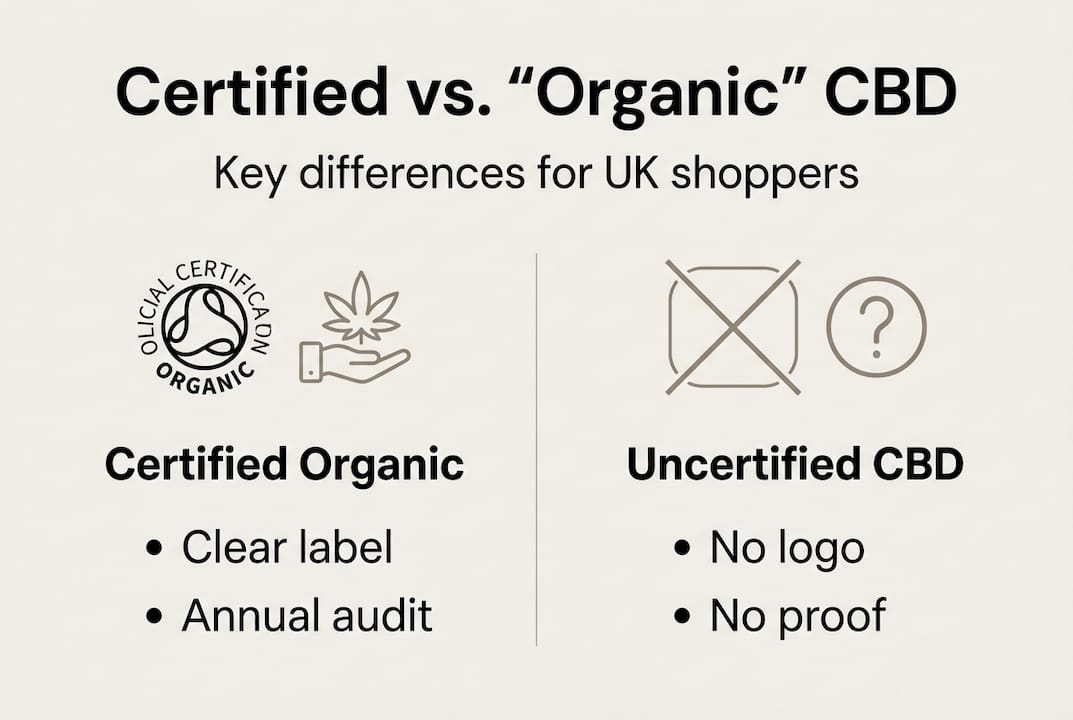
For UK consumers, prioritising Soil Association certified products provides assured organic standards. Always cross-check COAs, the FSA list, and avoid unverified ‘organic’ claims.
| Feature | Certified organic CBD | Unverified ‘organic’ claim |
|---|---|---|
| Certifier code on label | Yes (e.g., GB-ORG-05) | No |
| Annual third-party inspection | Yes | No |
| Verifiable supply chain | Yes | Often not available |
| COA available | Typically yes | Variable |
| FSA novel food listing | Required for legal sale | Required for legal sale |
The red flags to watch for when shopping include:
- No certifier code on the label despite claiming to be organic.
- Vague language such as ‘naturally sourced’ or ‘grown organically’ without a certifying body named.
- No Certificate of Analysis (COA) available, or a COA that is outdated or lacks batch-specific information.
- Not listed on the FSA’s public list of CBD products with novel food applications.
- Pressure to buy quickly without being given time to review documentation.
A useful statistic to keep in mind: CBD quality checks consistently highlight that COA verification is the single most reliable quality indicator available to consumers, regardless of whether a product is certified organic or not.
Your practical buyer’s checklist before purchasing any CBD product:
- Check for a named certifying body and certifier code on the label.
- Check the COA for batch-specific lab results.
- Confirm the product appears on the FSA’s novel food list.
- Look up the certifier code in the certifying body’s online directory.
- Contact the brand directly if any documentation is missing or unclear.
How organic certification fits with CBD law, safety, and wellness
Certifications are just one aspect. Here’s how they fit into the wider legal and safety landscape for UK CBD.

Organic certification and UK CBD law are related but separate systems. A product can be legally sold as CBD in the UK without being organically certified. Equally, a product can hold organic certification but still fail to meet CBD-specific legal requirements. The two frameworks operate in parallel, and you need to check both.
Under UK law, CBD legality hinges on FSA novel food approval, THC levels below 1mg per container, and a valid COA. Organic certification adds farming purity but does not override hemp licensing requirements.
Here’s what organic certification does and doesn’t guarantee:
- Does guarantee: Hemp was grown without synthetic pesticides, fertilisers, or GMOs; the supply chain has been independently audited; standards are reviewed annually.
- Does not guarantee: That the product is FSA approved, that THC levels are within legal limits, or that the CBD content matches the label claim.
This is why COA verification remains essential even when buying certified organic CBD. A COA (Certificate of Analysis) is a lab report from an independent third-party testing facility confirming the cannabinoid profile, THC levels, and absence of contaminants. No COA means no verified safety data, full stop.
Pro Tip: When reviewing a COA, check the date. A COA older than 12 months may not reflect current batch quality. Always look for batch-specific reports, not generic brand-level documents.
For a thorough overview of your CBD legal requirements, we’ve covered the full regulatory picture in a dedicated guide. Organic certification boosts your confidence in how the hemp was farmed, but it works best when combined with FSA listing, a current COA, and transparent brand practices.
What most UK CBD shoppers miss about organic certification
Here’s the honest perspective: most people shopping for CBD in the UK focus on the label and stop there. A green logo, a few reassuring words, and a reasonable price are often enough to trigger a purchase. That’s completely understandable, but it’s also where many shoppers get caught out.
The real protection isn’t in the visual design of a product. It’s in the documents behind it. A brand that willingly shares its certifier code, publishes batch-specific CBD batch COA reports, and maintains a transparent FSA application history is demonstrating something that no logo can: accountability.
Many reputable brands go well beyond the minimum certification requirements. They publish their full supply chain details, make COAs searchable by batch number, and invite customer questions about their sourcing. That level of transparency is what you should be looking for, not just a logo that looks official.
The uncomfortable truth is that certification alone doesn’t make a product trustworthy, and the absence of organic certification doesn’t make a product unsafe. What matters most is the quality of evidence a brand provides. Ask for it every time.
Explore trusted, quality-assured CBD options
If this guide has made one thing clear, it’s that documentation and transparency are the real markers of quality in the CBD space. You deserve products backed by verifiable evidence, not just appealing packaging.
At SMOKO CBD, we make it straightforward to review the evidence behind every product. Our COA for SMOKO CBD reports are batch-specific and independently verified, so you can check exactly what’s in the product you’re considering. Whether you’re drawn to our CBD Mint Tincture or exploring other formulations, you’ll find clear documentation at every step. For a broader picture of what CBD may offer your wellbeing, our CBD health benefits page is a helpful next stop.
Frequently asked questions
How can I tell if a CBD oil is truly organic certified in the UK?
Look for the certifier’s logo (such as the Soil Association symbol), a certifier code like GB-ORG-05 on labels, and cross-check batch COAs and FSA approval to confirm the claim is legitimate.
Does organic CBD work better than regular CBD?
There is no scientific proof that organic CBD is more effective than non-organic. Its primary value lies in purity and stricter farming controls, with COAs as the key metric for assessing actual product quality.
Is organic certification required for legal UK CBD?
No, organic certification is entirely optional for UK CBD brands. Legal sale depends on FSA novel food approval, THC limits below 1mg per container, and a valid batch COA.
Which is the most recognised organic certifier for CBD in the UK?
The Soil Association is the UK’s most recognised organic certifier for CBD and hemp-derived products, operating under GB Organic Regulation standards retained post-Brexit.
Recommended
- UK CBD Law: Your Complete Guide to Regulations & Compliance – SMOKO CBD
- What is Broad-Spectrum CBD? A 2026 Guide for Natural Health – SMOKO CBD
- CBD Benefits and Uses for Wellness in 2026: UK Guide – SMOKO CBD
- CBD Dosage Guide UK 2026: Safe Relief in 70mg Limits – SMOKO CBD
- What is Certified Organic CBD? A 2026 Wellness Guide | Edwin’s Edibles & Elixirs