TL;DR:
- Organic CBD in the UK is derived from hemp grown without synthetic chemicals and must be certified by an accredited body.
- Certification, lab results, and traceability are essential to verify genuine organic claims and safety.
- Organic status does not guarantee regulatory approval; consumers should check for FSA compliance and third-party testing.
Walk into any health shop or scroll through a wellness website in the UK, and you will find the word ‘organic’ plastered across CBD oils, capsules, and gummies. It feels reassuring. It sounds premium. But does it actually mean anything? Many UK adults assume that ‘organic CBD’ is automatically the safest or most effective option, when in reality, the term is frequently misused. This article cuts through the noise. We will explain precisely what organic CBD means in a UK context, how it is produced, how the regulations work, and what you genuinely need to check before spending your money.
Table of Contents
- What does ‘organic CBD’ actually mean in the UK?
- How organic CBD is made: From farm to bottle
- UK regulations and safety for organic CBD
- How to choose organic CBD in the UK: What really matters
- Our take: What most people miss about organic CBD
- Explore certified organic CBD options
- Frequently asked questions
Key Takeaways
| Point | Details |
|---|---|
| Organic equals certified | Only products with recognised UK organic certification can claim to be organic CBD. |
| Regulation is key | Organic status sits alongside UK regulations for CBD, including safety checks, not in place of them. |
| Check before buying | Always look for certification logos, third-party lab results, and FSA listing before you purchase CBD. |
| Safety over hype | Organic does not guarantee safety or effectiveness; product quality, traceability, and correct dosage are critical. |
What does ‘organic CBD’ actually mean in the UK?
Let’s start with the basics. Organic CBD refers to cannabidiol (CBD) derived from hemp that has been grown according to strict organic farming standards. That means no synthetic pesticides, herbicides, or chemical fertilisers at any point during cultivation. Crucially, the product must be certified by a UK-accredited organic body. The Soil Association is the most recognised of these in Britain. As their certification framework confirms, organic certification requires full traceability and adherence to a defined set of production standards.
Here is where people often go wrong. The word ‘organic’ in this context describes a farming and production method, not a different type of CBD molecule. The cannabidiol itself, as a phytocannabinoid found in cannabis, is chemically identical whether it came from an organic or conventional hemp plant. What differs is what may (or may not) be present alongside it.
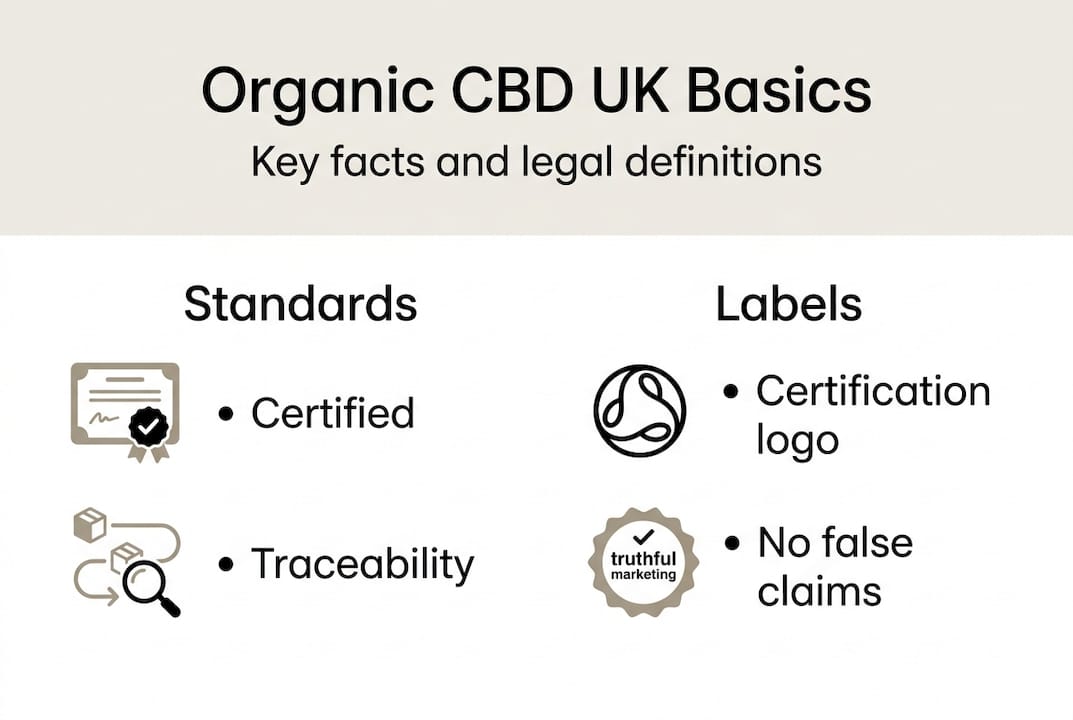
This leads to one of the most common confusions in the industry: the difference between ‘organic’, ‘natural’, and ‘certified’. These words are not interchangeable, but brands frequently use them as though they are.
Key differences between common CBD label claims:
- Organic: Hemp grown without synthetic chemicals, certified by an accredited body such as the Soil Association. Requires documented traceability.
- Natural: A loosely used term with no legal definition in UK CBD labelling. It can appear on almost any product without certification.
- Certified: Should indicate third-party verification, but only carries real weight when the certifying body is named and accredited.
- Broad-spectrum / Full-spectrum: These describe the range of cannabinoids present, not the farming method used.
| Claim | Legally defined in UK? | Requires certification? | What it tells you |
|---|---|---|---|
| Organic | Yes (if certified) | Yes | Farming method, no synthetic chemicals |
| Natural | No | No | Very little, used loosely |
| Certified | Depends on certifier | Should do | Only meaningful with a named, accredited body |
| Broad-spectrum | No | No | Cannabinoid profile only |
Pro Tip: Always look for a physical certification logo on the product packaging, not just the word ‘organic’ in the product name. If there is no logo, the claim is unverified.
How organic CBD is made: From farm to bottle
Now that you know what makes CBD organic, let’s follow the journey from seed to finished oil or capsule. Understanding this process helps you ask better questions and spot weaker products.
Steps in the organic CBD production process:
- Seed selection: Growers choose hemp varieties suited to organic cultivation, selecting for low THC content and high CBD yield.
- Organic cultivation: The crop is grown using permitted organic inputs only. Soil health is maintained through crop rotation and composting rather than synthetic fertiliser.
- Harvesting: Plants are harvested at peak cannabinoid content, typically by hand or with minimal mechanical intervention to avoid contamination.
- Extraction: CBD is extracted using chemical-free methods, most commonly CO2 extraction, which leaves no harmful residue in the final product.
- Processing and formulation: The extract is blended into a carrier (such as MCT oil) without synthetic additives.
- Third-party testing: Independent laboratories test for cannabinoid content, pesticide residue, heavy metals, and other contaminants.
- Certification audit: An accredited certifier reviews documentation at each stage. As confirmed by UK organic farming standards, full traceability is a legal requirement for the organic mark.
| Production stage | What organic certification checks |
|---|---|
| Cultivation | No prohibited pesticides or fertilisers |
| Extraction | Chemical-free solvents only |
| Processing | No synthetic additives |
| Labelling | Accurate organic claim, certifier logo |
| Distribution | Chain of custody traceability |
For context on how CBD regulations and safety interact with this production chain, it helps to know that organic certification alone is not the same as regulatory approval for sale in the UK. Both matter.
‘In the UK, always look for a recognised organic logo and traceability certificate on organic CBD products.’
Traceability is the backbone of any credible organic claim. If a brand cannot show you a clear audit trail from the field to the bottle, proceed with caution.

UK regulations and safety for organic CBD
Understanding how organic CBD is produced flows directly into knowing the UK safety and regulatory landscape. This is where many consumers, and even some brands, get confused.
In the UK, CBD regulation operates on two distinct tracks. If a product makes medicinal claims (for example, that it treats a specific condition), it falls under the Human Medicines Regulations and requires a product licence. Most CBD products sold in health shops and online are positioned as food supplements, which places them under the Food Standards Agency (FSA) novel food authorisation framework.
Here is the critical point: organic status does not replace FSA authorisation. A product can be certified organic and still be non-compliant if it has not been through the novel food process. The two are entirely separate checks.
The FSA has also set a provisional safe intake benchmark. Based on FSA guidance for food supplements, the suggested daily intake is 10 mg of CBD per day for a healthy 70 kg adult using isolates at 98% purity. This figure is cautious by design and does not mean higher doses are immediately harmful, but it signals the importance of responsible dosing.
Safety checks to look for before buying any CBD product:
- Valid organic certification logo from a named, UK-accredited body
- Batch-specific third-party lab results (Certificate of Analysis)
- Inclusion on the FSA’s published novel food list or evidence of authorisation
- Clear labelling of CBD content per dose (in milligrams)
- No unlicensed medicinal claims on packaging or marketing
Organic does not mean risk-free. Co-ingredients, dosage, and potential interactions with medication all matter. Always check current UK CBD regulations and consult your GP if you take prescription medicines. For a fuller overview, CBD law and compliance resources can also help you stay informed.
How to choose organic CBD in the UK: What really matters
With regulations in mind, it is time to focus on practical steps for making a safe and effective organic CBD purchase. The checklist below is designed specifically for UK consumers.
Before you buy, check for:
- A visible, named organic certification logo (Soil Association or equivalent)
- Batch-level lab reports from an independent, accredited laboratory
- Inclusion on the FSA novel food list or equivalent authorisation
- Full traceability information (country of origin, extraction method)
- Realistic health claims. As UK organic certification standards confirm, verifiable certification is what separates genuine organic products from branding claims.
- Clearly stated CBD content per serving, not just per bottle
The gap between branding and evidence-based certification is wider than most people realise. A product with a green leaf logo and the word ‘organic’ in the name is not the same as a product bearing the Soil Association mark with a traceable audit trail.
Pro Tip: Avoid brands that use ‘organic’ and ‘natural’ interchangeably without displaying a specific certifier’s logo. If the packaging does not name the certifying body, that claim is essentially decorative.
Product form matters too. Tinctures, capsules, and gummies all deliver CBD differently, and the right choice depends on your lifestyle and what you are hoping to address. For help matching products to your needs, the CBD dosage guidance resource is a good starting point. If you are exploring CBD for specific concerns, reviewing the potential health benefits information alongside a UK CBD for pain and sleep guide can help you set realistic expectations.
Our take: What most people miss about organic CBD
From where we stand, the biggest issue with organic CBD in 2026 is not a shortage of products. It is a shortage of scrutiny. The word ‘organic’ has become a shorthand for ‘trustworthy’, and brands know it. That means the term is being stretched, softened, and occasionally fabricated in ways that put consumers at a disadvantage.
What we find time and again is that people focus on the word ‘organic’ and stop asking questions. They do not check whether a named certifying body is listed. They do not request a Certificate of Analysis. They assume that if it sounds natural, it must be safe. That assumption can be costly.
Certification and traceability are the only reliable lines of defence against greenwashing. A trusted organic CBD guide will always point you back to verifiable documentation, not marketing language.
‘Organic isn’t a shortcut to safety. Always verify the details.’
Pro Tip: Never hesitate to ask sellers directly for their certification proof and lab results before you buy. Any reputable brand will provide them without hesitation.
Explore certified organic CBD options
You now have a clear framework for understanding, evaluating, and choosing organic CBD in the UK. The next step is finding products that genuinely meet the standard.
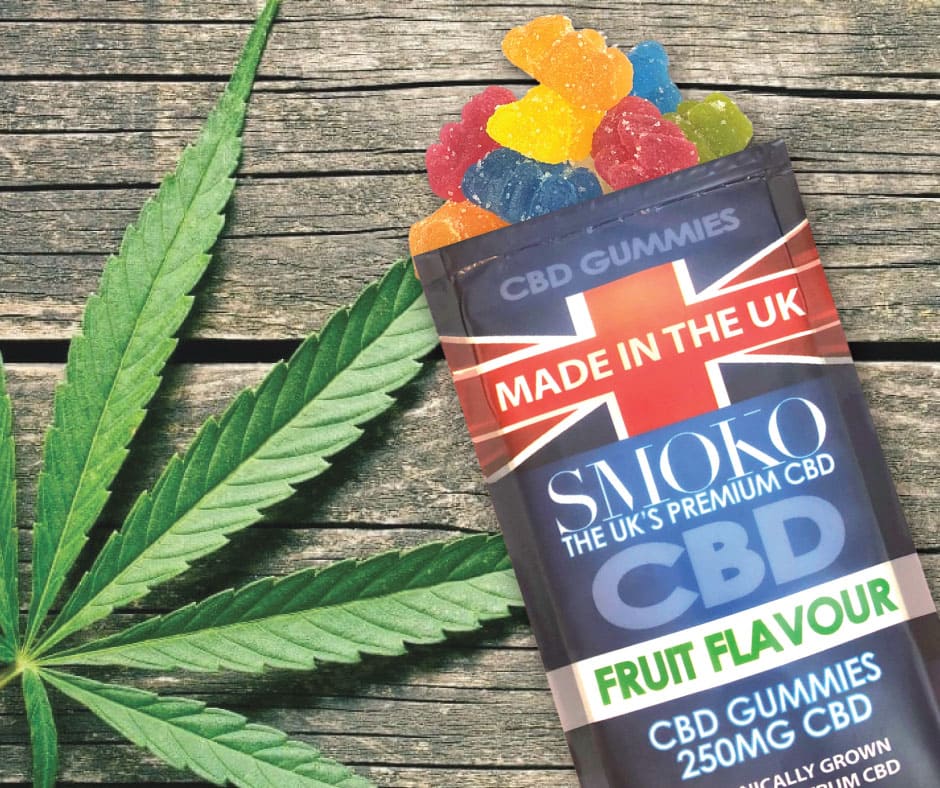
At SMOKO CBD, transparency is built into everything we do. Our products are independently tested, clearly labelled, and formulated for UK consumers who want quality they can verify. If you are looking for a precise, convenient option, our CBD soft gel capsules offer consistent dosing in every capsule. For those who prefer a tincture, our mint CBD tincture is a popular choice. Browse the full SMOKO CBD range to find the right product for your wellness goals.
Frequently asked questions
Is organic CBD safer than non-organic CBD?
Organic CBD avoids synthetic pesticides and must meet UK organic farming standards, but safety also depends on proper third-party lab testing and regulatory compliance, not organic status alone.
Can any CBD product be labelled organic in the UK?
No. Only CBD products with recognised UK certification from an accredited organic body can legally carry the organic label in the UK.
What is the maximum recommended CBD dosage for UK adults?
The FSA provisionally recommends a maximum of 10 mg of CBD per day for a healthy adult taking food supplements, though this guidance continues to be reviewed.
How can I check if my CBD is truly organic?
Look for an organic certification logo from a named, accredited body and check for batch traceability details on the packaging or the brand’s website.
Recommended
- UK Organic CBD Certification Guide: Trusted Products 2026 – SMOKO CBD
- CBD Oil Terminology Explained: Make Informed Wellness Choices – SMOKO CBD
- What is CBD oil: a clear UK guide to benefits and quality – SMOKO CBD
- UK CBD Law: Your Complete Guide to Regulations & Compliance – SMOKO CBD
- How organic period products impact health & sustainability – Tampon Tribe