TL;DR:
- Understanding CBD terminology helps consumers choose safe, legal, and effective products.
- Bioavailability varies by intake method, affecting how much CBD the body absorbs and benefits from.
- Reputable brands provide transparent lab testing and clear labels to support informed purchasing decisions.
Walk into any health shop or browse CBD oil websites in the UK, and you’ll quickly encounter a wall of unfamiliar terms. “Broad-spectrum,” “bioavailability,” “CO2 extraction,” “nanoemulsion” — the language can feel more like a chemistry lecture than a wellness guide. Yet understanding these terms is not just useful; it is essential for choosing products that are safe, legal, and genuinely effective. This guide cuts through the jargon, offering clear definitions backed by evidence, so you can shop with confidence and get the most from your CBD oil experience.
Table of Contents
- What is CBD oil? Essential terms defined
- Bioavailability, absorption, and how your body uses CBD
- CBD oil product labels decoded: What claims and numbers mean
- Choosing the right CBD oil: Applying terminology for healthy decisions
- Why simple terminology matters for empowered CBD oil choices
- Explore trusted CBD oil options for informed wellness
- Frequently asked questions
Key Takeaways
| Point | Details |
|---|---|
| CBD oil basics clarified | Understanding common terms like full spectrum and carrier oil ensures confident shopping. |
| Absorption affects effects | Bioavailability and how you take CBD determine how much your body uses. |
| Read UK product labels | Check strength, spectrum, THC content, and lab reports for safety and legality. |
| Choose wisely for your needs | Knowing terms helps you match CBD oil types with your goals and avoid common mistakes. |
What is CBD oil? Essential terms defined
Now that we’ve highlighted the confusion around CBD oil jargon, let’s break down the foundational terms you’ll encounter most often.
CBD (cannabidiol) is a naturally occurring compound found in the hemp plant. Unlike THC (tetrahydrocannabinol), CBD does not produce a psychoactive “high.” Both are cannabinoids, meaning they interact with the body’s endocannabinoid system, but they behave very differently. THC binds strongly to receptors that affect mood and perception; CBD works more subtly, modulating the system rather than overwhelming it. Understanding the CBD oil benefits and quality differences between these compounds helps you make smarter choices from the outset.
When it comes to extract types, three terms dominate:
- Full-spectrum: Contains CBD alongside other cannabinoids, terpenes, and trace amounts of THC (below legal limits). The combined effect of these compounds working together is often called the “entourage effect.”
- Broad-spectrum: Similar to full-spectrum but with THC removed. A popular choice for those wanting the entourage effect without any THC exposure.
- Isolate: Pure CBD only, with all other plant compounds removed. Ideal for those who want precise, predictable dosing.
Extraction methods matter too. CO2 extraction is considered the gold standard because it preserves beneficial compounds without leaving chemical residues. Ethanol extraction is another common method, effective but requiring careful post-processing. The carrier oil used in the final product, typically MCT oil (derived from coconut) or hempseed oil, helps deliver CBD into your system efficiently. MCT oil is particularly popular because it absorbs quickly and pairs well with CBD’s fat-soluble nature.

Pro Tip: When scanning a product label, look for the extraction method listed. CO2-extracted CBD oils generally indicate a higher quality standard and a cleaner final product.
Bioavailability, absorption, and how your body uses CBD
Understanding the types of CBD oil is just the start — the next step is grasping how your body absorbs and uses CBD.
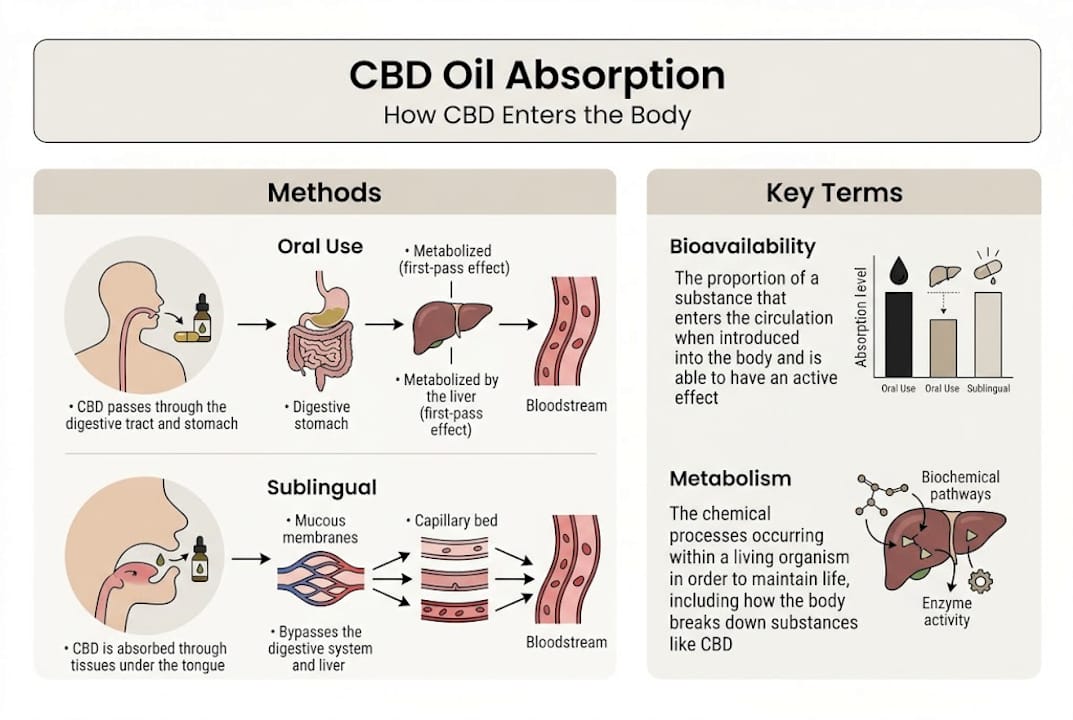
Bioavailability simply means the proportion of a substance that actually enters your bloodstream and has an active effect. Think of it as the “delivery rate” of CBD. You might take 30mg of CBD, but if only 20% reaches your bloodstream, your body is working with 6mg. This matters enormously for product choice and dosing.
| Method | Estimated bioavailability | Key factor |
|---|---|---|
| Oral (capsules, gummies) | 6 to 20% | Passes through digestive system |
| Sublingual (drops under tongue) | 12 to 35% | Absorbed through mucous membranes |
| With high-fat meal | Up to 5x higher | Fat aids CBD absorption |
| Nano-formulation | Potentially higher | Smaller particles, faster uptake |
As research confirms, oral CBD bioavailability sits at 6 to 20%, while sublingual delivery reaches 12 to 35%, and high-fat meals can substantially increase absorption. This is why many people notice stronger effects when they take their CBD oil after a meal containing healthy fats like avocado, nuts, or olive oil.
Practical ways to boost absorption include:
- Taking CBD drops sublingually and holding for 60 to 90 seconds before swallowing
- Pairing oral CBD products with a fat-containing meal or snack
- Considering nano-emulsified formulations if consistent absorption is a priority
Bioavailability also explains why two people taking the same dose can have very different experiences. Metabolism, body weight, and gut health all influence how much CBD your body actually uses. Reviewing CBD oil dosage tips alongside absorption knowledge helps you fine-tune your approach.
Pro Tip: If you’re using CBD oil drops, place them under your tongue rather than swallowing immediately. This simple change can meaningfully increase the amount of CBD your body absorbs.
CBD oil product labels decoded: What claims and numbers mean
Once you know how CBD is absorbed, it’s crucial to interpret packaging details and marketing claims confidently.
The mg number on a CBD oil bottle refers to the total milligrams of CBD in the entire product. A 10ml bottle labelled “1000mg CBD” contains 1000mg across the whole bottle. If the dropper delivers 0.5ml per serving, each serving contains roughly 50mg. Always check the “mg per serving” figure rather than relying on the total bottle strength alone.
Here is a quick comparison of common label claims and what they actually mean for you:
| Label claim | What it means | Value to you |
|---|---|---|
| Full-spectrum | Contains CBD, cannabinoids, terpenes, trace THC | Potential entourage effect |
| Broad-spectrum | CBD and cannabinoids, THC removed | Entourage effect, no THC |
| Isolate | Pure CBD only | Precise dosing, no other compounds |
| Third-party tested | Independent lab has verified contents | Confirms accuracy and safety |
| Organic hemp | Grown without synthetic pesticides | Cleaner ingredient source |
In the UK, the Food Standards Agency sets a provisional acceptable daily intake of 10mg CBD for healthy adults, and all CBD products must contain less than 0.2% THC to be legally sold. Products are also assessed under Novel Foods regulations, meaning reputable brands must have their products on the FSA’s validated list.
To verify a product’s legal status and labelling accuracy, follow these steps:
- Check the brand’s website for a Certificate of Analysis (COA) from a third-party laboratory.
- Confirm the COA matches the batch number on your bottle.
- Verify the product appears on the FSA’s Novel Foods validated list.
- Review CBD oil legal requirements to understand what compliant labelling looks like.
- Check CBD testing certificates directly when available on a brand’s website.
Choosing the right CBD oil: Applying terminology for healthy decisions
Bringing all these definitions together enables you to select the best product for your wellness goals.
With a clear grasp of terminology, you can now build a practical checklist for choosing CBD oil:
- Identify your THC preference: If you are subject to workplace drug testing or simply want zero THC exposure, choose broad-spectrum or isolate products.
- Consider your sensitivity: Some people are particularly sensitive to even trace THC. Broad-spectrum is the safer choice in these cases, as experts note.
- Match strength to your needs: Start with a lower mg product and adjust gradually. The FSA’s provisional guidance of 10mg per day for healthy adults is a sensible starting point.
- Check the carrier oil: MCT oil tends to support faster absorption; hempseed oil adds omega fatty acids. Neither is wrong, but knowing the difference helps.
- Prioritise lab-tested products: A COA from an independent laboratory is non-negotiable. It confirms what’s in the bottle and what isn’t.
Common pitfalls to avoid include buying products based on price alone, ignoring the mg per serving figure, and assuming “natural” automatically means “safe” or “legal.” Some products make bold health claims that exceed what current evidence supports. If a product promises to cure a condition, treat that as a warning sign rather than a selling point.
For those managing safe CBD dosage questions, remember that oral bioavailability can be improved with fat-containing meals or nano-formulations, meaning your effective dose may vary depending on how and when you take it.
Pro Tip: Always download and read the Certificate of Analysis before purchasing a new CBD oil. If a brand does not provide one, look elsewhere. Transparency is the clearest indicator of quality.
Why simple terminology matters for empowered CBD oil choices
With practical terms in hand, it is worth considering what clear communication truly means for personal wellness and the wider CBD market.
Too much jargon does real harm. When everyday wellness seekers encounter terms like “nanoemulsion” or “terpene profile” without explanation, many simply give up or, worse, make uninformed purchases. This is not a minor inconvenience; it actively blocks access to products that could genuinely support wellbeing.
We believe the CBD market has a responsibility to communicate clearly. Brands that invest in plain-language education are not just being helpful; they are building the kind of trust that sustains long-term customer relationships. Transparency in labelling and honest, evidence-backed claims shift the entire market towards higher standards.
The uncomfortable truth is that some brands benefit from confusion. Vague language and inflated claims are harder to challenge than precise, verifiable ones. Informed consumers disrupt that dynamic entirely. When you know what “broad-spectrum” actually means, you stop being swayed by marketing and start evaluating products on merit.
Reading about UK CBD safety regulations alongside product terminology gives you the full picture. Knowledge really is the most practical wellness tool available.
Explore trusted CBD oil options for informed wellness
If you’re ready to put your new understanding to use and want reputable CBD oil options, these trusted choices can help.
At SMOKO CBD, every product is third-party lab tested, clearly labelled, and made with organically grown hemp. Whether you prefer the convenience of drops or the simplicity of capsules, you can shop knowing exactly what you’re getting.
Our mint CBD oil tincture is a great starting point for those new to CBD, offering a clean MCT oil base and clear mg per serving information. For those wanting a stronger option, our extra strength mint CBD oil delivers double the potency in the same easy-to-use format. Prefer a no-fuss approach? Our CBD soft gel capsules offer precise, pre-measured doses with no guesswork involved.
Frequently asked questions
What does ‘broad spectrum’ mean on CBD oil?
Broad-spectrum CBD oil contains multiple cannabinoids and terpenes but has THC removed entirely, making it well suited for those who want to avoid THC exposure whether for personal preference or workplace drug testing.
How much CBD oil can I legally take in the UK?
The UK Food Standards Agency sets a provisional daily intake of 10mg CBD for healthy adults, and all legally sold products must contain less than 0.2% THC.
What boosts CBD oil absorption in the body?
Taking CBD oil sublingually and holding it under the tongue for at least 60 seconds, or pairing it with a high-fat meal, can significantly increase absorption compared to simply swallowing it.
Why is third-party testing important for CBD oil?
Independent laboratory testing verifies that the CBD and THC levels on the label are accurate, confirming both safety and compliance with UK FSA standards and giving you genuine peace of mind.
What does the ‘mg’ number mean on CBD oil?
The mg figure shows the total milligrams of CBD in the entire bottle, so dividing it by the number of servings tells you exactly how much CBD you’re taking each time you use it.