Many UK residents assume that CBD and cannabis are treated the same under British law, but that assumption is simply wrong. CBD (cannabidiol) is a non-psychoactive compound found in the hemp plant, and it sits in a very different legal category from cannabis or THC (tetrahydrocannabinol, the compound that gets you high). Understanding this distinction is genuinely useful, whether you are exploring CBD for pain relief, anxiety, or sleep support. This article walks you through the key laws, safety benchmarks, and practical guidance that shape the CBD landscape in the UK today.
Table of Contents
- Legal frameworks that make CBD legal in the UK
- Exempt product criteria and their impact on CBD
- Novel food regulations and ingestible CBD in the UK
- Medicinal CBD and MHRA regulation
- What most people misunderstand about CBD legality in the UK
- Discover safe, compliant CBD options in the UK
- Frequently asked questions
Key Takeaways
| Point | Details |
|---|---|
| CBD is non-controlled | CBD is not a controlled drug under UK law, which is why it can be legally sold. |
| Strict product criteria | Legal CBD products must meet low THC levels and comply with packaging and use requirements. |
| Novel food compliance | Ingestible CBD must be authorised by the Food Standards Agency and stay within safe daily limits. |
| Medical claims are regulated | Medicinal CBD products need MHRA approval and a prescription to be legally sold. |
| Buy from trusted sources | UK residents should always select proven, compliant CBD products for safety and legality. |
Legal frameworks that make CBD legal in the UK
The confusion between CBD and cannabis is understandable. Both come from the same plant family, yet UK law treats them in entirely different ways. The critical distinction comes down to one compound: THC.
THC is a controlled substance under the Misuse of Drugs Act 1971, classified as a Class B drug. Cannabis itself is also controlled under this Act. CBD, however, is a separate matter entirely. CBD is not a controlled drug under the Misuse of Drugs Act 1971, as confirmed by the MHRA (Medicines and Healthcare products Regulatory Agency). This is the foundational legal fact that makes CBD products available on UK shelves.
“CBD (cannabidiol) itself is not a controlled drug under the Misuse of Drugs Act 1971.” — MHRA official statement
Because CBD does not produce psychoactive effects, it does not fall under the same prohibitions as THC. The UK CBD regulation guide outlines how this distinction shapes everything from product labelling to retail availability.
Here is a quick comparison to make this clearer:
| Feature | CBD | THC |
|---|---|---|
| Psychoactive | No | Yes |
| Controlled under MDA 1971 | No | Yes (Class B) |
| Legal to sell in UK | Yes (with conditions) | No |
| Prescription required | Only if medicinal | Yes (licensed medicines only) |
Key points to remember about CBD’s legal standing:
- CBD itself is not listed as a controlled substance
- Products must contain no more than 1mg of THC per finished product
- CBD derived from industrial hemp is treated differently from cannabis-derived CBD in practical terms
- Selling CBD as a food supplement requires separate regulatory approval (covered below)
For those curious about formats like CBD softgels, the same legal principles apply across all product types. The key is always the THC content and the claims being made.
Exempt product criteria and their impact on CBD
Knowing that CBD is not controlled is only part of the picture. For a CBD product to be legally sold in the UK, it must also qualify as an ‘exempt product’ under specific regulations. CBD products can be exempt from MDA prohibitions if they meet the criteria set out in the Misuse of Drugs Regulations 2001, Regulation 2.

These criteria are quite specific. The product must not be designed for administration to a human being or animal in a way that produces a psychoactive effect. It must also contain no more than 1mg of any controlled substance (including THC) per container. This is not a percentage threshold; it is an absolute quantity per finished product.
Understanding the difference between CBD and hemp oil matters here too, as hemp seed oil contains no cannabinoids at all and is not subject to the same rules.
Here is a summary of what makes a CBD product legally exempt:
| Requirement | Detail |
|---|---|
| THC content | No more than 1mg per finished product |
| Psychoactive intent | Must not be intended to produce psychoactive effects |
| Packaging | Must not suggest psychoactive use |
| Administration route | Must not be designed to deliver a high |
For ingestible products, compliance becomes more complex. Oral CBD products face additional scrutiny because they are consumed and absorbed into the body, which raises questions about cumulative THC exposure. This is one reason why the CBD wellness benefits conversation is so closely tied to regulatory compliance.
Bullet points for practical compliance:
- Always check the Certificate of Analysis (lab report) for THC levels
- Look for products tested by third-party laboratories
- Confirm the THC figure is listed as an absolute amount, not just a percentage
- Be cautious of products with vague or missing lab data
Pro Tip: When shopping for CBD in the UK, always ask for or look up the product’s third-party lab report. A reputable brand will make this information easy to find, and it is your clearest assurance that the product meets the 1mg THC limit.
Novel food regulations and ingestible CBD in the UK
Here is where many consumers are genuinely surprised. Even if a CBD product clears the MDA exemption hurdle, ingestible CBD faces an entirely separate layer of regulation through the Food Standards Agency (FSA).
CBD is classified as a novel food by the FSA since 2019. A ‘novel food’ is any food or food ingredient that was not widely consumed in the EU before May 1997. Because CBD was not a mainstream food ingredient before that date, it requires formal authorisation before it can be legally sold as a food supplement in the UK.
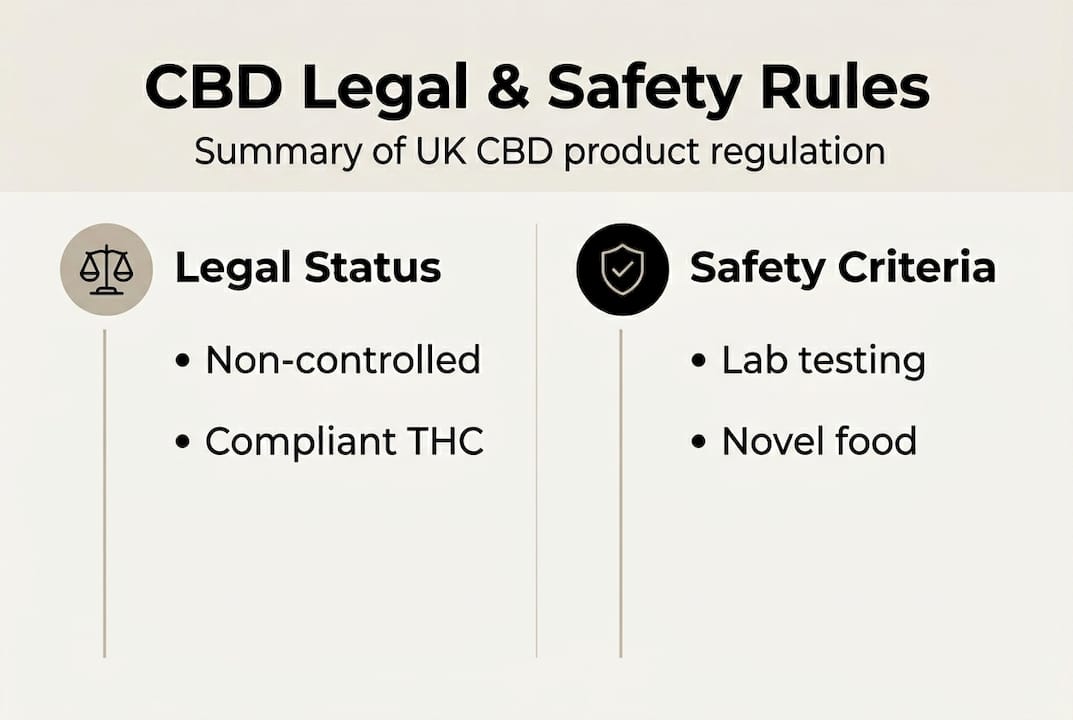
This is a significant regulatory step. Brands must submit a safety dossier to the FSA, demonstrating that their product is safe for human consumption at the intended dose. The FSA then reviews the data before granting authorisation.
One of the most important figures to know is the provisional Acceptable Daily Intake (ADI). The FSA has set this at 10mg of CBD per day for healthy adults, excluding pregnant women, breastfeeding mothers, and people taking medication. This is a provisional benchmark, meaning it reflects the best available evidence as of 2026 but may be updated as more safety data emerges. You can read more about this in our CBD daily intake guidance.
FSA requirements for legally selling CBD as a food supplement:
- Submit a novel food application with full safety data
- Demonstrate the product’s composition, manufacturing process, and proposed daily intake
- Show that the product does not pose a safety risk at the intended dose
- Comply with the provisional 10mg/day ADI guidance
- Maintain accurate and compliant product labelling
For practical guidance on how much to take, our CBD dosage guide covers safe usage in detail. The 10mg/day figure is a useful starting point, but individual needs vary.
Medicinal CBD and MHRA regulation
Wellness CBD and medicinal CBD are not the same thing legally, and this distinction matters enormously. A CBD oil sold as a food supplement operates under FSA rules. A CBD product that claims to treat, cure, or prevent a medical condition falls under an entirely different regulatory framework governed by the MHRA.
Medicinal CBD products require MHRA marketing authorisation under the Human Medicines Regulations 2012. Any product making unlicensed medical claims is classified as a medicine and requires a prescription. This is why you will not see legitimate CBD brands claiming their products cure anxiety or eliminate chronic pain.
The steps involved in obtaining MHRA approval for a medicinal CBD product are extensive:
- Submit a Marketing Authorisation Application (MAA) to the MHRA
- Provide clinical trial data demonstrating safety and efficacy
- Show consistent manufacturing standards under Good Manufacturing Practice (GMP)
- Demonstrate the product’s quality, safety, and therapeutic benefit
- Receive formal approval before making any medicinal claim in marketing
Currently, the only licensed CBD medicine in the UK is Epidyolex, prescribed for rare forms of childhood epilepsy. Everything else sold as a wellness supplement must stay firmly within food supplement territory.
For everyday wellness use, products like CBD oil and CBD cream can support general wellbeing without crossing into medicinal claims. Our article on how CBD supports health naturally explores this further.
Pro Tip: If you see a CBD product online claiming it will “cure” your anxiety or “eliminate” your chronic pain, treat that as a red flag. Legitimate UK brands are careful with their language, and unsubstantiated medical claims are a sign the product may not meet UK regulatory standards.
What most people misunderstand about CBD legality in the UK
Here is the honest truth: saying CBD is “legal in the UK” is accurate but incomplete. The reality is that legality exists on a spectrum of compliance, and many products on the market sit in a grey zone.
As of 2026, some CBD applications have been deemed safe up to 10mg/day, while others have insufficient data, and many products remain non-compliant with FSA novel food requirements. This means a product can technically avoid being a controlled substance while still failing to meet food safety standards.
Most consumers do not know to ask whether a brand has a validated novel food application. They assume that if it is on a shelf or a website, it must be fully legal. That is not always the case. Our UK CBD compliance guide breaks down exactly what to look for.
The practical advice is straightforward. Choose brands that publish third-party lab results, state their THC content clearly, and can demonstrate FSA compliance for ingestible products. “Legal” should mean fully compliant, not just technically not-illegal.
Discover safe, compliant CBD options in the UK
Understanding the regulations is genuinely empowering. It means you can shop with confidence, knowing exactly what to look for in a quality CBD product.
At SMOKO CBD, every product is third-party lab tested to confirm zero THC levels, and our broad-spectrum formulations are made with organically grown hemp. Whether you are starting out with our mint CBD tincture or stepping up to our high-strength mint CBD, you can trust that our products are designed to meet UK standards. Browse SMOKO CBD to explore our full range of tinctures, gummies, and capsules built for UK consumers who want quality they can rely on.
Frequently asked questions
Is CBD legal in the UK for both ingestible and topical products?
CBD is not a controlled drug, but ingestible products must meet FSA novel food authorisation requirements, whilst topicals are easier to comply with as long as THC content stays within the 1mg per product limit.
What is the maximum legal daily CBD intake in the UK?
The FSA provisional ADI is 10mg of CBD per day for healthy adults, and this excludes pregnant women, breastfeeding mothers, and those on medication.
Can I buy CBD products online in the UK legally?
Yes, provided the products comply with UK regulatory standards, contain no more than 1mg of THC per product, and hold valid FSA novel food authorisation for any ingestible items.
Are medical CBD products available without prescription in the UK?
No. Medicinal CBD requires MHRA authorisation and a valid prescription; any product making unlicensed medical claims is prohibited from sale without going through the full approval process.