TL;DR:
- Bioavailability determines how much CBD effectively enters your bloodstream for active effects.
- Consuming CBD with fatty food and using sublingual or enhanced formulations boosts absorption.
- Product choice and proper intake methods profoundly impact CBD’s wellness benefits.
Most people taking CBD assume that a 1,000mg bottle delivers 1,000mg of benefit. The reality is far more nuanced. Oral CBD bioavailability can be as low as 6%, meaning the majority of what you swallow never actually reaches your bloodstream. This guide explains what bioavailability means, why it matters for your wellness routine, and, most importantly, how you can make smarter choices to genuinely improve how much CBD your body uses.
Table of Contents
- What does ‘CBD bioavailability’ actually mean?
- How food, absorption routes, and formulations impact CBD bioavailability
- Comparing CBD products: tinctures, capsules, gummies, and more
- How to maximise CBD bioavailability for optimal wellness
- Why most people underestimate CBD bioavailability
- Explore effective CBD solutions for improved absorption
- Frequently asked questions
Key Takeaways
| Point | Details |
|---|---|
| Bioavailability explained | CBD bioavailability determines how much of your dose actually reaches your bloodstream. |
| Food boosts absorption | Taking CBD with fatty foods can dramatically increase effectiveness. |
| Formulation matters | Enhanced products and certain carriers are proven to deliver more CBD. |
| Optimal usage tips | Choosing the right product and timing with meals can maximise wellness results. |
What does ‘CBD bioavailability’ actually mean?
Bioavailability is a pharmacological term (used in medicine to describe drug absorption) that refers to the fraction of a substance that enters systemic circulation and is available to have an active effect. In plain terms: it is how much of the CBD you take actually makes it into your blood, where it can interact with your body’s endocannabinoid system.
When you swallow a CBD capsule or gummy, several obstacles stand between the product and your bloodstream. First, CBD must survive your digestive tract, which is not particularly welcoming to it. Then it travels to the liver, where enzymes break a significant portion of it down before it ever circulates. This process is called first-pass metabolism, and it is the primary reason oral CBD absorption is so low.
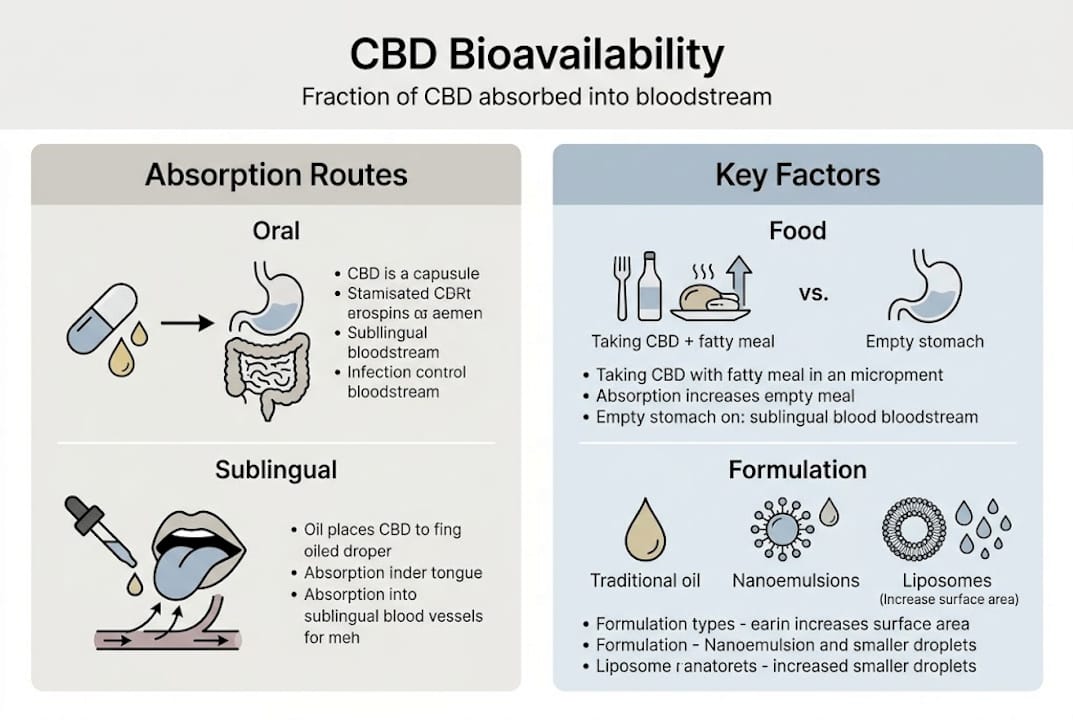
A second major obstacle is CBD’s chemistry. CBD is lipophilic, meaning it dissolves in fats rather than water. Since your blood is largely water-based, CBD does not mix easily into it. Think of trying to stir olive oil into a glass of water. Without help from the right carriers or formulations, much of the CBD simply cannot cross from the gut into the bloodstream effectively.
Here is a quick summary of what reduces oral CBD bioavailability:
- First-pass metabolism in the liver breaks down a large proportion of CBD before it circulates
- Poor water solubility limits how well CBD crosses the gut wall
- Inconsistent gut absorption means results can vary from person to person
- Fasting state reduces absorption further, as dietary fats are absent
Understanding CBD terminology like bioavailability helps you read product labels and dosage guides with real confidence. It also helps you understand why two people taking the same product might report very different results. The science is not complicated once you see what is actually happening inside the body, and knowing it puts you firmly in control of your wellness choices.
“Bioavailability isn’t just a technical footnote — it’s the difference between a supplement that works and one that doesn’t.”
It is also worth knowing that CBD and blood interactions can vary depending on individual liver enzyme activity, which is another reason bioavailability differs between people.
How food, absorption routes, and formulations impact CBD bioavailability
Now that we have defined why bioavailability matters, let us look at the practical influences: how food, administration routes, and product design actually affect absorption.
The food effect is dramatic. Research shows that a high-fat meal can increase CBD exposure by up to 17 times compared to taking CBD on an empty stomach. That is not a small improvement. It is the difference between a genuinely effective dose and one that largely passes through you unused. Foods rich in healthy fats, such as avocado, eggs, nuts, or full-fat yoghurt, are ideal companions for your CBD routine.
Administration routes matter enormously. Here is how the main methods compare:
| Route | Estimated bioavailability | Onset time |
|---|---|---|
| Oral (capsules, gummies) | 6% to 19% | 60 to 120 minutes |
| Sublingual (tinctures under tongue) | 20% to 35% | 15 to 45 minutes |
| Inhalation (vaping) | 31% to 56% | 2 to 10 minutes |
Sublingual administration, where you hold a tincture oil under your tongue for 60 to 90 seconds, bypasses much of the digestive process. CBD is absorbed directly through the mucous membranes and enters the bloodstream more quickly and at higher levels. CBD tinctures are particularly popular for this reason.
Formulation technology is a game changer. Not all capsules are created equal. Enhanced oral formulations use techniques such as nanoemulsification, lipid-based delivery, or self-emulsifying systems to make CBD more water-compatible and far easier for the gut to absorb. Research comparing enhanced capsules to standard reference capsules shows a striking difference in blood CBD levels, with enhanced versions delivering measurably higher concentrations.
- Take CBD with a fat-rich meal or snack
- Consider sublingual tinctures for quicker, more reliable absorption
- Look for enhanced or lipid-based capsule formulations
- Read product labels for information on carrier oils used
Pro Tip: If you are currently taking a standard CBD capsule, try switching to a sublingual tincture or taking your capsule with a tablespoon of coconut oil. Many people notice a real difference in how the product feels within the first week.
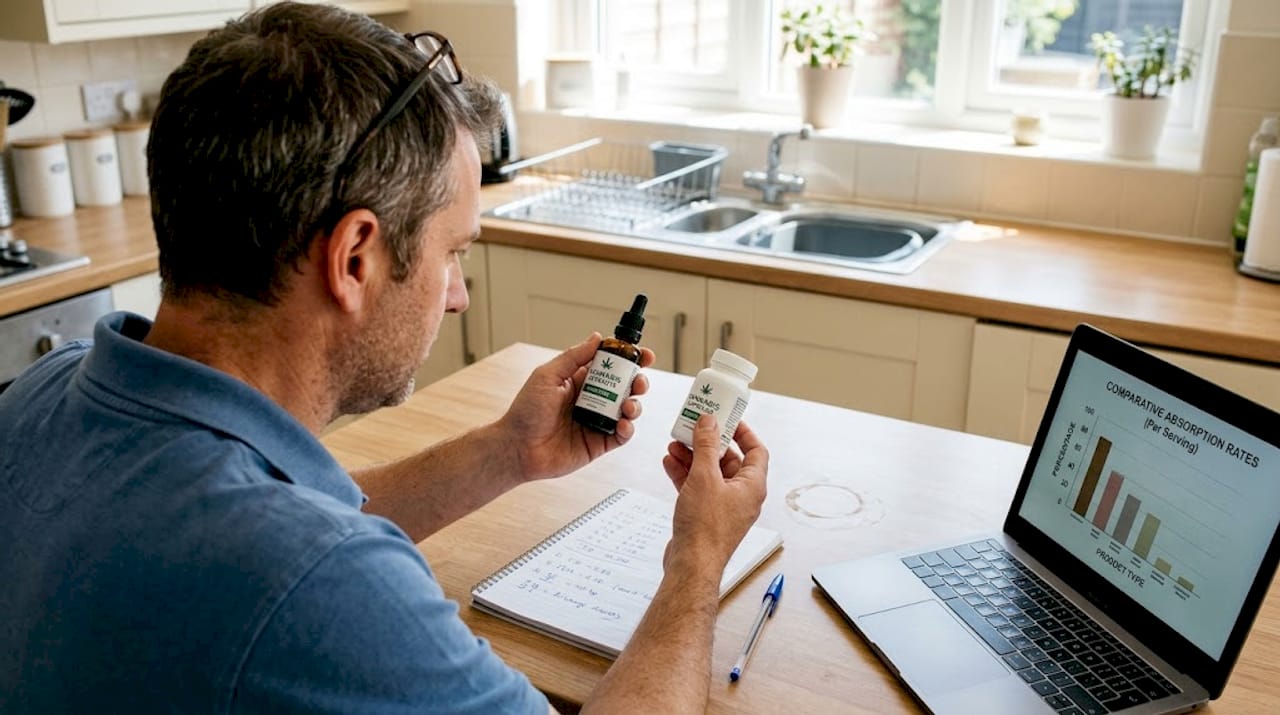
When evaluating types of CBD products, it helps to think not just about the CBD content listed on the label, but about how much of it your body can realistically absorb.
Comparing CBD products: tinctures, capsules, gummies, and more
Understanding routes and food effects prepares us to compare products directly. Which types and carrier oils actually deliver the most CBD into your system?
| Product type | Bioavailability range | Key benefit | Best suited for |
|---|---|---|---|
| Sublingual tincture (MCT oil) | 20% to 35% | Fast, efficient absorption | Daily wellness routines |
| Enhanced capsules | Up to 5x standard | Consistent, measurable dosing | Those preferring capsules |
| Standard capsules or gummies | 6% to 19% | Convenient and discreet | Occasional or low-dose users |
| Inhalation (vaping) | 31% to 56% | Fastest onset | Immediate relief needs |
Different formulations affect measured CBD exposure significantly, which is why the product you choose genuinely shapes the results you experience.
Carrier oils play a particularly important role in tinctures. MCT oil (medium-chain triglycerides, derived from coconut) is widely regarded as one of the best carriers because it is rapidly absorbed by the body and helps CBD dissolve more effectively. Hemp seed oil is another common carrier with its own nutritional benefits, though MCT oil tends to give slightly better absorption results for CBD specifically.
Here are the key factors to weigh when comparing products:
- Carrier oil quality: MCT oil outperforms many alternatives for CBD absorption
- Formulation type: Enhanced or lipid-based products outperform plain extracts
- Concentration: Higher concentration products may offer better value per effective milligram
- Third-party testing: Always check lab reports to confirm actual CBD content
Read more about CBD oil capsules to understand how capsule formulation affects what you actually absorb. It is also worth considering how long CBD lasts in your system, as bioavailability affects not just peak levels but duration of effect too.
For those interested in faster relief, CBD vaping offers the highest bioavailability of any common route, though it may not suit everyone’s lifestyle or preferences.
How to maximise CBD bioavailability for optimal wellness
Applying what we have covered, here are practical ways to boost bioavailability and get genuinely more from your CBD routine.
Food and formulation are the two most powerful levers you can pull to dramatically improve how much CBD your body absorbs. Most people adjust neither, which explains why so many feel underwhelmed by their results.
Practical steps to maximise absorption:
- Always take CBD with dietary fat. Even a small handful of nuts or a glass of full-fat milk can meaningfully improve absorption compared to taking CBD on an empty stomach.
- Choose sublingual tinctures when possible. Hold the oil under your tongue for at least 60 to 90 seconds before swallowing to allow direct absorption through the mucous membranes.
- Select enhanced or lipid-based formulations. These use science-backed delivery methods to get more CBD into your bloodstream from each dose.
- Be consistent. CBD tends to build up in fatty tissues over time, and consistent daily use improves baseline levels.
- Start low and adjust gradually. Check CBD daily intake guidance and increase your dose only once you have established a baseline.
Pro Tip: If you are not feeling the effect you expect within 30 to 60 minutes of taking a tincture sublingually, check that you are holding it under the tongue long enough. Many people swallow too quickly and lose a good portion of the benefit. Also review how long CBD takes to work to set realistic expectations based on your chosen product type.
Lastly, store your CBD products properly. Heat, light, and air degrade cannabinoids over time, reducing potency before the product even reaches your system. A cool, dark cupboard is ideal.
Why most people underestimate CBD bioavailability
Here is an uncomfortable truth: a lot of popular CBD advice online either skips bioavailability entirely or treats all products as if they are equally effective. They are not. The gap between a sublingual tincture taken with a fatty meal and a plain capsule taken on an empty stomach can be the difference between genuine wellness support and no noticeable effect at all.
Most people assume that the milligrams on the label are the milligrams their body receives. That assumption is understandable but inaccurate. Formulation and dietary fat radically alter how much CBD is absorbed, yet these factors are rarely highlighted on product pages or in mainstream wellness articles.
At SMOKO CBD, we believe an informed customer gets better results. Choosing quality CBD tinctures with the right carrier oils, used correctly, is not just marketing. It is science that works in your favour when you understand it. Intentional choices, grounded in the real science of absorption, are what separate a CBD routine that truly supports your wellness from one that simply costs money.
Explore effective CBD solutions for improved absorption
Now that you understand how bioavailability shapes your CBD experience, the logical next step is choosing products built to maximise it.
At SMOKO CBD, our broad-spectrum products are formulated with quality in mind. Our CBD mint tincture uses MCT oil as a carrier, one of the most effective ways to improve absorption, and delivers 1,000mg in a convenient 10ml bottle. For those who prefer something a little more enjoyable, our CBD gummies offer a tasty and practical option. Or, if you prefer a measured and discreet daily dose, our CBD soft gels are a reliable choice. All products are third-party lab tested with zero THC, so you know exactly what you are getting.
Frequently asked questions
Why does oral CBD have such low bioavailability?
Oral CBD is largely lost due to limited absorption in the gut and extensive metabolism in the liver before reaching the bloodstream. First-pass metabolism is the primary reason so little of a standard oral dose ever circulates actively.
Can eating before taking CBD improve absorption?
Yes, consuming CBD alongside a high-fat meal can dramatically increase the amount absorbed into your system. High-fat food boosts CBD bioavailability by up to 17 times compared with taking CBD whilst fasting.
Which CBD product type offers the best bioavailability?
Enhanced formulations and sublingual tinctures generally provide better bioavailability than standard capsules or gummies. Research shows an enhanced capsule formulation can deliver roughly 5.7 times the peak blood concentration of a reference product.
Does the carrier oil affect CBD absorption?
Yes, carrier oils like MCT oil can significantly improve the solubility and absorption of CBD. Lipophilicity and carrier oils are key determinants of how efficiently CBD crosses from the gut into the bloodstream.