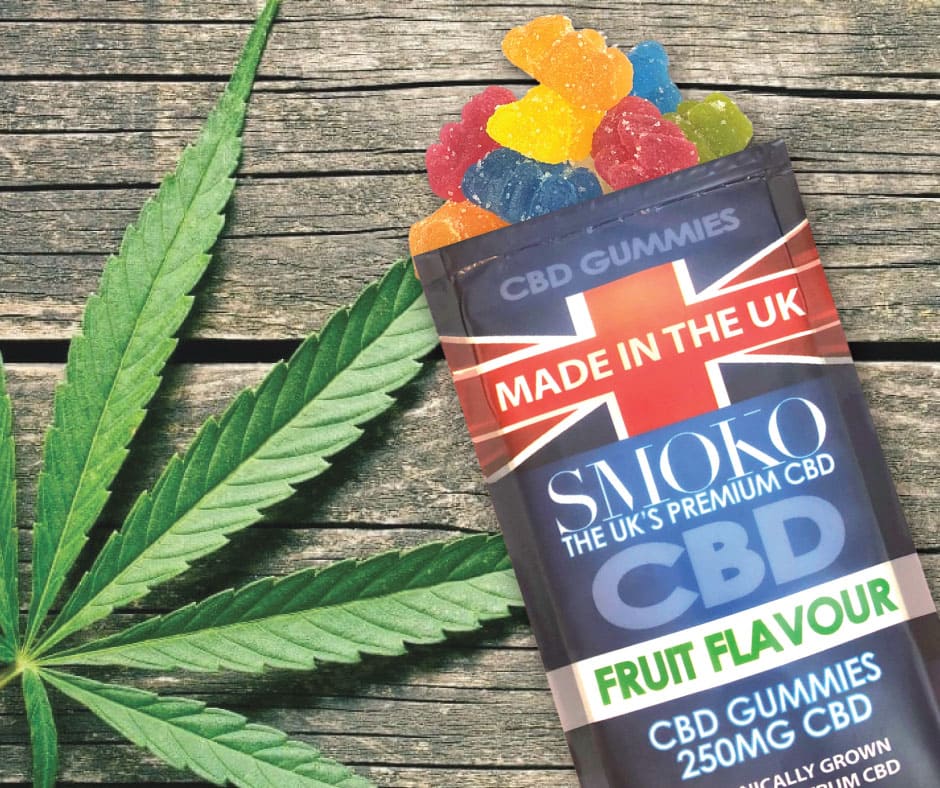
There is no single statutory minimum age covering every CBD product in the UK, but authorities and retailers treat CBD as an adult-only product. Vape products carry a hard 18+ legal minimum, and the Food Standards Agency (FSA) recommends against any CBD use by under-18s. Reputable sellers, Smokocbd included, apply an 18+ rule at checkout regardless of product type.
TL;DR:
- CBD products in the UK are treated as adults-only, with vape products requiring a strict 18+ purchase age, enforced both online and in-store.
- Retailers must verify customers’ ages at checkout, often through date-of-birth declarations, due to legal and reputational risks associated with underage sales.
- Medical use of CBD for minors requires prescriptions from NHS specialists; over-the-counter CBD products are not suitable treatments for children.
- The provisional acceptable daily intake for CBD is 10mg for healthy adults, and stacking multiple products can easily exceed this safe limit.
- Reputable sellers, like Smokocbd, consistently publish third-party lab tests confirming zero THC and clear dosage info to ensure product safety and compliance.
Table of Contents
- What UK law and official guidance actually say about age and CBD
- Age rules by product type: vape, food, cosmetics
- How do retailers verify age for CBD purchases?
- Can minors use CBD for medical reasons in the UK?
- What is the safe CBD dosage and who should avoid it?
- How to buy CBD safely as a UK adult
- Smokocbd’s approach to age-compliant CBD sales
- Why the “18+ rule” deserves more credit than it gets
- Ready to buy CBD as a verified UK adult?
- Sources
What UK law and official guidance actually say about age and CBD
CBD sits in an odd regulatory position. It’s not classed as a controlled drug when THC levels are within legal limits, so there’s no single act of Parliament stating “you must be 18 to buy CBD oil.” What exists instead is a patchwork of guidance, sector-specific law, and industry convention that adds up to the same practical outcome.
Gov tells sellers to advise customers of the maximum recommended daily amount for healthy adults, and states plainly that CBD isn’t recommended for vulnerable groups, including anyone under 18. That’s not a criminal law. It’s a consumer protection standard, and it works because retailers who ignore it risk trading standards action and reputational damage.
The reasoning behind this precautionary stance comes down to gaps in the evidence. Regulators simply don’t have enough long-term data on how CBD affects developing brains, so the FSA’s risk-management approach leans towards restriction rather than assumption of safety.
That caution also underpins the daily intake ceiling regulators use as a benchmark.
Provisional ADI: The Committee on Toxicity’s adviceasanovelfoodforuseinfoodandfoodsupplements-RP521) sets a provisional acceptable daily intake of CBD for a healthy adult. That’s the figure novel-food applications are built around, and it’s meaningfully lower than many older product servings on the market.
Key regulatory threads worth holding onto:
- No single statute names an age limit for all CBD products.
- FSA guidance recommends against under-18 consumption as standard advice.
- The provisional ADI applies to healthy adults, not children.
- Labelling proposals aim to make suitability and dosage explicit on packaging.
Age rules by product type: vape, food, cosmetics
CBD isn’t one product category in law. It’s regulated differently depending on how it’s sold, and that changes where the age line sits.
- Vapes and e-cigarettes: covered by existing vaping law, which sets a firm 18+ minimum. Retailers ID-check CBD vapes exactly as they would nicotine vapes, no exceptions.
- Food supplements and edibles: these fall under novel-food rules. Many applications reviewed by the Advisory Committee on Novel Foods and Processes explicitly exclude under-18s from their safety assessment, which is why gummies and capsules increasingly carry “not suitable for under 18s” wording.
- Cosmetics and topicals: governed by cosmetics regulation rather than food law, so the legal mechanism differs. Responsible retailers still warn against use by minors, because the underlying uncertainty about CBD’s effects on young people doesn’t disappear just because a product is applied to skin rather than swallowed.
The pattern across all three is consistent even where the legal basis isn’t: adults only, verified where the law demands it, recommended where guidance does.
How do retailers verify age for CBD purchases?
Three things drive the 18+ checkpoint you’ll hit at almost every UK CBD retailer, online or in-store.
- Consumer protection expectation. FSA guidance treats under-18 exclusion as a baseline safety measure, and trading standards bodies use it as a benchmark for compliant selling.
- Vape law is non-negotiable. Any CBD vape product inherits the 18+ requirement from e-cigarette regulation, full stop.
- Reputational risk. A retailer caught selling to a minor, or failing to label products correctly, faces damage that’s hard to repair in a market still building consumer trust.
Online checkout age verification usually means a date-of-birth declaration, sometimes backed by third-party identity checks for higher-risk categories like vapes. Expect to confirm your age before payment, not after delivery.
Pro Tip: If a retailer sells you a CBD vape without any age check at all, that’s a red flag worth reporting to your local trading standards office. It suggests the wider compliance culture, including lab testing and labelling accuracy, may be equally lax.
Can minors use CBD for medical reasons in the UK?
Retail CBD and prescription cannabinoid medicine are two entirely different things, and conflating them is one of the most common mistakes parents make.
- Licensed medicines exist for specific conditions. Epidyolex, a cannabis-derived medicine, is prescribed for certain forms of severe childhood epilepsy under strict clinical oversight.
- Access runs through specialists, not shops. A child needing cannabinoid treatment goes through NHS paediatric neurology or a specialist clinic, with dosing, monitoring, and interactions managed by a clinician, not a product label.
- Over-the-counter CBD is not a substitute. Retail tinctures and gummies aren’t formulated, dosed, or regulated to the standard required for treating a diagnosed medical condition in a child.
If your child has a condition where cannabinoids might help, the route is your GP or specialist, never the CBD aisle.
What is the safe CBD dosage and who should avoid it?
The 10mg-per-day provisional ADI matters because it’s a ceiling, not a target. Many product servings on UK shelves sit close to or above that figure once you count multiple gummies or a full dropper of oil, so stacking products across a single day can push a healthy adult past the recommended limit without them realising.
Certain groups should avoid retail CBD altogether, or only use it under medical supervision:
- Under-18s, per FSA and GOV.UK guidance.
- Pregnant or breastfeeding people, and those trying to conceive.
- Anyone taking regular medication, since CBD can interact with certain drugs metabolised by the liver.
- People who are immuno-suppressed or managing complex health conditions.
Before buying anything, check the third-party lab report for THC content and confirm the milligram figure per serving, not just per bottle. If you’re taking more than one CBD product a day, whether that’s an oil and a gummy, or a capsule and a topical, add up the totals rather than assuming each one is negligible on its own.
How to buy CBD safely as a UK adult
A handful of checks separate a compliant, well-tested product from one riding the grey edges of the market.
- Look for a certificate of analysis (COA) that’s specific to the batch you’re buying, not a generic PDF from years ago. Learning to read a COA properly makes the difference between trusting a label and just hoping it’s accurate.
- Check the THC result reads zero or sits within GB legal limits. If a brand won’t publish this, walk away.
- Read the label for ADI guidance and age suitability wording. Compliant UK CBD sellers increasingly state both clearly.
- Talk to a GP or pharmacist first if you’re on medication. This takes five minutes and avoids a genuinely risky interaction.
Pro Tip: Save the COA batch number alongside your purchase confirmation. If a product is ever recalled or challenged by trading standards, you’ll want that reference to hand.
Smokocbd’s approach to age-compliant CBD sales
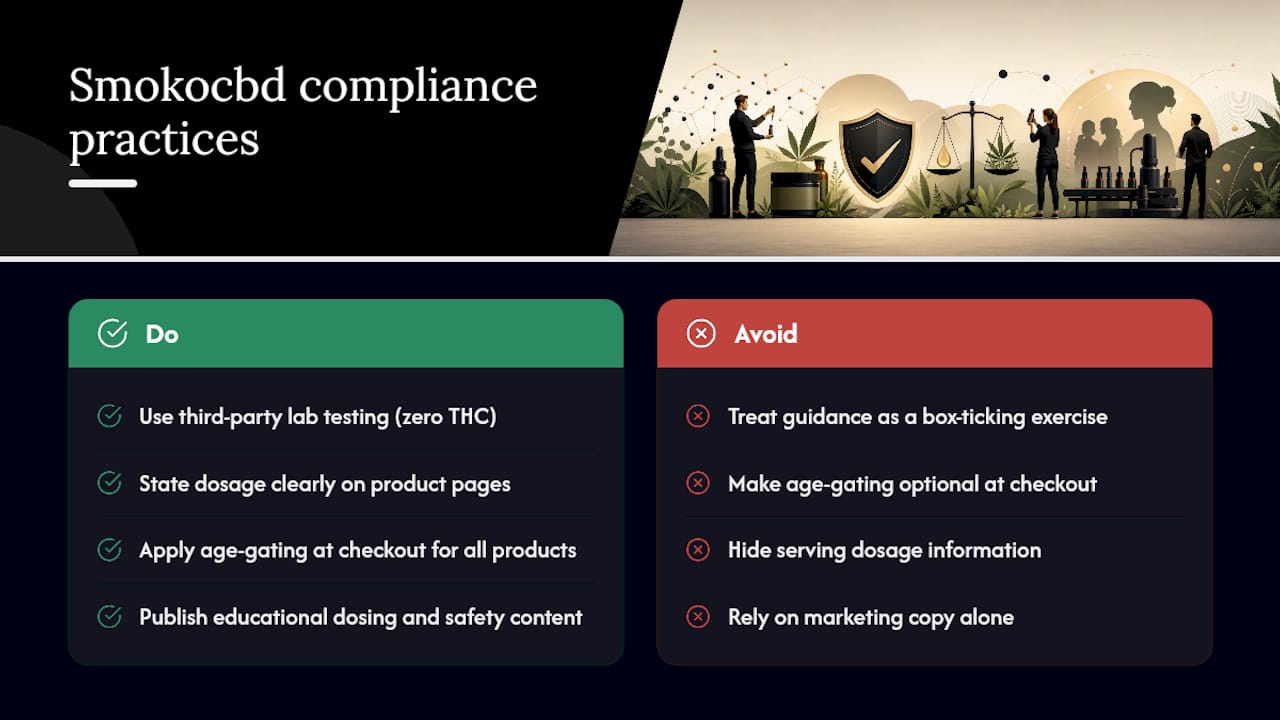
Smokocbd builds its entire retail process around the guidance outlined above rather than treating it as a box to tick. Every batch carries third-party lab testing confirming zero THC, and product pages state dosage clearly so adult customers aren’t left guessing what a serving actually contains.
Age-gating isn’t optional at checkout. It’s applied consistently across tinctures, gummies, and capsules, in line with the precautionary standard the FSA and GOV.UK both recommend for vulnerable groups. Smokocbd also publishes educational content on safe dosing and CBD use, so adult customers can make an informed choice rather than relying on marketing copy alone.
That combination, verified testing plus honest labelling, is what a compliant CBD retailer should look like in 2026.
Why the “18+ rule” deserves more credit than it gets
Most coverage of CBD age rules treats the 18+ norm as a minor technicality, something retailers do to avoid trouble rather than something with real substance behind it. That reading undersells it. The provisional 10mg ADI, the labelling proposals, the vape law inheritance, none of these are bureaucratic box-ticking. They exist because the evidence base on CBD and developing bodies is genuinely thin, and regulators have chosen caution over convenience.
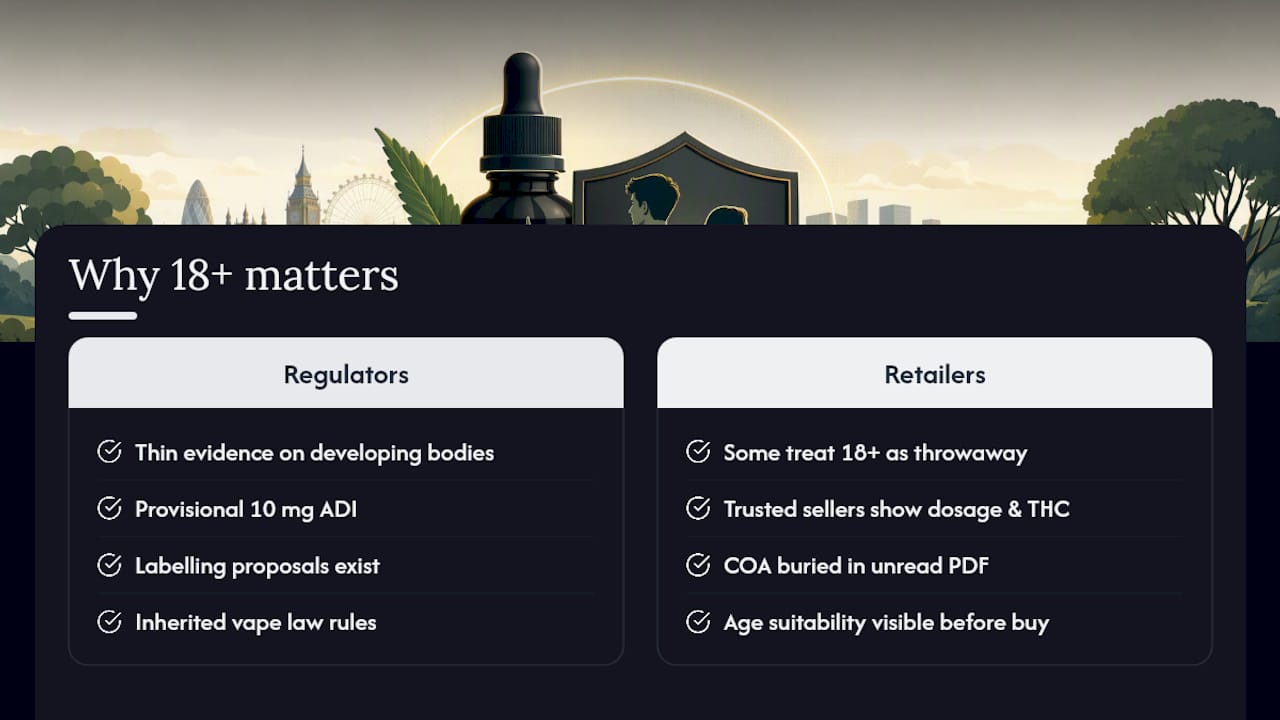
What frustrates me is how many sellers still treat “not for under-18s” as a throwaway line rather than a standard to build a business around. A COA buried in a PDF nobody reads isn’t compliance, it’s cover. The retailers worth trusting are the ones who put dosage, THC results, and age suitability where you’ll actually see them before you buy, not after a complaint forces their hand.
The other thing worth saying plainly: parents searching for CBD as a shortcut to help a child with a genuine medical condition are, understandably, looking for options. But retail CBD was never built for that job. Epidyolex exists, specialist NHS pathways exist, and neither runs through a shop.
— Mike
Ready to buy CBD as a verified UK adult?
Smokocbd tests every batch for zero THC and states dosage clearly on the label, so you’re not left guessing what you’re actually taking. If you’re an adult looking for a straightforward, lab-verified starting point, the Mint 2000mg Broad Spectrum CBD Tincture is a practical place to begin, with clear per-serving strength so you can stay within recommended limits from the first drop.
If you’re pregnant, breastfeeding, or taking regular medication, speak to your GP or pharmacist before adding CBD to your routine. Once you’ve got the green light, checkout takes a couple of minutes and includes the same age verification standard covered throughout this guide.