Pesticides are used in hemp cultivation, and residues do turn up in laboratory testing. That’s the direct answer. The reassuring part is that regulators, accredited laboratories and rigorous test methods now give both consumers and growers reliable ways to check for them before a product reaches your hands.
The infrastructure for catching problem residues is genuinely robust. The US Environmental Protection Agency (EPA) has issued its first pesticide tolerance specific to hemp, laboratories increasingly follow the ASTM D8399 standard for multi-residue testing, and the workhorse instrument behind almost every credible result is LC-MS/MS (liquid chromatography tandem mass spectrometry), a method sensitive enough to detect residues in the parts-per-billion range.
So what should you actually do with that information?
If you’re buying a CBD product:
- Ask for a current third-party Certificate of Analysis (COA) from an accredited laboratory before you buy or use it.
- Check that the lab is ISO 17025 or UKAS accredited, not just “independently tested” in marketing copy.
If you’re growing hemp:
- Build pest management around Integrated Pest Management (IPM) rather than routine spraying.
- Stick to pesticides on the approved list for your jurisdiction and respect withholding periods before harvest.
Pro Tip: A COA that only lists a handful of pesticides tells you almost nothing. Look for panels covering dozens of analytes, ideally the same list your regulator screens for, so a “clean” result actually means something.
Key Takeaways
Reliable protection against pesticide residues in hemp comes down to accredited LC-MS/MS testing, transparent COAs, and adherence to jurisdiction-specific action limits.
| Point | Details |
|---|---|
| Residues are real but testable | Pesticide classes like pyrethroids, neonicotinoids and fungicides show up in hemp testing, typically at ppb concentrations. |
| Regulations vary by place and product | EPA tolerances, state action lists, and Canadian MRLs differ, and smokable products often face stricter limits than oils. |
| LC-MS/MS is the analytical backbone | Isotope-dilution LC-MS/MS methods report LOQs as low as 0.0025 µg/g with recoveries near 100%. |
| Read the COA, not the label | Check LOQ, LOD, accreditation (ISO 17025/UKAS) and batch-matching before trusting a result. |
| Growers can cut risk before harvest | IPM, biopesticides and withholding periods reduce the residue load labs later have to detect. |
| Smokocbd publishes batch-level COAs | Its broad-spectrum tinctures, gummies and soft gels are tested by accredited third-party labs before sale. |
Table of Contents
- Which pesticides in hemp show up most often in testing?
- How are pesticides in hemp regulated, and where do the limits come from?
- How is pesticide residue testing for hemp actually done?
- Why is hemp such a difficult matrix to test accurately?
- How do you actually read a hemp CBD Certificate of Analysis?
- What should consumers do to reduce pesticide exposure from hemp products?
- How do hemp growers reduce pesticide risk before harvest?
- What makes LC-MS/MS the practical standard for reliable pesticide data?
- Where to check the rules and the science yourself
- Frequently asked questions
- Sources
Which pesticides in hemp show up most often in testing?
Hemp pesticide testing tends to uncover residues from a fairly predictable set of chemical families, because these are the classes farmers reach for when pests threaten a crop. Understanding them helps you make sense of what a COA is actually screening for.
The main classes found in hemp pesticide testing include:
- Pyrethroids (synthetic versions of a naturally occurring insect repellent), used against a broad range of chewing and sucking insects.
- Neonicotinoids, such as imidacloprid, applied against aphids and other sap feeders.
- Organophosphates, an older insecticide class that affects insect nervous systems.
- Acaricides, targeted specifically at spider mites, a persistent hemp pest.
- Fungicides, used to control powdery mildew and botrytis, especially in humid growing conditions.
- Herbicides and plant growth regulators, which manage weeds and shape plant development rather than target pests directly.
Surveys of cannabis and hemp markets have flagged specific analytes with some regularity: imidacloprid, piperonyl butoxide (a synergist often paired with pyrethroids), and spinosad, a biologically-derived insecticide, all appear in residue panels. Oddly, DEET, the insect repellent found in bug spray, has also shown up as an unexpected contaminant, most likely from cross-contact during handling rather than deliberate crop application. Concentrations detected typically sit in the parts-per-billion (ppb) range, though one Oregon regulatory report found occasional multi-part-per-million spikes of certain insecticides in unregulated samples, a reminder of why accredited testing matters.
Product type changes the picture considerably. Many pesticides are lipophilic, meaning they dissolve readily in fats and oils rather than water. When hemp is processed into oil or a concentrate, these compounds can concentrate alongside the cannabinoids, sometimes appearing at higher levels than in the raw flower they came from. That’s one reason how extraction methods handle pesticide carryover matters as much as the growing practices upstream. Seeds and flower, by contrast, tend to reflect whatever was sprayed more directly, without the concentrating effect of extraction.
How are pesticides in hemp regulated, and where do the limits come from?
There’s no single global rulebook here, which is precisely why checking the source matters. Regulatory treatment of pesticides on hemp varies by country and, within countries like the United States, by state.
The EPA has begun setting tolerances (legal residue limits) specifically for hemp, rather than relying on rules written for other crops. Its tolerance for ethalfluralin on hemp seed followed a full human health risk assessment and required an updated pesticide label explicitly permitting hemp use. That’s significant: a pesticide isn’t legally usable on hemp just because it’s approved for other crops. The label has to say so.
Beyond federal action, individual US states maintain their own action limit lists, sometimes covering anywhere from 59 to over 100 pesticides for cannabis and hemp testing, according to a peer-reviewed regulatory review. Canada, meanwhile, sets maximum residue limits (MRLs) for a wide range of compounds under its own framework. A “tolerance”, “action limit” and “MRL” all describe roughly the same concept: the highest residue concentration permitted before a batch fails and can’t legally be sold.
Product type matters too. Smokable or inhalable hemp products often face stricter limits than oils or edibles in the jurisdictions that distinguish between them, because inhalation can deliver residues more directly into the body. If you’re checking regulatory status yourself:
- Search the EPA’s pesticide registration database for the specific active ingredient and confirm hemp is listed on the label.
- Look up your state or national regulator’s published action-limit or MRL list for cannabis/hemp.
- Compare the product type (flower, oil, edible) against any limits that differ by category.
Pro Tip: Before assuming a pesticide is “banned” for hemp, check whether it’s simply unregistered for that crop yet. Registration status changes as more tolerances get established, so a COA panel from two years ago may not reflect this year’s approved list.
How is pesticide residue testing for hemp actually done?
Every credible hemp pesticide test starts with getting the sample ready for analysis, and this step matters more than people assume. QuEChERS (Quick, Easy, Cheap, Effective, Rugged, Safe) is the dominant sample preparation approach, extracting pesticides from plant material before a cleanup stage, often using dispersive solid-phase extraction (dSPE) or C18 cartridges, strips out the fats, chlorophyll and cannabinoids that would otherwise interfere with detection.
Once cleaned up, the sample goes into an instrument. LC-MS/MS handles the bulk of the work, separating compounds by liquid chromatography before mass spectrometry identifies and quantifies them. Some labs run a dual-source setup, combining electrospray ionisation (ESI) with atmospheric pressure chemical ionisation (APCI), specifically because ESI struggles with certain non-polar pesticides that APCI or GC-MS/MS (gas chromatography, better suited to volatile, non-polar compounds) can pick up instead.
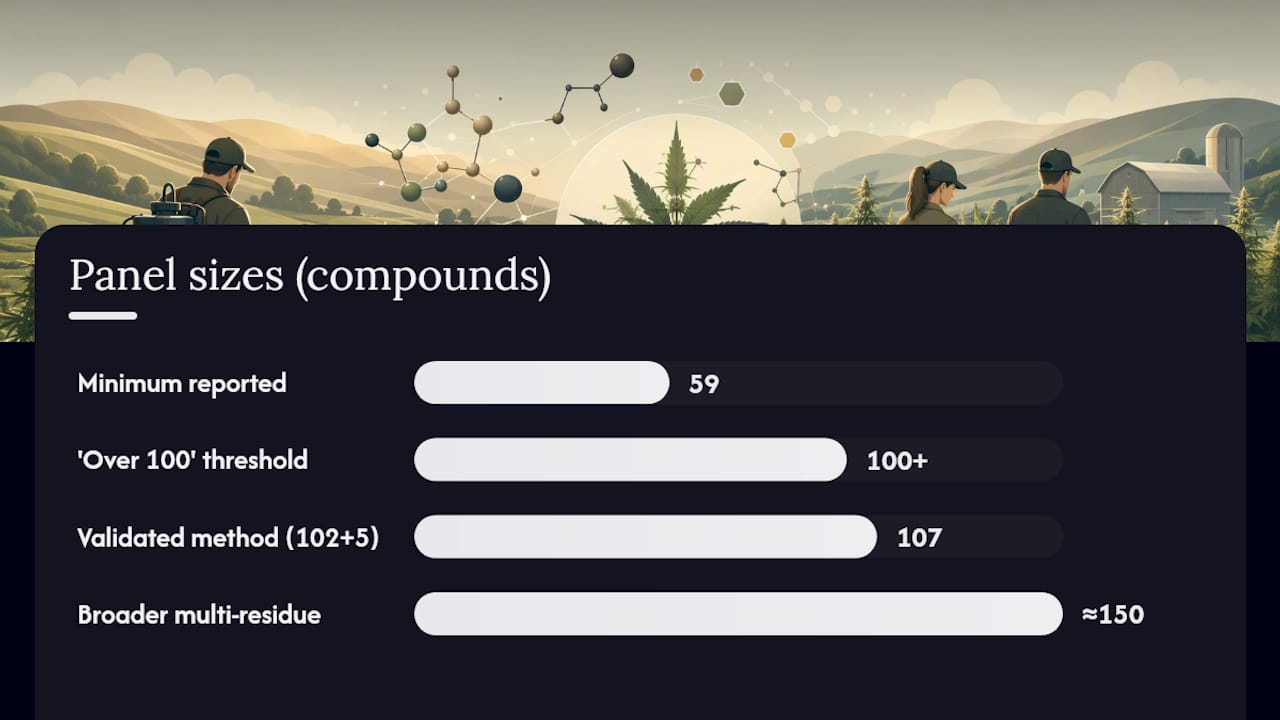
Panel size varies enormously by lab and jurisdiction:
- Some state-mandated panels require screening for 59 to over 100 individual pesticides.
- A validated method published in Chromatography Online covers 102 pesticides plus five mycotoxins using a single dual-ionisation LC-MS/MS platform, built specifically to meet Colorado’s action limits.
- Broader multi-residue panels sometimes stretch toward 150 or more compounds when labs want margin against evolving regulatory lists.
Statistic callout: Method validations published for hemp pesticide testing report limits of quantitation (LOQs) as low as 0.0025 µg per gram, roughly 2.5 parts per billion, up to around 0.1 µg per gram for the least sensitive analytes in the same panel. That range shows just how much detection sensitivity can differ from one pesticide to the next within a single test.
Why is hemp such a difficult matrix to test accurately?
Hemp isn’t an easy substance to run through a mass spectrometer, and that’s worth understanding before you take any “non-detected” result at face value. The plant is dense with lipids, chlorophyll, cannabinoids and terpenes, all of which can interfere with the ionisation process that mass spectrometry depends on.
This interference shows up as matrix effects, specifically ion suppression or enhancement, where co-extracted compounds distort how strongly a target pesticide signal appears. Get this wrong and a lab can report a false negative (missing a real residue) or a false positive (flagging something that isn’t really there). Analytical chemists writing in Spectroscopy Online note that modified QuEChERS cleanup steps, combined with isotope-labelled internal standards, are essential countermeasures rather than optional extras.
Isotope dilution deserves a specific mention here. It works by spiking a sample with a chemically identical version of the target pesticide, but built with heavier isotopes, before extraction. Because the internal standard behaves almost identically to the real analyte through extraction and ionisation, any matrix-driven signal loss affects both equally, letting the lab correct for it mathematically. A validated method for hemp oil using this approach achieved mean recovery of roughly 101.9% across 64 pesticides, with precision held under 15% variation, numbers that would be very difficult to hit without isotope correction in a matrix this complex.
Statistic callout: That same isotope-dilution method reported linearity of R² ≥ 0.995 across its calibration range, a strong indicator that the quantitation stays accurate from trace levels right up to higher regulatory decision thresholds.
The practical takeaway: a “non-detected” result is only as meaningful as the LOQ behind it. If a lab’s detection limit sits close to, or above, the regulatory action limit, “not detected” could still mean “present, but below where we could reliably measure it.”
How do you actually read a hemp CBD Certificate of Analysis?
A COA looks intimidating until you know what four abbreviations mean. LOD (limit of detection) is the smallest amount a method can reliably spot at all. LOQ (limit of quantitation) is the smallest amount it can measure with confidence, always higher than the LOD. MRL (maximum residue limit) is the legal ceiling set by a regulator. Results are usually reported in µg/g (micrograms per gram) or the equivalent in parts per billion.
A trustworthy COA should show, for each analyte tested, either a numerical result or a clear “non-detected below LOQ” notation, never a vague blank. Look for the testing certificate itself to confirm the format matches this standard.
Accreditation matters as much as the numbers. A lab holding ISO 17025 certification, in the UK verified through UKAS, has demonstrated its methods are validated and its results are reproducible under independent audit. Understanding this testing terminology makes label claims far easier to evaluate critically rather than take on faith.
Pro Tip: Watch for two red flags together: a panel that tests only 10 to 15 pesticides when your regulator’s list covers 60 or more, and LOQs reported suspiciously close to the legal limit itself. Either one alone might be innocent. Both together suggest a lab, or a brand, working to make marginal results look clean.
What should consumers do to reduce pesticide exposure from hemp products?
Reducing your exposure comes down to insisting on transparency rather than trusting a label’s claims alone. A few habits make the biggest difference:
- Ask for a COA dated within the last few months, not a generic one reused across multiple production batches.
- Match the batch number on the product packaging to the batch number on the COA itself, since they must correspond exactly.
- Favour broader pesticide panels over narrow ones, particularly for oils and concentrates, where lipophilic residues concentrate.
- Check for accreditation marks (ISO 17025, UKAS) rather than assuming “third-party tested” means the same thing as “accredited.”
Product type genuinely changes your risk profile. Because pesticide compounds in oils and extracts can carry over from raw plant material at higher relative concentrations, a tincture or soft gel deserves closer COA scrutiny than a comparable weight of dried flower. Inhalable products, in jurisdictions that regulate them separately, typically face tighter limits precisely because inhalation route matters for risk.
Pro Tip: Check the COA’s test date against the product’s own manufacture or “best before” date. A result from testing conducted a year before the product reached shelves tells you almost nothing about what’s actually in the bottle you’re holding.
How do hemp growers reduce pesticide risk before harvest?
Good growers treat pesticides as a last resort, not a default tool, and the practices that follow from that mindset shape everything downstream in testing.
Integrated Pest Management (IPM) anchors this approach: regular crop monitoring to catch problems early, biological controls like beneficial insects that prey on pests naturally, and cultural controls such as crop rotation and spacing, before any pesticide gets considered at all. When a pesticide genuinely is necessary, biopesticides (derived from naturally occurring organisms or substances) tend to carry a lower residue and toxicity profile than synthetic alternatives, though growers still need to confirm the specific product is labelled for hemp use.
Pre-harvest withholding periods, the mandatory gap between the last application and harvest, give residues time to degrade before testing. Careful record keeping of every application, product, date, and rate, supports traceability if a batch ever needs investigating. None of this eliminates drift risk from neighbouring farms entirely, but responsible stewardship, tighter buffer zones and communication with adjacent growers, meaningfully reduces cross-contamination.
What makes LC-MS/MS the practical standard for reliable pesticide data?
Technically literate readers will want to know why LC-MS/MS specifically, rather than older or cheaper methods, has become the benchmark for defensible pesticide results in hemp.
The short answer is isotope-dilution mass spectrometry, using stable isotope-labelled versions of target pesticides as internal standards, which corrects for the matrix effects hemp is notorious for causing. Because the labelled standard and the real pesticide behave almost identically through extraction and ionisation, any signal distortion from co-extracted lipids or chlorophyll gets mathematically cancelled out. That’s the mechanism behind the ~101.9% recovery figures mentioned earlier in validated hemp oil methods.
Dual-source configurations, pairing ESI with APCI on a single LC-MS/MS platform, let labs cover both polar pesticides (which ionise well under ESI) and more non-polar compounds (which respond better to APCI) without switching instruments entirely. This single-platform strategy is what allowed one validated method to cover 102 pesticides and five mycotoxins against Colorado’s full regulatory list without needing a separate GC-MS/MS run for every sample.
Statistic callout: Method validation reports typically document recovery rates of 80 to 120% and relative standard deviations under 20% as the accepted benchmark for a defensible pesticide method, figures the 66-pesticide hemp validation cited earlier met comfortably.
Pro Tip: If you want to gauge a lab’s rigour, ask three questions: how many isotope-labelled internal standards does their method use, do they participate in external proficiency testing, and are their published LOQs below the action limits they’re screening against? A lab that answers all three confidently is one worth trusting.
A publisher’s perspective on access versus safety
Hemp and CBD products offer real value to people managing pain, anxiety or sleep issues, and restricting access isn’t the answer to residue concerns. What matters is refusing to treat testing as optional. Every batch deserves a genuine third-party COA from an accredited lab, not a marketing gesture dressed up as one. That trade-off, transparency over convenience, should never be negotiable for anyone selling a product people put in or on their bodies.
How Smokocbd approaches pesticide-free CBD
Every batch we sell is tested by an independent, accredited laboratory before it ever reaches a customer, and we publish those results rather than keeping them behind a customer service request. Our tinctures, gummies and soft gels use organically grown hemp sourced from the USA, verified through the same third-party testing process discussed throughout this article, checking not just THC content but the pesticide residue panels that matter most to careful buyers.
You don’t have to take our word for any of it. Read the batch testing certificate for the broad-spectrum CBD tincture before you buy, and if you’re comparing how other hemp-derived products handle scrutiny like drug testing or sourcing claims, this hemp alternatives guide is a useful companion read. Check the COA, then decide for yourself.
Where to check the rules and the science yourself
For regulatory status, start with the EPA’s pesticide registration pages and your local action-limit list. For laboratory standards, ASTM D8399 sets out the accepted multi-residue LC-MS/MS workflow labs are measured against.
Frequently asked questions
Are pesticides commonly found in hemp and CBD products? Yes. Testing surveys regularly detect residues from pyrethroids, neonicotinoids and fungicides, usually at parts-per-billion concentrations, which is exactly why third-party COAs matter before purchase.
What is the best way to check if a CBD product is pesticide-free? Request a current, batch-matched Certificate of Analysis from an ISO 17025 or UKAS-accredited laboratory, and confirm the pesticide panel covers a broad range of analytes rather than a handful.
Does organic hemp guarantee zero pesticide residue? Organic certification restricts which pesticides can legally be used, mainly permitting biopesticides, but it doesn’t guarantee zero residue from drift or historical soil contamination. A verified organic standard still needs COA backing.
Why do CBD oils sometimes show higher pesticide levels than raw hemp flower? Many pesticides are lipophilic and dissolve into fats during extraction, so they can concentrate in oils and concentrates relative to the raw plant material they came from.
What does a QuEChERS test actually involve? QuEChERS is a sample preparation method, not the final test itself. It extracts and cleans a hemp sample of interfering compounds like chlorophyll and lipids before it goes into an LC-MS/MS or GC-MS/MS instrument for actual pesticide quantitation.
This article is general information, not a substitute for advice from a qualified doctor. Consult a qualified healthcare professional about your own circumstances before acting on anything here.
Sources
- A LC‑MS/MS method with electrospray ionization and atmospheric pressure chemical ionization source for analysis of pesticides in hemp (Journal of Cannabis Research)
- Regulatory status of pesticide residues in cannabis: implications to medical use in neurological diseases (PMC/NIH)
- D8399 Standard Test Method for Multi‑residue Analysis of Pesticides in Dried Cannabis and Hemp Raw Materials Using LC‑MS/MS (ASTM D8399‑23)
- EPA establishes first pesticide tolerance for hemp | US EPA
- Novel LC‑MS/MS method for analysis of 102 pesticides and 5 mycotoxins regulated by the State of Colorado in dried hemp | Chromatography Online