TL;DR:
- Hash oil CO2 is a cannabis concentrate made using carbon dioxide under supercritical or subcritical conditions to extract cannabinoids and terpenes. The extraction process involves pressurizing and controlling temperature to dissolve plant compounds, with post-processing necessary to refine the oil. While CO2 extraction offers safety and scalability benefits, product quality depends on post-processing and terpene reintroduction rather than the extraction method alone.
Hash oil CO2 is a cannabis concentrate produced by using carbon dioxide in a supercritical or subcritical state as a solvent to pull cannabinoids and terpenes from plant material. The industry term for this process is supercritical fluid extraction (SFE), and it has become the preferred method for commercial cannabis oil production worldwide. Products ranging from vape cartridges and tinctures to soft gel capsules rely on CO2 oil as their base. Understanding how the CO2 extraction method works helps you make more informed choices about the products you buy and the quality claims on their labels.
How does the CO2 extraction method work for hash oil?
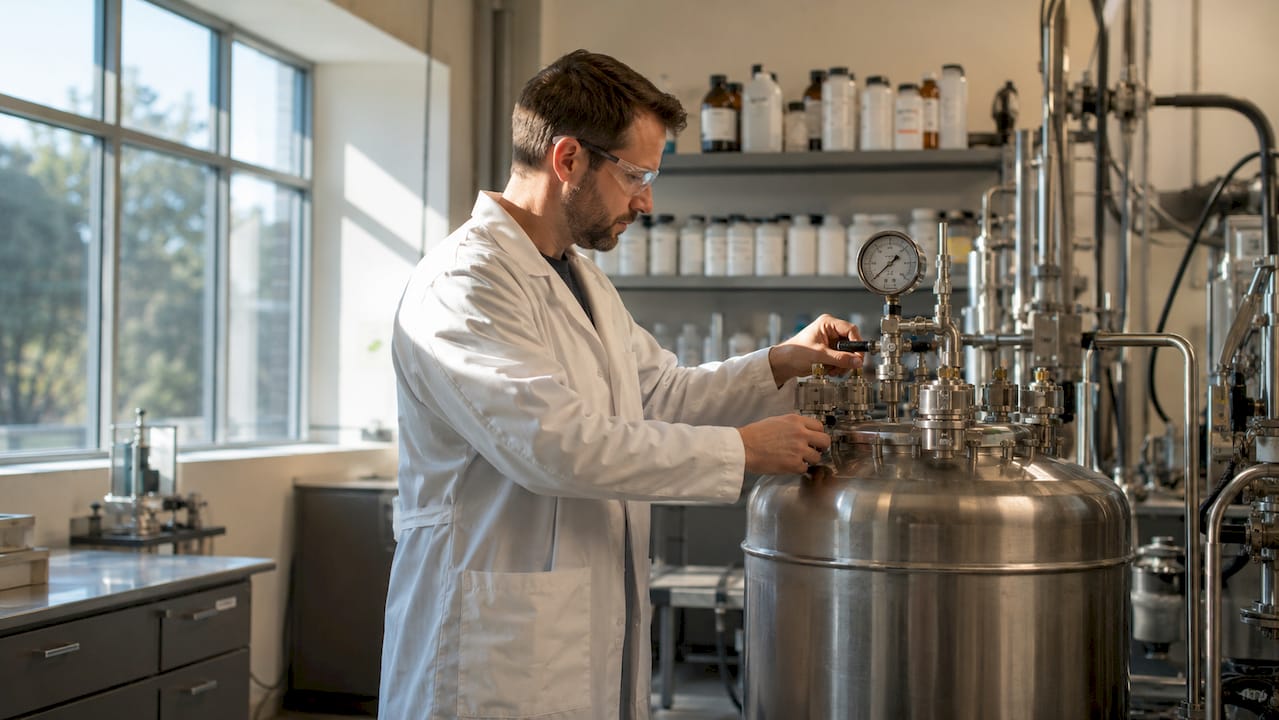
CO2 extraction works by forcing carbon dioxide through cannabis biomass under precisely controlled pressure and temperature conditions. At those conditions, CO2 enters a supercritical state, behaving simultaneously as both a gas and a liquid. That dual behaviour allows it to penetrate plant material like a gas while dissolving cannabinoids and terpenes like a liquid.
The process follows a clear sequence:
- Preparation. Dried and ground cannabis biomass is loaded into an extraction vessel. Moisture content must be low to avoid diluting the extract.
- Pressurisation. A pump forces CO2 into the vessel. Supercritical conditions require pressures above 1,073 PSI and temperatures above 31.1°C. At these parameters, CO2 becomes an effective solvent.
- Extraction. The supercritical CO2 flows through the biomass, dissolving target compounds including cannabinoids, terpenes, waxes, and lipids.
- Separation. The CO2 and dissolved compounds move into a separation chamber. Pressure drops, causing the CO2 to revert to a gas and leave the extracted oil behind.
- CO2 recovery. The gaseous CO2 is captured and recycled back into the system for reuse, making the process both cost-efficient and environmentally considerate.
- Post-processing. The crude oil collected at this stage is not yet ready for consumer products. Winterisation and distillation are required to remove waxes and lipids before the oil is suitable for vape cartridges or tinctures.
CO2 extraction yields 18–25% cannabinoids by weight of dried biomass, with batch times running 2–6 hours depending on equipment scale. Those figures represent a commercially viable output, which explains why large-scale producers favour this approach.
Pro Tip: If you are evaluating a CO2 oil product, ask whether the producer uses subcritical or supercritical settings. Subcritical runs at 800–1,070 PSI and preserves more delicate terpenes, while supercritical runs at 2,000–5,000 PSI and pulls a broader range of compounds including waxes.
What are the advantages and limitations of CO2 extraction?
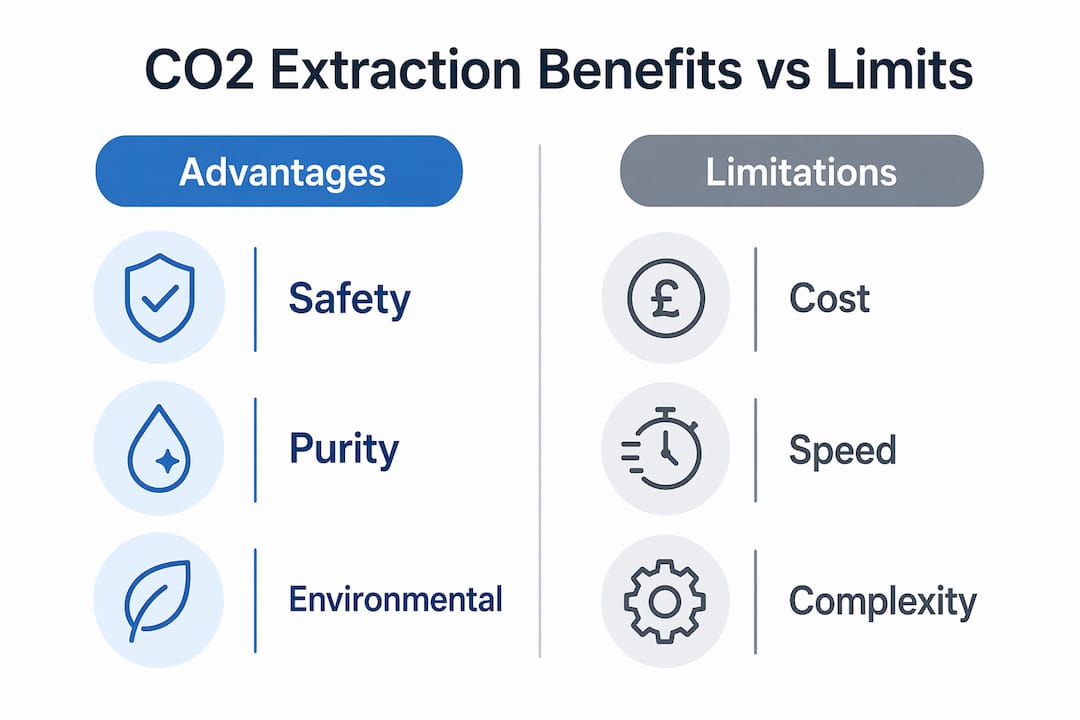
CO2 extraction holds several clear advantages over hydrocarbon methods such as butane hash oil (BHO) extraction and ethanol-based processes. The comparison below captures the key differences.
| Factor | CO2 extraction | Hydrocarbon (BHO) | Ethanol extraction |
|---|---|---|---|
| Solvent safety | Non-flammable, food-grade | Highly flammable | Flammable |
| Residual solvent | None | Risk of butane residue | Risk of ethanol residue |
| Terpene retention | Moderate (reintroduction common) | High with cryogenic methods | Moderate |
| Equipment cost | High | Moderate | Lower |
| Scalability | High | Moderate | High |
| Post-processing | Required | Required | Required |
The most significant advantage of CO2 is its safety profile. CO2 is non-flammable and food-grade, leaving no residual chemical solvent in the final product. That clean profile supports “solvent-free” label claims on consumer products, which matters to health-conscious buyers.
There are, however, important limitations to acknowledge:
- Terpene loss. Supercritical conditions are aggressive. Monoterpenes, the lighter aromatic compounds responsible for fresh cannabis scent, are often lost during high-pressure extraction.
- Equipment investment. Industrial CO2 extraction systems cost significantly more than basic ethanol setups, creating a barrier for small producers.
- Processing complexity. The crude oil output requires mandatory post-processing before it reaches consumer-ready quality.
- The “solventless” misconception. CO2 is classified as GRAS by the FDA (Generally Recognised As Safe) and fully evaporates from the final product, but it does function as a solvent during extraction. A product labelled “CO2 extracted” is not the same as a product labelled “solventless.” Solventless concentrates, such as rosin, use only heat and pressure with no chemical solvent at any stage.
Understanding these distinctions helps you read product labels with greater accuracy. For a broader look at how different extraction approaches compare, Smokocbd’s guide to CBD oil extraction methods covers quality and purity in useful detail.
How do extraction parameters shape the final CO2 oil?
Two operators using identical cannabis biomass and identical CO2 equipment can produce oils that look, smell, and perform very differently. The reason is parameter control. Operators adjust pressure and temperature in real time, and those adjustments directly determine which compounds end up in the final extract.
Supercritical CO2 at 2,000–5,000 PSI pulls cannabinoids, waxes, lipids, and chlorophyll aggressively. The result is a darker, thicker crude oil rich in cannabinoids but carrying unwanted plant material that requires removal. Subcritical CO2 at 800–1,070 PSI is gentler. It captures light terpenes and cannabinoids while leaving waxes behind, producing a lighter, more aromatic extract with less post-processing required.
Higher extraction pressure pulls heavier cannabinoids and waxes, while lower pressure yields lighter, more terpene-rich extracts with noticeably different viscosities. This means the pressure dial is effectively a composition dial. Producers targeting a high-CBD distillate for capsules will run very different parameters than those producing a terpene-forward vape oil.
Colour and viscosity are the most visible indicators of parameter choices. A pale gold, free-flowing oil typically signals a lower-pressure, terpene-focused run. A dark amber, thick oil suggests supercritical conditions with significant wax content still present before post-processing.
Post-processing then refines the crude output further. Winterisation chills the oil in ethanol to precipitate and filter out waxes and lipids. Distillation uses heat under vacuum to isolate specific cannabinoid fractions. Both steps are standard practice for producing the clear, consistent oils found in commercial vape cartridges and tinctures.
Pro Tip: When comparing two CO2 oils, look at the colour and consistency before reading the label. A very clear, pale oil has almost certainly been heavily distilled, which may mean terpenes were stripped out and reintroduced artificially. A slightly amber, less refined oil may retain more of the original plant profile.
What products are made using CO2 extracted hash oil?
CO2 oil appears across a wide range of consumer cannabis and hemp products. Its clean profile and adjustable composition make it particularly well-suited to formats where purity and consistency matter most.
Common product formats include:
- Vape cartridges. CO2 oil is widely used in pre-filled vape cartridges because its viscosity can be tuned to work with standard hardware, and its lack of residual solvent addresses safety concerns around inhalation.
- CBD tinctures. Broad-spectrum and full-spectrum tinctures frequently use CO2 extracted oil as their base, combined with a carrier oil such as MCT (medium-chain triglyceride) oil.
- Soft gel capsules. The precise, consistent cannabinoid content achievable through CO2 extraction suits the measured dosing that capsule formats require.
- Topical formulations. Balms, creams, and salves use CO2 oil for its clean extraction profile and compatibility with skin-care ingredients.
Terpene reintroduction is standard practice in premium products. Because supercritical CO2 extraction can strip monoterpenes, producers often add terpenes back after extraction to restore aroma and flavour. Those terpenes may be cannabis-derived, botanical, or a blend of both. For consumers interested in the therapeutic potential of terpenes, hemp terpene profiles offer a useful reference for understanding what each compound contributes.
Product labelling adds another layer of complexity. Broad-spectrum CO2 oil retains multiple cannabinoids and terpenes but contains no detectable THC. Full-spectrum oil preserves the complete plant profile including trace THC. Isolate products strip everything except a single cannabinoid, typically CBD. The CO2 extraction method can produce all three, depending on post-processing choices. For a clear breakdown of these terms, Smokocbd’s CBD oil terminology guide is worth reading before you purchase.
Key takeaways
CO2 extraction produces clean, consistent cannabis oil, but the label “CO2 extracted” describes the solvent used, not the guaranteed quality of the final product.
| Point | Details |
|---|---|
| Supercritical state is the key | CO2 must exceed 1,073 PSI and 31.1°C to act as an effective extraction solvent. |
| Post-processing is mandatory | Crude CO2 oil requires winterisation and distillation before it suits consumer products. |
| Parameters determine the product | Pressure and temperature settings directly control cannabinoid, terpene, and wax content. |
| “CO2 extracted” is not “solventless” | CO2 acts as a solvent during extraction, even though it leaves no residue in the final oil. |
| Terpene reintroduction is common | Premium CO2 oils often have terpenes added back after extraction to restore flavour and aroma. |
Why the CO2 label tells you less than you think
I have spent a considerable amount of time reading product labels and speaking with producers, and the phrase “CO2 extracted” has become one of the most misunderstood claims in the cannabis wellness space. Consumers often treat it as a quality guarantee. It is not. It describes a solvent choice.
The quality of a CO2 oil depends far more on what happens after extraction than during it. A poorly managed post-processing run can strip a beautifully extracted oil of everything that made it interesting. Conversely, a skilled operator can take a supercritical crude and refine it into something genuinely excellent.
What I find most underappreciated is the terpene question. CO2 extraction is often praised for terpene preservation, but the reality is more nuanced. Cryogenic hydrocarbon methods can actually preserve monoterpenes more effectively than supercritical CO2. The CO2 advantage lies in safety and scalability, not necessarily in aroma fidelity. Producers who care about flavour compensate through careful terpene reintroduction, and the best ones are transparent about whether those terpenes are cannabis-derived or botanical.
My advice to anyone choosing a CO2 oil product is straightforward. Look for third-party lab reports, ask about post-processing steps, and check whether terpenes were reintroduced and from what source. The extraction method is a starting point, not the whole story. Future innovations in CO2 technology, including mid-critical extraction and fractional separation, will likely give producers even finer control. For now, informed reading of lab reports remains the most reliable quality check available to consumers.
— Mike
Explore Smokocbd’s CO2 extracted CBD oils
If you are looking for CBD products built on the clean extraction principles described in this article, Smokocbd offers a range of broad-spectrum tinctures and soft gel capsules made from organically grown hemp and third-party lab tested to confirm zero THC.
The 1000mg Mint CBD Tincture uses broad-spectrum CO2 extracted oil in an MCT carrier, delivering consistent cannabinoid content in every drop. For those who prefer a capsule format, the 750mg Soft Gel Capsules offer the same extraction quality in a measured, easy-to-take form. Both products reflect the purity and transparency that CO2 extraction, done properly, makes possible.
FAQ
What is hash oil CO2?
Hash oil CO2 is a cannabis or hemp concentrate extracted using carbon dioxide as a solvent under supercritical or subcritical pressure and temperature conditions. The process pulls cannabinoids and terpenes from plant material without leaving chemical residues in the final product.
Is CO2 extracted oil the same as solventless?
No. CO2 acts as a solvent during the extraction process, even though it fully evaporates from the finished oil. Solventless concentrates such as rosin use only heat and pressure, with no chemical solvent involved at any stage.
What is the difference between subcritical and supercritical CO2 extraction?
Subcritical CO2 runs at 800–1,070 PSI and gently captures terpenes and lighter cannabinoids, while supercritical CO2 runs at 2,000–5,000 PSI and pulls a broader range of compounds including waxes and lipids. The choice of conditions directly shapes the composition and character of the final oil.
Why do CO2 oils sometimes have terpenes added back?
High-pressure supercritical extraction can strip volatile monoterpenes from the oil during processing. Producers reintroduce terpenes after extraction to restore the aroma and flavour profile that consumers expect from premium cannabis products.
Does CO2 extraction guarantee a high-quality product?
The CO2 label describes the solvent used, not the quality of the final product. Quality depends on the skill of the operator, the parameters used during extraction, and the rigour of post-processing steps such as winterisation and distillation.