TL;DR:
- CBD extraction method significantly influences the purity, potency, and safety of the final product, with CO2 extraction being the gold standard due to its solvent-free and tunable nature. Proper post-processing steps like winterisation, distillation, and chromatography are essential for refining CBD oils and ensuring safety and quality. Consumers should scrutinize third-party lab reports to verify cannabinoid levels and absence of residual solvents, pesticides, and heavy metals before purchasing.
Not all CBD oils are created equal, and the reason usually comes down to CBD oil extraction. The method used to pull cannabinoids from hemp plants directly shapes the purity, potency, and safety of the final product. Yet most consumers choose a CBD oil based on milligram strength or flavour alone, without any idea how it was processed. Understanding what happens between the hemp field and the bottle gives you a genuine advantage when evaluating quality and deciding what you put into your body.
Table of Contents
- Key takeaways
- Understanding the CBD oil extraction process
- CO2 versus ethanol: the two dominant methods
- Winterisation and its role in refining CBD oil
- Advanced purification: distillation and chromatography
- Quality, safety, and regulation in CBD production
- My honest take on CBD extraction and what most people miss
- Why Smokocbd’s CBD oils are worth your attention
- FAQ
Key takeaways
| Point | Details |
|---|---|
| Extraction shapes quality | The method used for CBD oil extraction directly affects cannabinoid purity, potency, and residual solvent levels. |
| CO2 is the gold standard | Supercritical CO2 extraction leaves no solvent residue and allows precise control over which compounds are captured. |
| Winterisation matters | Removing waxes and fats after extraction is a critical step that affects clarity, taste, and downstream product quality. |
| Purification goes beyond extraction | Distillation and chromatography are needed to produce broad-spectrum or isolate products with reliable cannabinoid profiles. |
| Lab testing is non-negotiable | Third-party Certificates of Analysis confirm solvent residues, pesticides, and heavy metals are within safe limits. |
Understanding the CBD oil extraction process
Before any extraction begins, the quality of the raw hemp biomass sets the ceiling for everything that follows. Industrial hemp plants used for CBD production are bred to contain high concentrations of cannabidiol and legally compliant THC levels, which in the UK and EU must stay below 0.2% in the growing plant. The starting material matters enormously.
Once harvested, hemp biomass goes through a drying and curing stage. Getting moisture content right is not optional. Too much moisture introduces the risk of mould and interferes with solvent-based processes; too little can degrade terpenes before extraction even starts. Most producers target a moisture content of around 10 to 12% for consistent results.
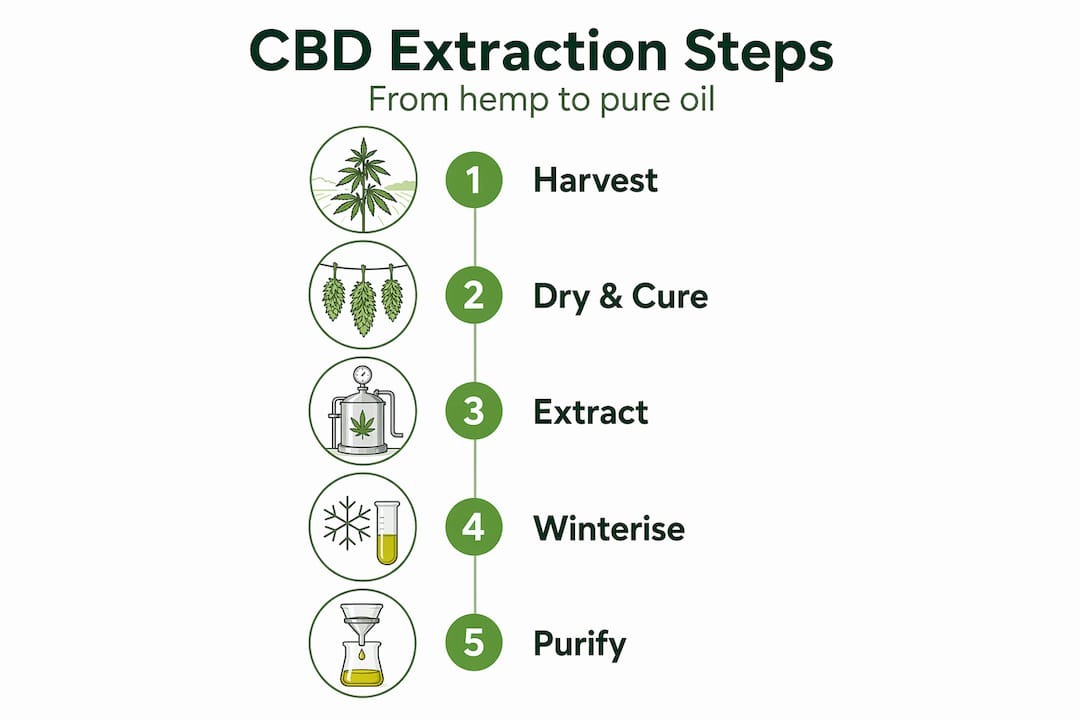
After drying, the plant material is typically milled or ground into a coarse powder. This increases the surface area exposed to the solvent or CO2, which directly improves extraction efficiency and cannabinoid yield. Skipping or rushing this pre-processing step is one of the less discussed ways that producers cut corners without it being immediately visible to consumers.
Key considerations for high-quality hemp preparation include:
- Strain selection: High-CBD, low-THC hemp cultivars are selected specifically to maximise useful cannabinoid content from the outset.
- Harvest timing: Cannabinoid concentrations peak at specific points in the flowering cycle, so precise timing affects raw potency.
- Drying conditions: Temperature and airflow during drying preserve terpene profiles and prevent cannabinoid degradation.
- Particle size: Consistent, fine grinding maximises solvent contact and reduces the risk of uneven extraction across the batch.
CO2 versus ethanol: the two dominant methods
Commercial CBD extraction is typically performed using either supercritical CO2 or ethanol, and the choice between them has real consequences for the quality of what ends up in your tincture or capsule.
Supercritical CO2 extraction works by raising carbon dioxide above its critical point, approximately 31.1°C and 1,073 PSI, at which point it behaves simultaneously like a liquid and a gas. In this state, CO2 becomes an exceptional solvent for cannabinoids and terpenes. When the pressure is released afterwards, the CO2 simply evaporates, leaving absolutely no solvent residue in the extract. The tunability of CO2 is one of its most underappreciated advantages. By adjusting temperature and pressure mid-process, operators can selectively target specific cannabinoids or terpenes in separate fractions. This is not possible with most liquid solvent methods.
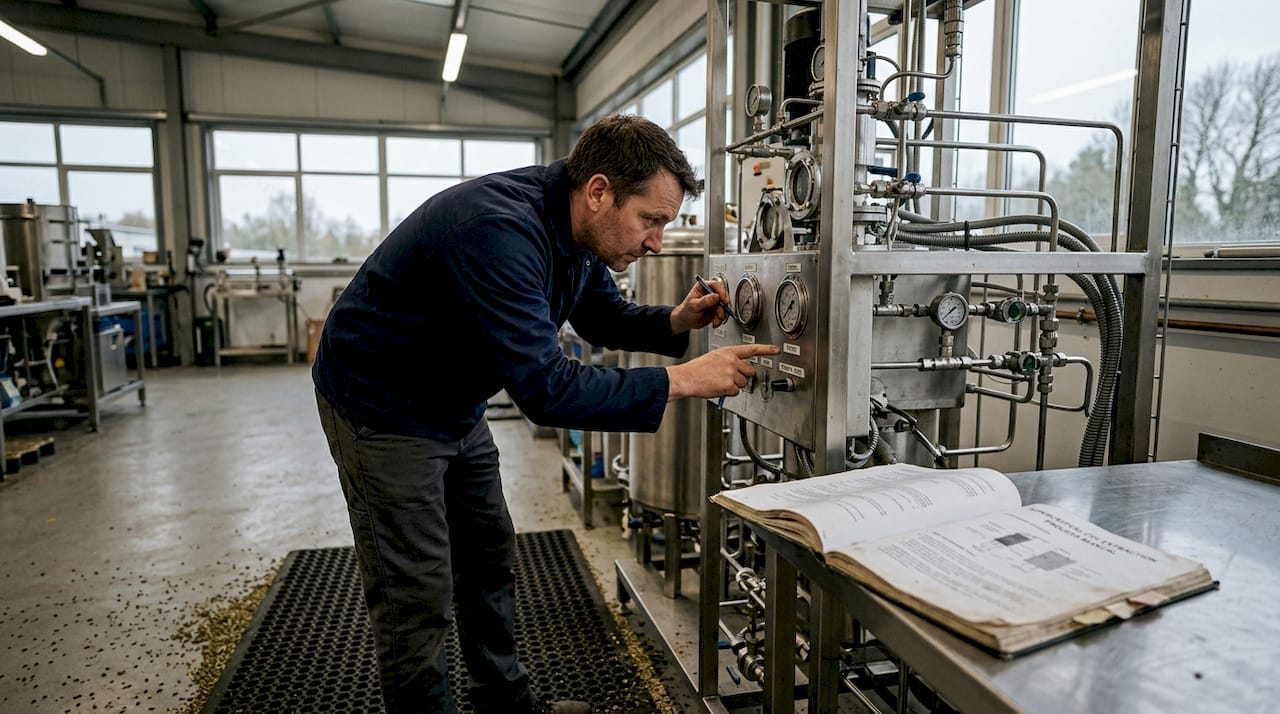
Ethanol extraction takes a different approach. Ethanol is a polar solvent, meaning it pulls both cannabinoids and water-soluble compounds from the plant simultaneously. Cold ethanol workflows chill the solvent to as low as negative 40°C before contact with the biomass. This dramatically reduces co-extraction of chlorophyll and water-soluble pigments, producing a cleaner crude. Warm ethanol extraction is faster and cheaper but pulls considerably more waxes and chlorophyll, increasing purification workload downstream.
| Feature | CO2 extraction | Ethanol extraction |
|---|---|---|
| Solvent residue | None | Requires evaporation and testing |
| Equipment cost | High | Moderate |
| Selectivity | High (tuneable) | Moderate |
| Chlorophyll co-extraction | Low | Higher (especially warm ethanol) |
| Throughput | Moderate | High |
| Post-processing required | Moderate | Intensive |
Pro Tip: If a brand cannot tell you whether their product was CO2 or ethanol extracted, treat that as a red flag. Reputable producers know their process in detail and are happy to share it.
Precise control of extraction parameters, including temperature, pressure, flow rate, extraction time, and feed moisture, directly influences which cannabinoids dominate the final extract. Even small shifts in these variables can change the composition meaningfully.
Winterisation and its role in refining CBD oil
Winterisation is one of those steps that separates a well-made CBD oil from a mediocre one, yet it rarely gets mentioned on product pages. After extraction, crude CBD oil contains waxes, fats, and lipids that were pulled from the hemp plant along with the cannabinoids. Left in the oil, these compounds affect texture, taste, and the clarity of the final product.
The process exploits a simple principle: cannabinoids and terpenes remain soluble in cold ethanol at temperatures as low as negative 40°C, while waxes and fats precipitate out of solution. The crude extract is mixed with ethanol (typically in a 10:1 ratio of ethanol to crude), chilled to sub-zero temperatures for a set hold time, and then filtered to remove the solid wax particles.
Here is a typical winterisation protocol step by step:
- Mix the crude: Combine the raw extract with chilled ethanol at a ratio of approximately 10 parts ethanol to 1 part crude by volume.
- Chill thoroughly: Place the mixture in a freezer or cold room at negative 20°C to negative 40°C for a minimum of 24 hours. Longer hold times produce better wax removal.
- Filter the mixture: Pass the cold solution through a filter medium such as Buchner filtration with Celite to capture precipitated waxes and fats.
- Collect the filtrate: The filtered solution now contains cannabinoids and terpenes in ethanol, largely free from lipids.
- Recover the solvent: Evaporate the ethanol using a rotary evaporator or falling film evaporator to recover the winterised extract.
Pro Tip: CO2 crude typically requires less intensive winterisation than warm ethanol crude because the process co-extracts fewer waxes to begin with. If you are comparing products, a CO2-extracted broad-spectrum oil will generally have a cleaner starting point before any winterisation is applied.
One important limitation: winterisation removes waxes primarily, not pigments. Chlorophyll and other plant pigments require a separate colour remediation step, usually involving chromatography, to be fully removed. This is why some CBD oils remain dark green even after winterisation.
Advanced purification: distillation and chromatography
Once winterised, a CBD extract still needs further refinement before it can become the kind of clean, well-characterised product you find in a quality tincture. This is where distillation and chromatography come in.
Distillation is used to concentrate cannabinoids and remove residual ethanol along with lighter volatile compounds. Short-path or wiped-film distillation is standard practice. The extract is heated under vacuum, which lowers the boiling points of the target compounds and allows them to be separated by their volatility. The result is a distillate with a significantly higher cannabinoid concentration than the winterised crude.
Chromatography takes things further. For broad-spectrum products, THC must be removed to below detectable limits while preserving the other cannabinoids and terpenes. This is achieved through preparative chromatography techniques that separate compounds based on their interactions with a stationary phase. You can learn more about what this means for the CBD isolate process and how it differs from full-spectrum and broad-spectrum products.
Purification choices directly determine the final product type:
- Full-spectrum: Minimal post-extraction purification; retains the complete cannabinoid and terpene profile including trace THC.
- Broad-spectrum: THC removed via chromatography; other cannabinoids and terpenes preserved. Commonly produced by Smokocbd.
- CBD isolate: Further selective crystallisation yields CBD at 99%+ purity with all other plant compounds removed.
Understanding CBD oil terminology across these categories helps consumers make genuinely informed decisions rather than guessing based on marketing language. Identifying clean cannabis ingredient sourcing in products also helps consumers across different categories evaluate whether proper colour remediation and purification have been applied.
Quality, safety, and regulation in CBD production
Extraction and purification are only as trustworthy as the quality control that follows them. Residual solvents are one of the primary safety concerns in CBD products. The FSA’s safety assessment of CBD isolate batches found that residual ethanol and pentane showed absence results at a limit of detection of 0.01%, confirming that properly conducted extraction and solvent recovery can achieve full compliance. That is a reassuringly high standard, but it depends entirely on producers following validated protocols and testing every batch.
A thorough Certificate of Analysis (COA) from a reputable third-party laboratory should cover:
- Cannabinoid potency: Confirmed CBD concentration and THC levels at or below legal limits.
- Residual solvents: Results for ethanol, pentane, butane, and other solvents used in processing, with detection limits stated.
- Heavy metals: Screening for lead, mercury, arsenic, and cadmium, with results compared against regulatory thresholds.
- Pesticides: Confirmation that agrochemical residues from hemp cultivation are below maximum residue levels.
- Microbials: Testing for total viable count, yeast, mould, and pathogens where required.
“A COA that only shows cannabinoid content is not a full safety document. If a brand’s lab report does not include solvent residues, heavy metals, and pesticides, you are not seeing the complete picture.”
Understanding why third-party CBD testing matters is one of the most practical things you can do as a consumer. The extraction method alone does not guarantee safety. It is the combination of controlled processing, validated protocols, and independent verification that produces a product you can genuinely trust.
My honest take on CBD extraction and what most people miss
I have spent considerable time reviewing how different extraction methods translate into real product differences, and the honest conclusion is this: the industry conversation focuses far too much on extraction method as a marketing badge and far too little on what happens afterwards.
CO2 extraction is genuinely superior in several respects. No solvent residue, excellent selectivity, and clean crude. But I have seen CO2 extracts that produced mediocre final products because the winterisation and distillation steps were poorly controlled. The extraction is the start of the process, not the end of it.
Ethanol extraction, particularly cold ethanol, is not the inferior option many people assume. When managed carefully, it produces excellent broad-spectrum crude at a scale that makes the final product accessible rather than expensive. The key is the temperature at extraction and the rigour of the post-processing.
What I find genuinely overlooked is the role of winterisation in determining the taste and mouthfeel of a CBD oil. Most consumers attribute a bitter, waxy character to hemp itself, when in fact it often signals incomplete dewaxing. A properly winterised and distilled oil should have a clean, clear quality with a taste profile that reflects the terpenes and carrier oil, not residual plant lipids.
My advice: ask for the COA, look at the solvent residue section specifically, and check whether the brand can tell you whether the product is full-spectrum, broad-spectrum, or isolate based on their actual purification process rather than just a label claim.
— Mike
Why Smokocbd’s CBD oils are worth your attention
Smokocbd sources its hemp from organically grown USA cultivars and applies controlled extraction and purification processes to produce broad-spectrum CBD oils with confirmed zero THC levels. Every batch is independently tested, with COAs covering cannabinoid potency, residual solvents, heavy metals, and pesticides. That level of transparency is precisely what this article has argued you should be looking for.
The product range covers several strengths and formats to suit different preferences. The 1000mg broad-spectrum mint tincture is a strong starting point for those seeking a higher-strength daily option, while the 500mg citrus tincture suits those building up their routine gradually. For convenient, pre-measured dosing, the 750mg soft gel capsules offer the same extraction quality in a no-fuss format. When you understand what good extraction and purification looks like, choosing a product backed by genuine lab transparency becomes straightforward.
FAQ
How is CBD oil extracted from hemp?
CBD oil is extracted from dried, ground hemp biomass using either supercritical CO2 or ethanol as a solvent. The crude extract then undergoes post-processing including winterisation, distillation, and chromatography to produce the final refined oil.
What is supercritical CO2 extraction for CBD?
Supercritical CO2 extraction uses carbon dioxide raised above its critical temperature and pressure to dissolve cannabinoids from hemp. When pressure is released, the CO2 evaporates completely, leaving no solvent residue in the extract.
Is ethanol extraction safe for CBD oil?
Yes, ethanol extraction is safe when validated protocols are followed and residual solvent levels are confirmed by laboratory testing. The FSA’s assessment of CBD isolate batches confirmed residual ethanol at absence levels below a 0.01% detection limit.
What is winterisation in CBD production?
Winterisation is the step after extraction where the crude is mixed with cold ethanol and chilled to sub-zero temperatures to precipitate and remove waxes, fats, and lipids through filtration. It significantly improves the clarity, taste, and downstream processability of CBD oil.
What should a CBD oil Certificate of Analysis include?
A complete COA should cover cannabinoid potency, residual solvent levels, heavy metals, pesticides, and microbial testing. A report showing only cannabinoid content is insufficient for confirming the full safety of the product.