TL;DR:
- Lab-tested broad-spectrum hemp CBD may be a lower-risk adjunct for some chronic pain types in the UK. Prescription medicines remain the standard for severe, acute, or cancer pain, with limited evidence supporting CBD alone. Always consult a healthcare professional before making changes to pain management strategies.
For many people managing chronic neuropathic or fibromyalgia pain in the UK, lab-tested broad-spectrum hemp (CBD) products can serve as a lower-risk adjunct to some prescription medicines. For acute severe pain, cancer pain, and post-operative care, prescription medicines remain the clinical standard.
- A BMJ Open network meta-analysis of 90 trials (22,028 patients) found low to moderate certainty evidence that cannabis for medical use and opioids produce similarly small improvements in chronic non-cancer pain, with modelled risk differences for achieving a minimum important difference ranging from roughly 5% to 15%.
- The NHS prescribes medicinal cannabis only for a narrow set of conditions (certain epilepsy syndromes, chemotherapy-induced nausea, MS-related spasms) when other treatments have failed. Over-the-counter hemp CBD supplements are legal as food supplements but their quality and health benefits are not guaranteed.
- Three licensed prescription cannabinoid medicines exist in the UK: Sativex (nabiximols, for MS spasticity), Nabilone (for chemotherapy nausea), and Epidyolex (cannabidiol, for specific childhood epilepsy syndromes). None are licensed for general chronic pain. These are fundamentally different from the broad-spectrum hemp supplements available online or in health shops.
This article provides general information, not medical advice. Always confirm current prescribing options and any medication changes with your GP or a qualified clinician.
Table of Contents
- What does the research actually say about cannabinoids for pain?
- How do common prescription pain medicines work, and what are the risks?
- Hemp/CBD versus prescription medicines: how do they compare by pain type?
- What are the safety risks, side effects, and drug interactions?
- What can you legally buy in the UK, and what needs a prescription?
- How do you choose a safe, reliable hemp CBD product in the UK?
- When should you see a GP, and what questions should you ask?
- Key takeaways
- Smokocbd’s broad-spectrum CBD tinctures: lab-tested and UK-made
What does the research actually say about cannabinoids for pain?
The honest answer is: promising for certain pain types, modest in effect size, and limited by the quality of the evidence available.
The most rigorous data comes from the BMJ Open network meta-analysis, which pooled 90 randomised controlled trials and over 22,000 patients. Its headline finding is that cannabis for medical use and opioids produce similarly small improvements in chronic non-cancer pain, with low to moderate certainty. Crucially, cannabinoids showed fewer discontinuations due to adverse events in some analyses, which matters when you are weighing long-term tolerability.
Effect size in context: The modelled risk differences for achieving a clinically meaningful improvement in pain ranged from approximately 5% to 15% for both cannabinoids and opioids versus placebo. That is a real but modest benefit. Only a minority of patients in these trials achieved what researchers classify as a clinically important improvement.
The picture shifts when you look at specific pain subtypes. A PMC narrative review found a stronger signal for cannabinoids in neuropathic pain and fibromyalgia, and a weaker or absent benefit for acute post-operative pain and many musculoskeletal conditions. A living systematic review updated through 2024 on plant-based treatments for chronic pain echoes this pattern.
One important caveat: most trials use preparations that combine CBD with THC, or use synthetic cannabinoids. Harvard Health notes that CBD interacts with multiple receptors and may have anti-inflammatory effects, but because most research combines CBD with THC, drawing firm conclusions about CBD alone is difficult. Broad-spectrum hemp supplements (zero THC) sold legally in the UK are not the same preparations studied in most trials. That gap between the research product and the shop-shelf product is worth keeping in mind.
How do common prescription pain medicines work, and what are the risks?
Prescription pain medicines span several distinct drug classes, each with different mechanisms, indications, and risk profiles.

| Drug class | Mode of action | Common indications | Typical onset | Primary risks |
|---|---|---|---|---|
| Opioids (morphine, oxycodone, codeine) | Bind mu-opioid receptors; reduce pain signal transmission | Severe acute pain, cancer pain, palliative care | — | Dependence, respiratory depression, overdose, constipation |
| NSAIDs (ibuprofen, naproxen, diclofenac) | Inhibit COX-1/COX-2 enzymes; reduce prostaglandins | Inflammatory pain, musculoskeletal, mild-moderate acute pain | — | GI bleeding, renal impairment, cardiovascular risk, warfarin interaction |
| SNRIs/antidepressants (duloxetine, venlafaxine) | Inhibit serotonin and noradrenaline reuptake; modulate descending pain pathways | Neuropathic pain, fibromyalgia, chronic musculoskeletal pain | 2–4 weeks | Nausea, insomnia, hypertension, discontinuation syndrome |
| Anticonvulsants (gabapentin, pregabalin) | Bind voltage-gated calcium channels; reduce neuronal excitability | Neuropathic pain, post-herpetic neuralgia | 1–2 weeks | Sedation, dizziness, dependence (pregabalin is a Class C controlled drug in the UK), weight gain |
| Sativex (nabiximols) | THC/CBD oromucosal spray; acts on CB1/CB2 receptors | MS-related spasticity (licensed UK indication) | 2–4 weeks | Dizziness, fatigue, oral discomfort, psychiatric effects |
| Nabilone | Synthetic cannabinoid; CB1 agonist | Chemotherapy-induced nausea (licensed UK indication) | 1–2 hours | Drowsiness, dizziness, dry mouth, psychiatric effects |
| Epidyolex | Purified CBD oral solution | Dravet syndrome, Lennox-Gastaut syndrome (licensed UK indications) | Weeks | Somnolence, elevated liver enzymes, diarrhoea |
A few points worth highlighting:
- Opioids carry the highest overdose and dependence risk of any analgesic class. NHS guidance recommends they be used at the lowest effective dose for the shortest necessary period, and that non-opioid and non-pharmacological therapies be maximised first, in line with CDC clinical guidance.
- NSAIDs are effective for inflammatory and mild-to-moderate acute pain but carry meaningful GI, renal, and cardiovascular risks with long-term use. They interact with warfarin, increasing bleeding risk.
- Gabapentin and pregabalin are widely prescribed for neuropathic pain but pregabalin is a controlled drug in the UK due to misuse potential.
- Sativex, Nabilone, and Epidyolex are licensed prescription-only products for specific indications. They are not interchangeable with over-the-counter hemp supplements.
Special populations require particular care. Opioids carry heightened respiratory risk in older adults and are contraindicated in pregnancy for non-acute use. NSAIDs should be used cautiously in older adults with renal impairment. Anticonvulsants require dose adjustment in renal disease. None of the licensed cannabinoid medicines are routinely indicated in children except Epidyolex for specific epilepsy syndromes.
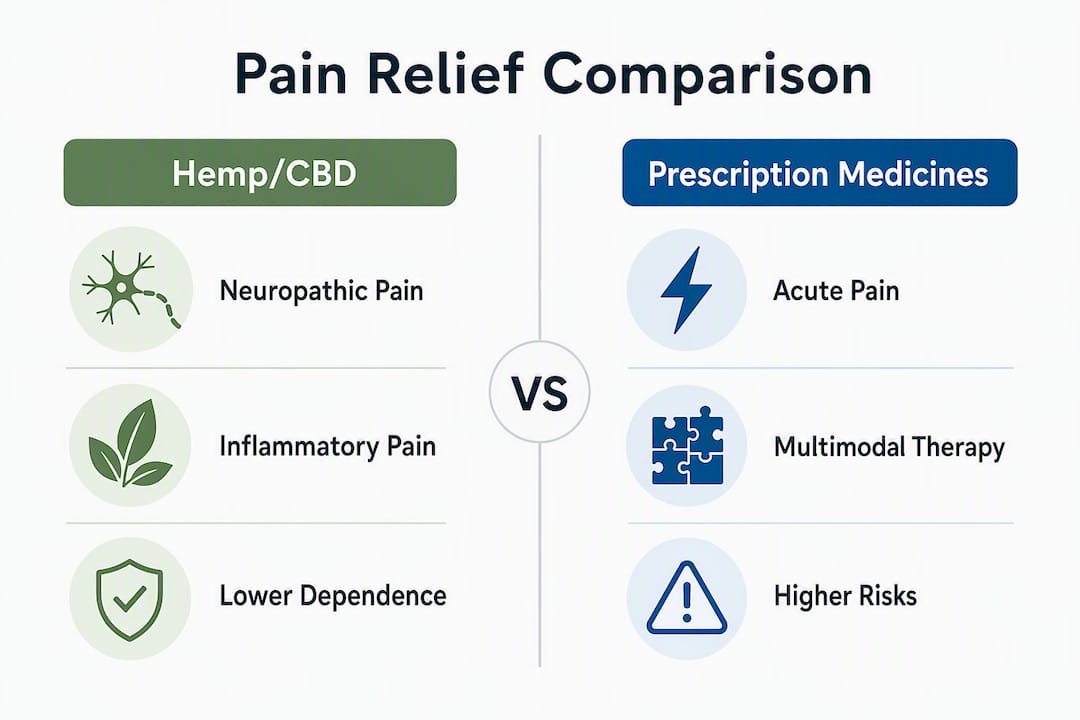
Hemp/CBD versus prescription medicines: how do they compare by pain type?
| Pain type | Hemp/CBD (broad-spectrum, zero-THC) | Prescription medicines | Strength of evidence | UK legal status | Typical onset | Cost/access |
|---|---|---|---|---|---|---|
| Neuropathic | Modest signal in reviews; CBD alone less studied than THC/CBD combinations | Duloxetine, pregabalin, gabapentin are first-line; Sativex for MS spasticity | Moderate for cannabinoids (combined THC/CBD); low for CBD alone | OTC hemp legal; Sativex prescription-only | Weeks | Hemp: ~£20/month OTC; Sativex: NHS/private prescription |
| Inflammatory/arthritis | Anti-inflammatory receptor activity plausible; clinical trial data limited | NSAIDs, DMARDs, corticosteroids | Low for hemp/CBD; high for NSAIDs in acute inflammation | OTC hemp legal | Days (NSAIDs); weeks (hemp) | NSAIDs: NHS prescription or OTC; hemp: OTC |
| Nociceptive/musculoskeletal | Limited evidence; some patient-reported benefit for sleep and function | NSAIDs, paracetamol, physiotherapy | Low for cannabinoids; moderate for NSAIDs | OTC hemp legal | Days (NSAIDs); weeks (hemp) | Similar OTC costs |
| Acute postoperative | Not supported by current evidence | Opioids, NSAIDs, paracetamol, regional anaesthesia | Very low for cannabinoids; high for multimodal prescription protocols | OTC hemp legal but not clinically indicated | N/A for hemp | Prescription in hospital setting |

Neuropathic pain is where cannabinoids show the most consistent signal. The PMC narrative review and the BMJ Open NMA both suggest a modest benefit, though most of that evidence involves THC-containing preparations rather than CBD-only products. If you have neuropathic pain and your current prescription medicines are causing intolerable side effects, this is the most defensible context in which to discuss cannabinoids with a clinician.
Inflammatory pain (rheumatoid arthritis, for example) has a plausible biological rationale for CBD, given its interaction with inflammatory pathways, but clinical trial data in humans remain limited. NSAIDs and disease-modifying drugs have a far stronger evidence base here.
Acute postoperative pain is not an appropriate context for self-managing with hemp products. Multimodal prescription protocols, including opioids where necessary, remain the standard of care.
Where evidence is equivocal, the right move is a clinician conversation, not a DIY switch. Research on substitution patterns shows many people self-substitute CBD for NSAIDs or opioids, often citing fewer side effects and improved sleep. That is understandable, but unmonitored substitution carries real risks, particularly for opioid-dependent patients.
What are the safety risks, side effects, and drug interactions?
Common adverse effects of cannabinoids and hemp products
Broad-spectrum hemp CBD products are generally well tolerated at typical supplement doses. The most commonly reported adverse effects are:
- Drowsiness and fatigue
- Dry mouth
- Transient dizziness, particularly on standing
- Mild GI upset (nausea, diarrhoea)
- Appetite changes
These are usually dose-dependent and resolve on reducing the dose. That said, the modest therapeutic effect sizes observed in trials mean you should not expect dramatic pain relief from hemp supplements alone.
Drug interactions: the CYP450 concern
CBD inhibits cytochrome P450 enzymes, particularly CYP3A4 and CYP2C9. This is clinically significant because many commonly prescribed medicines are metabolised by these enzymes.
Warfarin interaction: CBD can increase warfarin plasma levels by inhibiting CYP2C9, raising the risk of bleeding. Anyone taking warfarin, or other anticoagulants, should not start CBD without medical review and close INR monitoring. This interaction is documented in pharmacology reviews and is not theoretical.
Other interactions worth noting:
- Sedatives and benzodiazepines: CBD may potentiate sedation, increasing the risk of falls and cognitive impairment, particularly in older adults.
- Antiepileptics: Epidyolex (prescribed CBD) is known to interact with clobazam and valproate; similar caution applies to supplement-grade CBD.
- Antidepressants and SNRIs: Potential for altered drug levels; clinician review is advisable.
For a full review of your medication list before starting any CBD product, the PMC review on cannabinoids and drug interactions provides a useful clinical reference to share with your GP.
Dependence and overdose: comparing the risk profiles
Opioids carry a high risk of physical dependence and potentially fatal respiratory depression in overdose. Cannabinoids carry a lower overdose risk in the conventional sense, but they are not without dependence potential. Regular use of THC-containing products is associated with cannabis use disorder in a subset of users, and with cognitive effects, particularly in younger people. Broad-spectrum hemp products with zero THC have a lower dependence profile, but this should not be mistaken for zero risk.
Pregnancy: No safe level of cannabinoid use in pregnancy has been established. Avoid hemp and cannabis products entirely during pregnancy and breastfeeding.
Driving and machinery: Both cannabinoids and opioids can impair reaction time and judgement. Do not drive while adjusting doses or when experiencing drowsiness.
Older adults with polypharmacy: The combination of sedation risk, CYP450 interactions, and fall risk makes CBD a product to introduce cautiously and only with GP oversight in this group.
What can you legally buy in the UK, and what needs a prescription?
The UK legal framework creates three distinct categories, and confusing them is one of the most common mistakes people make.
- Hemp-derived CBD supplements (legal, OTC): Products containing CBD extracted from hemp with less than 0.2% THC are legal to sell as food supplements in the UK. They do not require a prescription. Quality, however, is not guaranteed by law, and the NHS explicitly notes that health benefits of CBD food supplements are not proven to the standard required for medicines.
- Licensed medicinal cannabis products (prescription-only): Sativex (nabiximols), Nabilone, and Epidyolex are licensed medicines prescribed for specific indications. Sativex requires a specialist prescription for MS spasticity. Nabilone is used in oncology settings. Epidyolex is prescribed by paediatric neurologists for specific epilepsy syndromes. These are not available over the counter.
- Unlicensed medical cannabis (specialist prescription, private or NHS): Since November 2018, specialist doctors in the UK can prescribe unlicensed cannabis-based products for medicinal use (CBPMs). NHS prescribing remains rare and is largely restricted to the three conditions above. Private clinics offer broader access, but costs can be substantial and product quality varies.
- Illicit THC products: Cannabis containing significant THC remains a Class B controlled drug. Possession, supply, and production are illegal. Products purchased outside licensed channels carry unknown potency, contamination risks, and legal consequences.
How to access a prescription for medicinal cannabis in the UK:
- Speak to your GP first. GPs cannot prescribe CBPMs directly but can refer to a specialist.
- A specialist (neurologist, pain consultant, oncologist) must recommend the prescription.
- NHS prescribing is limited; most patients access CBPMs through private clinics, where costs can range from several hundred pounds per month.
- Private clinics vary in quality. Look for those with GMC-registered prescribers and transparent product sourcing.
How do you choose a safe, reliable hemp CBD product in the UK?
With hundreds of products on the market and no mandatory pre-market approval for food supplements, the quality gap between reputable and poor-quality CBD products is wide — understanding solvent residues and product purity is critical, as explained in CRC Wax explained: safety, benefits, and what to know. Here is what to check before buying.
Product quality checklist:
- Third-party Certificate of Analysis (COA): The single most important document. It should confirm cannabinoid content (CBD, THC, CBG, CBN), heavy metals, pesticide residues, and solvent residues. Check the test date: a COA more than 12 months old is not current.
- THC content: UK legal products must contain less than 0.2% THC. Zero-THC broad-spectrum products, verified by a COA, are the safest choice for anyone concerned about drug testing or legal compliance.
- Broad-spectrum vs isolate: Broad-spectrum hemp extract retains multiple cannabinoids and terpenes (minus THC), which may produce a more complete effect via the entourage effect. CBD isolate is pure CBD with no other compounds. Both are legal; broad-spectrum is generally preferred for wellness use.
- Manufacturing location and batch numbers: UK-made products are subject to UK food safety regulations. Batch numbers allow traceability if a quality issue arises.
- Clear ingredient list: Avoid products with undisclosed additives or proprietary blends that obscure actual CBD content.
- Dosing form: Tinctures allow flexible dosing and relatively fast absorption (15–45 minutes sublingually). Capsules and gummies offer convenience and consistent dosing but slower onset (1–2 hours). Topicals act locally and do not enter the bloodstream in meaningful amounts.
For realistic expectations: most people need a consistent trial of four to eight weeks at an appropriate dose before drawing conclusions. Starting low (10–20 mg CBD daily) and increasing gradually is the standard approach.
Pro Tip: When reading a COA, look at the “as tested” cannabinoid profile, not just the headline CBD figure. If THC appears above 0.2%, or if heavy metals such as lead or cadmium are detected above trace levels, do not use the product. A reputable supplier will make their COA publicly available on their website, linked to the specific batch.
Smokocbd’s broad-spectrum tinctures are made in the UK and verified by third-party lab testing to confirm zero THC, which is exactly the kind of CBD quality standard you should be looking for. For a broader look at what UK-made production means for traceability and safety, the UK-made CBD guide is worth reading before you buy.
When should you see a GP, and what questions should you ask?
Red flags that require immediate medical review
- Pain that is rapidly worsening or changing in character
- Neurological symptoms (weakness, numbness, loss of bladder or bowel control)
- Signs of opioid overdose (extreme drowsiness, slow or stopped breathing, unresponsive)
- Pregnancy or planned pregnancy
- New or worsening mental health symptoms while using cannabinoids
Questions to take to your GP or pain specialist
- “How might CBD interact with my current medicines, particularly [name your medicines]?”
- “Is there evidence that cannabinoids would help my specific pain type?”
- “If I want to reduce my opioid dose, what does a supervised tapering plan look like?”
- “Would a referral to a pain specialist or a medicinal cannabis clinic be appropriate for my situation?”
- “What outcomes should I track, and over what timeframe, to know whether a trial is working?”
Tracking outcomes during a trial
Keep a simple daily log covering: pain intensity (0–10), sleep quality, mood, function (what you could or could not do), and any side effects. This gives your clinician something concrete to work with at your next appointment, rather than a general impression. Many people who substitute CBD for prescription medicines report improvements in sleep and anxiety as much as in raw pain scores, so tracking those domains matters.
Any tapering or transition away from prescription opioids must be clinician-supervised. Self-tapering with CBD carries real risks of withdrawal complications and should not be attempted without structured medical oversight.
How was this evidence compiled, and what are its limits?
This article draws on systematic reviews, network meta-analyses, randomised controlled trials, narrative reviews, and observational survey data. Priority was given to peer-reviewed sources indexed on PubMed, BMJ Open, and NCBI Bookshelf, alongside NHS and CDC clinical guidance.
Key limitations readers should bear in mind:
- Most cannabinoid trials are short (under 12 weeks), which limits conclusions about long-term safety and efficacy.
- Preparations vary enormously across trials: whole-plant cannabis, synthetic cannabinoids, THC/CBD combinations, and CBD isolate are not interchangeable, yet are sometimes pooled.
- Many studies rely on patient-reported outcomes, which are subject to placebo effects and recall bias.
- Some trials in this field have industry funding, which introduces potential conflicts of interest.
- Broad-spectrum hemp supplements with zero THC, the products most UK consumers actually buy, are underrepresented in the clinical literature compared with THC-containing preparations.
These limitations do not invalidate the evidence, but they do mean that confident clinical recommendations remain elusive for most pain types. The useful sources section below links directly to the primary documents.
Key takeaways
Hemp-derived CBD can be a reasonable, lower-risk adjunct for certain chronic pain types, but it does not replace prescription medicines for severe, acute, or cancer pain, and any switch should be clinician-supervised.
| Point | Details |
|---|---|
| Effect sizes are modest for both | The BMJ Open NMA found risk differences indicating a modest clinically meaningful improvement with both cannabinoids and opioids versus placebo. |
| Pain type shapes the decision | Neuropathic and fibromyalgia pain show the strongest cannabinoid signal; acute postoperative pain does not. |
| UK legal categories differ sharply | OTC hemp CBD supplements, licensed prescription cannabinoids (Sativex, Nabilone, Epidyolex), and illicit THC products are three distinct categories with different legal status and evidence bases. |
| Drug interactions are real | CBD inhibits CYP450 enzymes; warfarin users and anyone on multiple medicines must get medical review before starting CBD. |
| Smokocbd for UK buyers | Smokocbd’s zero-THC, third-party tested broad-spectrum tinctures meet the COA and UK-manufacturing standards the buying checklist recommends. |
Never stop or taper prescription pain medicines without clinician supervision, regardless of whether you are introducing a hemp product alongside them.
A note on balancing evidence with lived experience
The conversation around hemp versus prescription pain relief tends to split into two camps: those who dismiss cannabinoids as unproven, and those who credit them with near-miraculous results. Neither position holds up well against the data.
What the evidence actually shows is more nuanced and, in some ways, more useful. Both cannabinoids and opioids produce similarly modest improvements in chronic non-cancer pain. That is not a reason to dismiss cannabinoids; it is a reason to be equally clear-eyed about opioids. The dependence and overdose risks of long-term opioid use are well-documented and severe. If a patient can achieve comparable pain relief with a lower-risk option and fewer side effects, that is a clinically meaningful outcome, even if the raw analgesia numbers look similar.
What often gets missed in these comparisons is that many people who switch to CBD report improvements in sleep, anxiety, and daily function that go beyond pain scores alone. Those outcomes matter. Pain is not just a number on a scale; it is the ability to work, sleep, and engage with life. Measuring only pain intensity misses a significant part of the picture.
The practical wisdom here is not to choose a side. Use the evidence to have a better conversation with your clinician. Bring your medication list, ask about interactions, track your outcomes, and give any trial enough time to generate real data. That approach, rather than either uncritical enthusiasm or blanket scepticism, is what actually serves people managing chronic pain.
Smokocbd’s broad-spectrum CBD tinctures: lab-tested and UK-made
If you have read this far and are considering trialling a hemp CBD product, the quality of what you buy matters more than most people realise. Smokocbd offers broad-spectrum CBD tinctures made in the UK, with zero THC verified by third-party lab testing on every batch. That means you get a COA you can actually check, a product that complies with UK food supplement law, and no surprises on a drug test.
Two strengths are available: the 1000mg broad-spectrum CBD tincture is a sensible starting point for most adults, while the 2000mg option suits those who have already established a baseline dose under clinician guidance. Both use organically grown hemp and are available in mint flavour.
Before ordering, check with your GP if you take any prescription medicines, particularly anticoagulants or sedatives. Start at a low dose, track your outcomes, and give it four to eight weeks before drawing conclusions. That is the approach the evidence supports, and it is the approach Smokocbd’s product range is designed to fit.
Useful sources and further reading
- Cannabinoids as a potential alternative to opioids in the management of various pain subtypes, PMC — Narrative review covering pain subtypes, drug interactions, and CYP450 mechanisms.
- Living systematic review on cannabis and other plant-based treatments for chronic pain: 2025 update, NCBI Bookshelf — The most current living review on plant-based pain treatments, updated through 2024.
- Alternatives to opioids for managing pain, StatPearls, NCBI Bookshelf — Broad clinical overview of non-opioid analgesic options and their evidence base.
- Can CBD oil help manage pain? Harvard Health — Accessible overview of CBD pharmacology and the limits of CBD-only evidence.