TL;DR:
- Hemp origin significantly influences CBD safety, legality, and therapeutic effectiveness for UK consumers.
- UK-grown hemp operates under strict regulation, ensuring traceability, low THC levels, and quality control from seed to shelf.
Many UK adults shopping for CBD assume that hemp is hemp, regardless of where it’s grown or how it’s processed. This assumption can lead to costly mistakes — not just financially, but in terms of safety, legality, and whether your CBD product actually delivers the pain relief, anxiety support, or sleep improvement you’re looking for. The truth is that hemp origin is one of the most consequential decisions baked into every CBD product you buy, and understanding the difference can completely change your experience. Let’s clear up the confusion and help you make smarter, safer choices.
Table of Contents
- What makes UK-grown hemp unique for CBD products?
- Legal safety and quality: Why UK sourcing matters
- Wellness impact: Does origin really make a difference for pain, anxiety, and sleep?
- Making confident choices: How to verify your CBD source
- Why hemp origin is just the start: A practitioner’s view on real UK CBD quality
- Explore trusted UK-grown CBD wellness solutions
- Frequently asked questions
Key Takeaways
| Point | Details |
|---|---|
| UK-grown hemp means confidence | Strict regulation and traceability reduce the risk of contaminants and illegal THC, making your CBD choice safer. |
| Legal requirements protect buyers | UK-sourced CBD products must follow clear guidelines on plant use, exposure limits, and thorough product testing. |
| Wellness benefits start with quality | Choosing UK-grown, batch-tested CBD supports real gains for pain, anxiety, and sleep by ensuring what is on the label matches what is in the bottle. |
| Verify with COAs every time | To guarantee compliance and personal safety, always check batch lab reports, spectrum, and labelling before use. |
What makes UK-grown hemp unique for CBD products?
Having set the stage for why hemp origin is so frequently misunderstood, let’s unpack what genuinely sets UK-grown hemp apart from overseas alternatives.
The first thing worth knowing is that hemp cultivation in the UK is tightly regulated by government licence. Only low-THC cannabis varieties are permitted, and the legal framework restricts which parts of the plant may be used commercially. Specifically, licences cover seeds and fibre from the mature stalk. Leaves and flowers — the parts typically richest in cannabinoids including THC — are not permitted for use under standard industrial hemp provisions. This isn’t just bureaucratic red tape. It’s a meaningful quality filter that directly shapes the CBD products available to UK consumers.
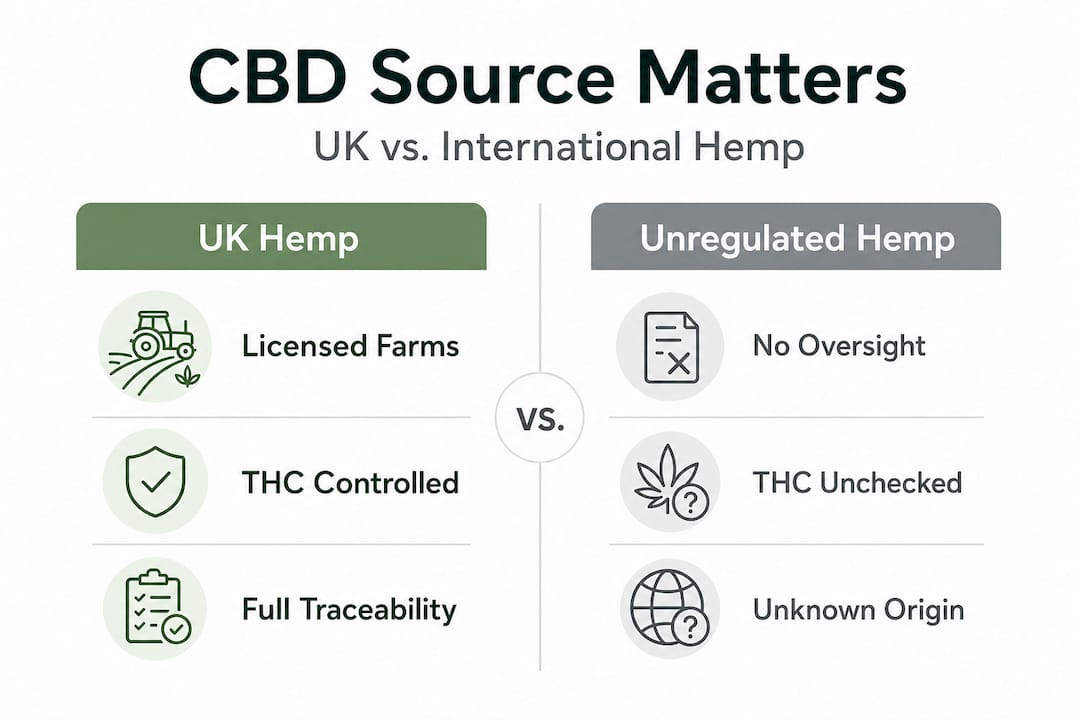
What this means in practice is that UK-grown hemp operates within a clear and traceable system. Farmers must apply for Home Office licences, maintain records of their crops, and adhere to strict THC concentration thresholds throughout cultivation. This level of accountability is simply not present in many overseas growing environments, where enforcement may be inconsistent or verification difficult.
Here’s a quick comparison of what UK-grown hemp regulation brings to the table:
| Factor | UK-grown hemp | Unregulated international hemp |
|---|---|---|
| THC content oversight | Mandatory, licence-controlled | Variable, inconsistent |
| Traceability | Crop-level records required | Often limited or absent |
| Plant part restrictions | Enforced by law | Varies by country |
| Consumer transparency | Higher by default | Product-dependent |
| Regulatory body | Home Office (UK) | No single authority |
The benefits of UK-made CBD extend well beyond simple peace of mind. When a CBD product is traceable back to a licensed UK grow, you have a much clearer chain of custody. This matters enormously if you’re using CBD to support chronic pain management, daily anxiety, or consistent sleep quality, because inconsistent sourcing often means inconsistent results.
Key qualities that distinguish UK-grown hemp:
- Licenced cultivation ensuring THC stays within legal parameters throughout the growth cycle
- Mandatory record-keeping that makes traceability possible from soil to shelf
- Restriction on high-cannabinoid plant parts, reducing legal ambiguity in the final product
- Home Office oversight, providing a formal accountability structure for growers
Understanding UK CBD law and compliance is worth your time if you’re serious about your wellness routine. The UK has one of the more detailed regulatory environments for CBD in Europe, and that works in your favour as a consumer.
Legal safety and quality: Why UK sourcing matters
With the specifics of UK-grown hemp in mind, let’s look more closely at how this affects legality, safety, and quality for everyday UK consumers.
One important detail from UK industrial hemp licensing guidance is that licences exclude the use of leaves and flowers for CBD production, which directly shapes how legal products are formulated. Products sold legally in the UK must therefore use permitted plant parts or import CBD extracts that meet equivalent standards. This is why knowing your brand’s sourcing story matters.
The Food Standards Agency (FSA) has been active in assessing CBD as a novel food. Its CBD safety assessment establishes frameworks for acceptable daily intake and sets clear expectations around THC contamination limits. This gives UK consumers a measurable benchmark — not a vague guideline, but a specific threshold that informs whether a product is genuinely safe for daily use.
“Legal compliance in UK CBD isn’t just a box-ticking exercise. It’s the foundation of product safety and consumer trust — and the best brands treat it that way.”
Compare the key safety and legal differences between product types:
| Product type | THC risk | Regulatory clarity | Consumer assurance |
|---|---|---|---|
| UK-sourced, batch-tested CBD | Very low | High | Strong |
| Imported CBD, no COA | Variable | Low | Weak |
| UK-grown, full traceability | Minimal | Very high | Very strong |
| Unverified online CBD | Unknown | None | None |
CBD regulations for UK safety are evolving, and staying informed helps you avoid products that might technically claim CBD compliance but don’t meet the rigorous standards that truly protect you. The difference between a compliant product and a borderline one can be the difference between genuine wellness support and unexpected side effects or legal risk.
Pro Tip: Always check whether a CBD brand’s products appear on the FSA’s public list of novel food applications. This is one of the quickest ways to confirm that a brand is operating within the UK’s legal framework for CBD supplements.
UK CBD quality standards go hand in hand with sourcing transparency. When hemp is grown under regulated conditions and processed by brands committed to compliance, the end result is a product that you can actually trust to support your pain, anxiety, or sleep needs consistently, day after day.

Wellness impact: Does origin really make a difference for pain, anxiety, and sleep?
Now that legal safety and quality are clearly in focus, let’s address how sourcing decisions translate to real-world wellness — because this is where the rubber meets the road for most UK CBD users.
The short answer is yes, origin genuinely matters. Here’s why. Hemp grown in unregulated environments may carry pesticide residues, heavy metals, or elevated THC that interfere with how your body responds to CBD. These contaminants don’t just create health risks — they can actively undermine the very wellness outcomes you’re seeking. Pain relief that’s inconsistent, anxiety symptoms that fluctuate unpredictably, or sleep that doesn’t improve despite regular CBD use can often be traced back to product quality rather than CBD ineffectiveness.
The FSA’s research on CBD safety establishes a provisional acceptable daily intake for CBD and sets upper limits for THC contamination that guide safe use for UK adults. These frameworks matter because they ensure that what’s on the label is accurate and that the dosage you’re taking is within a range considered safe by food science experts.
Here’s a practical checklist for evaluating how hemp origin impacts your wellness goals:
- Check for contaminant testing on the batch COA, specifically for pesticides and heavy metals. Clean hemp means your body can process CBD without interference.
- Confirm the cannabinoid spectrum — broad-spectrum CBD retains beneficial plant compounds without THC, which is ideal for those wanting wellness benefits without any psychoactive risk.
- Look at the CBD concentration per serving and verify it matches what’s stated on the label through third-party testing.
- Ask about batch consistency — regulated growing conditions produce more consistent cannabinoid profiles, which means more predictable effects for pain and anxiety support.
- Review the THC reading on the COA and confirm it falls within UK legal limits, giving you confidence that you won’t experience unwanted psychoactive effects or drug test concerns.
Understanding CBD daily limits helps you calibrate your intake sensibly, whether you’re managing ongoing pain, winding down before bed, or supporting your mood through a stressful period. And knowing the difference between CBD vs THC for wellness helps you select the right product type from the very start.
Pro Tip: If you’re using CBD for anxiety or sleep, broad-spectrum products from clean, regulated hemp sources are generally the best starting point. They offer the benefits of multiple cannabinoids working together (sometimes called the “entourage effect”) without the THC levels that might cause concern.
Making confident choices: How to verify your CBD source
With the real-life wellness pathway clearly mapped, the next step is knowing how to check and trust your CBD’s origins every single time you buy.
The most important document in any CBD purchase is the Certificate of Analysis, or COA. This is a third-party laboratory report confirming what’s actually in your product. Batch COAs and a robust THC compliance strategy are essential for consumers who want to avoid drug test risks and get consistent wellness value. Not all COAs are created equal, so here’s what to look for in a genuine one:
- Batch number matching — the COA should correspond to the specific batch on your product label, not a generic or outdated test.
- Independent laboratory name — the testing should be conducted by an accredited third party, not an in-house team at the brand itself.
- Full cannabinoid panel — including CBD, THC, CBG, CBN, and others depending on the product’s claimed spectrum.
- Pesticide and heavy metal screening — confirming the hemp was grown cleanly and processed safely.
- THC result clearly stated — expressed as a percentage or milligrams, and falling below the UK legal threshold.
Practical steps for choosing safe CBD products include:
- Check the brand’s website for a COA page or QR code on product packaging that links directly to your batch’s test results.
- Verify the lab is accredited — ISO 17025 accreditation is the gold standard for testing laboratories.
- Look for UK compliance statements on the label, including novel food compliance or FSA registration references.
- Read the labelling carefully to ensure CBD content, hemp source, and spectrum type are clearly declared.
- Investigate organic CBD certification if you want the additional assurance of organically grown, chemical-free hemp.
The simplest rule: if a brand can’t show you a current, batch-specific COA with ease, that’s a clear signal to shop elsewhere. The best brands make this information effortlessly accessible because they have nothing to hide and everything to gain by building your trust.
Why hemp origin is just the start: A practitioner’s view on real UK CBD quality
Here’s a perspective that doesn’t always make it into standard CBD buying guides. Hemp origin is genuinely important — but it’s only one piece of a more complex puzzle. We’ve seen brands market themselves heavily on UK-grown credentials while glossing over critical issues like spectrum inconsistency, outdated batch testing, or vague labelling. Conversely, some of the most rigorously tested and genuinely effective CBD products available in the UK use organically grown hemp sourced from the USA, where cultivation standards in certain states can match or exceed UK regulatory frameworks.
The real question isn’t simply “was this grown in the UK?” It’s “can I verify the full chain of quality from seed to supplement?” That means asking about the farming practices, the extraction method (CO2 extraction preserves cannabinoid profiles far better than solvent-based methods), the spectrum verification, and the batch-level testing. A UK-grown label is a positive signal, but it’s not a substitute for the rigorous transparency that should underpin every premium CBD product.
CBD vs hemp oil explained is a helpful starting point for understanding these nuances. Many buyers still confuse hemp seed oil — which contains no meaningful CBD — with genuine CBD extract. Getting this distinction right is as important as understanding where the hemp was grown.
What UK wellness seekers should genuinely demand is a combination of the following: batch-level transparency that lets you verify your specific product, broad-spectrum verification that confirms the cannabinoid profile, and compliance credentials that demonstrate the brand takes UK law seriously. Origin matters. But it matters most when it’s paired with everything else that defines a truly premium CBD product.
Explore trusted UK-grown CBD wellness solutions
If you’ve made it this far, you’re clearly serious about making informed, confident choices about the CBD products you bring into your wellness routine. That’s exactly the kind of thinking we encourage at SMOKO CBD.
Our range of UK-compliant, broad-spectrum CBD products is designed with your safety and wellness outcomes at the forefront. Whether you prefer the flexibility of a 1000mg mint CBD tincture, the convenience of 25mg CBD gummies, or the precision of 750mg CBD soft gels, every product comes with full batch COA access and transparent labelling so you always know exactly what you’re taking. Start your safe, well-supported CBD wellness journey with SMOKO CBD today.
Frequently asked questions
Is UK-grown hemp better for CBD products?
UK-grown hemp offers greater traceability and regulatory oversight, giving you added confidence in safety and quality. Licences issued for low-THC cannabis cultivation ensure strict controls are in place from the very start of the growing process.
Can CBD from UK hemp make me fail a drug test?
Legally compliant UK CBD products contain negligible THC, but always check for batch COAs and spectrum type to minimise risk. The FSA’s THC contamination frameworks set the benchmarks that UK products must meet to be considered safe.
What should I check before buying UK-grown CBD?
Look for third-party tested batch COAs, clear UK compliance statements, and transparent labelling for THC and cannabinoids. A thorough THC compliance strategy from your chosen brand is essential for both safety and consistent wellness results.
Are UK regulations stricter than other countries for hemp and CBD?
Yes, the UK enforces stringent regulations on hemp cultivation, plant part usage, and final CBD safety standards. Industrial hemp licensing rules mean that only low-THC varieties may be grown and only specific, non-flowering plant parts are permitted for commercial use under standard provisions.