TL;DR:
- CBD tolerance is unlikely because its indirect mechanism avoids receptor downregulation seen with THC. Most routine issues stem from product variability, absorption factors, or expectation shifts, not physiological tolerance. Checking product quality, standardizing intake, or taking short breaks can restore effectiveness without increasing dosage.
If you’ve been using CBD daily and feel it’s stopped working, classical pharmacological tolerance is probably not the culprit. Reviews of multi-month CBD trials report a low risk of the escalating-dose tolerance commonly seen with THC. What’s far more likely is a combination of metabolic adaptation, product variability, or a natural shift in how you perceive the effects once your body reaches homeostasis. The good news: most of these causes are fixable without simply taking more.
Before you change your dose, try these three steps first:
- Check your Certificate of Analysis (COA). Product mislabelling is one of the most common reasons a routine appears to stop working. Confirm the CBD concentration matches what’s on the label.
- Keep a three-day dose log. Note the time, amount, what you ate beforehand, and your subjective response. Patterns often reveal the real cause within days.
- Try a short reset before increasing your dose. A two-day break can restore sensitivity for many users. Jumping straight to a higher dose may actually make things worse, thanks to CBD’s biphasic nature.
Table of Contents
- What does ‘tolerance’ actually mean, and is CBD different?
- How CBD interacts with the endocannabinoid system and why classical tolerance is unlikely
- Why your CBD routine can seem to stop working
- Step-by-step troubleshooting when CBD seems less effective
- When tolerance or adaptation is a real clinical concern
- Key takeaways
- The part most guides get wrong about CBD and routine
- Smokocbd broad-spectrum tinctures: consistent quality you can verify
- Useful sources and how to read a COA
What does ‘tolerance’ actually mean, and is CBD different?
The word “tolerance” gets used loosely, and that matters when you’re trying to work out what’s happening with your routine. There are three distinct types worth knowing.
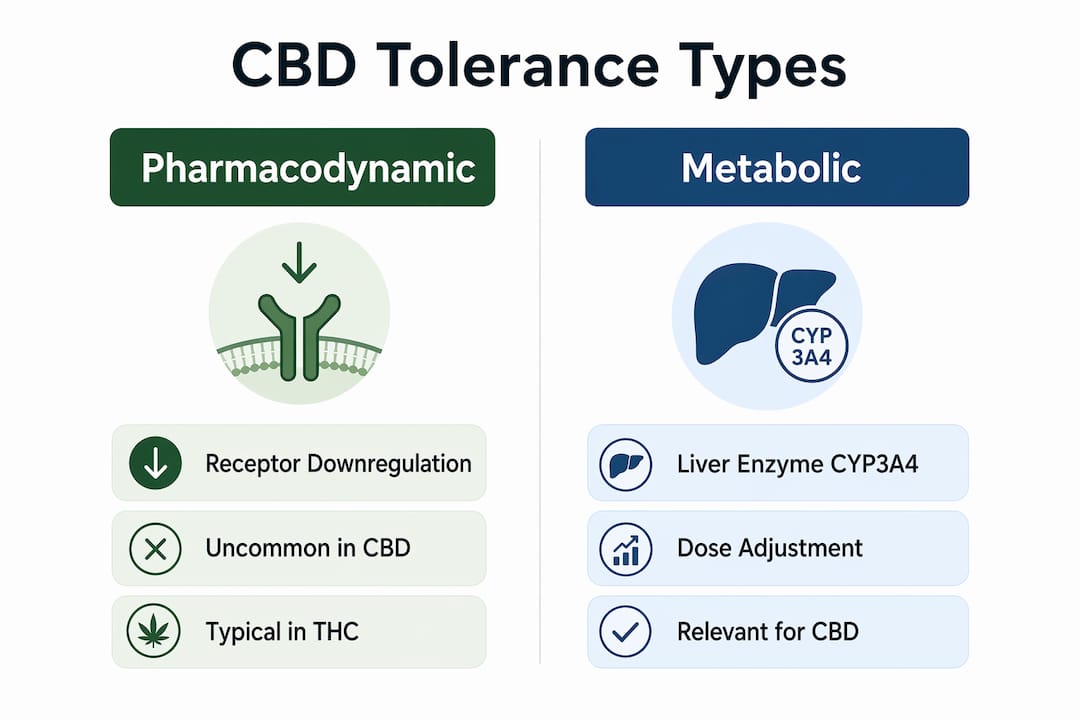
Pharmacodynamic tolerance occurs when receptors become less responsive to a substance over time, typically because they downregulate (reduce in number or sensitivity) after prolonged stimulation. This is the classical mechanism behind tolerance to opioids or THC. Pharmacokinetic tolerance is different: the body simply gets better at metabolising the compound, so less of it reaches the bloodstream. Behavioural tolerance is subtler still, a psychological adaptation where the contrast between your pre-dose and post-dose state shrinks as your baseline shifts.
Then there’s reverse tolerance, which runs in the opposite direction entirely. Some long-term CBD users report that smaller doses become effective over time, possibly because CBD upregulates cannabinoid receptors or gradually improves endocannabinoid signalling. This is the inverse of what happens with THC or caffeine.
| Type | Mechanism | Typical for THC? | Typical for CBD? |
|---|---|---|---|
| Pharmacodynamic | Receptor downregulation | Yes | Unlikely |
| Pharmacokinetic | Faster liver metabolism | Yes | Possible with long-term use |
| Behavioural | Expectation/baseline shift | Yes | Common |
| Reverse tolerance | Receptor upregulation | No | Reported by some users |
The comparison matters because the correct response to each type is different. Pharmacodynamic tolerance calls for a break; pharmacokinetic tolerance calls for timing or formulation changes; behavioural tolerance often calls for nothing more than structured logging.
Pro Tip: Before assuming physiological tolerance, ask yourself: “Did I notice a big effect in week one that gradually faded?” If yes, you may be experiencing expectation bias rather than true tolerance. Your body reached a new homeostatic balance, and the dramatic contrast simply isn’t there anymore. A symptom log kept before you started CBD, compared with one from now, will often show the benefits are still present, just quieter.
How CBD interacts with the endocannabinoid system and why classical tolerance is unlikely
CBD does not behave like THC, and that distinction is central to understanding why routine use rarely produces classical tolerance.

THC binds directly to CB1 receptors as a full agonist, flooding them with stimulation and triggering the downregulation that drives tolerance. CBD takes a fundamentally different approach. It acts as a negative allosteric modulator at CB1, meaning it modulates how the receptor responds to other signals rather than activating it directly. It also inhibits FAAH (fatty acid amide hydrolase), the enzyme that breaks down anandamide, your body’s own endocannabinoid. By slowing anandamide’s breakdown, CBD gently ramps up the endocannabinoid system’s natural activity rather than overriding it. This multi-receptor, indirect mechanism is precisely why the receptor-overstimulation pathway that causes THC tolerance is far less relevant for CBD.
Understanding how CBD works with the endocannabinoid system helps explain why long-term users don’t typically need to keep escalating their dose the way they might with other substances.
The metabolic side: CYP3A4 and what it means for your dose
Where things get more complicated is in the liver. The enzyme CYP3A4 plays a key role in metabolising CBD, and with consistent long-term use, this enzyme can become more active, clearing CBD faster and reducing the amount that reaches circulation. This is pharmacokinetic adaptation, not receptor tolerance, but the practical effect feels the same: you absorb less of what you take.
This matters most for people taking CBD alongside other medications that share the CYP3A4 pathway, including certain antiepileptics and statins. For everyday wellness users, the effect is usually modest, but it’s worth knowing it exists.
A note on the evidence: Most human studies on long-term CBD use are small or observational. An eight-week randomised trial using 50 mg daily in healthy adults found no significant escalating-dose tolerance, though the authors noted the duration and dose may have been insufficient to detect subtler changes. The WHO’s critical review of cannabidiol similarly found no evidence of abuse potential or classical tolerance in humans. The science is encouraging, but genuinely long-term, large-scale human data remains limited.
Why your CBD routine can seem to stop working
Classical tolerance is unlikely, but that doesn’t mean your routine can’t lose its edge. Several practical factors are far more common causes, and most are correctable.
Product and storage issues
- Mislabelled potency. Some CBD products contain less CBD than stated on the label, which means what felt like a consistent dose never was. Always verify against a current COA.
- Batch inconsistency. Even reputable brands can show variation between production batches. If you recently opened a new bottle, compare its COA with the previous one.
- Degraded product. CBD degrades with heat, light, and air exposure. A tincture stored on a sunny windowsill loses potency faster than one kept in a cool, dark cupboard. Smokocbd’s CBD storage guidance covers the specifics.
Absorption and administration
Taking CBD on an empty stomach versus with a high-fat meal produces meaningfully different results. High-fat foods can boost CBD bioavailability by multiples compared with fasting administration. If your morning routine shifted from a full breakfast to skipping it, your effective dose may have dropped significantly without you changing anything on the label. Delivery method matters too: a tincture held under the tongue for 60–90 seconds absorbs differently from a capsule passing through the digestive tract, which in turn differs from a topical applied to skin.

Dose and lifestyle factors
CBD has a biphasic dose effect: low and high doses can produce different, sometimes opposite, outcomes. Raising your dose when effects seem to fade is not always the right move. A lower dose may actually work better for certain outcomes, particularly sleep and anxiety. Beyond dosing, stress spikes, poor sleep, and new medications can all shift how you respond to CBD, independently of anything the product itself is doing.
Quick checklist before changing your dose:
- Locate and read your product’s COA (CBD concentration, THC below detection, no flagged solvents or pesticides)
- Check storage conditions and product expiry
- Review your last week of doses: time, amount, food intake
- Note any new medications, supplements, or significant lifestyle changes
- Consider whether your administration method has changed
Step-by-step troubleshooting when CBD seems less effective
Work through these steps in order. The goal is to isolate the variable before changing anything else.
Step 1: Confirm product quality
Pull up the COA for your current batch. Check that the CBD concentration matches the label, that THC reads below the detection limit, and that there are no flagged contaminants. If you can’t find a COA, that’s your first problem. Smokocbd’s guidance on CBD quality standards explains exactly what to look for.
Step 2: Standardise your administration
For three days, take your dose at the same time, with the same food (ideally something containing healthy fats), and using the same delivery method. This removes absorption variability from the equation entirely. Many users find this single change restores perceived effectiveness.
Step 3: Try a short tolerance break
If standardising administration doesn’t help, a short break is the next logical step. A two-day break is often enough; a 3–7 day break is the practical reset period most commonly recommended. Reintroduce at 25–30% below your previous dose and build back up only if needed.
| Reset type | Duration | When to use |
|---|---|---|
| Short break | 2 days | Mild reduction in effect, first-time troubleshooting |
| Medium break | 3–7 days | Persistent reduction, longer routine use |
| Dose reduction | Reduce by 25–30% | Biphasic effect suspected; effects feel blunted or anxious |
| Delivery switch | Ongoing | Absorption inconsistency suspected |
Step 4: Consider microdosing or switching delivery method
If a break helps but effects fade again quickly, try splitting your daily dose into two smaller doses rather than one larger one. This keeps circulating CBD levels more stable across the day. Alternatively, switching from capsules to a tincture (or vice versa) changes the absorption pathway and can restore responsiveness. Smokocbd’s CBD wellness routine examples include practical split-dose templates.
Pro Tip: Log four things every day for two weeks: dose amount, time of day, what you ate in the hour before, and a 1–10 score for your target symptom. After two weeks, patterns become obvious. Most people discover the issue is food timing or batch inconsistency rather than anything pharmacological.
When tolerance or adaptation is a real clinical concern
For most wellness users, the steps above are sufficient. But if you’re taking CBD at therapeutic doses, or if it’s been prescribed, the picture changes.
Epidyolex is the only licensed prescription CBD medicine currently available in the UK, approved for specific forms of treatment-resistant epilepsy (Dravet syndrome and Lennox-Gastaut syndrome) in patients aged two and over. At the doses used clinically, typically several milligrams per kilogram of body weight per day, pharmacokinetic interactions become clinically significant.
If you are taking Epidyolex or any prescribed CBD product, do not alter your dose without speaking to your prescriber or pharmacist first. CBD at therapeutic doses shares the CYP3A4 metabolic pathway with several antiepileptic drugs, including clobazam and valproate. Changes in CBD metabolism can affect the plasma levels of these co-medications in ways that carry real clinical risk. Any perceived reduction in effect at prescription doses must be assessed by a clinician, not self-managed with a tolerance break.
Key considerations for high-dose and prescription users:
- CYP3A4 induction from long-term use can reduce CBD exposure and potentially alter co-medication levels simultaneously.
- Antiepileptic drugs themselves can induce or inhibit CYP enzymes, creating a two-way interaction risk.
- The MHRA and NHS both advise that Epidyolex is managed under specialist supervision; dose changes should always go through your prescribing team.
- If you have concerns about your prescribed CBD’s effectiveness, contact your neurologist or epilepsy nurse specialist before making any changes.
Key takeaways
Classical tolerance to CBD is uncommon; the more likely culprits are product variability, absorption inconsistency, or a natural expectation shift, all of which are addressable without simply taking more.
| Point | Details |
|---|---|
| Classical tolerance is rare | CBD’s indirect ECS mechanism means receptor downregulation is unlikely; reverse tolerance is reported by some long-term users. |
| Check the COA first | Mislabelled potency and batch inconsistency are leading causes of a routine seeming to fail; always verify against a current third-party COA. |
| Short breaks work quickly | A 2-day break often restores sensitivity; a 3–7 day break covers most cases before you consider raising your dose. |
| Prescription CBD needs clinical oversight | Epidyolex and other high-dose regimens involve CYP3A4 interactions; never self-adjust without speaking to your prescriber. |
| Smokocbd for verified consistency | Smokocbd’s broad-spectrum tinctures are third-party tested to zero THC, with COAs available, making batch-to-batch verification straightforward. |
The part most guides get wrong about CBD and routine
Here’s an opinion that tends to get lost in the noise: the tolerance conversation is almost always framed as a pharmacology problem when it’s usually a product quality problem.
The science on CBD and classical tolerance is genuinely reassuring. CBD’s mechanism of action, working indirectly through the endocannabinoid system rather than hammering CB1 receptors directly, means the receptor downregulation that makes THC tolerance so predictable simply doesn’t apply in the same way. That’s not marketing; it’s the mechanistic reality.
But the UK CBD market has a quality consistency problem that the tolerance framing conveniently obscures. When a user’s routine “stops working,” the first question should be whether the product ever contained what the label claimed, not whether their receptors have adapted. Third-party COAs exist precisely to answer that question, yet a surprising number of users have never looked at one for their current product.
The biphasic point deserves more attention too. CBD is not a supplement where more reliably means better. Practitioners who work with CBD regularly see users who have drifted upward in dose over months, chasing an effect that a lower dose would have delivered more cleanly. The instinct to escalate is understandable, but it runs directly counter to how CBD actually behaves at higher concentrations for certain outcomes.
If your routine has lost its edge, the honest answer is: start with the product, not the dose.
Smokocbd broad-spectrum tinctures: consistent quality you can verify
If product inconsistency is what’s undermining your routine, the fix isn’t a higher dose. It’s a product you can actually trust.
Smokocbd’s broad-spectrum CBD tinctures are made in the UK using organically grown hemp, with zero THC verified by independent third-party laboratory testing. Every batch comes with a Certificate of Analysis you can check before you buy. The 1000mg tincture suits most daily wellness routines, while the 2000mg option is there for those who’ve evaluated their needs and want a higher concentration under guidance. Both are available in mint flavour with MCT oil as the carrier, which supports consistent absorption when taken with food. If you’d like to request a COA, get dosing guidance, or send your dose log to the support team for a second opinion, contact Smokocbd directly through the website. For prescription CBD users, please consult your prescriber before making any changes.
Useful sources and how to read a COA
The following UK-relevant authorities are the most reliable places to check current guidance on CBD safety, regulation, and product standards.
- MHRA (Medicines and Healthcare products Regulatory Agency) — governs the legal status of CBD products in the UK and publishes guidance on novel food authorisation and medicinal claims. Visit mhra.gov.uk.
- NHS — provides patient-facing information on Epidyolex and cannabidiol-based medicines. Search “cannabidiol” on nhs.uk for current prescribing context.
- Food Standards Agency (FSA) — oversees the novel food authorisation process for CBD products sold as food supplements in England, Wales, and Northern Ireland. Check food.gov.uk for the validated products list.
- WHO Critical Review of Cannabidiol — the foundational international review of CBD’s safety profile, abuse potential, and therapeutic evidence. Available at who.int.
- PubMed / PMC — for peer-reviewed studies, search “cannabidiol tolerance” or “CBD pharmacokinetics” on pubmed.ncbi.nlm.nih.gov.
How to read a COA quickly
A Certificate of Analysis is a lab report issued by an independent testing facility. Here’s what to look for:
| COA element | What to check |
|---|---|
| CBD concentration | Must match (within a reasonable margin) the label claim |
| THC level | Should read below the detection limit for UK legal compliance |
| Solvents and residuals | Should show “not detected” or below regulatory limits |
| Pesticides and heavy metals | Should show “not detected” or below regulatory limits |
| Issuing laboratory | Should be an accredited, independent lab, not the brand’s own facility |
| Batch number | Must match the batch number on your product |
A COA without a batch number, or one issued by the brand itself rather than an independent lab, is not a reliable quality signal. Smokocbd’s lab-tested CBD oil page explains the testing process in more detail.
This article is general information, not medical or pharmaceutical advice. If you are taking prescription CBD or any medication that may interact with CBD, confirm current guidance with your prescriber, pharmacist, or the MHRA before making changes to your regimen.