TL;DR:
- CBD works indirectly within the body’s endocannabinoid system to promote relief and regulation.
- It modulates receptors and boosts natural endocannabinoids for long-term wellness benefits.
- UK data shows CBD helps improve sleep, reduce pain, and ease anxiety over sustained use.
Most people assume CBD works like a light switch, binding directly to receptors and switching relief on. The reality is far more interesting. CBD takes a quieter, more indirect route through your body’s own regulatory network, the endocannabinoid system (ECS), to support pain relief, ease anxiety, and improve sleep quality. Rather than flooding your receptors like THC does, CBD fine-tunes the system you already have. For the growing number of UK adults turning to natural health solutions, understanding this distinction is not just academic. It changes how you choose products, set expectations, and get real results.
Table of Contents
- The endocannabinoid system: your body’s balancing act
- How CBD modulates cannabinoid receptors and signalling
- Indirect effects: enhancing endocannabinoid tone and emotional balance
- CBD, sleep, and pain relief: evidence from UK registries
- Our take: what most miss about CBD and the ECS
- Explore CBD products designed for natural wellness
- Frequently asked questions
Key Takeaways
| Point | Details |
|---|---|
| CBD modulates ECS indirectly | CBD supports endocannabinoid tone without directly activating cannabinoid receptors, reducing risk of psychoactivity. |
| UK registry data backs benefits | Real-world evidence shows CBD improves pain, anxiety, and sleep for millions of UK adults over months. |
| Optimal effects require balance | For some chronic conditions, blends of cannabinoids work better than pure CBD through wider ECS support. |
| CBD supports sleep naturally | By reducing anxiety and pain, CBD promotes restful sleep and lowers dependence on medications. |
The endocannabinoid system: your body’s balancing act
Think of the endocannabinoid system as your body’s internal dimmer switch. It does not simply turn processes on or off. Instead, it constantly adjusts the intensity of everything from mood and pain perception to sleep cycles and immune response. The ECS is present throughout your brain, nervous system, and organs, making it one of the most far-reaching regulatory networks in the human body.
The ECS has three core components that work together:
- Endocannabinoids: naturally occurring chemical messengers your body produces on demand. The two most studied are anandamide (AEA), often called the “bliss molecule” because it is also triggered by chocolate, and 2-arachidonoylglycerol (2-AG).
- Cannabinoid receptors: primarily CB1 receptors (found mainly in the brain and central nervous system) and CB2 receptors (concentrated in the immune system and peripheral tissues).
- Enzymes: proteins that break down endocannabinoids once they have done their job. The key enzyme for anandamide is fatty acid amide hydrolase, or FAAH.
CB1 receptors are particularly important for regulating mood, memory, pain signalling, and sleep. When anandamide binds to CB1, it can produce a sense of calm and reduce the perception of pain. CB2 receptors, meanwhile, tend to govern inflammation and immune function, making them relevant for chronic pain and autoimmune conditions.
Where does CBD fit in? Rather than binding strongly to CB1 or CB2, CBD primarily interacts with the ECS indirectly and as a modulator rather than a direct agonist. This distinction matters enormously. It is why CBD does not produce the intoxicating effects of THC, and why its benefits tend to feel more like a gentle recalibration than a sudden shift.
Exploring the wider range of CBD wellness benefits helps clarify how this modulating role plays out across different health goals, from managing daily stress to supporting recovery from physical discomfort.
Pro Tip: When researching CBD, look for products that specify “broad-spectrum” on the label. These contain multiple cannabinoids and plant compounds that support ECS balance together, amplifying the modulating effects CBD achieves on its own.
How CBD modulates cannabinoid receptors and signalling
With a clear sense of the ECS, let us explore exactly how CBD interacts with these receptors at a mechanistic level.
The scientific term you need to know here is negative allosteric modulator, or NAM. An allosteric modulator works by attaching to a receptor at a different site from where the main messenger binds. Rather than blocking or replacing that messenger, it changes the receptor’s shape slightly, altering how powerfully the messenger can act. CBD acts as a NAM of CB1 receptors, reducing the efficacy of agonists like THC or endocannabinoids without competing at the orthosteric site, with effects that are context-dependent, including inverse agonism at low concentrations.
In plain terms: CBD does not grab the CB1 seat that THC would occupy. Instead, it adjusts the seat itself, making it less responsive to overstimulation. This is why CBD can subtly moderate the stronger effects of THC when both are present, and why CBD alone does not cause a psychoactive “high.”
At CB2 receptors, the picture is slightly different. CBD exhibits inverse agonism or partial agonism at CB2 receptors, with potential heterodimerisation with other receptors like 5-HT (serotonin receptors), and it also alters receptor internalisation. Inverse agonism means CBD can actually suppress baseline receptor activity, which is relevant for dampening overactive inflammatory responses.
Here is a quick comparison of how CBD and THC differ in their receptor interactions:
| Feature | THC | CBD |
|---|---|---|
| CB1 binding type | Direct agonist | Negative allosteric modulator |
| CB2 binding type | Partial agonist | Inverse/partial agonist |
| Psychoactive effect | Yes | No |
| Pain modulation | Direct | Indirect, context-dependent |
| Anxiety impact | Can increase or decrease | Generally reduces |
| Sedation risk | Moderate to high | Low |
“CBD’s mechanism is not about replacing your body’s own signals. It is about making the system more responsive to those signals in a measured, sustainable way. That is a very different proposition to THC, and a more useful one for everyday natural wellness.”
This table makes clear why many UK adults who want CBD for pain relief prefer broad-spectrum products over THC-containing options. The goal is not to override the system but to support it intelligently. CBD achieves that through its nuanced, indirect modulation rather than brute-force receptor activation.
Indirect effects: enhancing endocannabinoid tone and emotional balance
Beyond direct receptor modulation, CBD further supports the ECS by boosting natural endocannabinoid tone. This is arguably where its most meaningful wellness benefits originate.

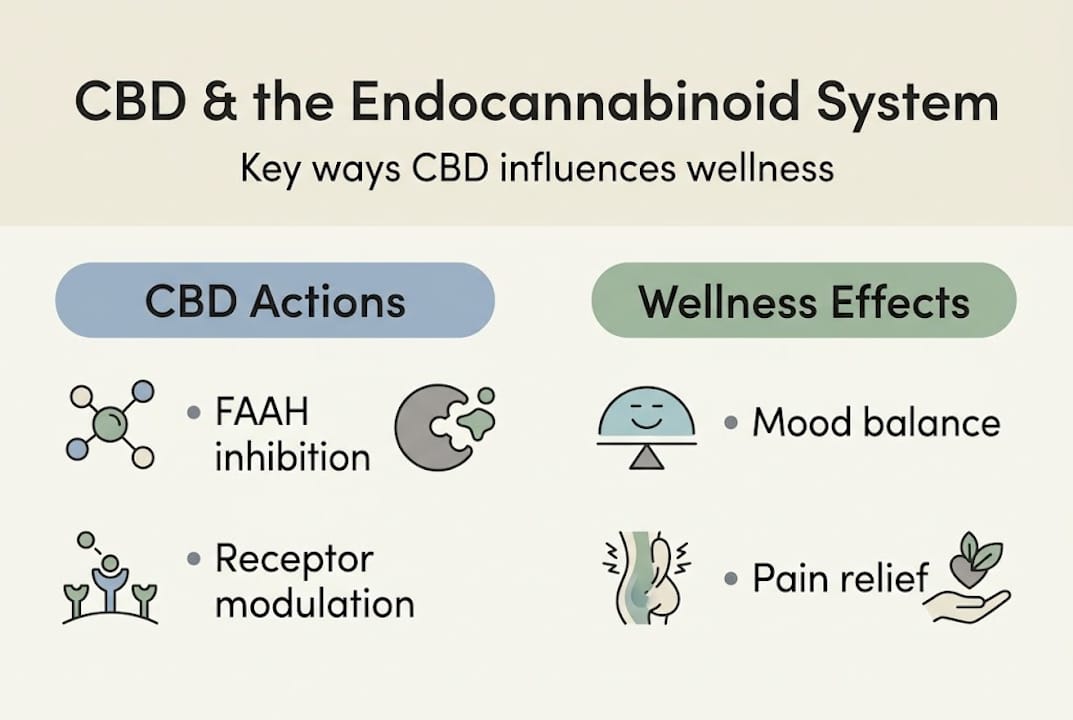
The key mechanism here involves FAAH, the enzyme responsible for breaking down anandamide. Under normal circumstances, anandamide is produced in response to positive experiences, exercise, and even certain foods, then rapidly degraded by FAAH before it can do too much. CBD interrupts this process. CBD indirectly boosts endocannabinoid signalling by inhibiting FAAH, the enzyme degrading anandamide (AEA), increasing AEA levels and prolonging CB1 activation. It also binds fatty acid binding proteins (FABPs) to prevent AEA transport to FAAH.
In practical terms, this means more anandamide stays active in your system for longer. More anandamide leads to a more sustained sense of calm, reduced pain signalling, and a more balanced emotional state. Think of it like reducing the speed at which your body clears away its own natural stress relief.
Here is a step-by-step picture of how this plays out:
- Stress or pain occurs, triggering anandamide production in the brain.
- FAAH would normally break down anandamide within seconds to minutes.
- CBD inhibits FAAH, slowing that breakdown and giving anandamide more time to act.
- Prolonged anandamide activity activates CB1 receptors in regions linked to calm and pain modulation.
- Cortisol levels reduce, amygdala activity (the brain’s fear centre) calms, and the nervous system settles.
- Synergy with 5-HT1A serotonin receptors adds another layer of anxiolytic (anxiety-reducing) action.
The serotonin angle is particularly important for UK adults managing anxiety. CBD’s interaction with 5-HT1A receptors mirrors the target of some conventional anti-anxiety medications, but without the dependency risks. UK registry data shows GAD-7 improvements with cannabinoid-based medicinal products (CBMPs) including CBD, providing real-world validation of this mechanism for anxiety management, with ECS modulation via increased AEA and 5-HT1A interactions promoting calm and reducing amygdala activity and cortisol.
If you are exploring CBD for anxiety specifically, this FAAH inhibition pathway helps explain why effects are not always immediate. It takes time for anandamide levels to build and stabilise. Equally, combining CBD with broader stress remedies such as mindfulness, regular exercise, and good sleep hygiene can create a compounding effect that accelerates results.
| ECS mechanism | Effect on the body | Wellness benefit |
|---|---|---|
| FAAH inhibition | Higher anandamide levels | Reduced anxiety, better mood |
| CB1 modulation | Calmer nervous system | Pain relief, emotional balance |
| 5-HT1A activation | Serotonin pathway support | Anxiety and stress reduction |
| CB2 inverse agonism | Dampened inflammation | Reduced chronic pain signals |
For those looking at practical anxiety relief tips, pairing CBD with lifestyle support consistently produces better outcomes than relying on CBD alone.
CBD, sleep, and pain relief: evidence from UK registries
With its ECS-modulating effects, CBD shows clear benefits for sleep and pain, supported by UK-specific registry data that goes beyond laboratory studies.
Sleep is one of the most common reasons UK adults try CBD. Poor sleep is often caused not by a primary sleep disorder but by secondary factors: persistent pain, racing thoughts, and anxiety that prevent the nervous system from winding down. CBD addresses these root causes through its ECS interactions rather than sedating the brain directly. CBD supports sleep by balancing ECS sleep-wake cycles and reducing anxiety and pain that disrupt rest, with UK studies reporting Sleep Quality Scale (SQS) improvements and a 30% reduction in sleep medication use with prescribed cannabinoids.
That 30% reduction in sleep medication is a meaningful statistic for UK adults who are concerned about long-term dependence on pharmaceutical sleep aids. CBD offers an alternative route that works with the body’s own systems rather than overriding them.
On the pain side, the picture is equally encouraging. UK real-world registry data shows sustained ECS-mediated improvements in pain (measured via the Brief Pain Inventory and McGill Pain Questionnaire), anxiety (GAD-7 scores), and sleep (SQS) up to 18 to 24 months, supporting CBD for chronic conditions. These are not short-term placebo effects. Sustained improvements over one to two years suggest genuine physiological benefits through the ECS.
It is worth being honest about an ongoing scientific debate. Some effects are observed only at high micromolar concentrations in vitro (in laboratory conditions), raising questions about physiological relevance at typical CBD doses. However, clinical benefits observed in UK registries for pain, anxiety, and sleep suggest that real-world dosing achieves meaningful outcomes, even if the precise dose-response relationship is still being studied.
Key takeaways from the current UK evidence base:
- SQS (Sleep Quality Scale) scores improve consistently across registry participants using CBMPs.
- Pain scores on validated tools like the BPI and McGill Questionnaire show sustained reduction.
- GAD-7 anxiety scores improve significantly, with benefits maintained beyond 12 months.
- Sleep medication use falls by approximately 30% in cohorts prescribed cannabinoids.
- Benefits are observed across chronic pain, anxiety-related insomnia, and inflammation-driven discomfort.
Pro Tip: When starting CBD for sleep, use a consistent evening routine. Take your CBD sleep guide recommendations seriously: take CBD 30 to 60 minutes before bed, avoid screens, and keep the dose steady for at least four weeks before adjusting. Pairing CBD with other evidence-backed sleep remedies such as magnesium and reduced caffeine amplifies results. If pain is the primary culprit, exploring dedicated inflammation support alongside CBD may provide additional relief.
Our take: what most miss about CBD and the ECS
With practical evidence in hand, it is worth addressing why so many guides still get CBD wrong, and what the real story means for you as a UK adult seeking natural relief.
The most common mistake in popular CBD articles is overstating direct action. Many guides imply CBD “activates” CB1 or CB2 receptors the way a key fits a lock. That framing creates inflated expectations and leads to confusion when someone does not feel an immediate, dramatic effect. The truth is subtler: CBD is a modulator and an enzyme inhibitor working through accumulation and balance, not instant activation.
The UK registry data is genuinely important here because it reflects real people, real doses, and real conditions rather than idealised lab settings. The fact that sustained improvements appear over 18 to 24 months tells us CBD’s benefits compound over time, much like a long-term lifestyle intervention rather than a one-off pharmaceutical.
There are also meaningful edge cases to consider. FAAH inhibition may not always enhance outcomes in every condition. Research shows no PTSD benefit in randomised controlled trials, with effects being context and stress-dependent. This is why top anxiety solutions often recommend balanced cannabinoid-based medicinal products (CBMPs) over pure CBD isolate for stress-related conditions. Broader cannabinoid profiles may provide more comprehensive ECS support in complex or treatment-resistant cases.
The practical lesson: pure CBD is a strong starting point and effective for many people. But if results plateau, a broad-spectrum or full-range product deserves consideration.
Explore CBD products designed for natural wellness
Now that you understand how CBD works with the ECS, finding the right product becomes much simpler. The goal is consistent, quality-assured broad-spectrum CBD that supports your ECS without unnecessary additives or THC.
At SMOKO CBD, every product is third-party lab tested and made with organically grown hemp to ensure you get the ECS support you are looking for. If you prefer a fast-absorbing option, our mint flavour CBD tincture delivers consistent dosing with clean ingredients. For daily convenience, our 750MG soft gel capsules make it easy to maintain steady ECS support throughout the week. Or try our popular CBD gummies pack for a tasty, measured way to support pain, anxiety, and sleep naturally. Explore the full range and find what fits your wellness routine.
Frequently asked questions
Does CBD get you ‘high’ like THC?
No. CBD’s non-psychoactive profile stems from its role as a negative allosteric modulator at CB1 receptors and indirect ECS enhancement, making it ideal for UK adults seeking natural relief without any intoxicating effect.
How fast does CBD work for anxiety or pain?
Effects can be noticed within hours to days for some people, but sustained ECS-mediated improvements in pain, anxiety, and sleep are typically observed over weeks to months of consistent use, as UK registry data confirms.
Is pure CBD better than blended cannabinoid products?
Not always. FAAH inhibition is context-dependent and may not benefit every condition equally, so balanced broad-spectrum cannabinoid products may offer more comprehensive ECS support for stress-related or complex conditions.
Are there risks with daily CBD use?
Most adults tolerate daily CBD well at typical doses. Clinical benefits in UK registries for pain, anxiety, and sleep support its ongoing safety profile, though correct dosing and product quality remain important considerations.
How does CBD help with sleep without sedation?
CBD improves sleep by addressing its root causes rather than sedating you directly. Balancing ECS sleep-wake cycles and reducing anxiety and pain that disrupt rest leads to natural, better quality sleep without next-day grogginess.