Many people assume CBD acts like a sleeping pill, delivering instant sedation. That’s not how it works. CBD supports sleep more gradually by addressing root causes like anxiety and pain. With one in three UK adults struggling with sleep difficulties, understanding how CBD genuinely influences rest and how to use it safely can transform your approach to natural sleep support.
Table of Contents
- Understanding Sleep Challenges And Natural Remedies
- How Cbd Interacts With Sleep Mechanisms
- Clinical Evidence Supporting Cbd For Sleep
- Dosage Recommendations And Variability
- Cbd Product Types And Sleep Effectiveness
- Safety, Legal, And Quality Assurance Considerations
- Common Misconceptions About Cbd And Sleep
- Practical Guide To Using Cbd For Sleep
- Discover Quality Uk Cbd Products For Better Sleep
- Is Cbd Safe To Use Every Night For Sleep?
Key takeaways
| Point | Details |
|---|---|
| CBD supports sleep indirectly | It reduces anxiety and pain rather than causing direct sedation, addressing common sleep disruptors. |
| Dosing requires personalisation | Effective amounts vary widely between individuals; start low and adjust gradually for best results. |
| Broad-spectrum products may work better | The entourage effect from multiple hemp compounds can enhance sleep benefits compared to isolates. |
| Quality and legality matter | UK-compliant, lab-tested products ensure safety, accurate dosing, and zero THC content. |
| Misconceptions hinder results | Understanding CBD’s gradual action and realistic expectations prevents disappointment and improves outcomes. |
Understanding sleep challenges and natural remedies
Sleep disorders remain remarkably common. Research shows that approximately one in three UK adults experiences sleep difficulties, ranging from trouble falling asleep to poor sleep quality. This widespread problem drives many people towards pharmaceutical sleep aids, which often bring unwanted side effects or dependency concerns.
Increasing numbers of UK adults now seek natural alternatives for better rest. CBD has emerged as one of the most researched and popular options, though confusion about how it works persists. Unlike conventional sleep medications, natural approaches like CBD work with your body’s existing systems rather than forcing sedation.
Consider these key factors when exploring natural sleep remedies:
- Sleep quality directly impacts physical health, mental wellbeing, and daily functioning
- Many pharmaceutical options create tolerance or dependence over time
- Natural remedies often address underlying causes rather than masking symptoms
- Individual responses vary significantly, requiring personalised approaches
- Understanding mechanisms helps set realistic expectations and improves outcomes
The shift towards natural sleep solutions reflects growing awareness that sustainable rest requires addressing root causes. CBD fits within this broader movement, offering a different mechanism than traditional sedatives.
How CBD interacts with sleep mechanisms
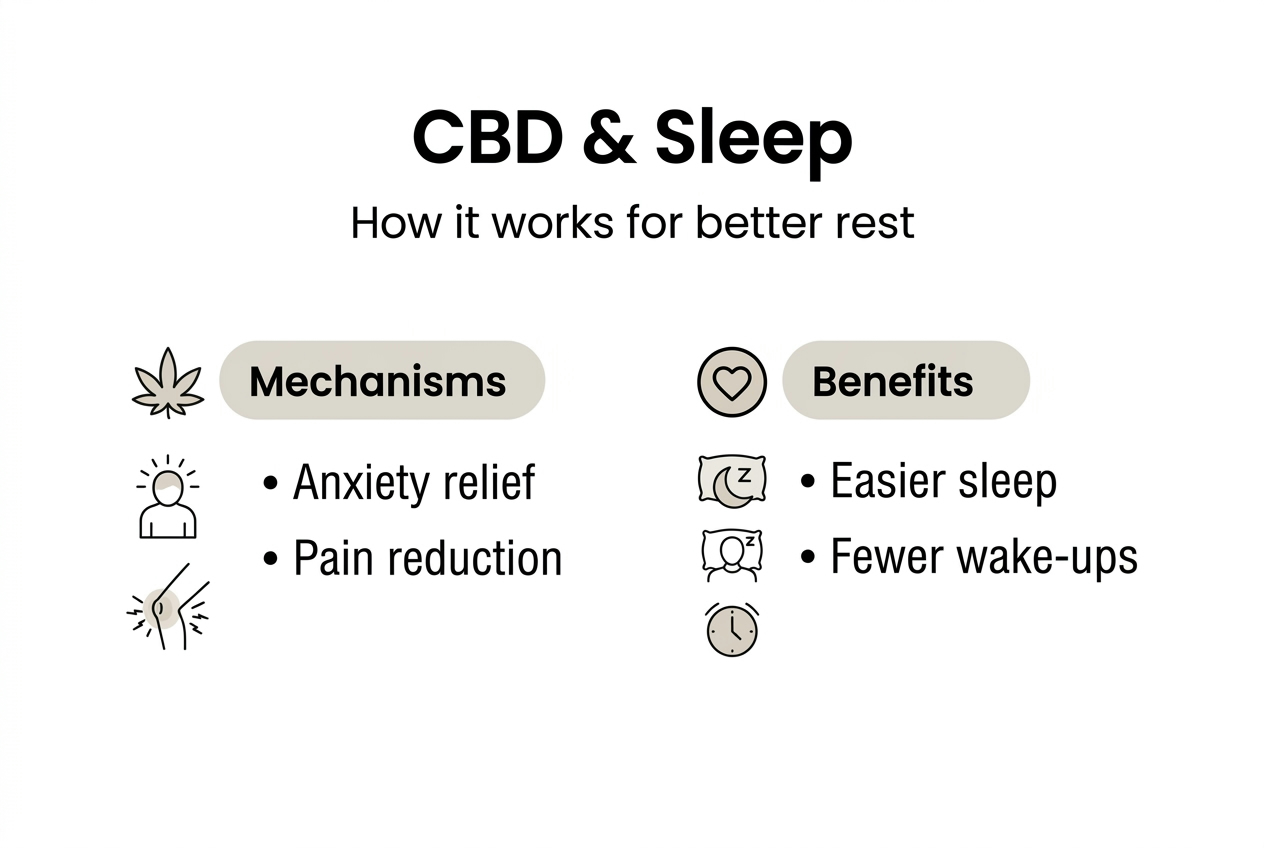
CBD’s influence on sleep operates through the endocannabinoid system, a complex network regulating numerous bodily functions. The ECS contains CB1 and CB2 receptors throughout your brain and body that CBD modulates. These interactions affect neurotransmitters like GABA and serotonin, which directly influence anxiety levels, pain perception, and ultimately sleep quality.
The crucial insight here is that CBD doesn’t force your brain into sleep like benzodiazepines do. Instead, it reduces barriers preventing natural rest. Anxiety remains a major factor in chronic insomnia, and CBD’s anxiety-reducing properties often explain improved sleep outcomes. Similarly, chronic pain disrupts sleep architecture, and CBD’s analgesic effects help maintain uninterrupted rest cycles.
CBD may also influence circadian rhythm regulation, though research continues exploring this mechanism. Your circadian rhythm governs when you feel alert or sleepy throughout the day. Disrupted rhythms contribute significantly to sleep difficulties, particularly for shift workers or those with irregular schedules.
Key mechanisms include:
- Modulation of CB1 receptors in the central nervous system affecting sleep-wake cycles
- Enhancement of GABA activity, promoting relaxation and reducing neural excitability
- Interaction with serotonin receptors influencing mood and anxiety levels
- Reduction of inflammatory responses that may disrupt sleep quality
- Potential influence on cortisol levels, affecting stress and arousal
Understanding these biological pathways helps explain why CBD works differently for different people. Your individual ECS functioning, anxiety levels, pain experiences, and other factors determine how you’ll respond. This biological reality makes personalised experimentation essential rather than following one-size-fits-all dosing.
Pro Tip: Track your sleep quality, anxiety levels, and any pain symptoms before starting CBD. This baseline helps you recognise genuine improvements versus placebo effects, making dosage adjustments more informed and effective.
Exploring CBD anxiety solutions provides deeper insight into how anxiety reduction translates to better sleep. The connection between daytime anxiety management and nighttime rest quality cannot be overstated.
Clinical evidence supporting CBD for sleep
Clinical research provides encouraging though nuanced evidence for CBD’s sleep benefits. A notable case series found that 66.7% of participants reported improved sleep after consistent CBD use, with anxiety reduction appearing as the primary mediator. These results occurred within the first month of treatment, though individual responses varied considerably.
The same study revealed important limitations. Not everyone experiences sleep improvements, and effects can fluctuate over time. Some participants reported initial benefits that diminished, whilst others found increasing effectiveness with continued use. This variability underscores the importance of realistic expectations and patient experimentation.
Real-world evidence complements controlled studies:
- Clinical observations suggest CBD works best when addressing anxiety-related sleep disruption
- Participants with pain-related insomnia also reported meaningful improvements
- Effects typically build gradually rather than appearing immediately
- Optimal dosing varies widely between individuals, from 25mg to 160mg daily
- Some users report no sleep benefits regardless of dose or duration
One researcher noted:
“CBD’s sleep benefits appear most pronounced in individuals whose insomnia stems from anxiety or pain rather than primary sleep disorders. The compound addresses underlying causes rather than directly inducing sleep.”
This distinction matters enormously for setting appropriate expectations. If your sleep difficulties primarily result from anxiety, CBD might offer substantial help. If you have a primary sleep disorder like sleep apnoea, CBD alone probably won’t resolve the issue.
The evidence supports cautious optimism. CBD represents a legitimate option worth trying, particularly for anxiety or pain-related sleep problems. However, it’s not a guaranteed solution, and individual trial remains necessary to determine personal effectiveness. Understanding what research shows helps you approach CBD intelligently rather than hoping for miraculous results.
For specific applications, exploring CBD for insomnia provides practical insights into how others have successfully integrated CBD into their sleep routines.
Dosage recommendations and variability
Effective CBD dosing for sleep varies dramatically between individuals, making personalised experimentation essential. Research indicates doses ranging from 25mg to 160mg daily can influence sleep, with lower amounts typically reducing anxiety and higher doses potentially promoting sedation. Starting low minimises side effects whilst you gauge personal responsiveness.

Begin with 10-25mg taken 30-60 minutes before bed. Maintain this dose for at least one week, monitoring sleep quality, ease of falling asleep, and next-day alertness. If you notice no improvement after seven days, increase by 5-10mg increments weekly until you find your effective dose or reach 40-50mg without benefits.
Follow these dosing principles:
- Start with the lowest effective dose rather than assuming more is better
- Increase gradually in small increments, allowing time to assess each level
- Take CBD at consistent times to establish routine and evaluate effects accurately
- Monitor both sleep quality and daytime functioning for complete assessment
- Consider that optimal doses may change over time as your body adapts
- Consult healthcare providers before exceeding 50mg daily or if taking other medications
Lower doses often work through anxiety reduction rather than sedation. If 15-25mg meaningfully reduces your nighttime worry or racing thoughts, that might be your optimal dose even if it doesn’t feel “sedating.” Higher doses above 50mg may produce more noticeable sedative effects but also increase risks of morning grogginess or other side effects.
Surprisingly, some individuals report better sleep with lower doses than higher ones. This counterintuitive finding likely relates to CBD’s biphasic effects, where different dose ranges produce different outcomes. Very high doses might actually increase alertness in some people, whilst moderate amounts promote relaxation.
One challenge involves the significant minority who experience no sleep benefits. Research suggests approximately 25% of users report no improvement regardless of dosage. If you’ve tried gradually increasing doses up to 50-75mg over several weeks without results, CBD might simply not work for your particular sleep issues.
Pro Tip: Keep a simple sleep journal noting CBD dose, time taken, sleep latency, number of awakenings, and morning alertness. After two weeks, patterns emerge showing which doses and timing work best for your unique physiology.
Patience proves crucial. Unlike pharmaceutical sleep aids that work immediately, CBD’s benefits typically build over days or weeks. Giving each dose level adequate time before adjusting prevents premature conclusions about effectiveness.
“The most common mistake I see is people giving up after trying one dose for two nights. CBD requires consistent use and patient adjustment to find your personal sweet spot.”
CBD product types and sleep effectiveness
Product format significantly impacts CBD’s sleep benefits through differences in absorption, onset timing, and duration. Understanding these distinctions helps you select the most appropriate option for your sleep patterns and preferences.
| Product Type | Onset Time | Duration | Best For |
|---|---|---|---|
| Tinctures | 15-45 minutes | 4-6 hours | Quick effect, flexible dosing |
| Soft Gels | 30-90 minutes | 6-8+ hours | Sustained release, convenience |
| Gummies | 30-90 minutes | 6-8+ hours | Taste preference, precise dosing |
Tinctures offer the fastest onset because sublingual absorption bypasses digestive processing. Hold the oil under your tongue for 60-90 seconds before swallowing. This method works well if you struggle with initial sleep onset and want effects beginning within 30 minutes. However, shorter duration means effects may fade before morning.
Edibles and soft gels take longer to work because they must pass through your digestive system first. This delay actually benefits sleep maintenance. Taking a capsule or gummy 60-90 minutes before bed means effects peak as you’re falling asleep and continue through the night. The extended duration reduces middle-of-the-night awakenings.
Product composition matters beyond format. Broad-spectrum CBD products contain multiple hemp-derived compounds like minor cannabinoids and terpenes, potentially enhancing sleep benefits through the entourage effect. These complementary molecules work synergistically, possibly producing better results than CBD isolate alone.
Key product considerations:
- Broad-spectrum options may outperform isolates for sleep support
- MCT oil carrier in tinctures improves CBD absorption and bioavailability
- Gelatin or pectin-based gummies affect absorption rates differently
- Flavouring and additional ingredients should be minimal and natural
- Packaging should protect CBD from light degradation
For sustained nighttime support, many find success with CBD gummies for sleep due to their longer duration. The delayed onset matches well with bedtime routines, allowing you to take them whilst preparing for sleep.
Pro Tip: Some people combine product types, using a tincture for quick onset and a capsule for sustained effect. Start with one format first to understand individual responses before experimenting with combinations.
Product quality dramatically affects effectiveness. Third-party lab testing confirms actual CBD content matches label claims and verifies absence of contaminants. Many products contain significantly less CBD than advertised or include concerning levels of heavy metals or pesticides. Only purchase from suppliers providing current lab certificates.
Safety, legal, and quality assurance considerations
CBD demonstrates a generally favourable safety profile with mild and infrequent side effects. Most users tolerate it well, though some experience dry mouth, drowsiness, reduced appetite, or diarrhoea at higher doses. These effects typically diminish with continued use or resolve by reducing dosage.
UK law requires CBD products contain no more than 0.2% THC, the psychoactive compound in cannabis. This legal limit ensures CBD products cannot produce intoxicating effects whilst maintaining the beneficial cannabinoids and terpenes from hemp. Reputable suppliers consistently test their products to verify THC compliance and overall safety.
Third-party laboratory testing represents the gold standard for product verification. Independent labs analyse CBD content, confirm THC levels remain legal, and screen for contaminants including:
- Heavy metals like lead, arsenic, mercury, and cadmium
- Pesticides and herbicides from hemp cultivation
- Residual solvents from extraction processes
- Microbial contaminants including moulds and bacteria
- Accurate cannabinoid profiles matching label claims
Only purchase products with current certificates of analysis readily available. These documents should be specific to the batch you’re buying, not generic reports from months or years ago. Legitimate companies proudly display test results and update them regularly.
Consult your GP or pharmacist before using CBD if you take other medications. CBD can interact with certain drugs by affecting liver enzymes that metabolise medications, potentially altering their effectiveness or side effects. This particularly matters for blood thinners, some antidepressants, and medications with narrow therapeutic windows.
Choosing quality products involves several factors beyond lab testing. Look for companies that provide transparent information about hemp source, extraction methods, and manufacturing practices. UK-based suppliers often maintain higher standards due to regulatory oversight and local accountability.
For verified quality, explore lab tested CBD oil UK options that meet rigorous safety standards. Understanding what distinguishes premium products from questionable ones protects both your health and your investment.
Additional guidance on safe use appears in resources about CBD oil and gummies for sleep, which address common safety questions specific to sleep applications.
Common misconceptions about CBD and sleep
Several persistent myths about CBD and sleep lead to unrealistic expectations and ineffective use. Understanding what CBD actually does versus popular misconceptions helps you use it successfully.
The most common misconception treats CBD like a conventional sleeping pill. People expect immediate sedation within minutes of taking it, then conclude it doesn’t work when they don’t feel drowsy. CBD doesn’t cause immediate sedation in most cases. Instead, it gradually reduces anxiety and pain that prevent natural sleep, with effects building over days or weeks.
Another myth suggests all CBD products work identically. Product type, spectrum, and quality dramatically affect outcomes. Broad-spectrum products containing multiple hemp compounds often outperform CBD isolate through synergistic effects. A high-quality broad-spectrum tincture produces different results than a poorly made isolate capsule, even at identical CBD milligram amounts.
Some believe higher doses always work better. This oversimplification ignores CBD’s biphasic nature, where different dose ranges produce different effects. Excessive doses might actually worsen sleep for some individuals, causing alertness rather than relaxation. Finding your personal optimal dose matters more than taking large amounts.
Key misconceptions to avoid:
- CBD works like pharmaceutical sleep aids with immediate sedative effects
- All CBD products are equivalent regardless of spectrum or quality
- Higher doses always produce better sleep outcomes
- Everyone experiences identical effects at the same doses
- CBD alone resolves all sleep problems regardless of underlying causes
- Results should appear immediately after first use
The belief that CBD works universally for everyone overlooks significant individual variability. Genetics, existing health conditions, other medications, anxiety levels, and numerous other factors influence CBD responsiveness. Some people genuinely don’t benefit from CBD for sleep, and that’s a normal outcome rather than product failure.
Expecting CBD to fix poor sleep hygiene represents another problematic assumption. If you consume caffeine late in the day, use screens before bed, maintain irregular sleep schedules, or sleep in unsuitable environments, CBD cannot overcome these fundamental barriers. It works best as part of comprehensive sleep improvement strategies, not as a standalone magic solution.
Understanding these realities helps you approach CBD with appropriate expectations. It offers genuine potential for many people, particularly those with anxiety or pain-related sleep disruption, but requires patient experimentation and realistic assessment of results.
Practical guide to using CBD for sleep
Successfully integrating CBD into your sleep routine requires systematic approach combining product selection, dosing strategy, and ongoing assessment. Follow these steps for best results:
- Establish your baseline by tracking current sleep patterns for one week without CBD, noting sleep latency, night awakenings, and morning alertness
- Select a broad-spectrum product with third-party lab certification from a reputable UK supplier, choosing format based on your onset timing preference
- Start with 10-25mg taken 30-60 minutes before your target bedtime, maintaining consistency in timing and routine
- Continue this initial dose for seven full days whilst tracking the same sleep metrics you established at baseline
- Assess results after one week, looking for improvements in any tracked metrics rather than expecting dramatic transformation
- Increase dose by 5-10mg increments weekly if needed, repeating assessment process at each level
- Find your optimal dose where benefits plateau, typically somewhere between 15-50mg for most people
- Maintain this dose consistently, only adjusting if effectiveness diminishes or circumstances change
Consult your healthcare provider before starting CBD, especially if you take other medications or have existing health conditions. This conversation should cover potential interactions, appropriate starting doses for your situation, and any monitoring needed during CBD use.
Choose quality products that provide transparency and testing. Resources like lab-tested CBD oil UK help identify suppliers meeting rigorous standards. Avoid products making exaggerated claims or lacking clear ingredient information.
Pro Tip: Combine CBD with strong sleep hygiene practices including consistent bedtimes, cool dark bedroom, limited screen time before bed, and caffeine restriction after 2pm. CBD works best supporting these fundamental practices rather than replacing them.
Patience proves essential throughout this process. Unlike pharmaceutical options providing immediate results, CBD’s sleep benefits typically emerge gradually over weeks. Some people notice improvements within days, whilst others require a month of consistent use before experiencing meaningful changes.
Monitor for side effects including daytime drowsiness, dry mouth, or digestive changes. Mild effects often resolve with continued use, but persistent problems warrant dose reduction or discontinuation. Your goal is sustainable improvement without unwanted effects.
If you reach 50mg without noticeable sleep improvements after four weeks, CBD might not effectively address your particular sleep issues. Consider consulting a sleep specialist to explore other underlying causes or treatment approaches.
For specific applications and protocols, CBD oil for insomnia provides detailed guidance on using CBD for chronic sleep difficulties with evidence-based strategies.
Discover quality UK CBD products for better sleep
Finding trustworthy CBD products that deliver consistent results makes all the difference in your sleep improvement journey. Quality matters enormously, as does choosing formats that match your preferences and needs.
Our SMOKO CBD mint flavour tincture 1000mg offers precise dosing control with fast sublingual absorption, perfect for those wanting flexible amounts and quicker onset. The mint flavour provides pleasant taste whilst the MCT oil carrier enhances bioavailability for maximum effectiveness.
For convenient pre-measured doses combining tincture flexibility with gummy convenience, the CBD tinctures and gummies bundle 500mg provides excellent value whilst letting you experiment with both delivery methods. Many find this combination ideal for discovering which format works best for their sleep patterns.
Those preferring capsule convenience appreciate our SMOKO CBD soft gel capsules 750mg, offering extended release perfect for maintaining sleep through the night. The gelatin coating protects CBD from degradation whilst enabling consistent absorption.
All our products feature broad-spectrum CBD from organically grown USA hemp, third-party lab tested to confirm zero THC and verify purity. We provide complete transparency with accessible lab certificates, ingredient lists, and usage guidance, ensuring you know exactly what you’re taking.
Explore our full range to find the CBD solution matching your sleep support needs, backed by quality assurance and UK compliance you can trust.
Is CBD safe to use every night for sleep?
Is CBD safe to use every night for sleep?
CBD is generally safe for nightly use with mild side effects like dry mouth or drowsiness. However, long-term daily use should ideally be discussed with your healthcare provider, particularly if you take other medications. Some people develop tolerance requiring dose adjustments, whilst others maintain consistent effectiveness indefinitely.
What dose of CBD should I take for sleep?
Effective doses vary significantly between individuals, typically ranging from 15mg to 50mg for most people. Start with 10-25mg nightly and increase gradually by 5-10mg weekly until you find your optimal amount. Your ideal dose depends on body weight, metabolism, anxiety levels, and sleep issue severity.
How long does CBD take to improve sleep?
CBD’s sleep benefits usually build over one to four weeks rather than working immediately like pharmaceutical sleep aids. Some people notice improvements within a few days, whilst others require a month of consistent use. Patience and regular tracking help you recognise gradual improvements that might otherwise go unnoticed.
Should I choose CBD oil or gummies for sleep?
CBD oil tinctures work faster, taking effect in 15-45 minutes but lasting 4-6 hours. Gummies take 30-90 minutes to work but last 6-8+ hours, better for maintaining sleep through the night. Choose tinctures if falling asleep is your main issue, gummies if you wake frequently during the night.
What makes CBD help with sleep?
CBD supports sleep by reducing anxiety and pain rather than directly causing sedation. It interacts with your endocannabinoid system to modulate neurotransmitters affecting stress, discomfort, and arousal. This indirect mechanism explains why CBD works well for anxiety or pain-related insomnia but less effectively for primary sleep disorders.
How do I know if CBD products are safe and legal in the UK?
Safe, legal UK CBD products contain less than 0.2% THC and provide third-party lab testing certificates verifying purity and cannabinoid content. Only purchase from suppliers offering current lab reports showing tested cannabinoid levels and screening for contaminants like heavy metals and pesticides.
Recommended
- Can CBD Oil be used for Treating Insomnia – SMOKO CBD
- Does CBD Oil and CBD Gummies Help Sleep and Insomnia? – SMOKO CBD
- 10 Natural Sleep Remedies for Better Sleep in 2025 – SMOKO CBD
- Acupressure Point for Sleeping - A Practical Guide to Restful Nights – SMOKO CBD
- CBD och återhämtning – Naturlig väg till bättre sömn - Cannaone.se