Rest days are not gaps in your training. They are when training actually works. Muscles repair micro-tears, the nervous system resets from sympathetic overdrive, and hormones such as testosterone and growth hormone return to ranges that support adaptation. Skip them consistently, and you are not training harder; you are simply accumulating damage without the repair cycle that converts effort into progress.
Three evidence-backed reasons rest days belong in every athlete’s programme:
- Improved adaptation and strength gains. Muscle protein synthesis (MPS) peaks during recovery, not during the session itself. Without rest, the stimulus exists but the adaptation does not.
- Lower injury risk and better immune function. Coaching guidance from TrainingPeaks confirms that insufficient recovery raises injury risk and weakens immunity, particularly during high-load training phases.
- Hormonal and nervous-system rebalancing. Chronic training without rest elevates cortisol and suppresses testosterone, a combination that stalls progress and increases the risk of overtraining syndrome.
Pro Tip: Schedule at least one full rest day per week as a non-negotiable training block. Use objective markers such as heart rate variability (HRV) and sleep efficiency to decide whether a second rest day is warranted that week.
Key takeaways
Rest days are when training converts into adaptation: without scheduled recovery, the physiological processes that produce strength, endurance and resilience cannot complete.
| Point | Details |
|---|---|
| Schedule rest proactively | Plan at least one full rest day per week; add a second during high-load blocks or when HRV trends downward. |
| Prioritise sleep above all else | A majority of elite athletes report poor sleep quality; rest days improve total sleep time and support MPS and glycogen restoration. |
| Eat to recover, not to compensate | Maintain protein and carbohydrate intake on rest days; severe calorie restriction impairs the repair processes rest days are designed to support. |
| Monitor trends, not single readings | Use a 7-day rolling HRV average and resting heart rate trends; act on patterns, not individual data points. |
| Avoid intensity creep | Active recovery must stay below 65% of maximum heart rate; anything above recreates training stress rather than resolving it. |
For further reading on adjunctive recovery options, Smokocbd’s guide to recovering faster from workouts covers science-backed strategies alongside information on CBD as a natural wellness adjunct for UK athletes.
Table of Contents
- How rest produces adaptation in your body
- Why sleep is your most powerful recovery tool
- Active recovery versus full rest: how to choose
- How to spot overtraining before it becomes a crisis
- How often should you take rest days?
- What to eat on rest days to support recovery
- Your complete rest-day checklist
- Common rest-day mistakes that slow your progress
- The science of autonomic balance and mental fatigue
- Rest is part of the plan, not a break from it
- Sources
How rest produces adaptation in your body
Muscle repair and protein synthesis
Every training session creates microscopic damage to muscle fibres. That damage is the stimulus. The adaptation, meaning the actual strength or endurance gain, happens during the recovery window that follows. During rest, satellite cells migrate to damaged fibres, inflammation resolves, and MPS rebuilds tissue that is slightly stronger than before. Compress that window with another hard session and you interrupt the process mid-cycle.

Healthline’s exercise recovery guidance notes that rest days allow replenishment of glycogen stores and healing of connective tissue; without adequate rest, athletes risk fatigue, decreased performance and higher injury rates. Connective tissue, tendons and ligaments in particular, repairs more slowly than muscle and is frequently the first structure to fail when recovery is neglected.
Hormonal effects of chronic high volume
Cortisol is the body’s primary stress hormone, and training raises it. That is normal and necessary. The problem arises when training volume is high enough, and rest infrequent enough, that cortisol never fully returns to baseline. Chronically elevated cortisol suppresses testosterone and blunts growth hormone secretion, both of which are central to tissue repair and adaptation. Rest days give the endocrine system the space to rebalance.
Autonomic nervous system and HRV
The autonomic nervous system has two branches: the sympathetic (“fight or flight”) and the parasympathetic (“rest and digest”). Hard training activates the sympathetic branch. Recovery requires a shift toward parasympathetic dominance. HRV, the variation in time between heartbeats, is one of the most accessible proxies for this balance. A rising HRV trend generally signals adequate recovery; a sustained decline signals the opposite.
Outside Online’s analysis of rest-day quality explains that neglecting rest days can shift the body into chronic sympathetic dominance, with higher cortisol and lower HRV, which impairs healing and can produce overtraining symptoms including mood change and prolonged recovery.
Key statistic: WHOOP member data shows that athletes who respected low-recovery (red) days were significantly less likely to experience another poor-recovery day compared with those who pushed through.
| Recovery metric | What it reflects | Typical concern threshold |
|---|---|---|
| HRV (multi-day trend) | Autonomic balance and readiness | Sustained decline over 3+ days |
| Resting heart rate | Cardiovascular recovery load | Rise of 5–7 bpm above personal baseline |
| Sleep efficiency | Quality of restorative sleep | Below 85% on consecutive nights |
| Poor sleep prevalence in athletes | Baseline recovery challenge | ~64–65% of elite and sub-elite athletes score ≥5 on the PSQI |
Why sleep is your most powerful recovery tool
Sleep is not passive downtime. It is the period during which growth hormone secretion peaks, glycogen is restored, MPS accelerates and the brain consolidates motor learning from training. Shortchange it and every other recovery strategy loses much of its effect.
A PMC study on athlete sleep practices found that approximately a majority of elite and sub-elite athletes reported poor sleep quality (a global PSQI score of 5 or above), while actigraphy data showed improved total sleep time on rest days. That gap between training days and rest days is significant: rest days create the conditions for longer, more efficient sleep by reducing physical discomfort, lowering core body temperature earlier in the evening and removing the cortisol spike that follows a hard session.
Statistic to note: Research published in PMC on sleep and athletic performance found that sleep deprivation is associated with higher circulating stress hormones, impaired glycogen regeneration and reduced muscle protein synthesis, all of which blunt training adaptation.
Sleep also handles the psychological side of recovery. Motor patterns practised during training are consolidated during slow-wave and REM sleep. Athletes who consistently under-sleep tend to show slower skill acquisition and reduced reaction times, even when their physical conditioning appears adequate.
Practical sleep hygiene on rest days
- Avoid setting an early alarm; allow natural waking when possible to complete full sleep cycles.
- Keep light exposure bright in the morning and dim after 9 PM to support melatonin production.
- Avoid intense exercise, heavy meals and screens within 90 minutes of bed.
- Keep the bedroom cool (around 18°C is often cited as optimal for sleep onset).
If you are carrying sleep debt from a heavy training week, rest days are the most practical opportunity to repay it. Even a 20–30 minute nap between 1 PM and 3 PM can meaningfully reduce accumulated fatigue without disrupting night-time sleep architecture.
Pro Tip: Use rest days to extend your sleep window by 30–60 minutes rather than keeping the same alarm. Consistent sleep extension over a recovery day has a measurable effect on next-day HRV and perceived readiness.
For athletes curious about non-pharmacological sleep support, Smokocbd’s guide on whether CBD affects sleep quality covers the current evidence in plain terms.
Active recovery versus full rest: how to choose
Not every rest day needs to look the same. The right choice depends on where you are in your training cycle, how your body feels and what your objective markers are showing.

Active recovery means low-intensity movement that increases blood flow to tissues, helps clear metabolic by-products such as lactate and reduces muscle stiffness, without recreating a training stimulus. Think a 20–30 minute walk, easy swimming, light yoga or gentle mobility work. UCHealth’s clinical guidance notes that active recovery can be more restorative than complete immobility for most athletes, provided intensity stays genuinely low.
Passive rest means minimal physical stress: no structured exercise, no long walks, no “just a quick session.” It is appropriate after your highest-strain sessions of the week, during the final days before a competition, or when objective markers (HRV, resting heart rate) are showing clear suppression.
When to choose each
- Active recovery: the day after a moderate session; mid-week during a heavy training block; when muscles feel stiff but HRV is within normal range.
- Passive rest: the day after your longest or most intense session; during a deload week; when HRV has declined for three or more consecutive days; when you are fighting off illness.
- Breathwork and mobility: useful on either type of day to shift the autonomic balance toward parasympathetic dominance without raising heart rate.
The critical pitfall with active recovery is intensity creep. A “recovery run” that drifts to 75% of maximum heart rate is not recovery; it is another training stimulus on top of an already-stressed system.
Pro Tip: After your highest-strain session of the week, default to passive rest or very gentle movement (a 15-minute walk at most). Use slow, diaphragmatic breathing for 5–10 minutes to actively shift your nervous system toward parasympathetic dominance.
How to spot overtraining before it becomes a crisis
Overtraining syndrome does not arrive suddenly. It builds through a series of warning signals that most athletes either ignore or misattribute to life stress. Catching them early is the difference between a planned rest day and a forced two-week layoff.
Subjective warning signs
- Persistent fatigue that does not resolve after a night’s sleep
- Declining motivation to train, or dread before sessions that previously felt enjoyable
- Mood changes: irritability, low mood or heightened anxiety without an obvious cause
- Increased perceived effort at paces or loads that previously felt manageable
- Poor sleep quality despite physical tiredness
Objective warning signs
- Resting heart rate elevated 5–7 bpm above your personal baseline for multiple consecutive days
- HRV trending downward over a week or more
- Performance plateau or decline despite consistent training
- Prolonged muscle soreness that does not resolve within 48–72 hours
Medical red flags requiring clinical attention
Some signs go beyond normal fatigue and warrant a conversation with a GP or sports medicine clinician:
- Unrelenting joint or tendon pain that persists through rest
- Frequent infections or slow wound healing (a sign of immune suppression)
- Unexplained weight loss
- Severe or persistent sleep disturbance that does not improve with rest days
Statistic: UCHealth’s clinical overview confirms that rest days help the immune system recover and reduce injury risk, with clinical experts noting that physiological repair during rest is what produces strength and endurance gains over time.
Pro Tip: Track trends, not single data points. One poor night’s sleep or one low HRV reading is noise. A pattern sustained over five or more days is a signal worth acting on.
How often should you take rest days?
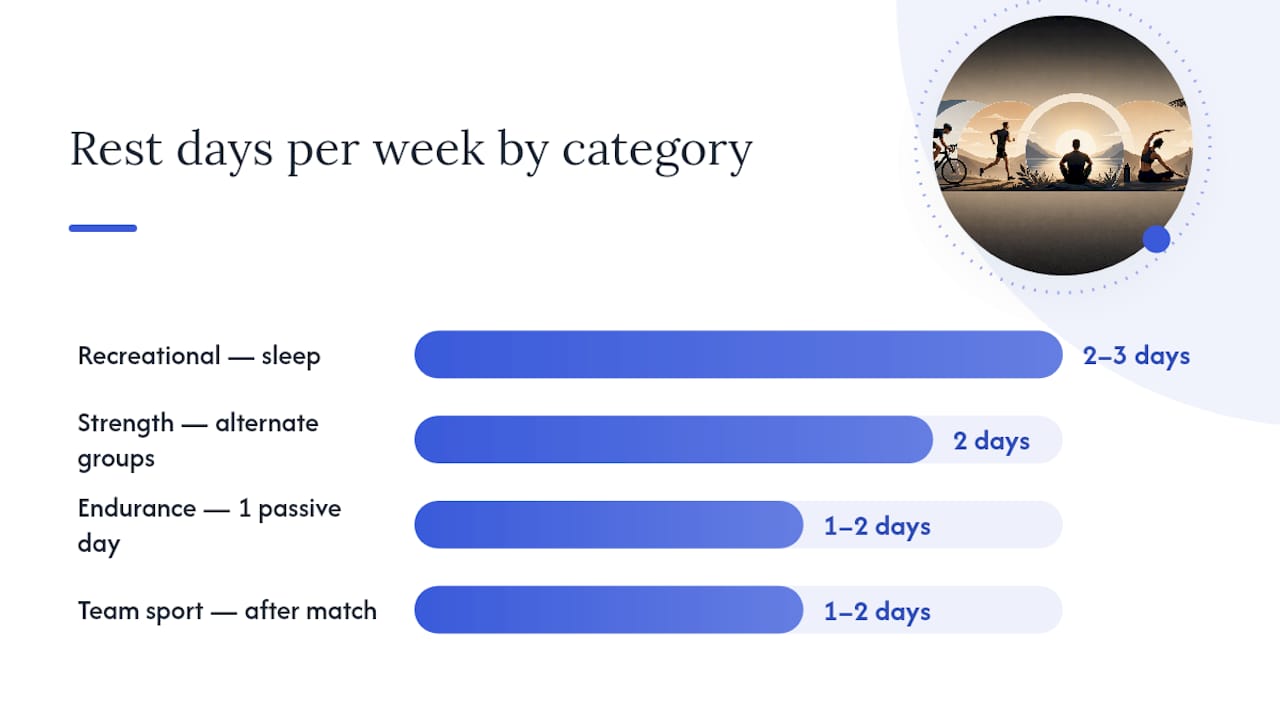
There is no single answer that fits every athlete, but there are practical ranges grounded in coaching evidence. TrainingPeaks coaching guidance recommends at least one full rest day per week for most athletes, with one to two rest days during high-intensity blocks or heavy resistance programmes.
The right frequency depends on training type, intensity, life stress and individual recovery capacity. Athletes with heavy training loads often need periodic deload weeks in addition to weekly rest days, with frequency individualised using load, sleep, nutrition and life-stress measures.
| Athlete category | Suggested rest days per week | Notes |
|---|---|---|
| Recreational (3–4 sessions/week) | 2–3 | Prioritise sleep and nutrition on rest days |
| Endurance (5–6 sessions/week) | 1–2 | Include one full passive rest day; use active recovery on the second |
| Strength/resistance (4–5 sessions/week) | 2 | Alternate muscle groups; full rest after highest-volume day |
| Team sport (training + matches) | 1–2 | Rest day after match day; active recovery mid-week |
| Elite/professional | Individualised | Use HRV and coach guidance; periodic deload weeks every 3–4 weeks |
Within a training week (microcycle), place your full rest day after the longest or most intense session. Within a training block (macrocycle), schedule a deload week every three to four weeks where overall volume drops by roughly 30–40% and rest days increase. This periodisation approach prevents the gradual accumulation of fatigue that leads to overtraining.
Pro Tip: Schedule rest days in your training calendar at the start of each week, not reactively when you feel exhausted. Planned rest is a training tool; reactive rest is damage control.
What to eat on rest days to support recovery
Rest-day nutrition is one of the most misunderstood areas of athlete recovery. Many athletes either eat far too little (treating rest days as a calorie-cutting opportunity) or give it no thought at all. Both approaches undermine the repair process that rest days are designed to support.
Macronutrient priorities
- Protein: maintain your usual daily protein intake on rest days. MPS continues for 24–48 hours after a session, and amino acid availability directly limits the rate of repair. Aim for 1.6–2.2 g per kg of body weight, distributed across meals.
- Carbohydrates: include carbohydrates to restore muscle glycogen. You do not need to match training-day carb intake exactly, but severe restriction delays glycogen replenishment and leaves you under-fuelled for the next session.
- Hydration and electrolytes: fluid needs are slightly lower on rest days, but hydration still supports nutrient transport and joint lubrication. Aim for pale yellow urine as a simple guide.
ACE Fitness practitioner guidance stresses keeping protein intake on rest days and using rest days for deliberate refeeding to aid repair and support subsequent training capacity. During intense training phases, insufficient calorie and carbohydrate intake can force the body to catabolise muscle protein for energy, the opposite of what recovery requires.
Sample rest-day meal structure
- Breakfast: eggs with wholegrain toast and fruit, or Greek yoghurt with oats and berries.
- Lunch: grilled chicken or salmon with brown rice and roasted vegetables.
- Dinner: lean protein (turkey, fish, legumes) with sweet potato and a green salad.
- Snacks: cottage cheese, a handful of nuts, or a protein smoothie with banana.
Some athletes find that broad-spectrum CBD products, such as those available through Smokocbd’s CBD for athletes recovery guide, are used as an adjunctive part of their rest-day routine alongside nutrition and sleep. These are not a substitute for the fundamentals above, but they sit alongside them for athletes exploring natural wellness options. For those interested in different formats, Smokocbd’s practical guide to CBD types for athletes explains tinctures, gummies and capsules in plain terms.
Pro Tip: Plan rest-day meals at the start of the week alongside your training meals. Treating rest-day nutrition as an afterthought, or cutting calories sharply for one day, disrupts the recovery cycle and leaves you under-prepared for your next session.
Your complete rest-day checklist
A well-structured rest day is not a blank calendar. It has a loose rhythm that supports recovery without adding stress. The following checklist is designed to be adapted, not followed rigidly.
- Wake naturally (or as late as your schedule allows). Avoid an early alarm. Allow your body to complete its final sleep cycles.
- Hydrate immediately. Drink 400–500 ml of water within 30 minutes of waking to begin rehydration after overnight fluid loss.
- Eat a nutrient-dense breakfast. Prioritise protein and complex carbohydrates within 60–90 minutes of waking.
- Do 10–15 minutes of gentle mobility or stretching. Focus on areas that feel tight from recent training. Keep it slow and deliberate, not a workout.
- Take a short walk (20–30 minutes) at a genuinely easy pace. This is optional and should be skipped if HRV is suppressed or you are fighting illness.
- Eat a protein-rich lunch with carbohydrates and plenty of vegetables.
- Take a short nap if needed (20–30 minutes, before 3 PM). A brief nap reduces accumulated fatigue without disrupting night-time sleep.
- Try 5–10 minutes of diaphragmatic breathwork in the afternoon. Slow, controlled breathing actively shifts the autonomic nervous system toward parasympathetic dominance.
- Begin your wind-down routine 90 minutes before bed. Dim lights, avoid screens, keep the bedroom cool.
- Eat an evening meal focused on carbohydrates and protein to support overnight glycogen restoration and MPS.
- Log your subjective recovery score, sleep quality and any soreness. One line in a training diary or app is enough; the trend over days matters more than any single entry.
For athletes interested in low-stress restorative options, a CBD-infused bath soak such as the Revive bath bomb from Montrose Cannabis (combining CBD and CBG) is one example of a passive, low-activation recovery modality that fits naturally into an evening wind-down.
Pro Tip: Keep the checklist short. The goal of a rest day is to reduce total stress load, not to replace training stress with recovery-task stress. If your rest day feels like a second job, simplify it.
Common rest-day mistakes that slow your progress
Mistake 1: over-scheduling recovery modalities
Ice baths, compression sessions, massage, red-light therapy and cold plunges all have their place. The problem is stacking them into a packed rest-day schedule that keeps the sympathetic nervous system activated. Outside Online’s analysis cautions that over-scheduling recovery tasks can maintain sympathetic arousal and reduce the parasympathetic recovery the body actually needs. Choose one or two modalities at most, and keep them genuinely passive.
Mistake 2: intensity creep on “active recovery” days
A recovery session that raises your heart rate above 65% of maximum is not recovery. It is a training stimulus. “Easy” runs, “light” gym sessions and “just a quick” HIIT class all count as training load. If you cannot hold a full conversation throughout, the intensity is too high.
Mistake 3: underfuelling to compensate for lower activity
Cutting calories sharply on rest days is one of the most common and most counterproductive habits in recreational sport. The body’s repair processes are metabolically expensive. Relative energy deficiency in sport (RED-S) is a recognised clinical condition that develops when calorie intake chronically fails to match training demand, and rest days are a common point where the deficit widens. Eat to recover, not to compensate.
- Corrective action for mistake 1: pick one passive modality (a warm bath, light stretching or a short massage) and leave the rest for training days.
- Corrective action for mistake 2: use a heart rate monitor on active recovery days and stay below 65% of your maximum heart rate throughout.
- Corrective action for mistake 3: plan rest-day meals in advance and keep protein and carbohydrate intake close to your training-day levels.
Pro Tip: The best rest day often feels almost boring. If you are constantly busy with recovery tasks, you are not resting.
The science of autonomic balance and mental fatigue
Most SERP-level coverage of rest days focuses on muscle repair and injury prevention. The autonomic nervous system and mental fatigue angle receives far less attention, yet it is often the mechanism that explains why athletes plateau or break down despite doing “everything right.”
Mental stress from work, relationships and daily life adds directly to the physiological recovery burden. The nervous system does not distinguish between the stress of a hard interval session and the stress of a difficult week at work. Both activate the sympathetic branch, both elevate cortisol and both consume recovery resources. World Athletics’ guidance on rest and recovery explicitly notes that mental fatigue is additive to physical stress, and that complete sport-free days provide psychological regeneration that sustains long-term training consistency.
Statistic: WHOOP’s member analysis found that athletes who took restorative approaches on low-recovery days were 2.3 times less likely to experience a subsequent poor-recovery day, a figure that reflects nervous-system recovery as much as muscular repair.
What nervous-system fatigue looks like in practice
- HRV declining for five or more consecutive days despite normal training load
- Sleep efficiency dropping below 85% without a change in sleep duration
- Resting heart rate elevated above baseline even on rest days
- Persistent low mood or reduced motivation that does not lift after a single rest day
Successful coaches use multi-day HRV declines, chronic reduced sleep efficiency and rising resting heart rate in combination with subjective markers to prescribe short deloads before overtraining develops. Relying only on how you feel risks late detection of nervous-system fatigue, because the subjective sense of readiness often lags behind objective markers by several days.
Pro Tip: Use a 7-day rolling average for HRV rather than comparing today’s reading to yesterday’s. A single low reading is noise; a declining 7-day trend is a clear signal to prioritise rest.
Wearables such as WHOOP, Garmin’s Body Battery or Polar’s Nightly Recharge make this trend-tracking straightforward. The data is only useful, however, if you act on it rather than override it because the training plan says otherwise.
Rest is part of the plan, not a break from it
There is a persistent idea in sport that rest is what you do when you cannot train. The evidence says the opposite. As trainers note, you can only train as hard as you recover. Inadequate recovery wastes the training stimulus because the body lacks the resources for adaptation.
The athletes and coaches who understand this treat rest days with the same intentionality as their hardest sessions. They schedule them in advance, they protect them from encroachment by extra sessions, and they use objective data to decide when one rest day is not enough.
There is also a psychological dimension that rarely gets discussed honestly. Training without adequate rest erodes motivation over weeks and months in ways that feel like a character flaw rather than a physiological consequence. The loss of enthusiasm, the dread before sessions, the sense that progress has stalled: these are often symptoms of accumulated fatigue, not signs that an athlete needs to push harder.
One practical example worth considering: a recreational runner training five days per week who adds a second planned rest day during a heavy block, and uses that day for sleep extension and deliberate nutrition, often finds that the following week’s sessions feel noticeably better. Not because they did less overall, but because the adaptation from the previous week’s work finally had space to complete.
Rest is not a concession. It is the mechanism.
Sources
- Your definition of rest day is wrong, and it’s slowing you down — Outside Online
- Feels vs facts: why you need rest days in training — WHOOP
- Doing rest days right: Ultimate 2026 recovery guide — TrainingPeaks
- Why rest and recovery is essential for athletes — UCHealth Today
- Exercise rest day: benefits, importance, tips — Healthline
- 8 reasons to take a rest day — ACE Fitness
- How to take a rest day — Today