TL;DR:
- CBD’s sleep effects depend on dosage and individual physiology, with higher doses promoting relaxation. Low doses are neutral or mildly alerting, while doses of 75 mg or more increase drowsiness and sleep duration. It reduces anxiety by calming the nervous system rather than acting as a sedative, making dosing, timing, and ingredient transparency crucial for effective use.
CBD is a non-psychoactive cannabinoid that can cause drowsiness, but whether it actually makes you sleepy depends almost entirely on the dose you take and your individual physiology. At low doses, CBD tends to be neutral or mildly alerting. At higher doses, it is associated with increased relaxation and longer total sleep time. This distinction matters enormously if you are considering CBD for better sleep. Products like Smokocbd’s broad-spectrum tinctures and soft gel capsules work with your body’s endocannabinoid system, the network of receptors that regulates mood, stress, and sleep cycles, rather than acting as a blunt sedative.
Does CBD make you sleepy at every dose?
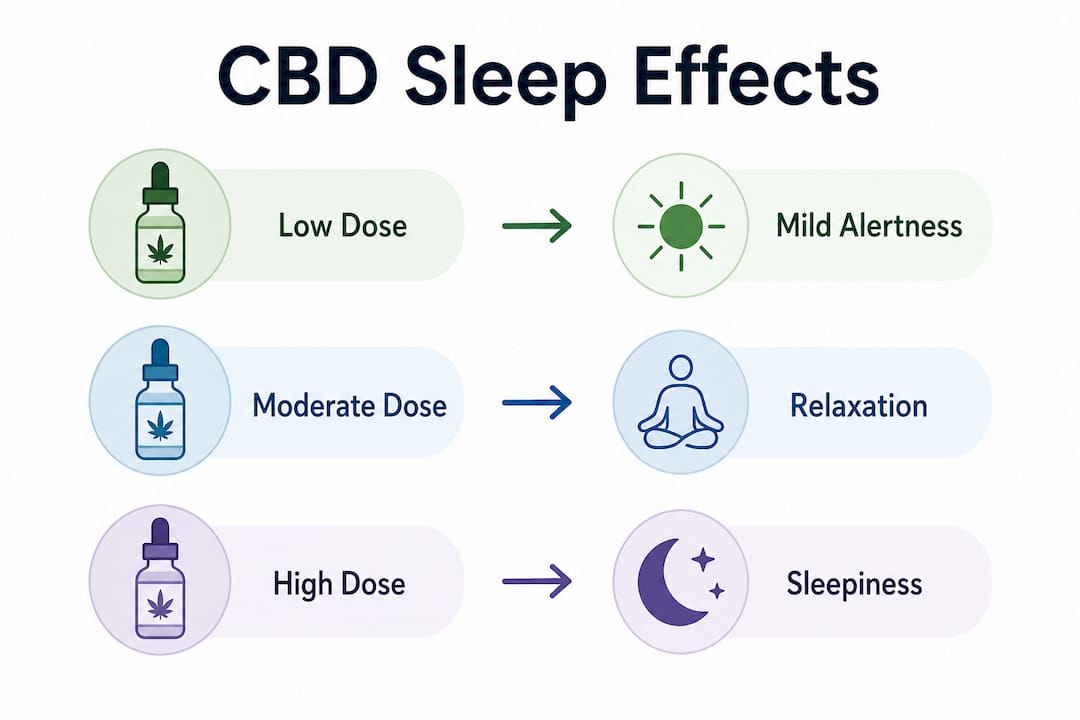
The short answer is no. CBD’s effect on sleep is dose-dependent: low doses in the 15–25 mg range tend to be alerting or neutral, while higher doses of 75 mg or more are associated with increased sleepiness and longer total sleep time. This is what researchers call the dose paradox, and it catches many first-time users off guard.
Most people start with a low dose, feel nothing particularly sedating, and conclude that CBD does not work for sleep. The reality is that they have not reached the threshold where sleep-promoting effects become apparent. Think of it less like a light switch and more like a dimmer: the higher you go, the more the body begins to wind down.
The table below summarises how dose ranges typically map to effects and the most practical use cases.
| Dose Range | Typical Effect | Best Use Case |
|---|---|---|
| 15–25 mg | Neutral to mildly alerting | Daytime anxiety relief |
| 25–75 mg | Mild relaxation, reduced mental tension | Evening wind-down |
| 75–160 mg | Increased drowsiness, longer sleep | Sleep support |
| 160–300 mg | Stronger sedation, possible grogginess | Supervised therapeutic use |
Pro Tip: Start at 25 mg taken 60–90 minutes before bed and increase by 10–15 mg every three to four nights until you notice a consistent improvement in how quickly you fall asleep.
What does the research actually show on sleep quality?
The scientific evidence on CBD and sleep quality is promising but nuanced. WHOOP data from CBD users shows that consuming CBD before 10pm was associated with an average increase in total sleep duration of 8.814 minutes, including 1.751 additional minutes of slow-wave sleep and 2.501 extra minutes of REM sleep. Those numbers may sound modest, but slow-wave and REM sleep are the stages where physical recovery and memory consolidation happen. Even small gains in these stages compound meaningfully over weeks.
A 2026 randomised controlled trial produced a more cautious finding. 300 mg CBD reduced sleep disturbances more than 50 mg did, but it did not significantly outperform placebo in individuals with high trait worry. This is a critical nuance. CBD may be less effective as a standalone sleep tool for people whose insomnia is driven primarily by chronic anxiety, at least at doses below 300 mg.
“Clinical trials reveal a significant placebo effect in sleep improvements, indicating psychological factors play a strong role in CBD’s perceived sleep benefits.” — CED Clinic
The table below compares key outcomes from recent research.
| Study / Data Source | CBD Dose | Key Sleep Outcome | vs. Placebo |
|---|---|---|---|
| WHOOP Data (2026) | Not specified | +8.814 min total sleep | Not compared |
| 2026 RCT (high worry group) | 300 mg | Reduced disturbances | No significant difference |
| 2026 RCT (high worry group) | 50 mg | Minimal effect | No significant difference |
The takeaway is that CBD can genuinely improve sleep architecture for many people, but it is not a guaranteed fix. Individual response varies considerably, and the placebo effect is real and worth acknowledging.
How does CBD promote sleep without being a sedative?
CBD is not a sedative but an anxiolytic. It reduces anxiety and mental tension, which in turn makes it easier for the body to transition into sleep naturally. This is a fundamentally different mechanism from sleeping tablets or antihistamines, which force sedation by suppressing the central nervous system.

Consumers commonly misunderstand this distinction. Many expect CBD to knock them out the way a pharmaceutical sleep aid might. When it does not, they assume the product has failed. What CBD actually does is reduce the mental friction that keeps you awake: the racing thoughts, the low-level stress, the inability to switch off.
This also explains why product ingredients matter so much. Most commercially available CBD gummies contain 5–25 mg CBD, which sits firmly in the mildly alerting range. Any drowsiness users report from these products is often due to added ingredients rather than CBD itself. Here is what to look for on the label:
- Melatonin: A hormone that signals the brain it is time to sleep. Effective at 0.5–5 mg. Common in CBD sleep gummies.
- CBN (cannabinol): A minor cannabinoid with mild sedative properties. Often added to CBD sleep formulations.
- Magnesium glycinate: A mineral that supports muscle relaxation and GABA activity, frequently included in premium sleep blends.
- L-theanine: An amino acid found in green tea that promotes calm without sedation.
If you want CBD oil sleep benefits from CBD alone, you need a product with a sufficient dose of CBD and transparent third-party lab results confirming what is actually in it.
Pro Tip: When buying a CBD sleep product, check the certificate of analysis before anything else. If the brand does not publish third-party lab results, the dose on the label may not reflect what is in the bottle.
Who benefits most from CBD for sleep?
Individual variability is the single biggest factor in how CBD affects sleep. Genetics, body weight, liver enzyme activity, and baseline anxiety levels all influence how you metabolise and respond to CBD. There is no universal dose that works for everyone, which is why a gradual, structured approach gives you the best chance of finding what works.
WHOOP data indicates CBD increases sleep duration more for day-sleepers, with individuals who sleep during the day gaining approximately 30 additional minutes of sleep with CBD. This makes it a particularly interesting option for night-shift workers or anyone with a non-standard sleep schedule. If you work nights and struggle to get quality rest during the day, CBD may offer a more meaningful benefit than it does for conventional night-time sleepers. You can read more about this in Smokocbd’s guide to circadian rhythm sleep disorder.
For those using CBD to support night-time sleep, here is a practical approach to getting started:
- Choose the right product form. Oral CBD, whether a tincture or soft gel, has an onset time of 2–4 hours. Take it well before your intended bedtime, not immediately before you lie down.
- Start at 25 mg and track your response. Note how long it takes to fall asleep, how often you wake, and how you feel in the morning.
- Increase gradually. Add 10–15 mg every three to four nights if you see no improvement. Most people find their effective dose sits between 50 mg and 150 mg.
- Time it correctly. CBD has a half-life of two to five hours, meaning it is largely metabolised before you wake if taken an hour before sleep. This significantly reduces the risk of next-morning grogginess.
- Combine with sleep hygiene. CBD works best alongside consistent sleep and wake times, a dark and cool bedroom, and reduced screen exposure in the hour before bed. For broader ideas, Smokocbd’s list of natural sleep remedies pairs well with a CBD routine.
- Speak to a healthcare professional. If you are taking prescription medication, particularly blood thinners or antiepileptics, consult your GP before adding CBD to your routine.
CBD generally does not cause next-morning drowsiness at doses below 100 mg. Very high doses taken close to bedtime may cause mild grogginess in some individuals, but this is uncommon at typical consumer doses.
Key takeaways
CBD’s sleep effects are dose-dependent, with higher doses promoting relaxation and longer sleep, while low doses remain neutral or mildly alerting.
| Point | Details |
|---|---|
| Dose determines drowsiness | Low doses (15–25 mg) are alerting; sleep benefits typically require 75 mg or more. |
| CBD is an anxiolytic, not a sedative | It reduces mental tension to aid sleep naturally, not by suppressing the nervous system. |
| Added ingredients often drive drowsiness | Melatonin and CBN in sleep gummies cause sedation more than CBD itself at typical doses. |
| Day-sleepers gain the most | WHOOP data shows day-sleepers gain approximately 30 extra minutes of sleep with CBD. |
| Timing and titration matter | Take oral CBD 1–2 hours before bed and increase dose gradually for best results. |
Why i think most people are using CBD for sleep incorrectly
After spending a considerable amount of time reviewing the research and speaking with people who use CBD regularly, the most common mistake I see is expecting CBD to behave like a pharmaceutical sedative. People take a 10 mg gummy at 11pm and wonder why they are still awake at midnight. The dose is too low, the timing is too late, and the expectation is entirely wrong.
The evidence from the 2026 WHOOP dataset and the randomised controlled trial tells a more honest story. CBD can genuinely improve sleep architecture, particularly slow-wave and REM sleep, but it does so by calming the nervous system rather than switching it off. For people whose poor sleep is rooted in anxiety or an overactive mind, that distinction is actually good news. You are not trading one dependency for another.
What I find most compelling is the shift-worker data. A 30-minute increase in daytime sleep duration is a meaningful clinical outcome. That is not a placebo. For anyone working non-standard hours and struggling to get restorative rest, CBD deserves serious consideration as part of a structured sleep routine, not as a magic solution, but as a genuinely useful tool.
My honest advice: read the label of any CBD sleep product carefully. If the drowsiness you feel comes from melatonin rather than CBD, that is fine, but you should know what is doing the work. Transparency in dosing and ingredients is the baseline standard you should expect from any reputable brand. Smokocbd publishes third-party lab results for all its products, which is exactly the kind of accountability that should be the norm across the industry.
— Mike
Try smokocbd’s CBD products for evening relaxation
If you are ready to put the research into practice, Smokocbd offers a range of broad-spectrum CBD products designed with sleep support in mind.

The 1000 mg broad-spectrum tincture delivers a flexible dose per drop, making it straightforward to titrate from 25 mg upward without switching products. For those who prefer a pre-measured option, the 750 mg CBD soft gels and gummies bundle provides consistent dosing in a convenient format. All Smokocbd products are made from organically grown hemp, contain zero THC, and are verified by independent lab testing. If you want a step-by-step plan for incorporating CBD into your evening routine, Smokocbd’s CBD sleep routine guide is a practical starting point.
FAQ
Does CBD make you sleepy straight away?
CBD does not typically cause immediate drowsiness. Oral CBD has an onset time of 2–4 hours, so effects on relaxation and sleep readiness are gradual rather than instant.
What dose of CBD is needed to feel sleepy?
Sleep-promoting effects are generally associated with doses of 75 mg or more. Doses in the 15–25 mg range are more likely to be neutral or mildly alerting than sedating.
Can CBD help with insomnia?
CBD can support sleep in people whose insomnia is linked to anxiety or stress, as it acts as an anxiolytic rather than a direct sedative. A 2026 RCT found that 300 mg CBD reduced sleep disturbances, though results varied compared to placebo. For more detail, see Smokocbd’s article on CBD oil for insomnia.
Will CBD cause grogginess the next morning?
CBD does not cause next-morning drowsiness at doses below 100 mg for most people. Its half-life of two to five hours means it is largely cleared from the body before waking.
Is the drowsiness from CBD gummies actually from CBD?
Not always. Drowsiness from CBD gummies is often caused by added melatonin or CBN rather than CBD itself, since most gummies contain only 5–25 mg of CBD, which sits in the alerting range.