TL;DR:
- Building a consistent CBD bedtime routine supports natural sleep by reducing anxiety and physical tension.
- Timing and dosage are critical; take CBD 60 to 90 minutes before bed with gradual dose adjustments.
- Combining CBD with environmental and behavioral sleep habits enhances its effectiveness over time.
Lying awake at 2am despite feeling exhausted all day is a frustratingly common experience for adults across the UK. Sleep problems affect millions of people here, and many are searching for natural alternatives to prescription medications that can leave them feeling foggy the next morning. CBD (cannabidiol), a non-psychoactive compound derived from hemp, has attracted growing interest as a potential sleep aid. Real-world UK data showed prescribed cannabinoids improved sleep quality scores from 2.66 to 3.81 over 18 months, with a 30% reduction in sleep medication use. This guide walks you through building a practical, evidence-informed CBD bedtime routine from scratch.
Table of Contents
- What you need to start your CBD sleep routine
- Step-by-step guide: creating your nightly CBD sleep routine
- Troubleshooting and common mistakes with CBD for sleep
- Measuring results: what to expect and how to track progress
- A realistic perspective on building a CBD sleep routine
- Explore quality CBD products for your sleep routine
- Frequently asked questions
Key Takeaways
| Point | Details |
|---|---|
| CBD preparation essentials | Gather the right CBD products, set a relaxing space, and check for any health caveats before you start. |
| Routine steps matter | Consistent timing and combining CBD with other relaxation habits is key for better results. |
| Track your progress | Record your sleep changes over at least two weeks to judge routine effectiveness. |
| Adjust for best results | Be ready to tweak your approach, dose, or timing based on your body’s response. |
What you need to start your CBD sleep routine
With your sleep challenge in mind, let’s look at what you’ll need to get started safely and effectively.
Before you take your first drop of CBD oil or chew your first gummy, a little preparation goes a long way. Building a routine is not just about choosing a product. It is about creating the right conditions for that product to work. Think of it like setting the stage before the performance begins.
Here is a quick overview of the essentials you will want to gather:
| Item | Purpose | Notes |
|---|---|---|
| CBD product (oil, gummies, or capsules) | Primary sleep aid | Choose broad-spectrum, third-party tested |
| Sleep journal or notebook | Track effects and patterns | Plain notebook works perfectly |
| Herbal tea (chamomile, valerian) | Supports relaxation ritual | Caffeine-free only |
| Water | Hydration and dry mouth prevention | Keep a glass by the bed |
| Blue light blocking glasses | Reduce screen stimulation | Optional but helpful |
| Dim lamp or candle | Signal to brain that sleep is near | Avoid overhead lighting |
Understanding how CBD works for sleep is genuinely useful here. CBD interacts with the body’s endocannabinoid system, a network of receptors that helps regulate mood, stress, and sleep cycles. Rather than sedating you directly, it appears to tone down anxiety and physical tension, making it easier for your body to drift into sleep naturally.
Before you begin, run through this short preparation checklist:
- Set a consistent bedtime. Pick a time and stick to it, even at weekends. Consistency is what trains your body clock.
- Cut off caffeine by 2pm. Caffeine has a half-life of around five to six hours, meaning an afternoon coffee is still active in your system at bedtime.
- Prepare your sleep environment. Cool, dark, and quiet is the gold standard. Even small changes like blackout curtains or a fan for white noise can make a measurable difference.
- Review your current medications. This step is critical. Consulting your GP is strongly advised if you are pregnant, taking prescription medications, or managing a medical condition, as CBD can interact with certain drugs. It may also cause dry mouth or grogginess at higher doses, and it is not suitable for anyone in a job that requires regular drug testing.
Understanding CBD dosage safety for sleep before you start means you are far less likely to make the common mistake of taking too much too soon.
Important: CBD is generally well-tolerated, but it is not a one-size-fits-all solution. Always start low and increase gradually. Your ideal dose may be very different from someone else’s.
Step-by-step guide: creating your nightly CBD sleep routine
Now you are prepared, here is how to put your routine into action step by step.
A good sleep routine is not complicated, but it does require consistency. The following steps are designed to be realistic for busy UK adults, whether you are winding down after work or managing a household before bed.
Step 1: Choose your CBD format
The three most common options are CBD oil (tinctures), gummies, and soft gel capsules. Each has its advantages. Oil taken under the tongue (sublingually) is absorbed relatively quickly, typically within 15 to 45 minutes. Gummies and capsules pass through the digestive system, so they take longer to kick in, usually 45 to 90 minutes. For sleep purposes, this slower onset can actually be an advantage, as the effects tend to be more sustained through the night.
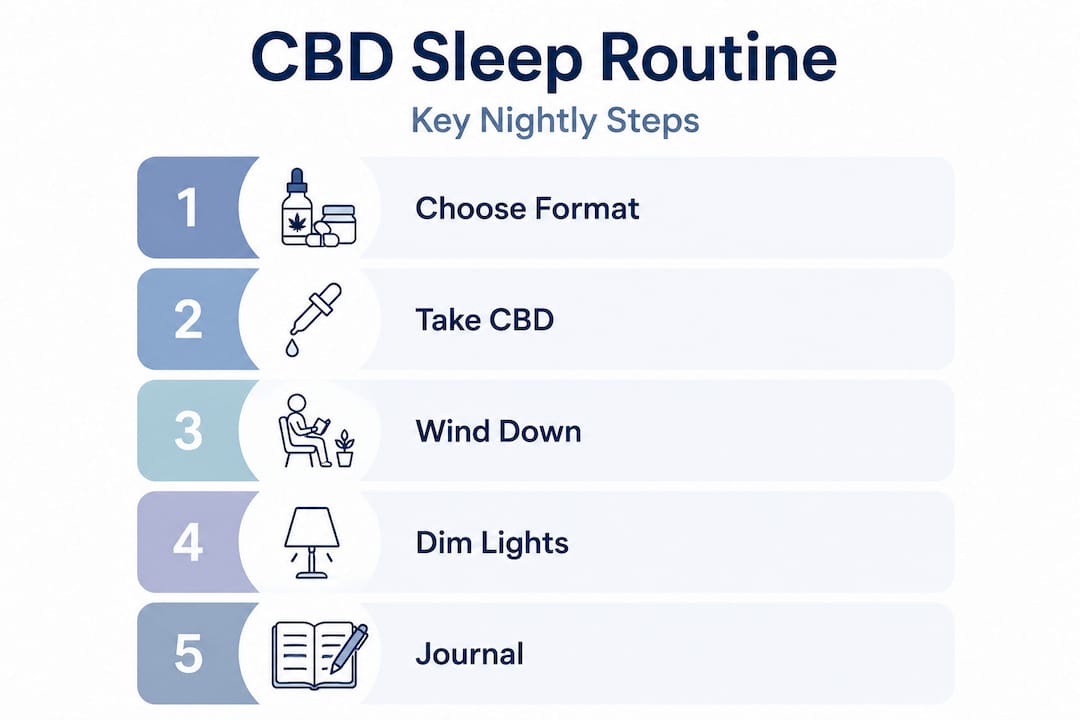
Step 2: Take your CBD 60 to 90 minutes before bed
Timing is everything. Sleep quality improvements in real-world studies were observed with consistent, structured use rather than sporadic dosing. Taking your CBD too close to bedtime means it may not have reached full effect when your head hits the pillow. Set a reminder on your phone if needed.
Step 3: Begin your wind-down ritual
Once you have taken your CBD, use the next 60 to 90 minutes to actively prepare your mind and body for sleep. This is where natural sleep remedies come into their own. Try reading a physical book, making a cup of chamomile tea, doing five minutes of gentle stretching, or practising slow breathing. Avoid scrolling on your phone or watching stimulating television.

Step 4: Dim your lights and reduce noise
Your brain takes its cues from light and sound. Dimming the lights signals the pineal gland to produce melatonin, the hormone that makes you feel sleepy. Pairing this with the calming effects of CBD creates a powerful combined signal that it is time to rest. Some people also find acupressure techniques for sleep a helpful addition at this stage, particularly for releasing tension held in the neck and shoulders.
Step 5: Write in your sleep journal
Before you get into bed, spend two or three minutes jotting down how you feel, what dose you took, and any thoughts you want to offload from your mind. This simple act of “brain dumping” reduces the mental chatter that keeps many people awake.
Here is a comparison of three different routine approaches to help you find the one that suits your lifestyle:
| Routine style | Time required | Best for | CBD format |
|---|---|---|---|
| Streamlined | 20 to 30 minutes | Busy professionals | Oil or capsules |
| Wellness-focused | 60 to 90 minutes | Those with anxiety or stress | Gummies with herbal tea |
| Flexible | 30 to 60 minutes | Parents or shift workers | Capsules (consistent timing) |
Pro Tip: If you find it hard to remember your routine, link it to an existing habit. For example, take your CBD immediately after brushing your teeth. Habit stacking like this dramatically improves consistency.
Troubleshooting and common mistakes with CBD for sleep
With your routine established, it is important to know how to adjust and troubleshoot along the way.
Even the best-designed routine will hit a few bumps. The good news is that most problems with CBD and sleep come down to a small number of fixable mistakes. Recognising them early saves weeks of frustration.
Common mistakes to watch out for:
- Dosing too late. Taking CBD right before getting into bed is one of the most frequent errors. As discussed, most formats need time to absorb. Aim for that 60 to 90 minute window consistently.
- Inconsistent timing. Taking CBD at 9pm one night and midnight the next confuses your body. Your endocannabinoid system responds better to regular, predictable input.
- Starting with too high a dose. More is not always better with CBD. A high dose can actually cause grogginess the following morning rather than refreshing sleep.
- Not tracking effects. Without a journal, it is very difficult to identify what is and is not working. You may be making progress without realising it, or missing a pattern that explains why some nights are better than others.
- Expecting instant results. CBD is not a sleeping tablet. It works gradually, supporting your body’s natural processes rather than overriding them.
If you are not seeing results after two weeks, consider reviewing your approach to CBD oil and gummies for insomnia to see whether a different format or dose might suit you better. Some people find that switching from oil to gummies, or vice versa, makes a noticeable difference simply because of how their digestive system processes each format.
Side effects to be aware of: According to sleep health guidance, the most commonly reported side effects of CBD are dry mouth and next-day grogginess, both of which are typically associated with taking too high a dose. If either occurs, reduce your dose by 25% and see whether the issue resolves. Persistent side effects warrant a conversation with your GP.
For those dealing with chronic sleeplessness, reading more about CBD oil for treating insomnia can provide additional context about how CBD interacts with the underlying causes of insomnia rather than just the symptoms.
Pro Tip: If you wake up feeling groggy after CBD, try taking your dose slightly earlier in the evening and reducing it by around 5mg. Small adjustments often resolve this issue within a few days.
Measuring results: what to expect and how to track progress
After a few weeks, here is how to determine if your sleep routine with CBD is really making a difference.
One of the biggest challenges with any natural wellness approach is knowing whether it is actually working. Sleep can feel subjective, and it is easy to dismiss gradual improvements as coincidence. Having a structured way to measure progress removes that guesswork entirely.
How to track your sleep quality:
- Rate your sleep each morning on a simple scale of 1 to 5, where 1 is terrible and 5 is excellent. Do this before you check your phone.
- Note how long it took you to fall asleep. Even a rough estimate is useful. Over time, you should see this number decrease.
- Record how many times you woke up during the night and whether you were able to get back to sleep easily.
- Track your mood and energy levels the following day. Better sleep shows up in your daytime functioning, not just your night-time experience.
- Log your CBD dose and timing each evening so you can cross-reference with sleep quality.
Here is a sample sleep quality tracker you can adapt for your own journal:
| Date | CBD dose (mg) | Time taken | Sleep rating (1-5) | Times woken | Morning energy (1-5) |
|---|---|---|---|---|---|
| Example | 20mg | 9:00pm | 3 | 2 | 3 |
| Week 2 | 20mg | 9:00pm | 4 | 1 | 4 |
| Week 4 | 25mg | 8:45pm | 4 | 0 | 5 |
What counts as meaningful progress?
The Project Twenty21 data showed improvements in sleep quality scores over an 18-month period, which tells us that this is not an overnight fix. Realistically, you should aim to trial your routine for a minimum of two weeks before drawing any conclusions. Signs that your routine is working include falling asleep more quickly, waking up less frequently, feeling less reliant on other sleep aids, and noticing improved energy and mood during the day.
Understanding your circadian rhythm and sleep quality can also help you interpret your tracking data. Your circadian rhythm is your internal 24-hour body clock, and CBD may help support it by reducing the anxiety and stress that so often disrupt it.
If you have followed a consistent routine for four to six weeks and see no meaningful improvement, it is worth speaking to your GP. Persistent sleep difficulties can sometimes indicate an underlying condition that needs direct attention.
A realistic perspective on building a CBD sleep routine
Now that you are monitoring your sleep, let us consider the big picture when building a routine.
Here is something that does not get said enough: CBD is not magic, and a sleep routine is not a formula. The honest truth is that the people who see the best results are those who treat CBD as one part of a broader commitment to better sleep, not as a shortcut that replaces everything else.
The real-world UK evidence is genuinely encouraging. Seeing sleep quality scores rise and medication use fall by 30% over 18 months is meaningful data. But it is worth noting that those results came from consistent, structured use within a supported programme, not from taking a gummy bear occasionally and hoping for the best.
What we have observed, both from the science and from the experiences of people who use CBD regularly, is that personalisation matters enormously. Two people with similar sleep problems can respond very differently to the same dose and format. One person might find 15mg of CBD oil taken 90 minutes before bed transforms their sleep within a fortnight. Another might need 30mg in capsule form and six weeks before noticing a clear shift.
This is not a flaw in CBD. It reflects the fact that the endocannabinoid system is deeply personal, shaped by genetics, lifestyle, stress levels, and general health. Exploring the full range of CBD options for pain, anxiety, and sleep can help you identify which combination of product, dose, and timing suits your individual biology.
The most important mindset shift is this: measure success in small, consistent improvements rather than dramatic overnight changes. If you are falling asleep five minutes faster after two weeks, that is progress. If you are waking up once instead of three times, that is meaningful. Build on those wins rather than dismissing them because they are not as dramatic as a sleeping pill.
Explore quality CBD products for your sleep routine
Ready to put your new routine into action? The right products can make all the difference.
At SMOKO CBD, we offer a range of broad-spectrum CBD products specifically designed to support your health and wellness goals, including better sleep. Our products are made from organically grown hemp, third-party lab tested for quality and purity, and confirmed to contain zero THC, so you can use them with confidence.

Whether you prefer the fast-acting flexibility of our CBD tinctures, the convenience of our soft gel capsules, or the enjoyable simplicity of our CBD gummy bears, there is an option to fit seamlessly into your nightly routine. Every product is crafted with the UK wellness market in mind, giving you a trusted, natural tool to support the restful nights you deserve. Browse our full range at SMOKO CBD and take the first step towards a more consistent, restorative sleep.
Frequently asked questions
How much CBD should I take for sleep?
Most UK guidelines suggest starting with a low dose (around 10 to 20mg) and not exceeding 70mg per day; always increase gradually and speak to your GP if you are unsure.
How long before bed should I take CBD?
It is best to take CBD 60 to 90 minutes before bedtime, giving the cannabinoids sufficient time to absorb and begin supporting your body’s natural wind-down process.
Can I combine CBD with other sleep remedies?
Yes, CBD pairs well with other natural sleep approaches such as mindfulness, herbal teas, and gentle stretching, as these all work through complementary mechanisms to promote relaxation.
What if I feel groggy after using CBD?
Try reducing your dose by around 25% and taking it slightly earlier in the evening; if persistent grogginess continues after a few adjustments, consult your GP.
Is CBD safe for everyone to use for sleep?
CBD is not recommended for pregnant individuals, those on certain prescription medications, or people in roles requiring regular drug testing; always seek GP advice before starting if any of these apply to you.