If you want to recover faster from your workouts, you absolutely have to nail the first hour after you finish training. This isn't just a suggestion; it's a physiological window of opportunity. During this "golden hour," your body is primed for repair, so hitting it with the right nutrients—specifically protein and carbohydrates—and some gentle movement is non-negotiable. This is how you kickstart the healing process and stop muscle soreness in its tracks.
The Science of Smart Workout Recovery
That amazing feeling of accomplishment after a brutal session is what we all chase, but what you do in the minutes and hours that follow is what truly dictates your progress. Real recovery isn't about fancy gadgets or complicated protocols; it's about understanding and working with your body's physiology.
When you train hard, you’re creating microscopic tears in your muscle fibres. That ache you feel a day or two later, known as Delayed Onset Muscle Soreness (DOMS), is simply your body's natural inflammatory response kicking in to repair that damage.
Your body is incredibly smart and gets straight to work, but it needs the right tools for the job. This repair process unfolds in a few key stages:
- Inflammation and Repair: Your immune system rushes fluid and restorative cells to the damaged muscle tissue. This is what causes that familiar swelling and soreness.
- Glycogen Replenishment: During your workout, you burn through your muscles' stored energy source, known as glycogen. Topping these stores back up is crucial if you want to perform well in your next session.
- Protein Synthesis: This is the big one. It's the process where your body uses the protein you consume to rebuild those damaged muscle fibres, making them stronger and more resilient than before.
Your First Hour Post-Workout
Thinking of recovery as something you do "later" is a massive mistake. The process starts the second you rack your last weight. Those initial 60 minutes are your best chance to tell your body it's time to rebuild, not break down. Skipping this step is like asking a construction crew to build a house but forgetting to give them any bricks.
This simple timeline lays out the most critical actions you should take as soon as you're done training.
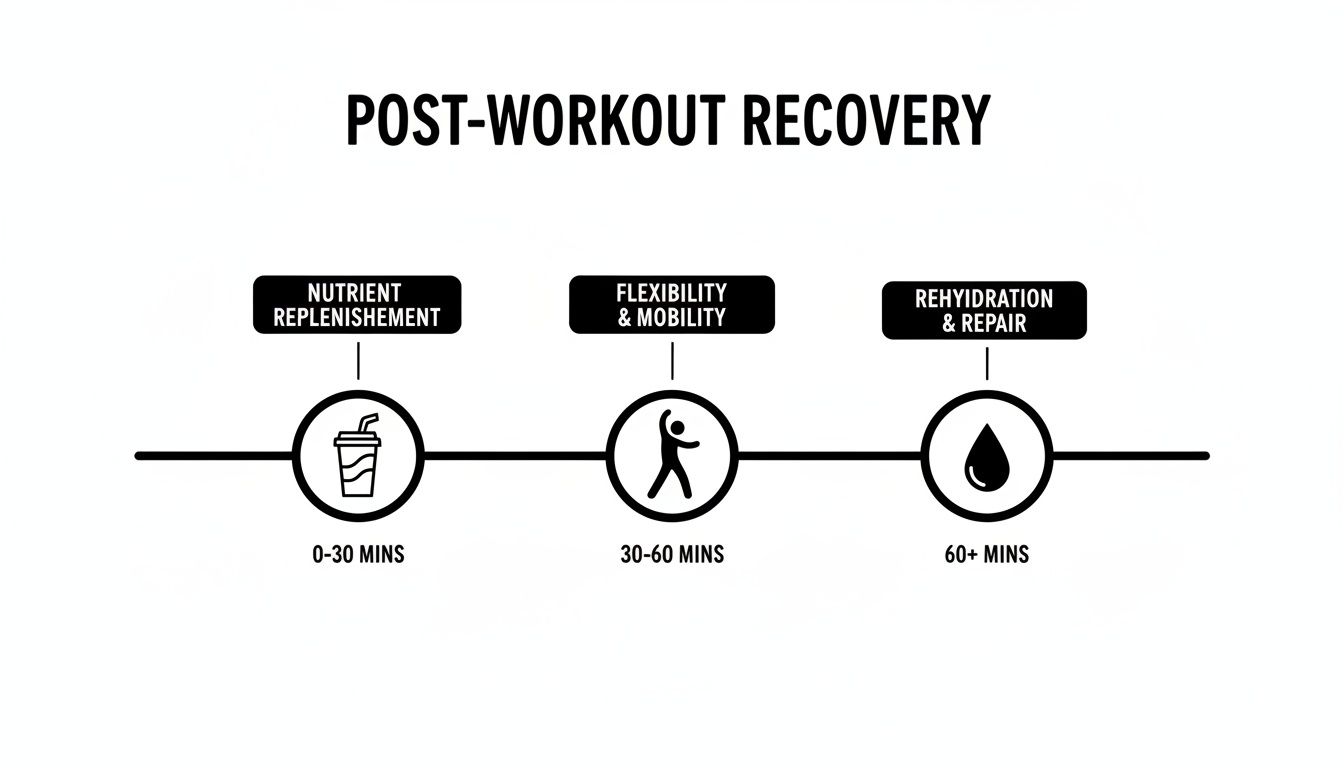
The takeaway here is simple: get your nutrition in straight away, then follow it up with some gentle mobility. This sets the stage for everything else.
To make this even easier to remember, here's a quick checklist of what to prioritise right after your session.
Your Immediate Post-Workout Recovery Checklist
| Recovery Pillar | Actionable Step | Why It Matters |
|---|---|---|
| Nutrient Timing | Consume a mix of protein and fast-digesting carbs within 30-45 minutes. | Kickstarts muscle protein synthesis and refills depleted glycogen stores when your body is most receptive. |
| Hydration | Start sipping on water or an electrolyte drink immediately. | Replaces fluids lost through sweat, which is vital for nutrient transport and overall cellular function. |
| Cool-Down | Perform 5-10 minutes of light cardio (e.g., walking, cycling) and gentle stretching. | Helps clear metabolic waste from muscles, reduces stiffness, and gradually brings your heart rate down. |
Following these steps provides your body with the essential resources it needs to switch from a state of stress to a state of repair, maximising your gains and minimising downtime.
This initial phase is all about managing that acute inflammatory response. While a bit of short-term inflammation is a vital part of the healing process, letting it run wild can seriously slow down your progress. For those exploring natural ways to support this response, understanding how certain compounds can help is key. You can learn more about using CBD to heal inflammation across the body in our detailed guide.
The goal isn't to eliminate soreness entirely—it's a sign of adaptation. The goal is to manage it effectively so you can return to training stronger and sooner, without compromising your performance or long-term joint health.
Fueling Your Recovery Through Strategic Nutrition

What you put into your body after a workout is so much more than just a meal. It's the most powerful signal you can send to kickstart the repair and rebuilding process. Forget the old "just drink a protein shake" advice; a truly smart nutrition strategy is about understanding the crucial partnership between macronutrients and micronutrients to really speed up your recovery.
When it comes to effective recovery nutrition, it all boils down to two main players: protein and carbohydrates. Protein delivers the amino acids—the essential building blocks—your body needs to repair the microscopic muscle tears you created during training. At the same time, carbohydrates are vital for refilling the muscle glycogen stores you just burned through for fuel.
Think of it like fixing a brick wall. The protein is the new bricks, and the carbohydrates are both the mortar holding it together and the energy for the builders doing the work. You absolutely need both. Skimping on one seriously undermines the effectiveness of the other.
The Protein and Carbohydrate Partnership
Straight after a tough session, your muscles are primed and ready to soak up nutrients like a sponge. This is precisely why getting a mix of protein and fast-digesting carbs into your system within 60 to 90 minutes post-workout is so incredibly effective for kick-starting the recovery process.
A good rule of thumb is to shoot for a carbohydrate-to-protein ratio of around 3:1 or 4:1. For instance, after a gruelling endurance run, you might aim for 60-80 grams of carbs with 20-25 grams of protein. After a typical strength training session, a 2:1 ratio might be a better fit.
Don't get bogged down in the numbers. The main idea is simple: give your body the building materials (protein) and the energy to actually use them (carbs). A post-workout meal of plain chicken breast just isn't a complete recovery plan.
This doesn’t mean you have to sprint home to cook a full meal. Simple, effective options can be planned ahead of time.
- Quick Shake: A scoop of whey or plant-based protein powder blitzed with a banana and a splash of oat milk.
- On-the-Go Snack: A pot of Greek yoghurt topped with a handful of berries and a little honey.
- Simple Meal: A tuna sandwich on wholemeal bread or a small bowl of oats with some nuts and fruit.
These choices deliver the necessary nutrients quickly and easily, tiding you over until your next proper meal and making sure you take full advantage of that critical post-workout window.
Beyond the Macros: Micronutrients for Repair
While protein and carbs grab the headlines, the micronutrients found in whole foods play a vital supporting role. They're key for managing inflammation and helping with cellular repair. Some foods are absolutely packed with compounds that can help calm the body's inflammatory response, which is a massive part of recovering faster from workouts.
Try to weave foods rich in antioxidants and anti-inflammatory properties into your daily diet, not just after you train. This helps create an environment that consistently supports recovery.
Foods to Prioritise for Recovery:
| Nutrient Source | Key Benefits for Recovery | UK-Friendly Examples |
|---|---|---|
| Omega-3 Fatty Acids | Helps to regulate the body's inflammatory processes, potentially reducing the severity of muscle soreness. | Salmon, mackerel, chia seeds, walnuts |
| Antioxidants | Fights oxidative stress caused by intense exercise, protecting cells from damage. | Berries, dark leafy greens (spinach, kale), beetroot |
| Potassium | An essential electrolyte for fluid balance and muscle function, often lost through sweat. | Bananas, avocados, sweet potatoes, spinach |
It's as simple as throwing a handful of spinach into your smoothie or having a side of steamed veg with your dinner to boost your micronutrient intake.
Hydration: The Overlooked Recovery Hero
Finally, whatever you do, don't underestimate the power of hydration. Water is fundamental to almost every single metabolic function in your body, from transporting nutrients to clearing out waste. Being even slightly dehydrated can make muscle soreness feel worse and dramatically slow down the entire recovery process.
A simple tip is to weigh yourself before and after a workout. For every kilogram of weight you've lost through sweat, aim to drink about 1.5 litres of fluid to get fully rehydrated. This ensures your body has everything it needs to flush out metabolic by-products and get nutrients delivered efficiently to your tired muscles.
This all-round approach to nutrition is part of a growing trend in the UK fitness scene, which is finally recognising that recovery is just as important as the workout itself. For UK fitness enthusiasts, matching solid nutrition with good sleep is a game-changer. It's been shown that getting 8 hours of sleep a night not only boosts protein synthesis but also supports the fitness industry's integration with the NHS, potentially saving billions in admissions each year. This people-first approach helps gym members, from the 48% of exercisers in the South West to the 40% in East England, recover smarter and maintain the industry's impressive growth. Find out more about the state of the UK fitness industry in this 2025 report. By fuelling your body correctly, you're laying the essential groundwork for every other recovery method to be truly effective.
Unlocking Deeper Recovery with Quality Sleep
We can spend hours planning our training and dialling in our nutrition, but many of us completely forget about the single most effective recovery tool we have: a good night's sleep. This isn’t just about feeling rested; it’s when your body gets down to the serious business of repair. This is where the real magic happens.
While you're sleeping, particularly during those deep, non-REM stages, your body gets busy producing human growth hormone (HGH). This hormone is non-negotiable for repairing the microscopic tears in your muscles that happen during exercise, ultimately making you stronger for your next session.
Put simply, if you're not getting enough quality sleep, you're leaving a huge chunk of your progress on the table. You can have the best training plan and the perfect diet, but poor sleep will always be the bottleneck holding you back from your true potential.
Creating Your Ideal Sleep Environment
Think of your bedroom as a sanctuary for rest, not a multi-purpose media room. Optimising your sleep environment sends a powerful cue to your brain that it’s time to switch off and start the recovery process. You don't need fancy gadgets, just a few smart adjustments.
The aim is to get your room as dark, quiet, and cool as you possibly can. Even a tiny bit of light from a phone charger or a gap in the curtains can disrupt your body's production of melatonin, the hormone that governs your sleep-wake cycle.
- Embrace the dark: Blackout curtains are a game-changer. At the very least, use a comfortable eye mask to block out light. Cover up or unplug any electronics with glowing lights.
- Keep it cool: The sweet spot for sleep temperature is generally between 16-18°C. A cooler room helps your core body temperature to drop, which naturally signals to your body that it's time for sleep.
- Silence the noise: If you're in a noisy area, a good pair of earplugs or a white noise machine can be a lifesaver, drowning out sounds that might otherwise pull you from deep sleep.
These small tweaks can make a surprisingly big difference to the quality of your sleep, which directly fuels how well your muscles repair themselves overnight.
Your body performs its most intensive repair work between the hours of 10 p.m. and 2 a.m. Aligning your sleep schedule to prioritise this window can significantly boost your recovery, helping you bounce back stronger after demanding training sessions.
Building a Simple Pre-Sleep Routine
Just like a warm-up gets you ready for a workout, a wind-down routine prepares your body for sleep. It’s a ritual that tells your brain the day is done and it's time to chill out. A consistent routine can actually train your body to fall asleep faster and stay asleep longer.
The absolute key is to ditch stimulating activities in the hour leading up to bed. This means stepping away from screens. The blue light from our phones, tablets, and TVs is notorious for suppressing melatonin and tricking our brains into thinking it's still daytime.
Instead, try weaving in a few of these calming habits:
- Screen curfew: Put your phone away at least 60 minutes before you want to be asleep. Honestly, this is the biggest win for most people.
- Gentle stretching: A few minutes of light mobility work can release muscle tension from the day, soothing aches and getting your body ready for rest.
- Mindful moments: Pick up a physical book (not an e-reader!), jot down some thoughts in a journal, or listen to some calming music to quiet a busy mind.
- Warm bath or shower: A warm bath not only relaxes your muscles, but the subsequent drop in your body temperature as you cool down is another powerful trigger for sleepiness.
For those nights when you need a bit of extra help drifting off, natural aids can be a great addition. We explore some fantastic options in our guide on 10 natural sleep remedies for better sleep in 2025, offering more ideas to build into your evening.
By making sleep a priority in your training plan, you're tapping into the most powerful recovery system you have. It's the secret to waking up not just rested, but properly recovered and ready for whatever your next session throws at you.
Using Active Recovery to Reduce Muscle Soreness
It might sound a bit backwards, but sometimes the worst thing you can do for sore muscles is sit completely still. While proper rest is non-negotiable, adding some strategic, low-intensity movement—what we call active recovery—can seriously speed up the healing process.
Being glued to the sofa can actually make things worse. It leads to stiffness and sluggish circulation, which means all that metabolic waste from your workout hangs around in your muscles for longer. Gentle movement, on the other hand, gets the blood pumping. This brings a fresh supply of oxygen and nutrients to your tired muscles and helps flush out the junk that causes that all-too-familiar ache. It's about using movement as a tool to feel better, faster.
What Does Active Recovery Actually Look Like?
Let's be clear: active recovery is not another punishing workout. It’s the complete opposite. The goal is to move your body at a very low intensity, somewhere around 30-50% of your maximum effort. Think "gentle and restorative," not "challenging and intense."
The whole point is to pick an activity that gets your muscles working without putting any real stress on them. This stimulates blood flow without causing any more damage to the muscle fibres that are already busy repairing themselves.
Here are a few real-world examples of what a solid active recovery session could be:
- A brisk walk: A simple 20-30 minute walk is probably the easiest and most accessible option out there.
- A light bike ride: Jump on a stationary bike or go for a gentle cycle on a flat path. The focus is on easy pedalling, not working up a sweat.
- A gentle swim or water aerobics: The water takes all the pressure off your joints, making it a fantastic, zero-impact way to get a full-body flush.
- Light yoga or dynamic stretching: Flowing through some gentle yoga poses is a great way to boost flexibility and circulation at the same time.
It's no surprise that low-impact classes are booming in the UK right now. People are realising just how effective this approach is. Active recovery, through things like yoga and Pilates, is becoming a go-to strategy, helping to speed up workout recovery by an estimated 35% simply by improving circulation. This trend is really taking off among the UK's 11.3 million gym members as a smart way to manage muscle soreness. For more on this, you can discover more insights about top recovery trends on m8group.co.uk.
Targeted Mobility Work for Faster Relief
Beyond just general low-intensity movement, you can use active recovery to zero in on specific tight spots. This is where tools like foam rollers and targeted stretching routines come in, helping you release knots and get your range of motion back.
Foam rolling is basically like giving yourself a deep-tissue massage. By applying pressure to those tight spots, or "trigger points," you can help break up muscle knots and make the tissue more flexible.
This screenshot from a Wikipedia article shows someone foam rolling their IT band, a classic tight spot for runners and lifters. It’s a perfect example of applying direct pressure to break up adhesions and get blood flowing right where it's needed most.
A good foam rolling session doesn't need to take all day. Just 5-10 minutes after a light warm-up or on a rest day can make a massive difference.
Pro Tip: When you're foam rolling, go slowly. When you find a tender spot, just pause on it for 20-30 seconds and breathe deeply to help the muscle relax. Steer clear of rolling directly over your joints or bones.
Sample Mobility Routines
Here are two quick routines you can throw into your active recovery days—one for when your lower body is screaming, and one for your upper body.
Lower-Body Focus (Post Leg Day):
- Foam Roll Quads: 60 seconds per leg.
- Foam Roll Hamstrings & Glutes: 60 seconds per leg.
- World's Greatest Stretch: 5 reps per side, holding each position for a few seconds.
- Pigeon Pose: 30-45 seconds per side to really open up the hips.
Upper-Body Focus (Post Push/Pull Day):
- Foam Roll Lats & Upper Back: 60 seconds.
- Cat-Cow Stretch: 10 reps to get the spine moving.
- Doorway Chest Stretch: 30 seconds per side.
- Thread the Needle: 5 reps per side to open up the shoulders.
Weaving these active recovery and mobility sessions into your week is a powerful strategy. For those looking to give their body's repair systems an extra boost, certain supplements can complement these physical practices nicely. You can explore our detailed guide on how CBD can be beneficial for athletes and sports recovery to learn more about natural options. By combining smart movement with other supportive measures, you create a solid system for bouncing back even stronger.
Building Your Personal Weekly Recovery Plan

Knowing the individual pieces of the recovery puzzle is great, but putting them together into a consistent weekly schedule is where the magic really happens. A solid plan takes the guesswork out of the equation, making sure you’re doing the right things at the right times to speed up repair and keep soreness at bay. This is how recovery stops being an afterthought and becomes an automatic part of your routine.
Your plan doesn't need to be over-the-top complicated. It just needs to be intentional. It should flex with your training split and the intensity of your sessions. After all, the recovery your body needs after some light cardio is a world away from what it's crying out for after a monster leg day.
The secret is to map out your week, plugging specific recovery actions into specific days. This structured approach is what builds habits that stick, turning good principles into consistent practice.
Structuring Your Recovery Around Training
First thing's first: take a good look at your training schedule. Are you running a 3-day full-body routine, a 5-day body-part split, or something else entirely? Your recovery plan should be a mirror image of this structure, with your most powerful recovery tools scheduled for the days surrounding your toughest workouts.
Let’s use a common 4-day upper/lower split as an example. Your week might look like this: training on Monday, Tuesday, Thursday, and Friday, with rest days on Wednesday, Saturday, and Sunday. That gives us a clear framework to work with.
- High-Intensity Days: These are your big sessions, like a heavy leg day or a high-volume upper body workout. Recovery on and after these days has to be a top priority.
- Moderate-Intensity Days: Think lighter upper body work or shorter cardio sessions. Recovery is still crucial, but it might not need to be quite as full-on.
- Rest/Active Recovery Days: These are your golden days off from the gym. They aren't "do nothing" days, but they are perfect for dedicated active recovery and mobility work.
Categorising your days like this helps you match the recovery dose to the training stress, so your efforts are always proportional.
Tailoring Recovery to Workout Intensity
So, how does this look in practice? It’s all about layering your recovery tactics based on how hard you’ve pushed your body.
Picture this: you've just smashed a brutal leg day, hitting new personal bests on squats and lunges. The micro-trauma to your muscles is significant, and your nervous system has taken a beating. Your recovery needs to be dialled right in.
After your most demanding workouts, the immediate goal is to calm your system down and kickstart the repair process as fast as possible. This is when your nutrition, hydration, and some gentle movement become completely non-negotiable.
Now, compare that to a moderate-intensity cardio session, like a 30-minute jog. You’ve worked your heart and lungs, but the muscular damage is minimal. Your recovery can be much simpler.
For those particularly gruelling sessions where you know muscle soreness is coming, topical solutions can offer some welcome, localised relief. A targeted application can help soothe those overworked areas. If you're building out your recovery toolkit, learning more about the benefits of a CBD muscle rub could be a great place to start.
Sample Weekly Recovery Schedule
To see how this all fits together, here’s a sample schedule showing how you can build recovery into a typical training week. Think of this as a foundation—feel free to tweak it to fit your own schedule, preferences, and how your body feels.
| Day | Training Focus | Key Recovery Actions |
|---|---|---|
| Monday | Upper Body (Heavy) | Immediate post-workout nutrition (protein/carbs). Evening: 10 mins targeted stretching for chest/back. Aim for 7-8 hours of sleep. |
| Tuesday | Lower Body (Heavy) | Immediate post-workout nutrition. Evening: 15 mins foam rolling for quads, glutes, and hamstrings. Consider a warm bath before bed. |
| Wednesday | Active Recovery | 30-minute brisk walk or light cycle. Full-body mobility routine focusing on hips and shoulders. Focus on hydration all day. |
| Thursday | Upper Body (Light) | Post-workout nutrition. Focus on whole-food meals throughout the day to support ongoing repair. |
| Friday | Full Body Conditioning | Cool-down with 5-10 mins of light cardio. Ensure adequate hydration to replace lost fluids and electrolytes. |
| Saturday | Active Recovery | Gentle yoga session or a long walk. Focus on mindful movement and breathing to calm the nervous system. |
| Sunday | Full Rest | Prioritise relaxation. Light stretching if needed. Prepare meals for the upcoming week to support nutritional goals. |
This schedule shows how you can strategically layer different recovery methods throughout the week. By planning ahead, you make sure that even on your busiest days, you’re still giving your body the support it needs to adapt, get stronger, and come back ready for the next challenge.
Common Questions About Workout Recovery
Even with the best recovery plan in place, it’s normal for questions to pop up. Fine-tuning your approach is all about learning to read the subtle (and not-so-subtle) signals your body is sending you.
Let's clear up some of the most common queries I hear, so you can feel confident you’re making the right calls for your body.
One of the biggest areas of confusion is muscle soreness. That familiar ache, known as Delayed Onset Muscle Soreness (DOMS), is a good thing! It’s a sign your muscles are adapting and growing stronger, and it usually peaks around 24 to 48 hours after a tough session.
But not all pain is productive. Sharp, stabbing, or nagging pain that hangs around for days is a definite red flag. If you’re so sore you can barely move, you’ve likely overdone it or, worse, picked up an injury.
How Much Soreness Is Too Much?
Knowing the difference between that "good ache" and a real problem is probably the most important recovery skill you can learn. DOMS should feel like a dull, generalised ache in the muscles you trained, not a sharp pain pinpointed in a joint or tendon.
You should still be able to go about your day. If you’re wincing every time you go down the stairs or can't lift your arms a couple of days later, it's a clear signal to ease off the intensity and double down on gentle recovery.
My rule of thumb is this: if the pain is sharp, located in a joint, or isn't getting better after 72 hours, it’s time to rest up and maybe get it checked out by a professional. The goal is consistent progress, not just suffering for the sake of it.
Making this distinction is key to recovering faster. It teaches you to listen to your body’s feedback, so you can keep challenging yourself without causing damage.
Are Ice Baths Really Necessary?
Ah, the great ice bath debate. They've been a go-to for elite athletes for decades, mainly to hammer down inflammation and soreness. The intense cold constricts your blood vessels, which can help flush out metabolic waste from your muscles once you get out and your circulation ramps back up.
But here’s the catch: some recent research suggests that blunting that inflammatory response too aggressively might actually hinder long-term muscle growth. A certain amount of inflammation is a crucial signal for your body to rebuild and get stronger.
So, for most of us, an ice bath is probably overkill. Here are a few solid alternatives:
- Contrast Showers: Try alternating between hot and cold water in the shower (say, one minute cold, two minutes hot). This can boost circulation without the full-body shock of an ice bath.
- Active Recovery: As we’ve already covered, light, gentle movement is one of the best ways to ease soreness by simply getting the blood flowing.
- Topical Relief: A good cooling gel or muscle rub can offer some fantastic, targeted relief from soreness without messing with your body's natural repair signals on a systemic level.
Ultimately, it comes down to your goals. If you're a competitor who needs to be back at peak performance for another event tomorrow, an ice bath might give you that edge. For general fitness and building strength over time, you’re far better off focusing on the fundamentals: nutrition, sleep, and active recovery.
At SMOKO CBD, we know that solid recovery is the foundation of any fitness journey. Our UK-made, lab-tested CBD products are crafted to support your body's own repair systems, helping you manage soreness and get back to what you love doing sooner. Check out our premium CBD oils and muscle rubs to find the perfect addition to your recovery toolkit.