TL;DR:
- Broad-spectrum CBD does not cause a caffeine-like energy spike but aids recovery through better sleep, inflammation reduction, and anxiety management. It is not ergogenic and offers no direct performance enhancement, but some athletes report improved sleep and reduced soreness. Always verify products with batch-specific COAs showing THC as “not detected” for safe and compliant use.
Broad-spectrum CBD does not give you a caffeine-style energy spike. What it can do is help you feel more energised by improving the quality of your sleep, reducing training-related inflammation, and taking the edge off pre-competition anxiety. That distinction matters for any athlete thinking clearly about what they are putting into their body.
- WADA status: The World Anti-Doping Agency removed CBD from its prohibited list in 2018. THC remains banned, which is why zero-THC verification via a third-party Certificate of Analysis (COA) is non-negotiable for tested athletes.
- UK regulatory position: The Food Standards Agency advises healthy adults to consume no more than 10mg of CBD per day from food sources.
- Evidence base: A 2026 doctoral thesis from Liverpool John Moores University (LJMU) confirmed that CBD is not ergogenic — it did not enhance a 10-minute cycling time trial — but noted plausible recovery and sleep benefits.
- Practical pointer: Choose a broad-spectrum product with a downloadable COA showing THC as “not detected.” Smokocbd’s tinctures meet this standard.
Table of Contents
- How does CBD support natural energy in athletes?
- What does the evidence actually show?
- Which CBD formats work best for athletes?
- How to use CBD safely: dosing, timing and interactions
- Three practical CBD protocols for athletes
- Key takeaways
- Why realistic expectations are the most honest advice
- Smokocbd’s mint tincture: built for athletes who need certainty
- Useful sources and further reading
How does CBD support natural energy in athletes?
The phrase “natural energy” is doing real work here. CBD does not stimulate the central nervous system the way caffeine does. Instead, it interacts with the endocannabinoid system (ECS) to create conditions where your body can recover, rest, and regulate itself more effectively — and that is where the energy comes from.
Sleep architecture. CBD appears to support slow-wave (deep) sleep, the phase most critical for physical repair and hormonal regulation. Athletes who sleep better wake up with more genuine readiness, not a borrowed alertness that crashes by midday.
Inflammatory pathways. CBD interacts with CB2 receptors, which are concentrated in immune tissue. By modulating the inflammatory response after hard training, it may help the body tone down excessive soreness without suppressing the adaptation signal entirely.
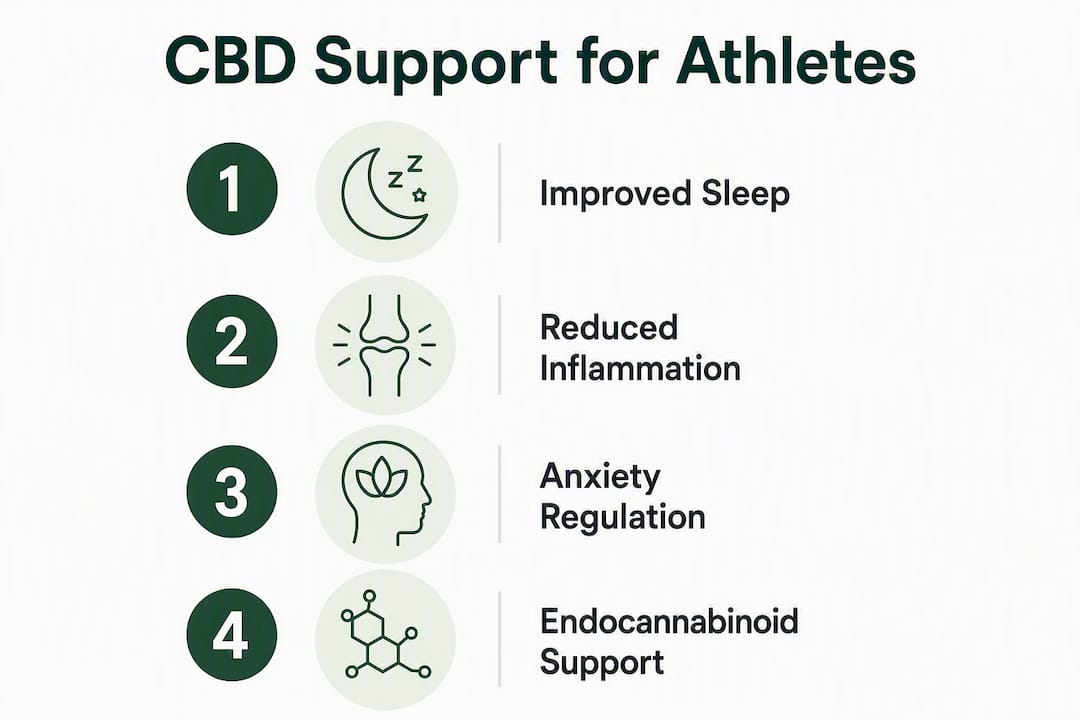
Anxiety and arousal regulation. CBD acts on 5-HT1A serotonin receptors and adenosine pathways, which helps ramp down the heightened arousal that keeps athletes awake after evening sessions or wired before competition.
Endocannabinoid regulation. The ECS governs mood, pain perception, and stress response. Consistent CBD use supports baseline ECS tone rather than delivering a one-off hit.
Research from LJMU is clear that CBD does not directly increase strength, speed, or aerobic capacity. The natural energy athletes describe is a downstream consequence of better recovery, not a pharmacological stimulant effect.
What does the evidence actually show?
The honest answer is: promising signals, but limited high-quality trials. Here is where the data currently stands.
A survey of elite Canadian athletes found that many reported CBD use, and among users, the majority agreed it improved their sleep and reduced training-related pain, while most did not agree that CBD directly improved physical performance.
The LJMU doctoral thesis adds an important caution: prolonged supplementation with broad-spectrum products led to the appearance of prohibited cannabinoids in urine in some participants. That contamination risk is real, and it is the single strongest argument for choosing only products with batch-level COAs.
| Outcome domain | Strength of evidence | Notes |
|---|---|---|
| Sleep quality | Moderate | Consistent self-report; some clinical support |
| Pain and soreness | Moderate | Strong self-report; RCT results mixed |
| Inflammation markers | Low–moderate | Mechanistic plausibility; limited human trials |
| Direct performance | Very low | No ergogenic effect in controlled trials |
Common limitations across the literature include small sample sizes, variable dosing, mixed product formulations, and expectation (placebo) effects. Treat the evidence as encouraging rather than conclusive, and track your own response over four to six weeks.
Which CBD formats work best for athletes?
Athletes use four main formats, each with a different onset speed and duration. Matching the format to your goal is more important than chasing the highest milligram count.
| Format | Onset | Duration | Best use case |
|---|---|---|---|
| Oil tincture (sublingual) | 15–45 min | 3–5 hrs | Pre-sleep; post-session baseline |
| Gummies / edibles | 45–90 min | 4–6 hrs | Sustained daily coverage |
| Soft gel capsules | 45–90 min | 4–6 hrs | Consistent daily dosing; travel |
| Vape | 1–3 min | 1–3 hrs | Acute pre-competition anxiety |
Onset and duration data sourced from practitioner guidance for UK athletes.
When choosing any format, check for these trust features before you buy:
- Third-party COA with batch number matching the product you receive
- “Not detected” for THC (not just “broad-spectrum” marketing language)
- Stated mg per bottle and mg per serving so you can dose accurately
- Novel food compliance — the product should appear on the FSA’s CBD products register
Surveys show that oral tinctures are the most common format among athletes, partly because the dose is easy to adjust and the COA is straightforward to verify. For localised post-training soreness, a topical option such as the Rikki Tikki recovery balm can complement an oral routine without adding to your systemic dose.
Pro Tip: When reading a COA, look at the cannabinoid panel, not just the headline CBD figure. “Not detected” next to THC, CBN, and other controlled cannabinoids is what you need to see — not just a low number.
How to use CBD safely: dosing, timing and interactions
Starting dose and titration. The FSA’s consumer advice sets a precautionary limit of 10mg per day from food sources for healthy adults. Practitioners working with athletes may suggest starting at or slightly above this level and titrating upward over two to four weeks, though any intake above 10mg daily should be discussed with a qualified professional. If you are subject to drug testing, stay conservative and verify every batch.
Timing by goal:
- Pre-sleep: Take a sublingual tincture 30–45 minutes before bed to align with the 15–45 minute onset window.
- Post-training: Dose within 60 minutes of finishing a session to support the acute inflammatory response.
- Daily baseline: A consistent morning or evening dose builds cumulative ECS tone more effectively than reactive dosing when soreness strikes.
Safety considerations:
- CBD inhibits CYP450 liver enzymes, which process many common medications. If you take blood thinners (such as warfarin), speak to your GP before starting CBD.
- CBD is not recommended during pregnancy or for anyone under 18.
- Common side effects include dry mouth, mild drowsiness, and transient changes in appetite — usually dose-dependent and manageable by reducing the amount.
For tested athletes: WADA permits CBD, but THC remains prohibited. Contamination from broad-spectrum products is a documented risk. Only use products with a current, batch-specific COA. See the CBD workout checklist for a pre-purchase verification routine.
Pro Tip: Split your dose: take half post-training and half pre-sleep. This approach covers both the acute recovery window and the sleep architecture benefit without doubling your total daily intake.
Three practical CBD protocols for athletes
Pre-sleep protocol
Format: Sublingual tincture | Timing: 30–45 min before bed | Dose range: Start at 10mg
Take your tincture after your evening wind-down routine. The goal is to support slow-wave sleep, so consistency matters more than the exact dose. Track sleep quality and morning readiness in a simple training log.
Post-session recovery protocol
Format: Tincture or soft gel | Timing: Within 60 minutes of finishing training | Dose range: 10mg
Practitioners recommend dosing close to the training session rather than hours later, when the inflammatory cascade is already underway. Pair with adequate protein and hydration — CBD is a complement to recovery nutrition, not a replacement for it.
Travel and competition protocol
Format: Soft gel capsules | Timing: Evening before competition; morning of if anxiety is high | Dose range: 10mg
Capsules travel easily and deliver a consistent dose without measuring. For acute pre-competition nerves, some athletes add a low-dose vape, though this format carries additional respiratory considerations. Stick to the lowest effective dose during competition periods and carry your COA documentation.
Pro Tip: Log three simple metrics each morning: sleep quality (1–5), muscle soreness (1–5), and perceived readiness (1–5). After four to six weeks, you will have a personal data set that tells you whether CBD is genuinely working for you.
Key takeaways
Broad-spectrum CBD supports natural energy in athletes indirectly, through better sleep, reduced inflammation, and lower anxiety — not by acting as a stimulant or ergogenic aid.
| Point | Details |
|---|---|
| CBD is not ergogenic | Controlled trials show no direct performance gain; benefits come via recovery and sleep. |
| Sleep and recovery are the mechanism | Many CBD-using elite athletes in a Frontiers survey agreed CBD improved their sleep. |
| Zero-THC COA is non-negotiable | Contamination risk is documented; always verify batch-level lab results before use. |
| Start low and track for 4–6 weeks | Cumulative ECS regulation takes time; sporadic high doses miss the benefit. |
| Smokocbd for athletes | The SMOKO CBD Mint 2000mg tincture offers a broad-spectrum, zero-THC verified option with a downloadable COA. |
Why realistic expectations are the most honest advice
The wellness space has a habit of overselling CBD as a cure-all, and the athletic supplement market is no different. What the evidence actually supports is more modest and, frankly, more useful: CBD can help you sleep more deeply, recover with less systemic inflammation, and feel less wired before competition. For athletes, those three things compound into something genuinely valuable over a training block.
What it will not do is replace a poor sleep routine, compensate for under-fuelling, or give you a performance edge in a single dose. The athletes who report the most consistent benefit are those who treat CBD as part of a structured recovery approach — consistent daily dosing, good sleep hygiene, and proper nutrition working together.
The contamination risk is also worth stating plainly. Broad-spectrum products can and do trigger positive tests when batch testing is absent. No marketing claim substitutes for a COA with “not detected” against THC. That is the one non-negotiable for any athlete under a testing regime.
Smokocbd’s mint tincture: built for athletes who need certainty
For athletes who want a CBD tincture with verified zero THC, the SMOKO CBD Mint 2000mg Broad Spectrum Tincture is the product that maps directly to the guidance in this article.
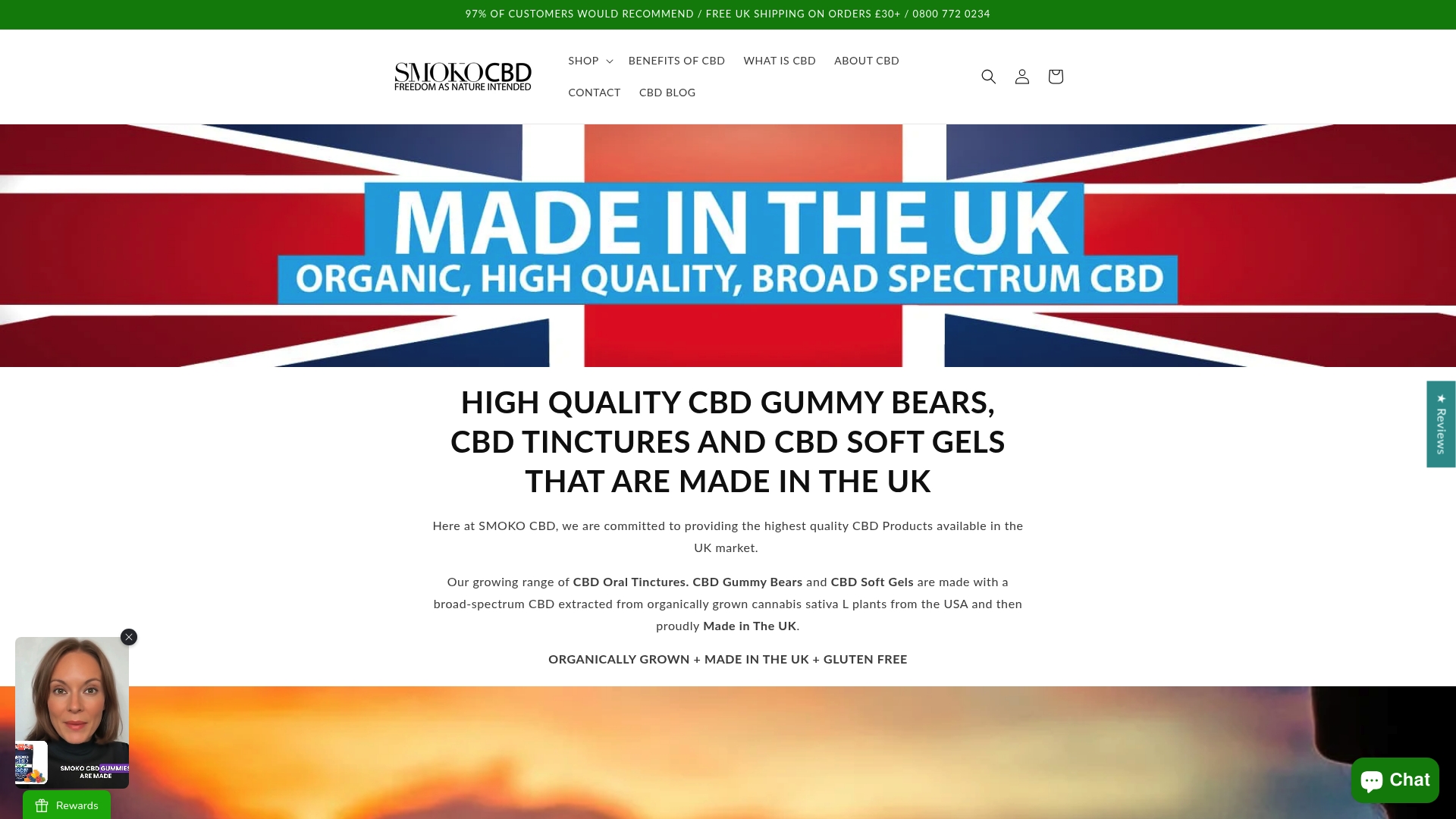
The 2000mg bottle delivers a clear mg-per-serving figure, uses organically grown hemp, and comes with a downloadable third-party COA confirming THC as “not detected” — the exact standard tested athletes need. The mint flavour makes sublingual dosing straightforward, and the MCT oil carrier supports consistent absorption. Smokocbd’s customer support team can advise on potency selection if you are unsure whether 2000mg is the right starting point for your training load. Visit the product page to download the COA and check current pricing before your next training block.
This article is for general information only and does not constitute medical or nutritional advice. Consult a qualified healthcare professional before starting CBD, particularly if you take prescribed medication or compete under an anti-doping programme.
Useful sources and further reading
- LJMU doctoral thesis: The Role of Cannabidiol in Sport — the most comprehensive UK-adjacent review of CBD’s ergogenic potential and contamination risks
- Frontiers in Nutrition: CBD use among elite Canadian athletes — athlete survey data on sleep, pain, and recovery outcomes
- Food Standards Agency: consumer advice for CBD — UK dosing guidance and the basis for the 10mg/day precautionary limit
- FSA CBD novel food applications — regulatory status of CBD as a novel food in Great Britain
- FSA register of CBD products — check whether a product is linked to a valid novel food application
- Smokocbd: CBD for athletes and sports recovery — practical recovery guidance for active people
- Smokocbd: types of CBD for athletes — format comparison and sport use cases
When in doubt about anti-doping compliance, contact your sport’s national governing body directly and carry your product’s COA to any testing appointment.