TL;DR:
- Sublingual CBD drops absorb faster and have higher bioavailability than swallowed pills due to bypassing first-pass liver metabolism. They typically produce effects within 15 to 45 minutes, while capsules take longer but offer sustained benefits and precise dosing. Bioavailability varies between 13 and 35 percent for drops, compared to 6 to 19 percent for oral forms, influenced by formulation, fat intake, and quality.
Sublingual CBD drops generally deliver faster onset and higher practical bioavailability than swallowed pills, and the reason comes down to one biological shortcut: partial bypass of first-pass liver metabolism. Hold a few drops under your tongue for 60–90 seconds and cannabidiol absorbs directly through the thin mucosal membranes into your bloodstream, typically producing effects within 15–45 minutes. Swallowed capsules must travel through your stomach, small intestine, and portal vein before the liver processes them, which both slows onset (often 30–120 minutes) and reduces how much CBD actually reaches circulation. Sublingual bioavailability is commonly estimated at 13–35%, compared with roughly 6–19% for oral forms. That said, drops are not automatically the right choice for everyone. Pills offer longer-lasting effects, pre-measured dosing, and no hemp taste, which matters more than a few percentage points of bioavailability for people who simply will not take their dose consistently. Smokocbd’s broad-spectrum tinctures and soft gel capsules both carry third-party certificates of analysis (COAs), so you can verify exactly what you are getting before choosing.
Table of Contents
- Why drops beat pills for CBD: the sublingual absorption mechanism
- How do onset times and bioavailability actually compare?
- What actually changes how much CBD your body absorbs?
- How to get the most from drops and pills
- When should you choose drops, and when do capsules make more sense?
- Safety, drug interactions, and UK guidance
- Smokocbd’s quality checks: what to look for in a trustworthy supplier
- Key takeaways
- The case for knowing your format before you buy
- Try Smokocbd’s tinctures and capsules
- Useful sources for further reading
Why drops beat pills for CBD: the sublingual absorption mechanism
The difference between drops and pills is not just speed. It is a fundamentally different route through your body.
When you place CBD drops under your tongue, the compound crosses the sublingual mucosa, a thin layer of tissue rich in capillaries that sits directly beneath the tongue. From there, CBD enters the bloodstream without passing through the digestive tract first. This partial bypass of the gut-to-liver pathway is what gives sublingual administration its edge.
Swallowed CBD follows a longer, more hostile route. A capsule dissolves in the stomach, CBD moves into the small intestine, and the portal vein carries it to the liver before it reaches systemic circulation. During that liver pass, cytochrome P450 enzymes, particularly CYP3A4, break down a significant portion of the compound. This is first-pass metabolism, and it is the primary reason oral bioavailability sits so much lower than sublingual.
The practical consequences of these two routes:
- Onset speed: Sublingual drops typically begin working within 15–45 minutes; capsules often take 30–120 minutes.
- Peak concentration: Drops tend to produce a higher peak blood level from the same nominal dose.
- Duration: Oral forms generally sustain effects for longer because absorption is slower and more gradual.
- Dosing control: Drops allow flexible micro-adjustments; capsules deliver a fixed, pre-measured amount per unit.
How do onset times and bioavailability actually compare?
The numbers are real, but they are also approximate, and understanding why they vary stops you from treating them as guarantees.
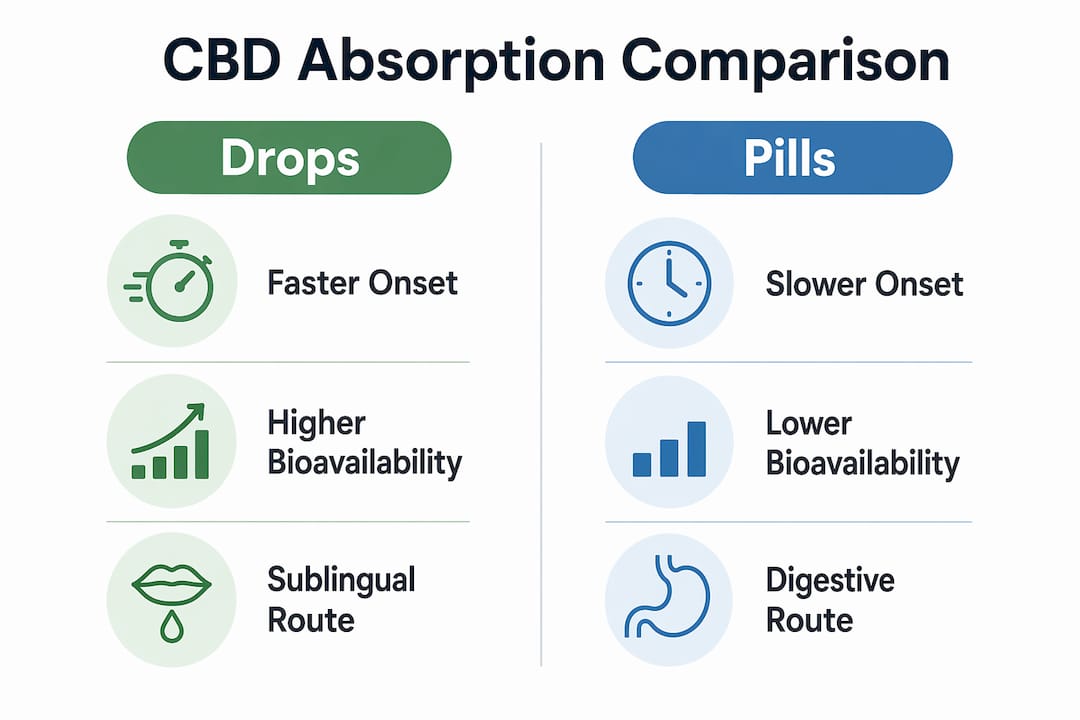
Sublingual CBD typically shows higher bioavailability than swallowed oral forms. Onset for drops generally occurs faster than for capsules and pills. On duration, sublingual forms tend to produce effects for a shorter window, while oral forms sustain them for longer, sometimes several hours, because the slower absorption creates a more extended release profile.
| Dimension | CBD drops (sublingual) | CBD pills / capsules (oral) |
|---|---|---|
| Typical bioavailability | ~13–35% | ~6–19% |
| Onset time | ~15–45 minutes | ~30–120 minutes |
| Duration of effect | Shorter (2–4 hours typical) | Longer (4 hours typical) |
| Dosing accuracy | Variable (dropper technique) | Consistent (pre-measured) |
| Convenience / portability | Moderate | High |
| Taste / adherence | Hemp flavour present | Tasteless, easy to swallow |
These ranges come from multiple studies with different populations, formulations, and doses, so individual results will vary. Metabolism speed, body composition, and whether you have eaten recently all shift where you land within those windows.
Pro Tip: The milligrams printed on a product label tell you what is in the bottle, not what your body absorbs. A 1,000 mg tincture with 13% bioavailability delivers roughly 130 mg to your system; the same figure at 35% delivers around 350 mg. Always read the COA alongside the label to confirm actual cannabinoid content before comparing products.
What actually changes how much CBD your body absorbs?
Two products with identical labels can behave very differently in the body. These are the variables that shift the absorption gap.
Carrier oil and lipophilicity. CBD is fat-soluble, which means it dissolves in lipids rather than water. Carrier oils like MCT (medium-chain triglyceride) oil and olive oil improve CBD’s ability to form the lipid-based particles that cross cell membranes. MCT oil is particularly efficient because medium-chain fatty acids are absorbed rapidly and carry CBD with them.

Formulation type. Broad-spectrum and full-spectrum extracts contain a range of cannabinoids, terpenes, and plant compounds that may support absorption and activity through what is often called the entourage effect. Isolate-based products contain CBD alone, which can mean a simpler but potentially less synergistic matrix.
Food and fat intake. Taking oral CBD with a high-fat meal can meaningfully increase absorption. Dietary fat triggers bile production and helps form micelles in the intestine, which improve CBD’s passage through the intestinal wall. For capsule users, this is one of the most practical levers available.
Product quality and concentration accuracy. Mislabelled products and potency variance are genuinely common in the CBD market. A product claiming 1,000 mg may contain significantly more or less. Third-party COAs, verified by an independent laboratory, are the only reliable way to confirm what you are actually taking.
Third-party lab testing is not a marketing badge. A COA should include a full cannabinoid profile, residual solvent testing, heavy metal screening, and a batch number that matches the product in your hand. If a supplier cannot provide one, that is a meaningful red flag.
How to get the most from drops and pills
Getting the technique right matters as much as choosing the right format.
For drops: Place the recommended number of drops directly under your tongue, not on top of it. Hold for at least 60 seconds, ideally 90, before swallowing. Swallowing immediately pushes the CBD into the oral route and loses most of the sublingual advantage. Start with a low dose and titrate gradually, increasing every few days until you find your effective range. A practical reference: knowing how many drops are in 1 ml of your tincture helps you convert volume to milligrams accurately.

For capsules: Take them with a meal that contains healthy fats, such as avocado, nuts, or olive oil. This simple step can materially narrow the bioavailability gap between capsules and drops. Choose softgels over hard-shell capsules where possible, as the liquid-fill formulation typically disperses more readily.
Tracking and titration. Keep a brief symptom and dose log for the first two to four weeks. Note the time you took your dose, what you ate, and when you noticed any effect. This removes guesswork and helps you identify your personal response pattern.
Pro Tip: If the taste of hemp oil puts you off drops, a flavoured tincture can make consistent dosing far more sustainable. Adherence matters more than theoretical bioavailability — the best format is the one you will actually take every day.
Avoid mixing drops and capsules in the same dose window until you understand how each affects you individually. Combining formats without a clear rationale makes it harder to identify what is working.
When should you choose drops, and when do capsules make more sense?
Neither format is universally better. The right choice depends on what you are trying to achieve.
Choose drops when:
- You need faster relief, such as during an anxiety spike or acute discomfort.
- You want flexibility to adjust your dose up or down without committing to a fixed unit.
- You are in an early titration phase and need to fine-tune your response.
- Speed of onset is your primary priority.
Choose capsules when:
- You take CBD as part of a daily maintenance routine and prefer a consistent, once-daily dose.
- You travel frequently or want a discreet, portable option.
- The taste of hemp oil is a barrier to consistent use. User compliance is often the decisive factor in real-world outcomes, and capsules remove the taste variable entirely.
- You find dropper measurement unreliable. Pre-measured capsules eliminate the dosing error that can offset the sublingual advantage for inexperienced users.
The longer duration of oral forms is also worth factoring in. If you want sustained background support through a working day, a morning capsule may serve you better than a tincture that peaks and fades within a few hours. Many people find that combining both formats, drops for acute moments and capsules for baseline maintenance, gives them the best of both. Just track carefully when you start.
Safety, drug interactions, and UK guidance
CBD is generally well tolerated, but it carries real interaction risks that are worth understanding before you start.
The most significant concern involves cytochrome P450 liver enzymes. CBD interacts with medications in a manner similar to grapefruit juice, inhibiting the enzymes that process many common drugs. If you take anticoagulants, antiepileptics, antidepressants, or other regular prescription medicines, speak to your GP before adding CBD to your routine. This is not a theoretical caution; it is a practical one.
If you take any prescription medication, treat CBD the same way you would treat grapefruit juice: check with your GP or pharmacist before combining them. The interaction risk is real and applies to both drops and capsules, regardless of the delivery format.
Common side effects include fatigue, changes in appetite, and occasional nausea, particularly at higher doses. The Food Standards Agency advises that healthy adults should not exceed 70 mg of CBD per day from food supplements. Pregnant and breastfeeding women are advised to avoid CBD products. For UK-specific dosage limits, Smokocbd’s UK safety guide covers the current guidance in detail.
Third-party COAs are your primary safeguard against contaminants. A reputable COA will confirm cannabinoid potency, absence of residual solvents, and heavy metal levels within safe limits. Never rely on a product that cannot provide one.
This article is general information, not medical advice. Confirm current guidance with the Food Standards Agency or a qualified healthcare professional for your own situation.
Smokocbd’s quality checks: what to look for in a trustworthy supplier
Quality signals on a product page tell you whether a supplier has done the work that actually protects you.
| Quality check | What to look for | Why it matters |
|---|---|---|
| Third-party COA | Independent lab report, not self-certified | Confirms actual cannabinoid content and absence of contaminants |
| Cannabinoid profile | CBD, CBG, CBC listed with mg/ml values | Verifies potency and broad-spectrum status |
| THC level | Zero or below legal threshold (UK) | Confirms legal compliance and no psychoactive risk |
| Residual solvents | Below detection limits | Indicates clean extraction process |
| Heavy metals | Lead, mercury, arsenic, cadmium tested | Protects against contamination from soil or processing |
| Batch number | Matches COA to specific production run | Allows traceability and recall identification |
Smokocbd publishes COAs accessible via product pages for its broad-spectrum tinctures and soft gel capsules, with batch numbers that correspond to specific production runs. The tinctures use MCT oil as a carrier, which supports the lipophilic absorption discussed earlier. If a COA is not immediately visible on a product page, contact customer support directly and ask for the batch-specific report. A supplier confident in their product will provide it without hesitation.
Key takeaways
Sublingual CBD drops typically outperform swallowed pills on speed and peak absorption because they partially bypass first-pass liver metabolism, though capsules offer longer duration and more consistent dosing.
| Point | Details |
|---|---|
| Sublingual advantage | Drops absorb via mucosal membranes, reaching the bloodstream faster with estimated bioavailability of 13–35% versus 6–19% for oral forms. |
| Onset difference | Drops typically take effect in 15–45 minutes; capsules take 30–120 minutes, but sustain effects for longer. |
| Fat improves oral absorption | Taking capsules with a high-fat meal can meaningfully narrow the bioavailability gap between the two formats. |
| Compliance often decides outcomes | Consistent daily dosing matters more than format; if the taste of drops puts you off, capsules are the better practical choice. |
| Smokocbd quality checks | Smokocbd’s broad-spectrum tinctures and capsules carry third-party COAs confirming cannabinoid content, zero THC, and contaminant testing. |
The case for knowing your format before you buy
There is a tendency in CBD discussions to treat bioavailability as the whole story, and it is not. The 13–35% sublingual range versus 6–19% oral range is a meaningful difference, but it is a range, not a fixed outcome. Someone who takes a capsule with a fatty meal, every morning, without fail, will likely get more consistent benefit than someone who uses drops sporadically because the taste bothers them.
What actually matters is the combination of absorption potential and real-world adherence. Drops have the edge on speed and peak levels, which makes them genuinely useful for acute situations. Capsules have the edge on consistency and convenience, which makes them the better backbone for a daily routine. The mistake is assuming one format is categorically superior.
Smokocbd’s position is straightforward: tinctures for speed and flexibility, soft gel capsules for routine and discretion. Both formats are only as good as the quality behind them, which is why COA verification is not optional. If a product cannot show you its lab report, the bioavailability debate is irrelevant.
Try Smokocbd’s tinctures and capsules
If you have read this far and want to put the absorption science into practice, Smokocbd’s broad-spectrum CBD tinctures are a practical starting point. The 1,000 mg mint tincture uses MCT oil as a carrier and comes with a third-party COA confirming cannabinoid content and zero THC. For those wanting a stronger option, the 2,000 mg mint tincture follows the same quality standard. Both are made from organically grown hemp and formulated for sublingual use.
If you prefer the convenience and consistency of capsules, Smokocbd’s soft gel capsules offer pre-measured broad-spectrum CBD in a format designed for daily maintenance. Start with the lower-strength tincture; hold it under your tongue for 60–90 seconds, and track your response over the first two weeks before adjusting. COAs are available on each product page; if you have questions about formulation or lab results, Smokocbd’s customer support team can help.
Useful sources for further reading
| Source | Best used for |
|---|---|
| Cannabidiol in Clinical Care, NCBI StatPearls | Clinical pharmacology, drug interactions, and liver enzyme effects |
| Food Standards Agency: CBD consumer advice | UK safety guidance, daily limits, and regulatory status |
| BBC Good Food: What is CBD oil and is it safe? | UK-focused safety overview and medication interaction guidance |
| Harvard Health: CBD products — do they work? | Evidence strength, labelling concerns, and product variability |
| Smokocbd: CBD bioavailability guide | Absorption routes, practical bioavailability figures, and format comparison |
| Smokocbd: UK dosage safety guide | UK-specific dosage limits and safe use guidance |
| Kejiwa Alchemy: herbal tinctures | Broader context on tincture formats and traditional extraction methods |