TL;DR:
- Soft gel capsules are a unique, oil-based format that enhances CBD absorption by housing liquid or semi-solid extracts in a hermetically sealed, elastic shell. They provide consistent dosing, are easy to swallow, and are suitable for various dietary requirements depending on shell material. However, the quality and formulation behind soft gels significantly influence their therapeutic effectiveness and absorption performance.
Not all capsules are created equal, and if you’ve ever picked up a bottle labelled “gel caps” without thinking twice, you might be missing something important. Soft gel capsules are a genuinely distinct format, one that behaves differently in your body compared to standard hard capsules, and one that carries particular relevance for CBD users seeking natural relief from pain, poor sleep, or daily anxiety. This guide explains exactly what soft gel capsules are, how they’re manufactured, why the format matters for CBD absorption, and what to look for when choosing a product that genuinely suits your needs.
Table of Contents
- What are soft gel capsules?
- How are soft gel capsules made?
- Why choose soft gel capsules for CBD?
- Shell materials and dietary considerations
- CBD soft gel capsules for wellness: Common uses
- Our perspective: What most guides miss about soft gels
- Finding the right CBD soft gel for you
- Frequently asked questions
Key Takeaways
| Point | Details |
|---|---|
| Soft gels explained | Soft gel capsules are one-piece, liquid-filled shells that deliver CBD in oil or suspension form for easy swallowing. |
| Better absorption potential | Some CBD soft gels can improve absorption, but effects depend on formulation and how you take them. |
| Dietary choices matter | Always check for gelatin or plant-based shells to match your dietary preferences or needs. |
| Right option for wellness | Soft gels are a practical choice for natural relief targeting pain, sleep, or anxiety as part of a CBD routine. |
What are soft gel capsules?
The term “capsule” covers several entirely different products, and the distinction matters more than most people realise. A soft gel capsule, or softgel, is a one-piece, hermetically sealed shell made from gelatin combined with plasticisers, filled with a liquid or semi-solid formulation, most commonly an oil. That single-piece, sealed design is what sets it apart structurally from a hard capsule, which is two separate pieces snapped together and usually filled with powder.
Key characteristics of soft gel capsules:
- One-piece construction — no seam that can leak or separate during storage
- Elastic shell — made primarily from gelatin or plant-based alternatives, giving the characteristic soft, squeezable feel
- Liquid or semi-solid fill — ideal for oil-based ingredients such as CBD extract
- Hermetically sealed — the fill is locked inside at the point of manufacture, protecting sensitive compounds from air and moisture
Why does this matter for CBD? Because CBD extract is an oil-soluble compound. It doesn’t dissolve in water, and it doesn’t compress neatly into a dry powder. A soft gel’s liquid-fill capability is exactly the right match for how CBD is actually formulated. Softgels are typically easier to swallow and are used when the active ingredient is prepared as a liquid, oil, or suspension rather than a dry powder, which is precisely why they’ve become the default choice for quality CBD capsule products.
“Soft gel capsules offer a uniquely practical solution for oil-based nutrients and plant extracts. For CBD users, the format means the extract is already in its most bioavailable-friendly state from the moment you swallow.”
Common shell materials used in soft gels:
| Shell material | Source | Suitable for |
|---|---|---|
| Gelatin | Animal-derived (bovine, porcine) | General population |
| HPMC (hydroxypropyl methylcellulose) | Plant-based | Vegetarians and vegans |
| Pullulan | Fermented from starch | Vegans, allergy-aware users |
Each of these materials produces a slightly different capsule texture and dissolution rate, which is worth keeping in mind when you’re comparing products.
How are soft gel capsules made?
Knowing what’s inside a soft gel, it helps to understand how they’re actually made. The manufacturing process is more sophisticated than it might look from the outside, and the quality of that process directly affects the consistency and effectiveness of each capsule you take.
The standard industrial method is called rotary die encapsulation: gelatin is melted, blended with plasticisers and water, then formed into thin, continuous ribbons. A precisely timed wedge mechanism injects the liquid fill material between two moving gelatin ribbons. Die rolls then press, seal, and cut individual capsules in one continuous, automated process. The result is a perfectly sealed, uniform capsule every time, assuming the machinery and quality controls are properly maintained.
The main stages of softgel production:
- Gelatin preparation — gelatin is dissolved, mixed with glycerol (or vegetarian alternatives) and water, then de-aerated to remove bubbles
- Fill preparation — the active ingredient (such as CBD extract) is blended into a carrier oil, often MCT oil derived from coconuts, to create a stable, homogeneous fill
- Encapsulation — gelatin ribbons are formed, the fill is injected, and the rotary die seals and cuts capsules simultaneously
- Drying and tumbling — freshly formed capsules are dried to reduce moisture content and achieve the correct final hardness and shelf stability
- Inspection and testing — finished capsules are checked for uniformity, weight, seal integrity, and fill content before packaging
For CBD products specifically, each stage matters because CBD is sensitive to heat, light, and oxygen. A poorly controlled manufacturing process can degrade the CBD before the capsule even reaches you. Third-party lab testing, such as that used by SMOKO CBD, helps confirm that the CBD content declared on the label is the CBD content you’re actually consuming.
Pro Tip: When reading a CBD soft gel label, look for both a manufacturing certificate and a third-party Certificate of Analysis (CoA). The CoA should confirm the actual CBD concentration and verify that THC levels are at zero, which is particularly important for UK legal compliance.
Understanding CBD oil terminology can also help you evaluate manufacturer claims more critically. Terms like “broad-spectrum,” “isolate,” and “full-spectrum” all describe different cannabinoid profiles, and that profile goes into the fill alongside the CBD itself.
Why choose soft gel capsules for CBD?
With a grasp on production, it’s important to look at what makes soft gels particularly valuable for CBD delivery. The honest answer is that the capsule format provides clear advantages in certain areas, but it isn’t automatically superior in every scenario.
CBD absorption research points to a few consistent themes. Because softgel fills are oil-based, CBD softgels are often marketed as having absorption advantages over less optimised CBD formats. However, real-world performance depends heavily on the specific formulation, the dose, and whether you take the capsule with or without food. Simply being a soft gel does not guarantee superior absorption.
What genuinely influences CBD absorption from a soft gel:
- Carrier oil quality — MCT oil is commonly used and is considered a good carrier for fat-soluble compounds
- Emulsification technology — some advanced formulations use surfactants or nanoemulsions to further improve water solubility and uptake
- Food intake — taking CBD with a fatty meal can materially change CBD exposure compared to taking it on an empty stomach
- Dose accuracy — soft gels provide a consistent, pre-measured dose every time, removing the guesswork associated with tincture drops
Comparing CBD delivery formats:
| Format | Onset time | Dose accuracy | Portability | Taste |
|---|---|---|---|---|
| Soft gel capsule | 45 to 90 minutes | Excellent | Excellent | Neutral |
| CBD tincture (sublingual) | 15 to 45 minutes | Moderate (drops) | Good | Varies |
| CBD gummy | 45 to 90 minutes | Good | Excellent | Sweet |
| CBD vape | 5 to 15 minutes | Lower | Moderate | Varies |
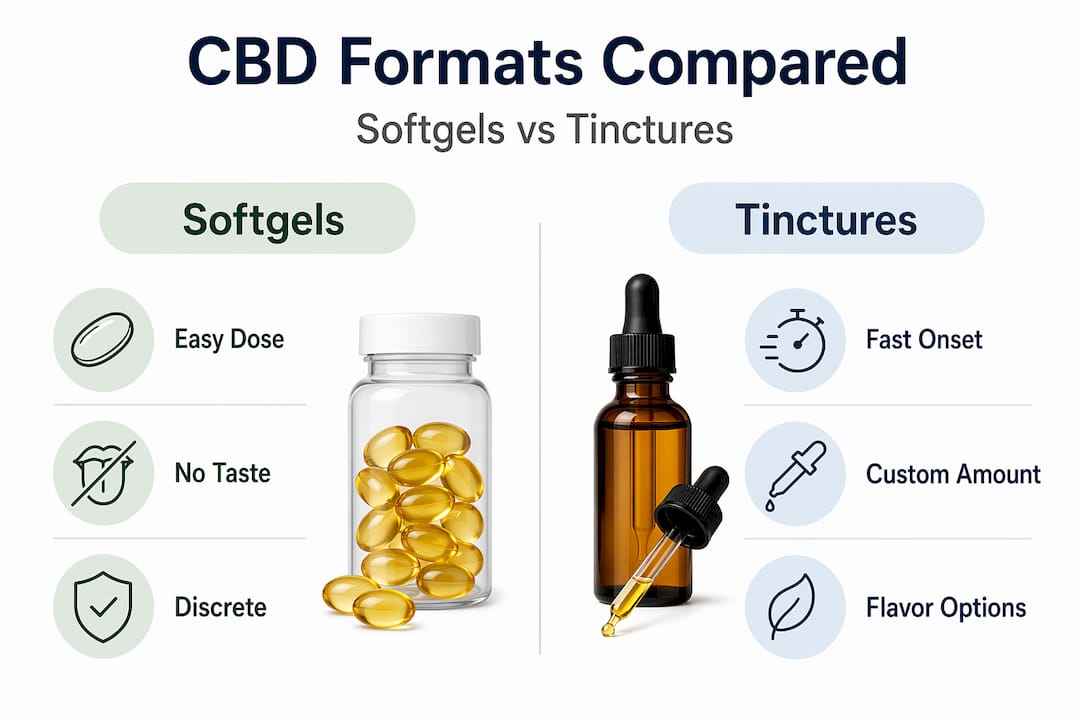
Comparing CBD tinctures versus softgels is a genuinely useful exercise if you’re deciding between the two. Tinctures act faster because the oil is absorbed under the tongue, bypassing some of the digestive process. Soft gels take longer to kick in because the capsule must dissolve in the stomach first, but they offer consistent dosing, no taste, and the convenience of something you can take anywhere without measuring.
For users whose primary goal is building a steady, daily wellness routine around CBD for chronic pain or persistent anxiety, the precise dosing and portability of a soft gel often make it the more practical long-term choice.

Shell materials and dietary considerations
Choosing a capsule also means considering your dietary preferences or restrictions. This is an area that catches many people out, particularly those following a vegan or vegetarian lifestyle.
Most traditional soft gel capsules use gelatin as the primary shell material. Gelatin is animal-derived, typically from bovine or porcine sources, and is not suitable for vegans or vegetarians. Some people with specific religious dietary requirements will also wish to avoid certain gelatin sources.
The good news is that vegetarian alternatives such as plant-based polymers, including HPMC and pullulan, are now widely used in quality CBD products. These create an effective soft shell with similar properties to gelatin but without the animal-derived content.
Checking product labels: what to look for:
- The ingredient list should clearly state “gelatin” or the specific vegetarian alternative used
- Look for certification logos such as “Vegan Society Approved” or “Vegetarian Society Approved” if this is important to you
- Check for common allergens such as soya or starch derivatives, which can appear in some plant-based shell formulations
- Third-party testing documentation should include shell material details as well as fill content
Pro Tip: If you have a shellfish allergy, be aware that some glucosamine-based vegetarian capsule materials may not be appropriate. Always read the full ingredient list and contact the manufacturer directly if you are uncertain.
| Dietary requirement | Suitable shell material | What to look for on the label |
|---|---|---|
| Vegan | HPMC, pullulan | “Plant-based capsule” or specific polymer named |
| Vegetarian | HPMC, pullulan, some gelatins | Confirm gelatin source if listed |
| Halal | Bovine halal gelatin or HPMC | Halal certification |
| Kosher | Kosher-certified gelatin or plant alternatives | Kosher certification mark |
SMOKO CBD’s soft gels and gummies bundle makes it easy to explore both formats alongside each other, and the product page clearly details the shell ingredients so you can make an informed choice before purchasing.
CBD soft gel capsules for wellness: Common uses
Now let’s see how these properties play out in real-world health and wellness routines. The structure, fill, and dosing consistency of soft gel capsules make them a particularly practical choice for people managing ongoing health concerns with CBD.
Integrating CBD soft gels into a daily wellness routine:
- Establish your baseline dose — start with a low dose (typically 10 to 25mg of CBD per day) and hold that dose for at least two weeks before adjusting
- Choose a consistent time — many people find taking soft gels at the same time each day, often in the evening with food, helps build a routine and tracks effects more accurately
- Track your experience — keep a brief daily note of sleep quality, pain levels, or mood to spot patterns over time
- Adjust gradually — if you feel little effect after two to four weeks, increase the dose incrementally rather than jumping sharply upward
For those using CBD for pain relief, the steady release that comes with an oral capsule format suits musculoskeletal or joint pain better than it does sudden acute pain, simply because onset takes longer. The CBD pain relief workflow goes deeper on this distinction and is worth reading before you build your routine.
For sleep support, CBD soft gels for sleep provides practical guidance on timing. Taking a soft gel approximately 60 to 90 minutes before bed gives the capsule enough time to dissolve and the CBD enough time to absorb before you’re trying to fall asleep. This is meaningfully different from a faster format like a tincture.
Some people also explore liquid CBD alternatives such as CBD seltzers for daytime use, pairing them with a soft gel taken at night. This multi-format approach suits those who want both rapid and sustained effects across the day.
Softgels are used when the active ingredient is a liquid or oil, which means they are not only convenient but structurally suited to housing CBD extract in a stable, consistent form.
Pro Tip: Always take your CBD soft gel with a meal that contains healthy fats (avocado, olive oil, nuts). Fat-soluble compounds like CBD absorb more efficiently when the digestive system is already processing dietary fats, and this simple habit can noticeably improve your results over time.
Our perspective: What most guides miss about soft gels
Most articles about soft gel capsules stop at the basics: they’re easy to swallow, they contain oil, they’re convenient. That’s all true, but it glosses over the variable that matters most, which is that not every soft gel delivers the same therapeutic effect, even at the same CBD milligram dose.
The quality of the carrier oil, the presence or absence of emulsification technology, and even the batch consistency from a manufacturer all feed into whether your 25mg soft gel actually behaves like a 25mg dose. Two products with identical labels can perform quite differently in practice. This is why third-party Certificates of Analysis, and specifically ones that test for potency rather than just contaminants, are genuinely important rather than a marketing box to tick.
It’s also worth questioning the phrase “gel caps” when you see it. Some products use this term loosely to describe hard capsules with a glossy outer coating, not true softgels with a liquid fill. The tactile difference (softgels are squishable; hard capsules are rigid) is the fastest way to tell them apart before you even read the label.
Reading up on safe use of CBD capsules offers more grounded guidance on this topic. In our view, informed consumers who check the shell material, verify the CoA, and understand their dosing context get far better results than those who simply reach for the cheapest bottle. The format is excellent. But the formulation behind that format is what truly determines your experience.
Finding the right CBD soft gel for you
If this guide has made one thing clear, it’s that soft gel capsules are worth choosing intentionally rather than accidentally. When you select a product with the right shell material, a quality oil fill, and a verified CBD content, you’re giving yourself a real foundation for natural wellness support.
SMOKO CBD’s 750mg CBD soft gels are made with broad-spectrum hemp extract, tested by third-party labs to confirm zero THC, and designed specifically for the UK market. If you’re curious about pairing formats, the CBD gels and gummies bundle lets you explore soft gels alongside gummies in one purchase. For those who prefer a standalone gummy option, the CBD gummies pack is a great starting point. Review the product pages carefully, match what you read to your dietary needs and wellness goals, and take that first step with confidence.
Frequently asked questions
Are soft gel capsules suitable for vegans?
Some soft gel capsules use vegetarian shells made from plant-based polymers such as HPMC, but many use animal-derived gelatin, so always check the product label before purchasing.
Do soft gel capsules work faster than other CBD products?
It depends on the formulation. Some soft gels show higher CBD absorption due to oil-based fills, but real-world performance depends strongly on the specific formulation, dose, and whether you take the capsule with or without food.
Can I take soft gel capsules with other supplements or medications?
Soft gels are a convenient format, but check with your GP or healthcare provider before combining CBD with other medications, as possible interactions depend on your CBD dose and overall health profile.
What is the difference between soft gel and hard capsules?
Soft gels have a one-piece liquid-filled shell that is elastic and hermetically sealed, while hard capsules are two rigid pieces fitted together and typically contain dry powders.