CBD is not a performance booster in the traditional sense, but the evidence suggests it can help some runners manage pre-race anxiety, perceived exertion, and sleep quality when chosen and used carefully. A 2024 systematic review covering seven studies found limited positive effects on certain physiological parameters such as VO2 and mean power, though results for strength and post-load recovery were inconsistent. For a runner deciding whether to try CBD, the honest takeaway is this: the potential benefits are real but modest, the safety profile looks favourable in the short term, and product quality matters enormously.
- Sleep and anxiety: the most consistent subjective benefits reported across trials
- Perceived exertion: a small pilot found an 8% reduction at the midpoint of a run; larger trials found no effect
- Objective performance: no trial to date has shown a meaningful improvement in run time or VO2 peak
- Safety: no major adverse events reported in short-term trials with healthy athletes
- Doping risk: CBD itself is permitted by WADA, but THC contamination in poorly tested products is a genuine risk
Key finding: A 2023 Frontiers review confirms plausible anti-inflammatory, anxiolytic, and analgesic mechanisms that could support recovery — but stresses that direct human trial evidence remains limited.
Key takeaways
CBD shows modest, context-dependent benefits for runners, particularly around sleep and pre-race anxiety, but has not improved objective endurance performance in any well-powered trial to date.
| Point | Details |
|---|---|
| Evidence is mixed | Subjective benefits (sleep, anxiety) are plausible; no trial has improved run time or VO2 peak. |
| Dose matters | Trials used 50–300 mg; most UK retail products are lower, so trial-to-shelf translation is uncertain. |
| Doping risk is real | CBD is WADA-permitted, but THC contamination in mislabelled products can trigger a positive test. |
| Always verify the COA | Buy only from brands with batch-specific, third-party lab certificates confirming zero THC. |
| Smokocbd option | The SMOKO CBD Mint 2000mg Tincture is third-party tested to zero THC and made in the UK. |
Table of Contents
- What is CBD and which product forms do runners use?
- What does the research say about CBD for runners?
- How do runners typically use CBD?
- Is CBD safe and legal for UK runners?
- How to choose a CBD product as a runner
- Key studies and reviews for runners who want the sources
- What are the long-term effects and research gaps for runners?
- How does CBD compare with traditional recovery methods?
- An honest perspective on CBD for runners
- Smokocbd’s broad-spectrum tincture for runners
- Sources
What is CBD and which product forms do runners use?
Cannabidiol (CBD) is a non-intoxicating cannabinoid extracted from hemp. Unlike THC (tetrahydrocannabinol), it does not produce a “high” and is not classified as a controlled substance in the UK when derived from approved hemp strains. CBD interacts with the body’s endocannabinoid system, a regulatory network that helps modulate pain, inflammation, mood, and sleep. Think of it as a dimmer switch: CBD can gently ramp up or tone down certain physiological signals rather than switching them on or off completely.
For runners, the main product forms are:
- Oral tinctures/oils: absorbed sublingually in 15–45 minutes; flexible dosing makes them popular for pre-run anxiety or post-run wind-down
- Soft gel capsules: convenient, pre-measured doses; slower onset (45–90 minutes) but consistent absorption, useful for daily recovery routines
- Edibles/gummies: palatable and discreet; similar onset to capsules, though bioavailability can vary with food intake
- Topical balms and creams: applied directly to sore muscles or joints; no systemic absorption, so no doping risk from THC, but effects are localised
- Inhaled (vaping): fastest onset but carries respiratory risks; not generally recommended for endurance athletes
A practical overview of types of CBD for athletes can help you match the format to your training schedule.
For athletes, that limit matters because even trace THC from a mislabelled or contaminated product can trigger a positive anti-doping test.
What does the research say about CBD for runners?
The evidence base is growing but still modest. Across the trials published to date, the clearest signals are in subjective outcomes (anxiety, perceived exertion, mood) rather than objective performance markers. Here is how the evidence stacks up by outcome:
Pain and analgesia
CBD’s analgesic properties are biologically plausible, given its interaction with CB1 and CB2 receptors and its influence on pain-signalling pathways. Human trial data for runners specifically is thin, though the Frontiers review identifies analgesic mechanisms as one of the more credible pathways for exercise-related benefit.
Perceived exertion and anxiety
A small pilot RCT (N=12) found that 300 mg CBD taken two hours before a 2-mile run produced an 8% reduction in rated perceived exertion (RPE) at the 1-mile mark and increased feelings of calm. Run time did not change. Those are preliminary findings from a very small sample, and they should be read as hypothesis-generating rather than conclusive.
A larger randomised, double-blind crossover trial (n≈51) told a different story: 150 mg oral CBD had no significant effect on affective valence, enjoyment, perceived exertion, or run time during a self-paced 10 km run. The dose difference (150 mg vs 300 mg) may partly explain the discrepancy, or the effect may simply not be robust enough to survive a well-powered trial.
Endurance performance
A 2025 dose-ranging RCT in trained runners (n=25) tested 50 mg and 300 mg acute CBD against placebo. Neither dose meaningfully changed time-to-exhaustion or VO2 peak. The 300 mg dose did produce a modest reduction in respiratory exchange ratio (RER) during submaximal running (p=0.030), which hints at a possible shift in substrate use, but the practical significance for race performance is unclear.
Sleep and recovery markers
Sleep is where many runners report the most noticeable benefit, though controlled trial data specific to athletes is limited. Muscle damage markers such as creatine kinase (CK) and myoglobin have not shown consistent reductions with CBD supplementation across the trials reviewed in the 2024 systematic review.

| Outcome | Evidence strength | Key finding |
|---|---|---|
| Perceived exertion | Mixed | 8% reduction in one small pilot; null in larger RCT |
| Run time / endurance | Consistently null | No trial has shown improvement |
| VO2 / mean power | Limited positive signal | Modest effects in systematic review; inconsistent |
| Sleep quality | Plausible, limited data | Subjective reports positive; controlled athlete data sparse |
| Muscle damage (CK/myoglobin) | Inconsistent | No reliable reduction shown |
| Anxiety / mood | Plausible | Pilot data positive; larger trials mixed |
Limitations to keep in mind: sample sizes across all trials are small (12–51 participants), dosing protocols vary widely (50–300 mg acute), product quality is inconsistent, and blinding is imperfect because CBD can produce detectable subjective effects. Researchers note that more standardised dosing and outcome measures are needed before firm conclusions can be drawn.
How do runners typically use CBD?
Practical use among runners tends to cluster around two goals: managing pre-race nerves and supporting post-run recovery or sleep. The approach that makes most sense is to start low and build gradually.
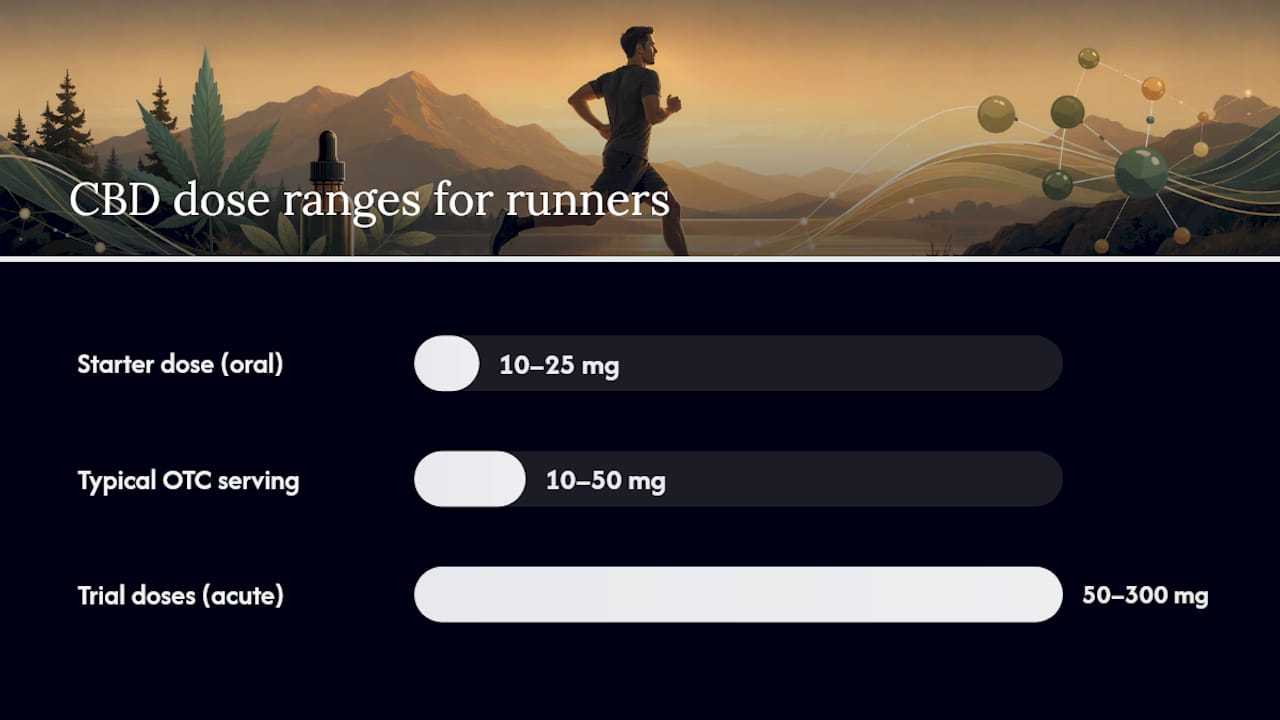
- Start with a low dose. A common initiation point is 10–25 mg per day for oral products. This is well below the doses used in trials (50–300 mg) but appropriate for gauging individual tolerance before increasing.
- Titrate over two to four weeks. Increase by 10–15 mg every five to seven days until you notice the effect you are looking for, or until you reach a dose that feels right. Keep a simple training log note alongside your CBD use.
- Choose your timing based on the goal. For pre-race anxiety, take an oral tincture 60–90 minutes before the event. For sleep and recovery, take it 30–60 minutes before bed on hard training days.
- Use topicals for localised soreness. A balm applied to the IT band, calves, or Achilles after a long run addresses local discomfort without any systemic absorption or doping concern.
- Give it a fair trial period. Acute single doses may produce little effect; some runners report better results after two to four weeks of consistent daily use. If you notice no benefit after a month at a reasonable dose, it may simply not be the right tool for you.
Typical doses in published trials range from 50 mg to 300 mg for acute use. Most over-the-counter products in the UK are sold in lower-strength formats (10–50 mg per serving), so the gap between trial doses and retail doses is worth bearing in mind when interpreting study results.
Pro Tip: Keep a simple weekly log: note your CBD dose, timing, sleep quality (1–10), and next-day muscle soreness. After four weeks, the pattern will tell you far more than any single session can.
For more on how CBD supports athletes during training cycles, Smokocbd’s resource section covers recovery-specific use cases in detail.
Is CBD safe and legal for UK runners?
Safety profile
Short-term CBD use in healthy athletes has not produced major adverse events across the trials reviewed. Common side effects at higher doses can include drowsiness, dry mouth, reduced appetite, and mild gastrointestinal discomfort. The more significant concern is drug interactions: CBD inhibits cytochrome P450 (CYP450) liver enzymes, which means it can alter the metabolism of certain medications, including blood thinners, anti-epileptics, and some anti-inflammatories. If you take any prescription medication, speak to your GP before adding CBD.
UK legal position
CBD products are legal in the UK provided they are derived from approved hemp strains and contain no more than 1 mg of THC per container. The Food Standards Agency (FSA) has set a precautionary daily intake guidance of 10 mg CBD per day for healthy adults not under medical supervision, though the doses used in sports trials are considerably higher. Athletes should treat any product without a third-party certificate of analysis (COA) as an unknown quantity.
WADA and anti-doping
WADA’s prohibited list confirms that CBD itself is not prohibited. THC, however, remains on the list, along with other synthetic cannabinoids. The risk for athletes comes from contaminated or mislabelled products: independent testing has repeatedly shown that some retail CBD products contain more THC than declared on the label. A positive test from an inadvertently contaminated product is still a doping violation, regardless of intent.
Athlete checklist to reduce doping risk:
- Request the batch-specific COA before purchasing, not just a generic lab report
- Confirm the COA was issued by an accredited third-party laboratory (not the manufacturer’s own facility)
- Check for THC, heavy metals, pesticides, and microbial contaminants on the COA
- Prefer broad-spectrum or isolate products with verified zero THC
- Avoid any product that cannot provide batch-level testing documentation
- Follow the CBD workout checklist for a step-by-step safety protocol
Trials across the reviewed studies reported no major adverse events with short-term use in healthy athletes, which is reassuring, though long-term safety data specific to runners remains limited.
How to choose a CBD product as a runner
Not all CBD products are equal, and for athletes the gap between a well-tested product and a poorly labelled one can mean the difference between a useful supplement and a failed drug test.
What to check before buying
- Batch-specific COA: a certificate of analysis tied to the exact batch you are buying, not a generic document
- THC content: confirmed at zero or below the UK legal threshold by an independent lab
- Heavy metals, pesticides, and microbial contaminants: all should appear on the COA
- Declared strength vs actual content: independent tests have found significant discrepancies in retail products; the COA should confirm the stated CBD concentration
- Broad-spectrum vs isolate: broad-spectrum retains minor cannabinoids and terpenes (potentially enhancing effect via the entourage effect) while still removing THC; isolate is pure CBD with no other cannabinoids
Format guidance
Tinctures offer the most dosing flexibility, which is useful when you are titrating. Soft gels suit runners who want a consistent, pre-measured dose without measuring droppers. Topicals are the lowest-risk option for localised soreness because they carry no systemic absorption.
Pro Tip: Never test a new CBD product for the first time on race day. Trial it on a regular training day first, so you know how your body responds before anything important is at stake.
Smokocbd’s recommended option
The SMOKO CBD Mint 2000mg Broad Spectrum CBD Tincture meets the key criteria on the checklist above. It is broad-spectrum, third-party tested with zero THC verified, made from organically grown hemp, and produced in the UK. The 2000 mg strength in a 10 ml bottle gives a high concentration per drop, making it straightforward to dial in a precise dose. For runners concerned about anti-doping, the zero-THC verification is the most important box it ticks.
Key studies and reviews for runners who want the sources
The research base is still developing, but these are the highest-value papers published to date:
- 2024 systematic review (PMC) — seven studies to April 2024; limited positive effects on VO2 and mean power; inconsistent for recovery. Takeaway: cautious optimism on some physiological markers, not a green light for performance claims.
- 2023 Frontiers review — mechanistic overview; anti-inflammatory, anxiolytic, analgesic pathways identified. Takeaway: the biology is plausible; the human trial evidence has not yet caught up.
Research gap to watch: no published trial has followed runners using CBD for longer than a few weeks. The absence of chronic-use data means the long-term picture, both for benefits and safety, remains genuinely unknown.
What are the long-term effects and research gaps for runners?
The honest answer is that nobody knows yet. Every trial to date has used acute or very short-term dosing protocols. No published study tracks runners over a full training season to measure whether CBD use correlates with fewer injuries, faster recovery between sessions, or sustained improvements in sleep architecture.
The gaps are specific and worth naming. First, dosing heterogeneity across trials makes it almost impossible to compare results: 50 mg, 150 mg, and 300 mg are very different exposures, and the optimal dose for a given outcome in runners has not been established. Second, product quality varies so widely in the retail market that even if a trial finds an effect, replicating it with an over-the-counter product of unknown purity is uncertain. Third, no trial has specifically examined female runners, masters athletes, or ultra-distance runners, populations whose physiology and recovery demands differ meaningfully from the young, trained males who dominate the existing sample pools.
Researchers also flag that the endocannabinoid system itself changes with exercise. Endurance running elevates endogenous cannabinoids (including anandamide, sometimes called the “bliss molecule”), which may partly explain the runner’s high. Whether exogenous CBD interacts with or simply adds to that response during sustained training is an open question that current trials have not addressed.
How does CBD compare with traditional recovery methods?
CBD sits alongside, not above, the established recovery toolkit. The methods with the strongest evidence base for runners remain sleep, nutrition, hydration, and progressive training load management. Cold-water immersion has a reasonable evidence base for reducing muscle soreness. Compression garments show modest benefits for perceived recovery. Non-steroidal anti-inflammatory drugs (NSAIDs) such as ibuprofen reduce acute inflammation but carry gastrointestinal and renal risks with chronic use, particularly during long-distance events.
CBD’s position in that hierarchy is as a potential complement, not a replacement. Its anti-inflammatory and analgesic mechanisms are plausible, but the trial evidence for reducing objective markers like CK and myoglobin is not yet consistent enough to place it above cold-water immersion or adequate sleep. Where CBD may genuinely add something the traditional toolkit does not is in the anxiety and sleep domains: NSAIDs do not calm pre-race nerves, and ice baths do not help you fall asleep after a late-evening tempo session.
For runners who already have their sleep, nutrition, and training load dialled in and are looking for an additional edge on recovery or anxiety, CBD is a reasonable next step to explore. For runners who are still sleeping six hours a night and skipping post-run nutrition, CBD is unlikely to move the dial. The science-backed recovery tips from Smokocbd cover the full recovery picture, including where CBD fits within it.
An honest perspective on CBD for runners
The conversation around CBD in running circles tends to split into two camps: enthusiastic early adopters who swear by it, and sceptics who dismiss it as expensive placebo. Neither position is quite right.
What the evidence actually shows is more nuanced. The subjective benefits, particularly around sleep and pre-race anxiety, are plausible and consistent with what we know about the endocannabinoid system. The objective performance benefits are, so far, essentially zero across well-powered trials. That is not a reason to dismiss CBD, but it is a reason to be clear-eyed about what you are buying it for.
If you are considering CBD for sleep quality on heavy training weeks, or to take the edge off before a big race, the evidence gives you a reasonable basis to try it. If you are expecting it to shave minutes off your marathon time or accelerate muscle repair after a hard session, the trials do not support that expectation. The most sensible approach is to treat it as you would any supplement: start with a quality-verified product, use a dose you can track, give it a defined trial period, and measure the outcome you actually care about.
One practical note: if you are on any prescription medication or competing under strict anti-doping rules, speak to a clinician or your national anti-doping organisation before starting CBD. The WADA status is clear, but product contamination risk is real, and drug interactions are not theoretical.
Smokocbd’s broad-spectrum tincture for runners
Runners who have read this far and want to try CBD with confidence in the product quality have a straightforward option. The SMOKO CBD Mint 2000mg Broad Spectrum Tincture is third-party tested to verified zero THC, made from organically grown hemp, and produced in the UK. That combination directly addresses the two biggest concerns for athletes: product purity and anti-doping safety.
The 2000 mg concentration in a 10 ml bottle gives you precise control over your dose, which matters when you are following a start-low-and-titrate protocol. Use it sublingually 60–90 minutes before bed on hard training days, or 60–90 minutes before a race if anxiety is your primary concern. Check the batch-specific COA on the Smokocbd website before your first order, and start with a small dose well before any competitive event.
Sources
- The Effect of Cannabidiol on Performance and Post-Load Recovery among Healthy and Physically Active Individuals: A Systematic Review - PMC
- The Effect of Cannabidiol on Subjective Responses to Endurance Exercise: A Randomised Controlled Trial | Sports Medicine - Open | Springer Nature Link
- Cannabidiol in sports: insights on how CBD could improve performance and recovery
- Wada-ama
This article is general information, not a substitute for advice from a qualified doctor. Consult a qualified healthcare professional about your own circumstances before acting on anything here.