There’s no single best hour to take CBD. The right timing depends entirely on what you want it to do. Want steadier focus through the day? Morning suits you. Chasing better sleep? Take it 30 to 90 minutes before bed. Want round-the-clock support for anxiety or pain? Split your dose morning and evening, and stay consistent for at least a week before judging results.
TL;DR:
- CBD’s effects depend on timing aligned with specific goals, such as morning focus, daytime stress, or bedtime sleep support.
- Pharmacokinetics show CBD takes several hours to reach peak levels, requiring consistent use over days to understand true effects.
- Product form influences onset time, with oils acting in 15 to 45 minutes and edibles taking 45 to 120 minutes, shaping dosing schedules.
- Taking CBD with fatty food enhances absorption, while interactions with liver enzymes can affect medication metabolism, demanding caution for users on prescriptions.
- Short-term trial protocols over two weeks help identify personal responses, emphasizing consistency and careful timing to find the most effective routine.
Table of Contents
- Best time to take CBD oil by goal: focus, anxiety, pain and sleep
- Why pharmacokinetics matters more than the clock on the wall
- Onset and duration: how your product form changes the timing
- Food, drug interactions and safety: what changes your absorption
- How to test what works: a simple two-week protocol
- Starter schedules using SMOKO CBD products
- A realistic take on finding your best time
- Fit CBD timing into your routine with SMOKO CBD
- Official guidance and key studies
- Sources
Best time to take CBD oil by goal: focus, anxiety, pain and sleep
Your reason for taking CBD should decide the clock, not the other way round. Current evidence doesn’t identify one universal optimal time — the research points instead towards matching timing with the effect you’re after, which is a more useful frame than chasing a mythical “perfect hour”.
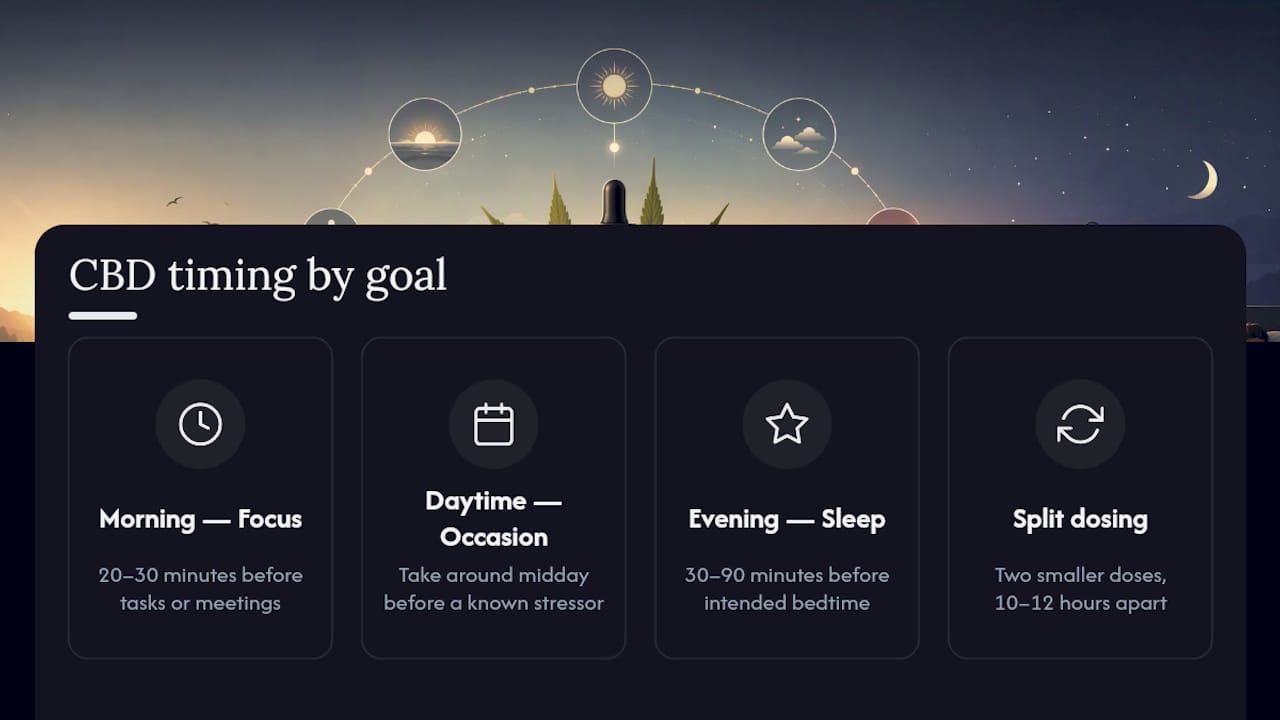
Morning dosing works well if you want steadier mood or clearer focus without the fog that some people report from larger evening doses. Taking your CBD oil with breakfast, roughly 20 to 30 minutes before you need to concentrate gives it time to reach your bloodstream before your first meeting or task block.
Daytime or occasion-based dosing suits predictable stress. If you know a presentation, exam or difficult conversation is coming at 2pm, taking CBD around midday gives it a reasonable head start rather than dosing in a panic five minutes beforehand.
Evening dosing for sleep is where timing matters most. Most people trying CBD for sleep do best taking it 30 to 90 minutes before their intended bedtime, giving oils and tinctures enough runway to take effect as you’re winding down. Our step-by-step CBD sleep routine walks through building this into a proper wind-down habit rather than a last-minute fix.
Split dosing, typically morning and evening, makes sense if you’re managing something that runs all day, chronic discomfort or background anxiety, for instance. Two smaller doses spaced 10 to 12 hours apart tend to feel more even than one large dose that peaks and fades.
Why pharmacokinetics matters more than the clock on the wall
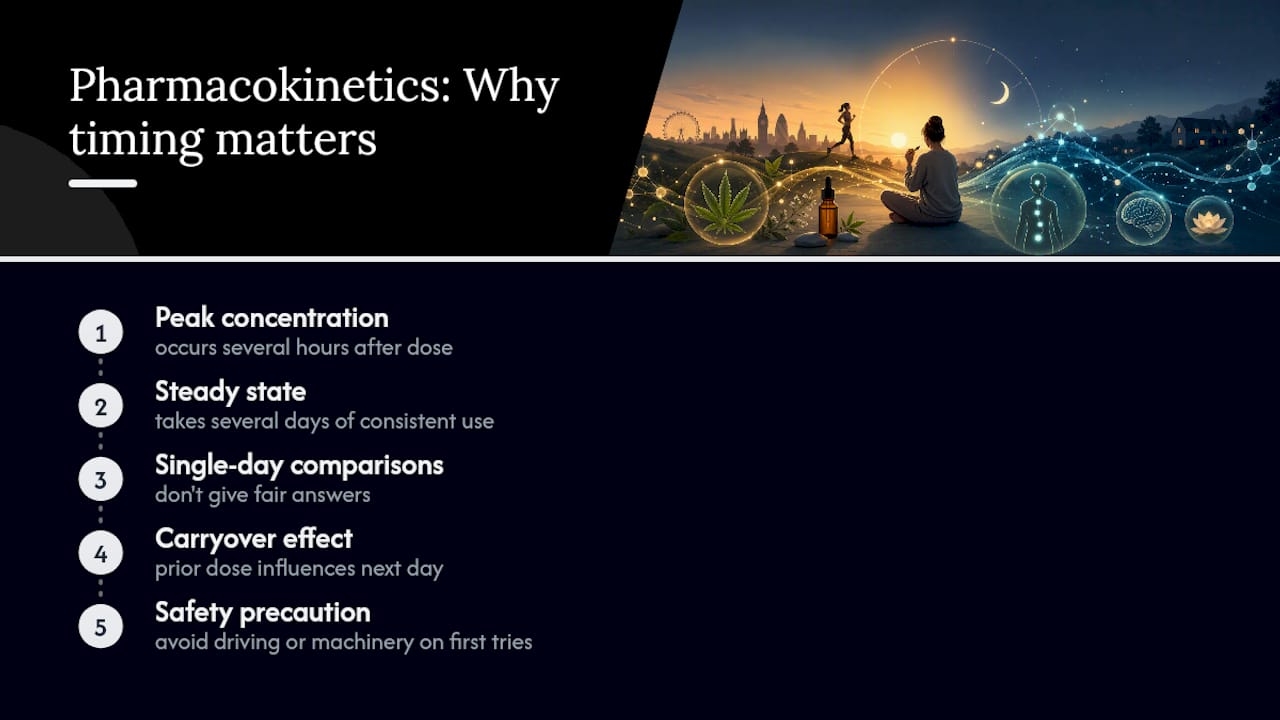
Comparing a morning dose against an evening dose on the same day almost never gives you a fair answer, because CBD doesn’t leave your system as quickly as most people assume. Phase 1 trial data on pharmaceutical-grade cannabidiol shows time to peak plasma concentration typically occurs several hours after dosing (https://www.ncbi.nlm.nih.gov/pmc/articles/PMC5895650/), which is one reason regulatory labels for clinical cannabidiol products often specify twice-daily dosing rather than a single dose.
Statistic Callout: Steady state, in pharmacology terms, means the level of CBD in your system has stopped rising with each new dose and plateaued. Reaching that plateau with a daily supplement typically takes several days of consistent use, not a single dose. Judging “morning versus evening” on day one is like judging a diet after one meal.
That carryover is exactly why casual self-testing gets confusing. If you take CBD in the morning on Monday and switch to evening on Tuesday, Tuesday’s morning is still partly influenced by Monday’s dose. You’re not comparing two clean conditions, you’re comparing a mixture.
One practical precaution: when you’re trialling a new dose or a new time of day, avoid scheduling anything safety-critical, driving long distances or operating machinery, for the first few attempts. Some trial data on CBD reports somnolence as a possible effect at higher doses, and you won’t know how a new schedule affects your alertness until you’ve tried it in a low-stakes setting.
Onset and duration: how your product form changes the timing
Not every CBD product hits the same way, and picking your form should shape your schedule as much as your goal does.
- Oils and tinctures (sublingual): Onset typically falls between 15 and 45 minutes when held under the tongue for 60 to 90 seconds before swallowing. This is the most flexible format for both morning and evening use because you can fine-tune the timing fairly precisely.
- Gummies and capsules: These pass through digestion first, so onset stretches to 45 to 120 minutes. If you’re targeting sleep, take edibles earlier in your wind-down window than you would an oil. Our CBD gummies for daytime wellness guide covers dosing gummies around a working day.
- Vaping or inhalation: Fastest onset of any format, often within minutes, but effects tend to fade sooner too. Better suited to immediate, short-term relief than steady all-day coverage.
- Topicals and patches: Localised and slower, often 30 minutes or more to notice anything, with effects staying concentrated where applied rather than circulating systemically. Timing here matters less for mood or sleep and more for when you need relief at a specific site.
Pro Tip: If you’re new to a product form, test it on a weekend first. Onset windows are averages, not guarantees, and your first experience with a new format shouldn’t coincide with a big meeting or a long drive.
For more detail on how long any of these forms keep working once they kick in, our guide on how long CBD effects last breaks down duration by format.
Food, drug interactions and safety: what changes your absorption
What’s in your stomach when you take CBD changes how much of it actually reaches your bloodstream, and by how quickly.
- Fatty meals boost absorption. Taking CBD alongside food containing fat significantly increases oral bioavailability, meaning more of the dose gets absorbed rather than lost to digestion. If you want a stronger, faster effect, pair your dose with breakfast or dinner rather than taking it on an empty stomach. Our breakdown of CBD and food interactions covers this in more detail.
- Medication interactions are real. CBD is processed by liver enzymes in the CYP450 family, the same pathway many common medicines use, including statins. If you take prescription medication, check with a pharmacist or GP before settling on a routine. Our guide on CBD and statins explains this interaction in plain terms.
- UK regulatory guidance exists for a reason. The Food Standards Agency provides consumer guidance on cannabidiol, including advice on daily intake and the importance of buying products with clear, tested composition.
Sleep supplements, CBD included, work best as one part of a wider routine. The NHS notes that lack of sleep carries real health consequences and that persistent or severe sleep problems deserve medical attention, not just a supplement swap.
Start low and go slow, especially in the first week of any new schedule, and avoid driving or operating machinery until you know how a new dose or timing affects you.
How to test what works: a simple two-week protocol
Guesswork wastes time. A short, structured trial gives you a real answer about your own body within about two weeks.
- Week one: Pick one time slot, morning or evening, and one dose. Take it at the same time daily. Ignore days one to three, since your body needs time to reach a stable level; only trust your notes from day four onwards.
- Week two: Switch one variable only, either the time slot or the dose, not both. Keep the product form and everything else constant so you’re comparing like with like.
- Track outcomes daily: Rate sleep quality, anxiety levels and daytime alertness on a simple 1 to 5 scale each evening. Patterns usually surface by day five or six of each block.
- Adjust from there: If neither week gave a clear result, extend one variable for another week before switching. Some people need three or four weeks of comparison before a pattern becomes obvious, particularly with sleep-related goals.
Pro Tip: Keep a one-line note each night rather than a long journal entry. “Slept fast, woke once” beats a paragraph you won’t want to write after day three.
Starter schedules using SMOKO CBD products
A morning-only routine suits an oil taken with breakfast, starting low and adjusting weekly. An evening-only routine points towards taking a tincture 30 to 90 minutes before bed, paired with the sleep routine guide above. Split dosing means a small morning measure and a smaller evening one.
Whichever schedule you choose, third-party lab testing and a zero-THC certificate matter more once you start experimenting, since you want to know exactly what’s in the bottle before you start changing when you take it.
A realistic take on finding your best time
There isn’t strong evidence for one universal best hour, only for matching timing to your goal and staying consistent long enough to judge it fairly. Test carefully, and speak to a GP first if you’re on medication.
— Mike
Fit CBD timing into your routine with SMOKO CBD
Once you’ve settled on a schedule, whether that’s a single evening dose or a morning-and-night split, the product format you choose should make that routine easier to stick to, not harder. SMOKO CBD’s MINT 2000mg Broad Spectrum CBD Oil is built for exactly this kind of flexible dosing: a dropper lets you measure a precise amount, whether you’re taking a small morning dose or a fuller evening one 30 to 90 minutes before bed.
Reputable CBD products often carry third-party lab testing and THC certificates, so as you shift your timing week to week, you know the dose itself isn’t the variable changing. If sleep is your main target, pair the oil with our step-by-step sleep routine guide for a structured way to build your evening habit. Visit the product page to check current strengths and start your own two-week timing trial this week.
Official guidance and key studies
- Food Standards Agency — cannabidiol (CBD) consumer guidance
- Gov
- World Health Organization — critical review on cannabidiol
- NHS — why lack of sleep is bad for your health
This article is general information, not a substitute for advice from a qualified doctor. Consult a qualified healthcare professional about your own circumstances before acting on anything here.
Sources
- Cannabidiol — pharmacology and therapeutic targets (review)
- Food Standards Agency — cannabidiol (CBD)
- Food effect on the pharmacokinetics of cannabinoids (review)