CBD can interact with some statins, particularly atorvastatin and simvastatin, because both are broken down by the same liver enzyme. If you take a statin, speak to your GP or pharmacist before starting CBD, and if you’re given the go ahead, start low and watch for muscle or liver symptoms. Clinical trials link high-dose CBD to raised liver enzymes in 13% of patients, so monitoring matters more than most people assume.
TL;DR:
- CBD can significantly increase blood levels of atorvastatin and simvastatin by inhibiting the CYP3A4 enzyme responsible for metabolizing these drugs.
- Use of high-dose CBD has been linked to elevated liver enzymes in about 13% of patients, highlighting the importance of regular liver monitoring.
- Patients taking pravastatin or rosuvastatin face lower interaction risks, but should always verify their specific medication details with a healthcare provider.
- Symptoms such as severe muscle pain, dark urine, jaundice, or unexplained fatigue indicate potential serious interactions requiring immediate medical attention.
- The risk scales with CBD dose, frequency, product type, and whether taken with fatty meals, making low-dose, consistently taken products a safer choice.
Table of Contents
- How CBD and statins are processed in the body
- Which statins are most likely to interact with CBD?
- What symptoms signal a statin-CBD problem?
- Does the CBD dose or product type change the risk?
- What should you do before combining CBD with a statin?
- How do you choose a lower-risk CBD product?
- Are there other risks or benefits worth weighing?
- What if CBD isn’t right for you on a statin?
- Publisher perspective: how Smokocbd thinks about safety for customers on medicines
- A safer way to start, once your GP says yes
- Sources
How CBD and statins are processed in the body
Your liver relies on a family of enzymes called cytochrome P450, or CYP, to break down most medicines you swallow. The one that matters most here is CYP3A4, a workhorse enzyme that processes roughly half of all prescription drugs, including several common statins. Two other enzymes, CYP2C9 and CYP2C19, play smaller supporting roles depending on the specific statin.
Here’s the problem: CBD doesn’t just get processed by CYP3A4, it also blocks it. Think of CYP3A4 as a checkout queue at a busy supermarket. Normally your statin moves through at a steady pace and gets cleared from your bloodstream on schedule. CBD effectively pulls a till out of service, so the statin queues up longer than it should, and blood levels climb higher than your prescribed dose was designed to produce.
A comprehensive pharmacology review confirms this mechanism, identifying CYP3A4 as CBD’s primary metabolic pathway and naming atorvastatin and simvastatin among the drugs most likely to be affected. The same review notes that other well-known CYP3A4 inhibitors, including grapefruit juice and antifungal drugs such as ketoconazole, produce a comparable effect. If you’ve ever been told to avoid grapefruit with a particular medicine, you’re already familiar with exactly this kind of interaction. CBD simply adds another substance to that same watch list.
Which statins are most likely to interact with CBD?
Not every statin carries the same risk, because they aren’t all metabolised the same way. The distinction comes down to how heavily each drug relies on CYP3A4 to clear from your system.
Statins that lean heavily on CYP3A4, and therefore carry the higher interaction risk with CBD, include:
- Atorvastatin (Lipitor), one of the most widely prescribed statins and heavily CYP3A4-dependent
- Simvastatin (Zocor), also processed predominantly through CYP3A4
Statins that rely far less on this pathway, and appear to carry lower interaction risk, include:
- Pravastatin, which is barely touched by CYP3A4 at all
- Rosuvastatin, metabolised mainly through a different route
- Pitavastatin, similarly less dependent on CYP3A4
A mechanism-focused review points to pravastatin and rosuvastatin as generally safer alternatives where switching makes clinical sense. That said, don’t guess based on the drug class alone. Check the exact name on your prescription label and raise it directly with your GP or pharmacist, since dose, formulation and your own liver function all factor into the actual risk.
What symptoms signal a statin-CBD problem?
When statin levels rise higher than intended, the two organs that bear the brunt are your muscles and your liver. Muscle-related harm ranges from mild aches (myalgia) through to muscle breakdown (myopathy) and, in rare but serious cases, rhabdomyolysis, a condition where damaged muscle tissue releases proteins into the bloodstream that can overwhelm the kidneys.

The number that matters: In controlled clinical trials, around 13% of patients taking high daily doses of CBD showed liver transaminase (ALT/AST) elevations above three times the upper limit of normal. That’s not a rare fluke reading. It’s a consistent, dose-related signal that shows up across trial data.
Watch for these red flags if you’re taking a statin and using CBD:
- Severe or worsening muscle pain, tenderness, or unexplained weakness
- Dark or tea-coloured urine (a possible sign of muscle breakdown)
- Yellowing of the skin or eyes, or unusual fatigue (possible liver signs)
- Persistent nausea, abdominal pain, or loss of appetite
Serious events remain uncommon at typical consumer doses, but “uncommon” isn’t “impossible”, and combining CBD with hepatically active drugs like atorvastatin can raise the odds enough to warrant prompt medical review if any of these symptoms appear.
Does the CBD dose or product type change the risk?
Risk isn’t binary here, it scales with exposure. An occasional low-dose CBD gummy taken once a week behaves very differently in your system than a daily 50mg tincture taken morning and night. Frequency and dose both push cumulative enzyme inhibition higher, and individual metabolism varies enough that two people on identical doses can end up with meaningfully different blood levels.
Product format matters too. Tinctures taken sublingually and soft gels swallowed whole both deliver measurable systemic CBD, though peak levels and timing differ between them. Edibles behave similarly to soft gels once digested. Topical products applied to the skin generally produce far less systemic absorption, which likely makes them the lowest-risk format for anyone concerned about drug interactions.
Food matters as well. CBD is fat-soluble, so taking it with a fatty meal can noticeably increase how much reaches your bloodstream, an effect worth understanding before you settle into a routine, as we’ve covered elsewhere. Higher absorption means higher exposure, which means the enzyme-inhibition effect on your statin is amplified rather than incidental.
What should you do before combining CBD with a statin?
A little groundwork before you start makes the difference between using CBD confidently and using it blind. Here’s a sensible sequence to follow:
- Tell your GP or pharmacist exactly which statin you take, at what dose, and that you’re considering CBD, including any other supplements you use.
- Ask about baseline blood tests, specifically liver enzymes (ALT/AST) and creatine kinase (CK), before starting, with a follow-up test agreed for a few weeks later if you begin regular use.
- Hold off on CBD if you’re on atorvastatin or simvastatin unless your clinician has specifically reviewed and approved it, given the stronger CYP3A4 dependence of both drugs.
- Stop immediately and seek medical care if you notice severe muscle pain, dark urine, or signs of jaundice.
- Keep a simple log of the product, dose, and timing of each CBD use, so any clinician assessing symptoms later has real data to work from rather than guesswork about what you’ve actually taken.
Pro Tip: Photograph the certificate of analysis (COA) for whichever CBD product you settle on and save it alongside your medicines list. If your pharmacist ever needs to check exactly what you’re taking, you’ll have the batch-specific lab data ready in seconds rather than trying to remember a product name.
How do you choose a lower-risk CBD product?
Contaminated or mislabelled CBD adds a second layer of risk on top of the enzyme interaction itself. A certificate of analysis shows exactly what’s in a batch: confirmed CBD content, verified absence of THC, and screening for solvents, pesticides, and heavy metals. Without one, you’re relying on a label with no independent check behind it.
Sensible habits worth adopting regardless of which statin you take:
- Choose brands that publish batch-specific COAs, not a generic one covering an entire product line
- Start at the lowest suggested dose and hold it steady for at least a week before adjusting
- Take CBD at a consistent time and, ideally, alongside a consistent type of meal to keep absorption predictable
- Avoid unregulated imports or marketplace listings with no verifiable UK supplier or lab data attached
Product-quality issues aren’t hypothetical. The Food Standards Agency has flagged mislabelled CBD products that deliver unexpected CBD concentrations or trace THC, which pushes the interaction risk higher than the label suggests.
Are there other risks or benefits worth weighing?
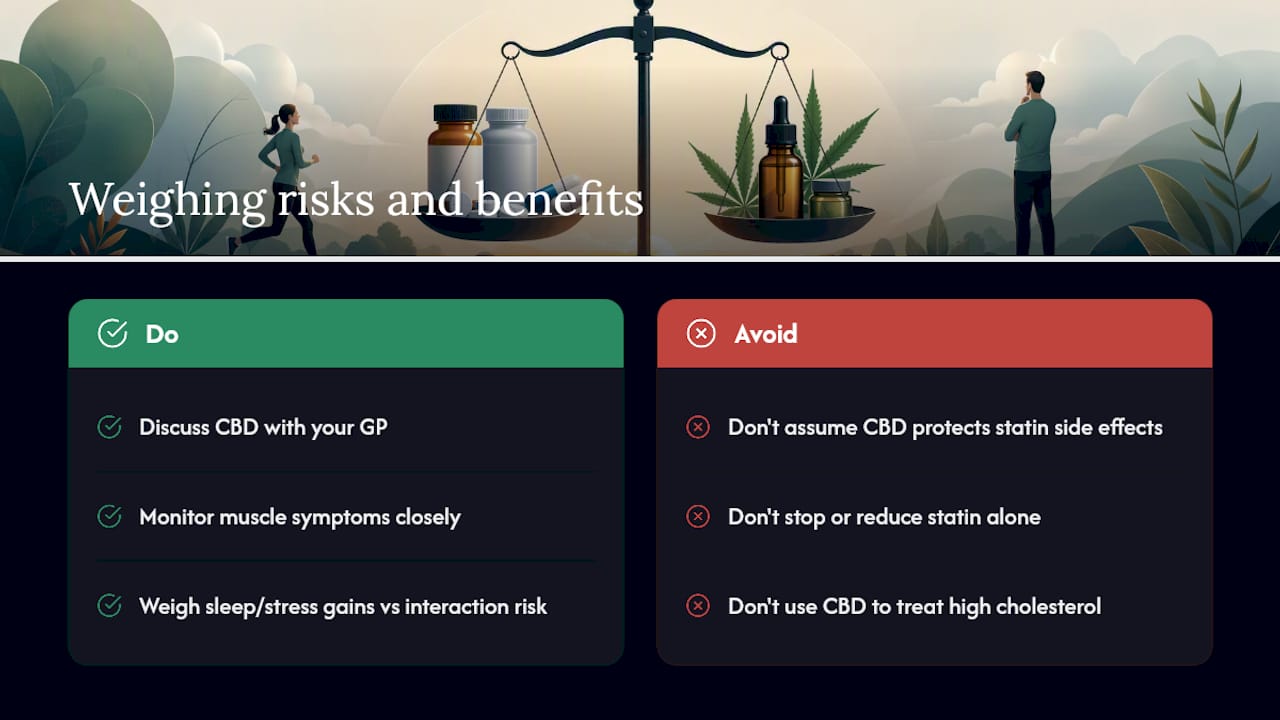
Statin interaction isn’t the only thing worth thinking through if you’re on long-term cholesterol medication and curious about CBD. Some patients on statins report muscle aches even without CBD in the picture, and layering in a substance that can independently affect calcium regulation and inflammation pathways adds a genuine variable, not necessarily a benefit, to that existing symptom. It’s not accurate to frame CBD as protective against statin side effects. The honest position is that it’s an additional factor that needs monitoring, not a workaround.
On the other side of the ledger, some people use CBD for sleep or everyday discomfort, and heart-healthy sleep and stress management are genuinely worth supporting, since poor sleep and chronic stress both affect cardiovascular markers over time; for broader context on CBD effects, see the benefits of CBD products. That’s a legitimate reason someone on statins might be drawn to CBD in the first place. The nuance is that any general wellness benefit has to be weighed against the specific pharmacological interaction risk covered earlier, not treated as separate from it.
CBD is not a treatment for high cholesterol, and no clinical evidence supports using it to lower LDL or replace a prescribed statin. Anyone tempted to reduce or stop a statin because they’ve started CBD should treat that as a conversation for their GP, not a decision to make alone based on how they feel.
What if CBD isn’t right for you on a statin?
If your GP advises against combining CBD with your specific statin, particularly on atorvastatin or simvastatin at higher doses, that’s not a dead end for managing cholesterol or supporting general wellbeing. Statin-specific switching is often the simplest first step. Moving to pravastatin or rosuvastatin, both far less dependent on CYP3A4, may resolve the interaction concern entirely while keeping the same class of cholesterol-lowering treatment in place, though that decision sits firmly with your prescriber.
Beyond statin substitution, several non-statin lipid-lowering options exist for patients who need additional LDL reduction or can’t tolerate statins at all: ezetimibe, which reduces cholesterol absorption in the gut, and PCSK9 inhibitors, an injectable option typically reserved for higher-risk patients who don’t reach their targets on statins alone. Bempedoic acid is another newer oral option some clinicians now use alongside or instead of statins.
None of these swaps CBD for a cholesterol treatment, they’re separate medical decisions your GP or a lipid specialist should guide. What matters for anyone reading this with genuine caution is knowing that “avoid CBD with your current statin” rarely means “no options at all”. It usually just means the conversation needs to happen with the person who prescribed your medicine, armed with a clearer picture of why the interaction exists in the first place.
Publisher perspective: how Smokocbd thinks about safety for customers on medicines
Every product Smokocbd sells carries a third-party certificate of analysis, confirming broad-spectrum content and verified zero THC batch by batch. That’s not a marketing flourish, it’s the document a pharmacist would actually want to see if a customer on statins asked whether a specific product was safe to combine with their medicine.
Our position is straightforward: if you take statins, talk to your GP or pharmacist before you buy anything, and bring the COA with you if you can. We’d rather lose a sale to a cautious conversation than see a customer skip that step. Customers on any prescription medicine, statins included, should treat that conversation as the first purchase decision, not an afterthought after the product arrives.
— Mike
A safer way to start, once your GP says yes
If your GP or pharmacist has reviewed your statin and given the go ahead for a trial of CBD, product choice becomes the next practical decision, and Smokocbd’s range is built around exactly the caution this article has walked through.
The SMOKO CBD 750mg soft gel capsules offer a fixed, consistent dose per capsule, which suits anyone who’s been told to start low and keep exposure predictable rather than estimating drops from a tincture. Every batch carries a third-party certificate of analysis confirming broad-spectrum content and verified zero THC, so you’re not guessing at what’s actually inside. For readers who prefer more flexibility over exact dosing, the SMOKO CBD Mint 2000mg tincture allows finer control drop by drop, though as covered earlier, tinctures can produce different absorption peaks depending on whether you take them with food.
Neither product replaces the conversation with your GP or pharmacist about your specific statin. Once that’s had, check the COA on either product page, start at the lowest suggested amount, and keep the symptom log outlined earlier in this piece. If you’re still deciding which format suits your routine, the full range at Smokocbd lists batch-specific lab results against every listing.
Sources
- Daily CBD use at consumer-level doses may elevate liver enzymes, FDA trial shows — Pharmacy Times
- Cannabidiol interactions with medications, illicit substances, and alcohol: a comprehensive review — PMC
- Cannabidiol (CBD) — Food Standards Agency
This article is general information, not a substitute for advice from a qualified doctor. Consult a qualified healthcare professional about your own circumstances before acting on anything here.