TL;DR:
- CBD is not a proven substitute for prescription antidepressants, and evidence supporting its use for mood disorders remains limited and uncertain. It may serve as an adjunct for mild anxiety or sleep issues under medical supervision, but stopping prescribed medication abruptly poses serious risks. Quality CBD products verified by independent lab testing are essential if considering use alongside existing treatments.
CBD is not a proven replacement for prescription antidepressants. That is the short answer, and it matters. Whether you are taking fluoxetine, sertraline, or citalopram and wondering whether CBD oil could do the same job, or you are looking for something to sit alongside your current treatment, the evidence base for CBD in mood disorders is still limited and largely preclinical. The NHS prescribes antidepressants through a structured stepped-care pathway, and the MHRA does not recognise CBD products sold over the counter as licensed medicines for depression or anxiety. That regulatory gap is significant.
What CBD may offer is a possible adjunct role, particularly for mild-to-moderate anxiety symptoms or sleep difficulties, when used under clinical supervision and alongside, not instead of, prescribed treatment. Products like Smokocbd’s broad-spectrum tinctures, verified by third-party lab testing, represent the quality end of the UK consumer market. But quality alone does not equal clinical efficacy. If you are currently on antidepressants, the single most important caution in this entire comparison is this: do not stop your medication abruptly. Antidepressant discontinuation syndrome is real, and the relapse risk is serious.
Here is a side-by-side overview of where the two approaches currently stand:
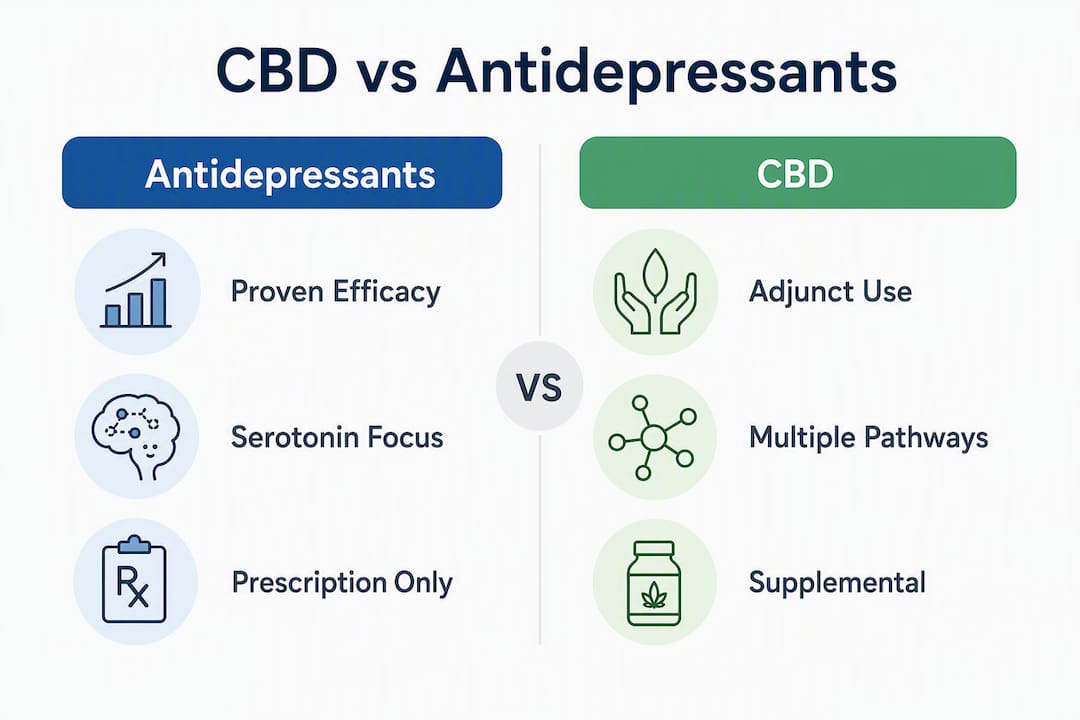
| Dimension | Prescription antidepressants (SSRIs) | CBD products |
|---|---|---|
| Mechanism of action | Serotonin reuptake inhibition (monoaminergic) | Putative 5-HT1A modulation, endocannabinoid, anti-inflammatory |
| Clinical evidence strength | Strong: multiple large RCTs and meta-analyses | Low certainty: mostly preclinical; limited human RCTs |
| Onset time | Typically 2–6 weeks for full effect | Variable; some report faster subjective effects |
| Common side effects | Sexual dysfunction, GI upset, sleep changes, agitation | Fatigue, diarrhoea, dizziness, appetite changes |
| Drug interaction risk | Moderate (CYP450 substrate) | Moderate to high (CYP450 inhibitor) |
| Withdrawal / relapse risk | Significant; supervised tapering required | Low physical dependence; relapse risk if replacing meds |
| UK regulation | Prescription-only; NHS/MHRA licensed | Consumer good; no medicinal claims permitted |
| Product quality assurance | Standardised pharmaceutical manufacturing | Variable; third-party COAs essential |
Key cautions before reading further:
- Never stop a prescribed antidepressant without speaking to your GP or prescriber first.
- If you are considering adding CBD to your current regimen, check for drug interactions (particularly CYP450 effects) with your pharmacist or doctor.
- Only use CBD products that carry a certificate of analysis (COA) from an independent laboratory confirming CBD content and zero THC.
- If you experience worsening mood, agitation, or suicidal thoughts, contact your GP or call NHS 111 immediately.
This article provides general information, not medical advice. Always confirm treatment decisions with a qualified clinician or your GP.
Table of Contents
- How do antidepressants and CBD actually work in the brain?
- What does the research actually show?
- Side effects, drug interactions and the risks of switching
- What does UK regulation say about CBD and antidepressants?
- How to decide: a practical checklist for UK adults
- How to choose CBD safely in the UK: quality, dosing and what Smokocbd offers
- Key takeaways
- A considered view on CBD alongside conventional care
- Smokocbd: a quality UK option if you choose to try CBD
- Useful sources for further reading
How do antidepressants and CBD actually work in the brain?
The mechanisms are genuinely different, and that difference shapes everything from onset time to which symptoms each approach targets.

How SSRIs work
Fluoxetine, sertraline, and citalopram all belong to the selective serotonin reuptake inhibitor (SSRI) class. They block the reabsorption of serotonin in synaptic gaps, leaving more of it available between neurons. Over time, this increased serotonin availability is thought to support mood regulation, reduce anxiety, and, through downstream neuroplastic effects, contribute to longer-term recovery from depression. The word “over time” is doing real work there: SSRIs typically take several weeks before patients notice meaningful mood improvement, partly because the therapeutic effect depends on gradual receptor adaptation, not just immediate serotonin flooding.
Other antidepressant classes, such as SNRIs (which also target noradrenaline) or tricyclics, operate through related but distinct monoaminergic pathways. The core principle remains the same: modulating neurotransmitter availability in a predictable, well-characterised way.
How CBD is thought to work
CBD’s proposed mechanisms are more diffuse and less clinically established. The most discussed pathway is indirect modulation of the 5-HT1A serotonin receptor, where CBD appears to act as a partial agonist, potentially producing anxiolytic effects through a route distinct from SSRIs. CBD also interacts with the endocannabinoid system, influencing CB1 and CB2 receptors indirectly by slowing the breakdown of anandamide, sometimes called the body’s own “bliss molecule.” Anti-inflammatory signalling and modulation of TRPV1 receptors add further layers to its pharmacological profile.
Preclinical studies have also linked CBD to increased brain-derived neurotrophic factor (BDNF), a protein associated with neuroplasticity and antidepressant-like effects in animal models. Animal studies show these antidepressant-like signals, including serotonin-related changes and BDNF upregulation, but these findings have not translated reliably into large-scale human trials.
Why the mechanism difference matters clinically:
- SSRIs act on a well-defined, validated target with predictable dose-response relationships.
- CBD’s effects are broader and less predictable; the same dose can produce different responses in different people.
- Onset for SSRIs is slow but consistent; CBD’s subjective effects on anxiety or sleep may feel faster for some individuals, but this is variable and not well characterised in controlled trials.
Pro Tip: When you read about CBD’s BDNF effects or neuroplasticity signals in animal studies, treat them as hypothesis-generating, not as proof of clinical efficacy. The gap between a rat model and a well-powered human RCT is substantial, and many compounds that looked promising in preclinical work have not performed in clinical trials.
What does the research actually show?
The honest answer is: promising signals, limited certainty. A systematic review published in PMC found that CBD demonstrated anxiolytic and some antidepressant properties in preclinical models, but explicitly called for well-conducted RCTs in mood disorders before clinical recommendations could be made. That call remains largely unanswered.
| Evidence type | Sample / certainty note | Main outcome | Certainty |
|---|---|---|---|
| Preclinical (animal models) | Multiple studies | Antidepressant-like effects; BDNF increase | Not applicable to humans directly |
| Small human RCTs (anxiety) | Limited participants | Some some improvements vs placebo on validated anxiety scales | Very low to low |
| Systematic reviews (mood disorders) | Multiple reviews | Anxiolytic potential; insufficient mood disorder evidence | Low |
| Ongoing registered trials | Various (ClinicalTrials.gov) | Awaiting results | Pending |
A 2025 evidence update on cannabis for anxiety and mood disorders could not determine that cannabis or CBD is effective for anxiety or depression, citing small RCTs, short follow-up periods, and overall very low to low certainty of evidence across mood disorder outcomes. One a 12-week RCT described in that review showed anxiety scale improvements in CBD groups compared with placebo, which is genuinely encouraging. The caveat: adverse events were more frequent in the CBD group, and the trial was small.
The evidence gap in plain terms: Antidepressants like fluoxetine and sertraline are supported by decades of large, well-powered RCTs and systematic reviews with high certainty of evidence. CBD’s human trial evidence for depression and anxiety currently sits at very low to low certainty. That is not a reason to dismiss CBD, but it is a reason to be clear-eyed about what the science currently supports.
StatPearls on NCBI Bookshelf confirms that CBD’s pharmacological profile includes anti-inflammatory, anxiolytic, and neuroprotective properties, but notes that regulatory approvals exist only for specific seizure indications (Epidyolex in the UK), not for mood disorders. Marketing has, in many cases, run well ahead of the science, and consumer health sources consistently flag this gap between advertising claims and the evidence base.
Several trials are registered on ClinicalTrials.gov examining CBD for anxiety and mood-related outcomes, including NCT02548559, NCT04286594, and NCT03549819. Results from these will be important for shaping future guidance, but they are not yet available in full.
For a deeper look at the evidence for CBD and depression, Smokocbd’s own educational resource covers the scientific picture in accessible terms.
Side effects, drug interactions and the risks of switching
This is where the comparison gets most clinically significant, and where the stakes are highest.

Side effects: what to expect from each
Antidepressants (SSRIs) commonly cause:
- Sexual dysfunction (reduced libido, delayed orgasm) — one of the most frequently reported reasons for stopping
- Gastrointestinal upset, particularly nausea in the first few weeks
- Sleep disturbance, including insomnia or vivid dreams
- Agitation or restlessness, especially early in treatment
- Weight changes with longer-term use
CBD commonly causes:
- Fatigue and sedation, particularly at higher doses
- Diarrhoea and gastrointestinal discomfort
- Dizziness or light-headedness
- Appetite changes
- Elevated liver enzymes at high doses (relevant if you are on other hepatically metabolised drugs)
The CYP450 interaction: why this matters more than most people realise
CBD inhibits cytochrome P450 liver enzymes, particularly CYP3A4 and CYP2D6. This is sometimes described as a “grapefruit effect,” because grapefruit juice does something similar. The practical consequence is that CBD can slow the metabolism of many prescription drugs, including some antidepressants, causing their blood levels to rise higher than intended. Harvard Health flags this interaction explicitly, noting that liver function monitoring is sometimes advised when CBD is used alongside other medications.
For someone taking sertraline or citalopram, elevated blood levels could amplify both the therapeutic effects and the side effects of those drugs. This is not a reason to panic, but it is a reason to tell your prescriber and pharmacist before adding CBD to your routine. Smokocbd’s guide to CBD drug interactions covers this in practical detail.
Stopping antidepressants: the most serious risk in this comparison
Do not stop antidepressants abruptly. Antidepressant discontinuation syndrome can cause dizziness, electric shock sensations (“brain zaps”), nausea, irritability, and severe mood instability. Beyond the withdrawal symptoms, abrupt cessation significantly increases the risk of depressive relapse. Clinical guidance is unambiguous: any reduction in antidepressant dose must be supervised by a prescriber, using a gradual tapering plan tailored to the individual.
The PMC systematic review identifies this as the principal clinical hazard in the CBD-versus-antidepressants conversation: patients stopping effective prescribed medication to try a supplement. CBD has not been shown to prevent relapse, and the consequences of untreated depression can be severe.
Psychiatric safety flags to be aware of:
- Patients with bipolar disorder face a risk of manic switch if antidepressants are used without a mood stabiliser; CBD’s effects on this risk are unknown.
- Any new or worsening suicidal thoughts during a treatment change require urgent clinical review.
- Adolescents and pregnant women should avoid CBD unless under specialist supervision; the safety data for these groups is insufficient.
- Elderly patients may be more sensitive to CBD’s sedative effects and interaction risks.
What does UK regulation say about CBD and antidepressants?
The regulatory picture in the UK is clear, even if the consumer market sometimes obscures it.
CBD’s legal status in the UK:
- Hemp-derived CBD products are legal to sell as consumer goods in the UK, provided they contain no more than 1mg of THC per container (the MHRA threshold for finished products).
- CBD products sold over the counter cannot legally make medicinal claims. If a product claims to treat depression, anxiety, or any other medical condition, it is making an unlicensed medicinal claim under MHRA rules.
- The only licensed cannabinoid medicine currently approved in the UK for a mood-adjacent indication is Epidyolex (cannabidiol), licensed specifically for rare forms of epilepsy, not for depression or anxiety.
NHS prescribing for depression:
The NHS follows a stepped-care model for depression. Mild depression is typically managed with watchful waiting, self-help resources, and talking therapies such as CBT. SSRIs, including fluoxetine, sertraline, and citalopram, become first-line pharmacological treatment for moderate-to-severe depression. Antidepressants are prescription-only medicines in the UK; they cannot be purchased over the counter.
The MHRA’s position on CBD: The MHRA has stated that CBD products making medicinal claims require a product licence. Consumer CBD products are regulated as food supplements, not medicines. This means they are not subject to the same manufacturing standards, clinical evidence requirements, or post-market surveillance as licensed pharmaceuticals. Third-party COAs are the consumer’s primary tool for verifying what is actually in a product.
Practical implications for UK buyers:
- Always check that a CBD product carries a COA from an accredited independent laboratory.
- Look for batch-specific testing, not just a generic certificate.
- Be sceptical of any product claiming to treat or cure a medical condition.
- If your GP or psychiatrist is not aware you are using CBD, tell them, particularly if you are on any prescription medication.
How to decide: a practical checklist for UK adults
Whether you are considering CBD as an adjunct to existing treatment, or wondering whether to discuss antidepressants with your GP, a structured approach reduces risk and improves outcomes.
Step-by-step decision process
- Assess your diagnosis and symptom severity. Mild-to-moderate anxiety or low mood is different from moderate-to-severe depression or active suicidal ideation. Severity determines the appropriate treatment tier under NHS stepped care.
- Review your current medicines. If you are already taking fluoxetine, sertraline, citalopram, or any other psychotropic, list them before considering any addition. CYP450 interactions are relevant for most of these.
- Consult your prescriber before making any changes. This is non-negotiable. Your GP or psychiatrist needs to know about any supplements you are considering, and they can advise on interaction risks and monitoring.
- If adding CBD, start at a low dose and increase slowly. This is sometimes called “start low, go slow.” It reduces the risk of side effects and makes it easier to attribute any change (positive or negative) to the CBD.
- Document your outcomes. Keep a simple daily log of mood, sleep, anxiety levels, and any side effects. This gives you and your clinician real data to work with rather than impressions.
When antidepressants should be the priority
- Moderate-to-severe depression, especially with functional impairment
- Active suicidal ideation or self-harm
- Bipolar disorder (requires specialist management)
- Psychotic features
- Previous relapse after stopping antidepressants
When CBD might be considered adjunctive
- Mild-to-moderate anxiety symptoms in a patient already stabilised on an antidepressant
- Sleep difficulties as a secondary symptom
- Patients who have discussed it with their clinician and have no significant interaction risks
Monitoring checklist when combining CBD with antidepressants:
- Mood and anxiety scores (GAD-7, PHQ-9 are freely available and easy to self-administer)
- Sleep quality and duration
- Any new or worsening side effects from your antidepressant (which may indicate raised blood levels)
- Liver function tests if your clinician recommends them
- Regular review appointments, at least every 4–6 weeks initially
For UK-specific practical tips on using CBD for anxiety, Smokocbd’s guide for UK adults is a useful starting point.
How to choose CBD safely in the UK: quality, dosing and what Smokocbd offers
Product quality is the single biggest variable in the UK CBD market. Harvard Health’s review of consumer CBD products found consistent evidence of label inaccuracy, with some products containing significantly more or less CBD than stated, and others showing unexpected THC levels. Third-party COAs are the only reliable way to verify what you are actually buying.
What to look for on a certificate of analysis
- Batch-specific testing: The COA should reference the exact batch number of the product you are buying, not a generic certificate.
- Accredited laboratory: The testing lab should be ISO 17025 accredited or equivalent.
- Full cannabinoid panel: Confirms CBD content and verifies that THC is below the legal threshold (1mg per container in the UK).
- Contaminant screening: Pesticides, heavy metals, and microbial contaminants should be tested and reported.
- Date of testing: COAs older than 12 months for a batch are less reliable.
Dosing cautions when on other medicines
There is no universally agreed therapeutic dose for CBD in anxiety or mood disorders, partly because the human trial evidence is still limited. The general principle is to start at a low dose for adults new to CBD and increase gradually over several weeks, monitoring for both benefit and adverse effects. If you are on any prescription psychotropic, discuss the starting dose with your pharmacist or GP before beginning.
A note on broad-spectrum versus full-spectrum products: Broad-spectrum CBD contains multiple cannabinoids and terpenes but has THC removed, making it the preferred choice for anyone concerned about THC exposure or drug testing. Full-spectrum products retain trace THC, which can accumulate with regular use. For people on prescription medication, broad-spectrum is the more cautious option.
Smokocbd’s quality commitments are directly relevant here. Smokocbd produces its broad-spectrum CBD tinctures in the UK, using organically grown hemp, and verifies zero THC through independent third-party laboratory testing. The product range includes tinctures, gummy bears, and soft gel capsules in varying strengths, with detailed product descriptions and accessible customer support. For readers who have done their research and want a UK-produced option they can verify, that combination of domestic production and independent testing addresses the main quality concerns the evidence raises.
Pro Tip: Before combining any CBD product with a prescription antidepressant, take the product’s COA to your pharmacist. They can check the cannabinoid content, flag any interaction concerns, and advise on monitoring. This takes five minutes and significantly reduces your risk.
For further context on how CBD interacts with the body’s systems, the Mongoose blog’s review of CBD evidence in chronic conditions provides useful background on the broader clinical picture.
Key takeaways
CBD is not a clinically proven substitute for prescription antidepressants, but it may serve as a carefully supervised adjunct for mild-to-moderate anxiety symptoms in adults already stabilised on treatment.
| Point | Details |
|---|---|
| CBD is not a replacement | No large-scale RCTs support CBD as a substitute for SSRIs like fluoxetine, sertraline, or citalopram. |
| Evidence certainty is low | Systematic reviews rate the human evidence for CBD in mood disorders as very low to low certainty. |
| Never stop antidepressants abruptly | Discontinuation syndrome and relapse risk make supervised tapering with your GP non-negotiable. |
| CYP450 interactions are real | CBD can raise blood levels of some antidepressants; always inform your prescriber and pharmacist. |
| Smokocbd for quality-verified CBD | Smokocbd’s broad-spectrum, third-party lab-tested tinctures are a UK-produced option for adults considering adjunctive CBD under clinical supervision. |
A considered view on CBD alongside conventional care
The conversation around CBD and antidepressants tends to split into two unhelpful camps: enthusiasts who treat CBD as a natural cure-all, and sceptics who dismiss it entirely. Neither position serves patients well.
What the evidence actually supports is a more nuanced picture. CBD is genuinely interesting pharmacologically. Its action on the 5-HT1A receptor, its endocannabinoid effects, and its anti-inflammatory signalling all represent plausible pathways to mood and anxiety benefit. The preclinical data is not noise. The problem is that plausible mechanisms and animal model results have a poor track record of translating into clinical efficacy, and the human trial evidence for CBD in mood disorders remains thin.
Where CBD seems most likely to offer real value is as an adjunct in patients who are already stabilised on an antidepressant and experiencing residual symptoms, particularly anxiety or sleep difficulties, that are not fully addressed by their prescription. In that scenario, a clinician-supervised trial of a quality-verified CBD product, with careful monitoring and no reduction in prescribed medication, is a reasonable thing to consider. The key word is “supervised.” Self-medicating with CBD while quietly reducing an antidepressant is where the real harm happens.
Vulnerable groups deserve particular caution. Pregnant women, adolescents, and elderly patients with polypharmacy all face elevated risks from CBD, whether through unknown developmental effects, CYP450 interactions, or sedation. For these groups, specialist advice is not optional.
The most honest thing to say about this comparison is that it is genuinely unresolved. CBD may prove, with better trials, to have a meaningful role in mood disorder management. It may not. What is clear right now is that prescription antidepressants have a far stronger evidence base, a regulated supply chain, and clinical oversight built into how they are accessed. CBD, at its best, is a thoughtful addition to a care plan, not a replacement for one.
Smokocbd: a quality UK option if you choose to try CBD
If you have read this far, spoken to your GP, and decided you want to trial CBD as an adjunct to your existing care, product quality is the next decision. Most of the risk in the UK CBD market comes not from CBD itself but from products that do not contain what they claim, or that carry unexpected THC.
Smokocbd’s broad-spectrum CBD tinctures are made in the UK, formulated from organically grown hemp, and independently verified for zero THC through third-party laboratory testing. That means you can check the COA, confirm the cannabinoid content, and know exactly what you are taking. The range includes tinctures in multiple strengths, including the 2000mg Mint Broad Spectrum CBD Tincture, alongside gummy bears and soft gel capsules for those who prefer a different format. Customer support is available if you have questions about dosing or product selection.
Before combining any CBD product with a prescription antidepressant, confirm the plan with your prescriber or pharmacist. Then, if you are ready to try, browse Smokocbd’s range and start at a low dose, monitoring carefully over the first few weeks.
Useful sources for further reading
The sources below are the most authoritative starting points for UK adults and clinicians wanting to go deeper on this topic.
-
Cannabidiol: A Potential New Alternative for the Treatment of Anxiety, Depression, and Psychotic Disorders (PMC) — A peer-reviewed review covering CBD’s pharmacological mechanisms and clinical potential. Best for readers who want to understand the science behind the 5-HT1A and endocannabinoid hypotheses.
-
Cannabidiol as a treatment for mood disorders: a systematic review (PMC) — The most directly relevant systematic review for this comparison. Covers preclinical evidence, human trial limitations, and clinical cautions. Suitable for both clinicians and informed patients.
-
Cannabidiol (CBD) in clinical care — StatPearls (NCBI Bookshelf) — A clinician-facing summary of CBD’s pharmacology, approved uses, and safety profile. Regularly updated and freely accessible.
-
Cannabis for anxiety and mood disorders — 2025 evidence update (Cannabisevidence) — The most current systematic evidence review available. Covers RCT data, certainty ratings, and ongoing trial landscape. Recommended for clinicians and researchers.
-
CBD products: do they work? — Harvard Health — An accessible, balanced consumer explainer covering product quality issues, interaction risks, and the gap between marketing and evidence. Good starting point for general readers.
-
CBD oil benefits — Healthline — A well-referenced consumer resource that flags where marketing has outpaced the science. Useful for readers who want a plain-language overview with links to primary sources.
-
ClinicalTrials.gov — registered CBD trials for anxiety and mood — For readers who want to track ongoing registered trials, ClinicalTrials.gov lists current and completed studies. Relevant trials include NCT04286594 and NCT03549819.
For clinicians: prioritise the PMC systematic reviews, the 2025 Cannabisevidence update, and StatPearls for evidence grading and interaction data. For general readers: Harvard Health and Healthline offer the clearest plain-language summaries, while Smokocbd’s educational articles provide UK-specific practical guidance.