TL;DR:
- Taking excessive CBD can cause dose-dependent side effects such as drowsiness, diarrhea, and potential liver injury signs that require urgent medical attention.
- Individual factors, formulation quality, and concurrent medications significantly influence the risk of adverse reactions, emphasizing careful dosing and product verification.
Taking too much CBD can cause side effects ranging from drowsiness and diarrhoea to serious liver injury signs that demand urgent medical attention. Cannabidiol (CBD) is widely regarded as safe at moderate doses, but “too much” is a real clinical threshold. The European Food Safety Authority (EFSA) has set a provisional safe intake level for CBD at just 0.0275 mg/kg/day for adults, roughly 2 mg per day for a 70 kg adult. That figure is strikingly low compared to the doses many wellness products suggest, which means the gap between a typical serving and an excessive one is smaller than most people realise.
What are the common side effects of too much CBD?
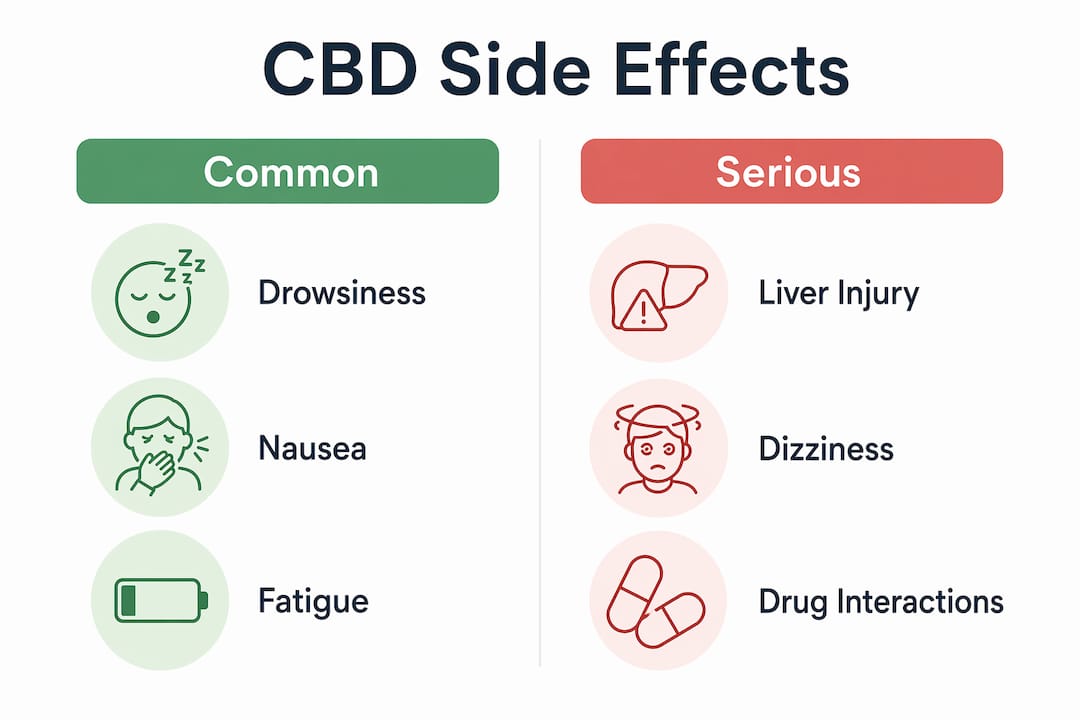
The most frequently reported too much CBD side effects are drowsiness, diarrhoea, nausea, fatigue, and irritability. These are dose-dependent, meaning they become more likely and more pronounced as intake climbs above your personal threshold. Understanding which symptoms appear first gives you an early warning system before anything more serious develops.

FDA pharmacovigilance data confirm that fatigue, nausea, and dizziness are among the most commonly reported adverse reactions associated with CBD and hemp products. This matters because these symptoms are easy to dismiss as unrelated tiredness or a stomach upset, when they may actually be your body signalling that your dose is too high.
Clinical research adds further detail. A 2026 phase I randomised trial comparing two CBD formulations found that loose stools, headache, and nausea were the most common adverse events, with drowsiness being the only moderate-severity event recorded. No serious adverse events occurred under controlled conditions, which is reassuring, but real-world dosing is rarely as controlled as a clinical trial.
Here is a summary of the most commonly reported excessive CBD effects and their relative frequency:
- Drowsiness / sedation — very common; can impair driving and operating machinery
- Diarrhoea / loose stools — common; often the first gastrointestinal sign of excess
- Nausea — common; frequently accompanies diarrhoea at higher doses
- Fatigue — common; distinct from normal tiredness and persistent throughout the day
- Dizziness — moderately common; more prevalent in older adults
- Irritability or mood changes — reported, particularly in younger users
- Insomnia — paradoxical but documented, especially at very high doses
- Depression — reported in pharmacovigilance data, though causality is not confirmed
Symptoms generally resolve as CBD metabolises out of the body. The oral half-life of CBD ranges from 18 to 32 hours, so side effects from a single excessive dose can persist for the better part of a day or longer.
How does dosage and product formulation affect CBD side effects?
Not all CBD products carry the same risk of adverse reactions, even at identical milligram doses. Formulation, bioavailability, and product purity all influence how much CBD your body actually absorbs and processes.
The EFSA’s provisional safe level applies specifically to high-purity CBD of 98% or above. Lower-purity or unverified products can deliver unintended exposure to additional cannabinoids, solvents, or contaminants, pushing effective intake well beyond what the label suggests. This is why third-party lab testing is not a marketing luxury but a genuine safety requirement.
Research comparing CBD powder (CBtru®) and oil (Epidyolex®) found that CBtru® produced more consistent absorption and higher metabolite exposure than the oil-based formulation. More consistent absorption sounds positive, but it also means less predictability in how your body responds if you switch products or take CBD with food. CBD exposure is measurably higher under fed conditions, so taking a tincture after a meal can significantly increase the amount that reaches your bloodstream.
| Factor | Lower risk profile | Higher risk profile |
|---|---|---|
| Dose | At or below EFSA provisional limit | Significantly above 2 mg/day for a 70 kg adult |
| Formulation | Third-party tested, high-purity oil or capsule | Unverified powder or variable-quality product |
| Food intake | Taken on an empty stomach | Taken after a high-fat meal |
| Concurrent medications | None | Anticoagulants, antiepileptics, or liver-processed drugs |
Pro Tip: If you are switching between a CBD oil and a capsule or powder product, treat it as a new starting dose. Absorption differences between formulations mean your previous dose may not translate directly, and you could inadvertently exceed your threshold.
For practical guidance on safe daily CBD amounts, the EFSA framework is a useful starting point, but individual responses vary considerably.
What serious risks should you watch for with excessive CBD use?
Most CBD side effects are uncomfortable rather than dangerous. A small number of symptoms, however, signal potential liver injury and require prompt medical evaluation rather than a simple dose reduction.
The Mayo Clinic identifies the following as urgent warning signs that should prompt you to stop CBD immediately and seek medical attention:
- Yellow skin or eyes (jaundice) — a sign of impaired liver function
- Dark urine — often accompanies jaundice and indicates liver stress
- Pale or clay-coloured stools — another liver-related warning
- Severe nausea with upper stomach pain — a cluster that clinicians associate with hepatic involvement
- Serious allergic reactions — rash, swelling, or difficulty breathing
Stop CBD and contact a healthcare professional immediately if you experience jaundice, dark urine, pale stools, or severe upper abdominal pain. These symptoms indicate possible liver injury and are not a sign to simply lower your dose.
Clinicians triage suspected CBD overdose cases by looking at symptom clusters. Gastrointestinal upset combined with drowsiness typically indicates excessive dosing that can be managed by reducing intake. A cluster of jaundice-related symptoms, by contrast, demands emergency evaluation. The distinction matters because acting on the wrong cluster could delay care that is genuinely time-sensitive.
High-dose CBD combined with central nervous system (CNS) depressants, including alcohol, benzodiazepines, or opioids, carries additional risk. While no fatal CBD overdoses have been documented, extreme sedation in combination with other depressants can be dangerous. Avoiding driving or operating heavy machinery until you fully understand how CBD affects you is not overcautious. It is the standard clinical recommendation from the Mayo Clinic.
For a full overview of CBD drug interactions, particularly those involving liver enzymes, Smokocbd has a dedicated resource worth reading before combining CBD with any prescription medication.
How do age, gender, and individual factors affect CBD risks?
CBD adverse reactions are not evenly distributed across the population. Age, gender, and health status all shift the risk profile in meaningful ways, and a dose that is well-tolerated by one person can cause significant problems for another.
Analysis of FDA adverse event reporting system (FAERS) data shows clear demographic differences in CBD side effects. Older adults report more physical adverse reactions, including dizziness, falls, and gastrointestinal symptoms. Younger adults, particularly those under 25, show a stronger pattern of neuropsychiatric effects such as anxiety, mood disturbance, and seizure-related events.
| Population group | Primary risk profile | Key concern |
|---|---|---|
| Adults over 65 | Dizziness, falls, GI upset | Increased fall risk with sedation |
| Adults under 25 | Anxiety, mood changes, seizure risk | Neuropsychiatric sensitivity |
| Women (general) | Higher overall adverse reaction rate | Broader susceptibility across categories |
| Men (general) | Higher seizure reporting | Specific neurological vulnerability |
| Pregnant or lactating | Unknown safety profile | EFSA excludes from provisional safe level |
| Medicated individuals | Drug interaction risk | Liver enzyme competition |
Women report more adverse drug reactions with CBD than men across most categories, with the notable exception of seizures, which are more frequently reported by men. This gender heterogeneity in adverse reactions suggests that personalised risk assessment is more useful than a single universal dose recommendation.
The EFSA’s provisional safe intake level explicitly does not apply to people under 25, those who are pregnant or breastfeeding, or individuals taking medication. These groups face either unknown risks or documented interactions that make standard dosing guidance unreliable.
Pro Tip: If you are over 65 or taking any regular medication, speak to your GP before starting CBD. The risk of dizziness-related falls and drug interactions in older adults is well-documented, and a brief conversation can prevent a serious incident.
What practical steps help you manage and avoid excessive CBD effects?
Managing CBD side effects starts before you take your first dose. A structured approach to dosing, product selection, and symptom monitoring removes most of the guesswork.
- Start at the lowest effective dose. Begin with a product that allows precise, small doses, such as a measured tincture or a pre-dosed capsule. Increase only after at least one week at the same dose with no adverse effects.
- Choose third-party tested products. Lab certification confirms actual CBD concentration and the absence of contaminants. Products without independent testing cannot guarantee the dose on the label matches what you are consuming.
- Track your symptoms. Keep a brief daily note of how you feel, particularly regarding sleep quality, digestion, and energy levels. Patterns become visible within a week and make it much easier to identify a dose that is too high.
- Check for drug interactions before combining. CBD is metabolised by the cytochrome P450 enzyme system in the liver, the same pathway used by many common medications. Combining CBD with anticoagulants, antiepileptics, or statins without medical guidance carries real risk.
- Avoid driving or operating machinery if drowsy. Sedation from excessive CBD is not always obvious to the person experiencing it. If you feel any unusual tiredness after taking CBD, treat it as impairment.
- Reduce dose or stop if GI symptoms appear. Diarrhoea and nausea are reliable early signals that your dose is too high. Reducing intake promptly usually resolves these symptoms within 24 to 48 hours.
- Seek medical attention for liver warning signs. Jaundice, dark urine, or severe upper abdominal pain are not manageable at home. Stop CBD and contact a healthcare professional the same day.
For further guidance on how much CBD to take safely, Smokocbd’s dosage guide covers the practical steps in detail.
Key takeaways
Taking too much CBD causes dose-dependent side effects ranging from drowsiness and diarrhoea to serious liver injury signs, with risk shaped by formulation quality, individual demographics, and concurrent medications.
| Point | Details |
|---|---|
| EFSA provisional limit is very low | The safe intake level of 0.0275 mg/kg/day means many commercial doses exceed guidance for a 70 kg adult. |
| Liver warning signs need urgent care | Jaundice, dark urine, and upper stomach pain require stopping CBD and seeking medical help immediately. |
| Formulation affects absorption | Powder and oil formulations differ in bioavailability; fed conditions increase exposure significantly. |
| Demographics shift the risk profile | Older adults face fall risk; under-25s face neuropsychiatric effects; women report more adverse reactions overall. |
| Start low and use tested products | Third-party lab testing and gradual dose titration are the two most effective ways to avoid adverse effects. |
Why dose awareness matters more than most people realise
I have spoken with a lot of people who started CBD with the best intentions and ended up confused about why they felt worse, not better. The pattern is almost always the same: they bought a product without lab certification, assumed more was better, and pushed the dose up when they did not see immediate results.
What strikes me most about the current evidence is how low the EFSA’s provisional safe level actually is. Two milligrams per day for a 70 kg adult is a fraction of what most tincture labels suggest as a starting dose. That does not mean every product at a higher dose is dangerous, but it does mean that the regulatory science is still catching up with the market, and in that gap, users carry the risk.
The demographic data from FAERS is the part I find most underappreciated. The fact that older adults and younger adults experience fundamentally different side effect profiles means there is no single “safe user” template. A 68-year-old taking CBD for joint pain and a 22-year-old taking it for anxiety are not the same clinical picture, and they should not be treated as if they are.
My honest view is that CBD is genuinely useful for many people, but it rewards caution and punishes assumptions. Buying a product with clear, verified lab results, starting at a low dose, and paying attention to how your body responds in the first two weeks will prevent the vast majority of adverse experiences. The side effects of too much CBD are real, but they are also largely avoidable with the right approach.
— Mike
Explore Smokocbd’s lab-tested CBD range
If you want to use CBD with confidence, product quality and dose control are the two factors that matter most. Smokocbd’s broad-spectrum range is third-party lab tested to confirm CBD concentration and zero THC levels, giving you a reliable baseline for managing your intake.
The 1000mg broad-spectrum CBD tincture comes with a measured dropper, making it straightforward to start low and adjust gradually. For those who prefer a fixed, pre-measured dose, the 750mg soft gel capsules remove the guesswork entirely. Both products are made from organically grown hemp and manufactured to UK quality standards, so what is on the label is what you are actually taking.
FAQ
What are the first signs you have taken too much CBD?
The earliest signs of excessive CBD intake are usually drowsiness, loose stools, and nausea. These symptoms are dose-dependent and typically resolve within 24 to 48 hours once intake is reduced.
Can you overdose on CBD?
No fatal CBD overdoses have been documented, but taking too much can cause significant adverse effects including severe sedation and, in rare cases, liver injury signs. Combining high-dose CBD with CNS depressants such as alcohol or benzodiazepines increases the risk of dangerous sedation.
How much CBD is considered too much?
The EFSA’s provisional safe intake level is 0.0275 mg/kg/day, approximately 2 mg per day for a 70 kg adult. This applies to high-purity CBD only and does not cover people under 25, pregnant women, or those on medication.
When should I seek medical help after taking CBD?
Seek medical attention immediately if you experience jaundice, dark urine, pale stools, or severe upper abdominal pain after taking CBD. These symptoms indicate possible liver injury and require same-day evaluation, not a simple dose reduction.
Does CBD affect everyone the same way?
No. FDA pharmacovigilance data show that older adults are more prone to physical side effects like dizziness and falls, while younger adults experience more neuropsychiatric effects. Women report more adverse reactions overall than men, with the exception of seizures, which are reported more frequently by men.