TL;DR:
- CO2 wax is a pure botanical concentrate made by pressurising carbon dioxide to extract cannabinoids and terpenes without solvent residue. It is produced through carefully controlled subcritical or supercritical extraction, which influences the final product’s aroma and cannabinoid content. Higher quality CO2 wax contains 70-90% cannabinoids, with careful post-processing ensuring purity and safety for various uses.
CO2 wax is a botanical concentrate produced by pressurising carbon dioxide to isolate cannabinoids and terpenes from plant material without leaving solvent residue. The industry term for this product category is “supercritical fluid extract,” though “CO2 wax” describes the waxy, semi-solid texture that results from specific extraction parameters. What makes this method stand out is its combination of purity, safety, and compound preservation. Unlike hydrocarbon methods, CO2 leaves no flammable residue and can be tuned to target specific plant compounds. Smokocbd uses CO2 extraction principles to produce its broad-spectrum CBD range, reflecting the method’s reputation as the gold standard for clean botanical extracts.
How does CO2 extraction work to produce wax?
CO2 extraction operates in two distinct modes, and the choice between them defines the character of the final wax. Subcritical extraction runs below 1,071 psi and 31°C, which preserves heat-sensitive terpenes and produces a lighter, more aromatic wax. Supercritical extraction pushes beyond those thresholds, turning CO2 into a dense fluid that pulls cannabinoids aggressively and delivers higher yields in a shorter time frame.
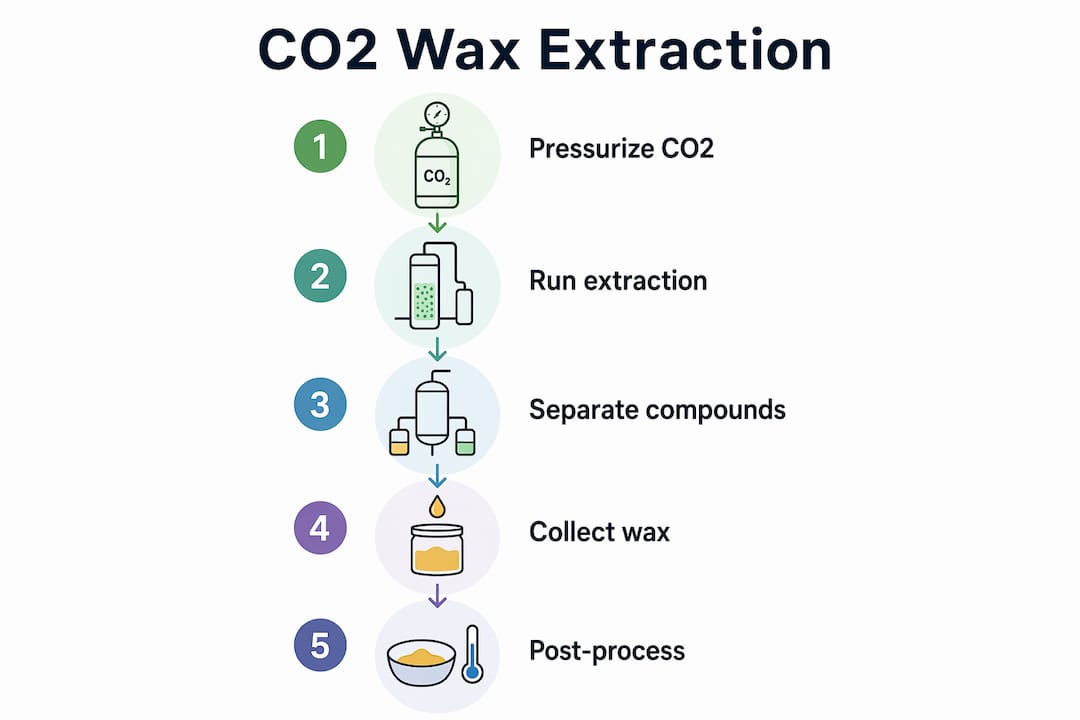
The process runs inside a closed-loop system. A pump compresses CO2 to the target pressure, then drives it through a vessel packed with plant material. The CO2 acts as a solvent, dissolving the desired compounds. The enriched fluid then passes into a separator, where pressure drops and CO2 reverts to gas, leaving the extracted wax behind. Yields typically reach 18–25% by weight, with each batch taking 2–4 hours to complete.
CO2’s behaviour as a solvent is what makes it so useful. Pressure and temperature adjustments determine which plant compounds are extracted, making it a genuinely tunable tool rather than a blunt instrument. Lower pressures pull terpenes and lighter compounds; higher pressures pull cannabinoids and heavier lipids. This selectivity is something hydrocarbon solvents simply cannot replicate.
CO2 is classified as GRAS (Generally Recognised As Safe) and carries no flammability risk. At atmospheric pressure, it evaporates completely, leaving zero solvent residue in the final product. That safety profile is a significant advantage over butane or propane, which require strict ventilation controls and carry explosion risk during processing.
Pro Tip: If you are evaluating a CO2 wax product, ask the producer whether they used subcritical or supercritical settings. That single answer tells you whether the extract was optimised for flavour or for yield.
What are the characteristics and quality factors of CO2 wax?
High-quality CO2 wax is defined by its cannabinoid concentration, terpene profile, colour, and purity. Commercial CBD wax concentrates typically contain 70–90% cannabinoids, with broad-spectrum products retaining minor cannabinoids such as CBG and CBC alongside the primary CBD content. That cannabinoid density is what separates a genuine concentrate from a diluted extract.

Colour is a reliable quality indicator. Lower extraction pressures produce lighter, more opaque wax rich in terpenes, while higher pressures yield darker, denser wax with more lipid content. A golden or amber colour generally signals a well-controlled extraction. Very dark or greenish wax often indicates that chlorophyll and plant waxes were co-extracted, which affects both flavour and smoothness.
Post-processing matters as much as the extraction itself. Supercritical CO2 co-extracts plant waxes and lipids alongside cannabinoids, so winterisation and purging are required to refine the extract. Winterisation involves dissolving the crude extract in ethanol and chilling it to precipitate unwanted fats. Purging then removes residual CO2 and ethanol from the wax.
The purging step deserves particular attention. A vacuum oven set to around 45°C with a vacuum pressure of approximately 200 microns, run for 24–48 hours, removes residual solvents without degrading cannabinoids or terpenes. Rushing this step is the most common cause of harsh-tasting or impure wax.
Key quality markers to look for in a CO2 wax product:
- Cannabinoid content: Verified by third-party lab testing, ideally showing 70–90% total cannabinoids
- Terpene profile: Listed on the certificate of analysis, confirming aromatic compounds survived extraction
- Residual solvent levels: Should read as non-detectable or below regulatory limits
- Colour and texture: Light amber to golden, with a waxy or crumbly consistency
Pro Tip: Always request a certificate of analysis before purchasing any CO2 wax. A reputable producer will publish third-party lab results showing cannabinoid percentages, terpene content, and residual solvent levels.
How does CO2 wax compare to other extraction methods?
CO2 extraction produces a cleaner product than butane or ethanol methods, but the trade-offs are real. Butane hash oil (BHO) extraction is faster and cheaper, and it preserves terpenes well at low temperatures. The problem is residual solvent risk. Butane is highly flammable, and even trace amounts left in the final product raise safety concerns. CO2 carries none of that risk.
Ethanol extraction is efficient and scalable, making it popular for large commercial operations. It pulls a broad range of compounds quickly, but it also co-extracts chlorophyll and water-soluble plant material, which requires additional filtration. CO2 extraction is more selective by nature, which reduces the post-processing burden when settings are dialled in correctly.
The choice between subcritical and supercritical extraction is a trade-off between flavour and yield. Subcritical favours terpene preservation and produces a more aromatic, flavour-forward wax. Supercritical favours throughput and cannabinoid density. Neither is universally superior. The right choice depends entirely on what the final product needs to deliver.
Cost is where CO2 extraction shows its limitations. The equipment is expensive, and the post-processing costs add complexity that impacts the final consumer price. Small-scale producers often find butane or ethanol more accessible. Commercial operations with the capital investment, however, consistently choose CO2 for the quality and safety advantages it provides.
Advantages of CO2 extraction over other methods:
- No flammability risk during processing
- Zero solvent residue after depressurisation
- Tunable selectivity for targeted compound extraction
- Suitable for food-grade and cosmetic applications
- Consistent batch-to-batch quality with precise parameter control
For a deeper look at how extraction method affects product quality, the CBD extraction methods guide from Smokocbd covers the full spectrum of techniques and their practical implications.
What are common uses and consumption methods of CO2 wax?
CO2 wax is versatile. Its purity and potency make it suitable for vaporising, topical formulation, and culinary use, depending on the cannabinoid and terpene profile of the specific extract.
-
Vaporising and dabbing. This is the most direct consumption method. The recommended temperature range for vaporising CO2 wax is 180–210°C, which preserves heat-sensitive terpenes and cannabinoids while avoiding combustion. Temperatures above 230°C begin to degrade terpenes and can produce unwanted byproducts. A quality dab rig or temperature-controlled vaporiser gives you the control needed to stay within that window.
-
Topical and skincare applications. CO2 wax dissolves readily into carrier oils and emulsifiers, making it straightforward to incorporate into balms, serums, and creams. Its purity means fewer unwanted compounds reach the skin. Formulators working with broad-spectrum extracts benefit from the retained minor cannabinoids, which contribute to the product’s overall effect profile.
-
Culinary use. CO2 wax can be infused into fats and oils for cooking applications. The terpene content adds distinctive flavour notes that complement certain dishes. Temperature control matters here too: prolonged heat above 160°C will degrade the more volatile terpenes, so low-temperature infusion methods work best.
-
Storage to maintain quality. CO2 wax degrades when exposed to heat, light, and air. Store it in an airtight, opaque container in a cool, dark location. For long-term storage, a refrigerator works well, though the wax will firm up and need to return to room temperature before use. Proper CBD storage practices apply equally to wax concentrates.
-
Safety considerations. Never combust CO2 wax directly. Combustion destroys terpenes, reduces bioavailability, and produces harmful byproducts. Vaporising within the 180–210°C range maximises both safety and the therapeutic value of the extract.
Key takeaways
CO2 wax is the cleanest, most tunable botanical concentrate available, and its quality depends entirely on extraction parameters, post-processing rigour, and third-party verification.
| Point | Details |
|---|---|
| Extraction mode determines character | Subcritical CO2 preserves terpenes; supercritical delivers higher cannabinoid yields. |
| Cannabinoid content signals quality | High-grade CO2 wax contains 70–90% cannabinoids, confirmed by third-party lab testing. |
| Post-processing is non-negotiable | Winterisation and purging at 45°C for 24–48 hours remove impurities without degrading potency. |
| Temperature control protects compounds | Vaporise CO2 wax between 180–210°C to preserve terpenes and avoid harmful combustion. |
| CO2 is safer than hydrocarbon methods | CO2 carries no flammability risk and leaves zero solvent residue after depressurisation. |
Why subcritical CO2 wax deserves more attention than it gets
Most of the conversation around CO2 extraction focuses on supercritical processing, because the yields are higher and the equipment runs faster. That makes commercial sense. But from a quality standpoint, subcritical CO2 wax is where things get genuinely interesting.
I’ve seen formulators dismiss subcritical extracts because the cannabinoid numbers look lower on paper. What they miss is the terpene density. A subcritical wax with a rich, intact terpene profile behaves differently in the body and on the palate than a high-potency supercritical extract that has been stripped of its aromatic compounds. The tunable solvent properties of CO2 are the whole point. Using supercritical settings for everything is like owning a precision instrument and only ever using it on the highest setting.
The other thing I’d push back on is the “solvent-free” marketing that surrounds CO2 products. CO2 is a solvent during extraction and requires careful purging, just like any other method. The advantage is that it evaporates cleanly at atmospheric pressure, not that it was never a solvent at all. Buyers who understand this distinction make smarter purchasing decisions and ask better questions of producers.
My practical advice: if you are buying CO2 wax for vaporising, prioritise terpene content and colour over raw cannabinoid percentage. If you are formulating a topical or culinary product, a well-purged supercritical extract with verified residual solvent levels is the right starting point. And always, always check the certificate of analysis before committing to a product.
— Mike
Broad-spectrum CBD products from Smokocbd
Smokocbd produces its broad-spectrum CBD range using CO2 extraction, which means the cannabinoids and terpenes in every product are preserved without solvent contamination.
The 1000mg broad-spectrum CBD tincture delivers a clean, potent extract in a convenient mint-flavoured MCT oil base, third-party tested to confirm zero THC. For those who prefer a different format, the broad-spectrum CBD gummy bears offer the same CO2-extracted quality in an easy, measured dose. Every Smokocbd product is made with organically grown hemp from the USA and verified by independent laboratory analysis, so you know exactly what you are getting.
FAQ
What is CO2 wax?
CO2 wax is a semi-solid botanical concentrate produced by using pressurised carbon dioxide to extract cannabinoids and terpenes from plant material. The waxy texture results from specific extraction pressures and temperatures during processing.
How does CO2 wax differ from BHO wax?
CO2 wax uses carbon dioxide as the solvent, leaving zero residue after depressurisation, while BHO uses butane, which carries flammability risk and requires rigorous purging to remove residual solvent. CO2 extraction also allows precise compound targeting through pressure and temperature control.
What cannabinoid content should I expect in CO2 wax?
High-quality CO2 wax contains 70–90% cannabinoids, with broad-spectrum products retaining minor cannabinoids like CBG and CBC alongside the primary cannabinoid. Always verify content through a third-party certificate of analysis.
What temperature should I use to vaporise CO2 wax?
The recommended range is 180–210°C for vaporising CO2 wax. Staying within this range preserves terpenes and cannabinoids while preventing the harmful byproducts that combustion produces above 230°C.
Where can I buy CO2 wax products in the UK?
Broad-spectrum CBD products made with CO2 extraction are available from UK-based retailers including Smokocbd, which publishes third-party lab results for every product. For a full overview of the extraction process behind these products, the CO2 extraction guide on the Smokocbd blog covers the process in detail.