CBD can genuinely support habit formation for adults, though it works best as a supportive tool rather than a standalone fix. Used consistently, it may lower background anxiety, ease physical recovery, improve sleep quality, and sharpen focus, all of which reduce the friction that stops new routines from sticking. The evidence is promising in places, mixed in others, and the strongest clinical data still concerns prescription CBD for specific epilepsy syndromes rather than everyday wellness goals.
Here is what the research suggests CBD can realistically help with:
- Lower background anxiety so starting a new routine feels less effortful
- Better sleep and recovery, which strengthens next-day self-control and motivation
- Reduced pain and inflammation, removing a common physical barrier to movement habits
- Improved focus and mood stability, supporting learning and consistency during habit-building phases
None of this replaces behaviour-change techniques such as habit-stacking, cue-reward loops, or tracking. CBD works alongside those methods, not instead of them. If you take prescription medication, speak to your GP or pharmacist before starting.
Pro Tip: Start with one anchor habit and pair CBD with it at the same time each day. Consistency of timing matters more than dose size in the early weeks.
Table of Contents
- How CBD may support the biology of habit formation
- What the scientific evidence actually shows
- How to use CBD practically to support your routines
- Side effects, drug interactions, and when to see your GP
- Is CBD itself habit-forming?
- How to pick a high-quality CBD product in the UK
- Key takeaways
- A practical note on using CBD with intention
- Smokocbd broad-spectrum CBD: a UK-made option worth considering
- Selected sources and further reading
How CBD may support the biology of habit formation
Habit formation depends on a cycle: cue, routine, reward, repetition. Each stage has a biological cost, and CBD’s interaction with the body’s endocannabinoid system (ECS) may reduce that cost in several ways.
The ECS is a signalling network of receptors (CB1 and CB2), endogenous cannabinoids such as anandamide (sometimes called the “bliss molecule,” found in small amounts in dark chocolate), and the enzymes that break them down. It helps regulate mood, pain perception, sleep, appetite, and immune responses. CBD does not bind directly to CB1 or CB2 receptors the way THC does. Instead, it modulates the system indirectly, inhibiting the enzyme FAAH that breaks down anandamide, which allows that calming signal to linger longer.
CBD’s multi-receptor profile means it can gently tone down the stress response, ramp up natural pain relief, and nudge the sleep-wake cycle, all without producing intoxication. Pharmacology reviews document interactions with 5-HT1A (serotonin), TRPV1 (pain and temperature), and PPARγ (inflammation) receptors, giving it a broad but modest influence across several systems relevant to habit support.
Here is how each mechanism maps onto habit formation:
Stress and anxiety reduction. Starting a new routine, whether a morning workout, a meditation practice, or a dietary change, requires overcoming inertia. Elevated cortisol and background anxiety raise that activation energy. CBD’s action on 5-HT1A receptors may tone down the stress response, making it easier to begin. Pharmacology research supports its anti-inflammatory and neuroprotective properties, which plausibly reduce the physiological load of chronic stress.
Sleep and recovery. Self-control is a limited resource that replenishes overnight. Poor sleep undermines willpower, decision-making, and the motivation to follow through on new behaviours. CBD’s influence on sleep architecture, particularly its interaction with TRPV1 and adenosine receptors, may support deeper, more restorative rest.
Pain and inflammation relief. Physical discomfort is one of the most common reasons people abandon exercise or movement habits. By modulating pain signalling through TRPV1 and reducing inflammatory markers, CBD may lower the perceived effort of physical routines, making repetition more likely.

Focus and mood stability. Serotonin pathway modulation via 5-HT1A receptors may support a more stable baseline mood, reducing the emotional volatility that disrupts consistency. A calmer, more focused state makes it easier to follow through on cognitive habits such as journalling, language learning, or structured work blocks.
One important caveat: CBD does alter consciousness. Harvard Health notes that while CBD does not produce a THC-style high, it does change how you feel, producing relaxation or sleepiness in some people. That matters for timing decisions. Taking CBD before a task requiring alertness may backfire if your response leans sedative.
Pro Tip: Track how CBD affects your energy and alertness for the first two weeks before committing to a specific timing. Some people find it energising at low doses; others find it calming at any dose.
What the scientific evidence actually shows
The honest picture is this: CBD has strong clinical evidence in one narrow area and limited or mixed evidence everywhere else.
The Mayo Clinic confirms that prescription cannabidiol (Epidiolex) is approved for Lennox-Gastaut syndrome, Dravet syndrome, and tuberous sclerosis complex. That approval is based on rigorous randomised controlled trials. For anxiety, sleep, pain, and habit-related outcomes, the evidence base is thinner: small sample sizes, short follow-up periods, inconsistent dosing across studies, and heavy reliance on preclinical (animal) work.
An umbrella review published in Addiction identified 22 systematic reviews examining CBD and substance use disorders. The overall conclusion was mixed: CBD monotherapy showed limited support, and results varied considerably across trials. Some combined THC/CBD formulations showed more promise for certain withdrawal outcomes, but that is a different product category entirely.
Animal studies add further complexity. Preclinical research on CBD and habit formation suggests context-dependent and sex-dependent effects, with some experiments showing that CBD may actually impair the updating of action-outcome contingencies rather than straightforwardly reducing habitual behaviour. Those findings do not translate directly to humans, but they do caution against assuming CBD uniformly supports habit flexibility.
| Evidence area | Strength of evidence | Key limitation |
|---|---|---|
| Epilepsy (prescription CBD) | Strong (RCT-based) | Specific syndromes only; not OTC |
| Anxiety reduction | Moderate (small trials) | Short duration, inconsistent dosing |
| Sleep improvement | Moderate (observational) | Few large RCTs; dose-response unclear |
| Pain and inflammation | Moderate (preclinical + small trials) | Most data from animal models |
| Habit formation directly | Weak (preclinical only) | Sex/context-dependent; no large human RCTs |
| Substance use disorder | Mixed (22 systematic reviews) | Heterogeneous; monotherapy limited |
The NCBI Bookshelf entry on cannabidiol stresses that clinical oversight, liver monitoring, and drug reconciliation are necessary in medical contexts, reinforcing that CBD is not a casual supplement for everyone.
The Merck Manual summarises the position well: potential uses exist for anxiety, sleep, and spasticity, but the evidence is modest and side effects and interactions must be weighed carefully.
A further complication is product quality. Reviews consistently flag that laboratory testing often finds products contain different amounts of CBD than their labels claim. That inconsistency makes it hard to draw firm conclusions from consumer-grade studies, and it is one of the strongest arguments for buying from suppliers who publish third-party certificates of analysis.
How to use CBD practically to support your routines
The most effective approach pairs CBD with established behaviour-change techniques rather than relying on it alone. Here is a practical framework for a first 30-day trial.
Product formats and ideal use cases
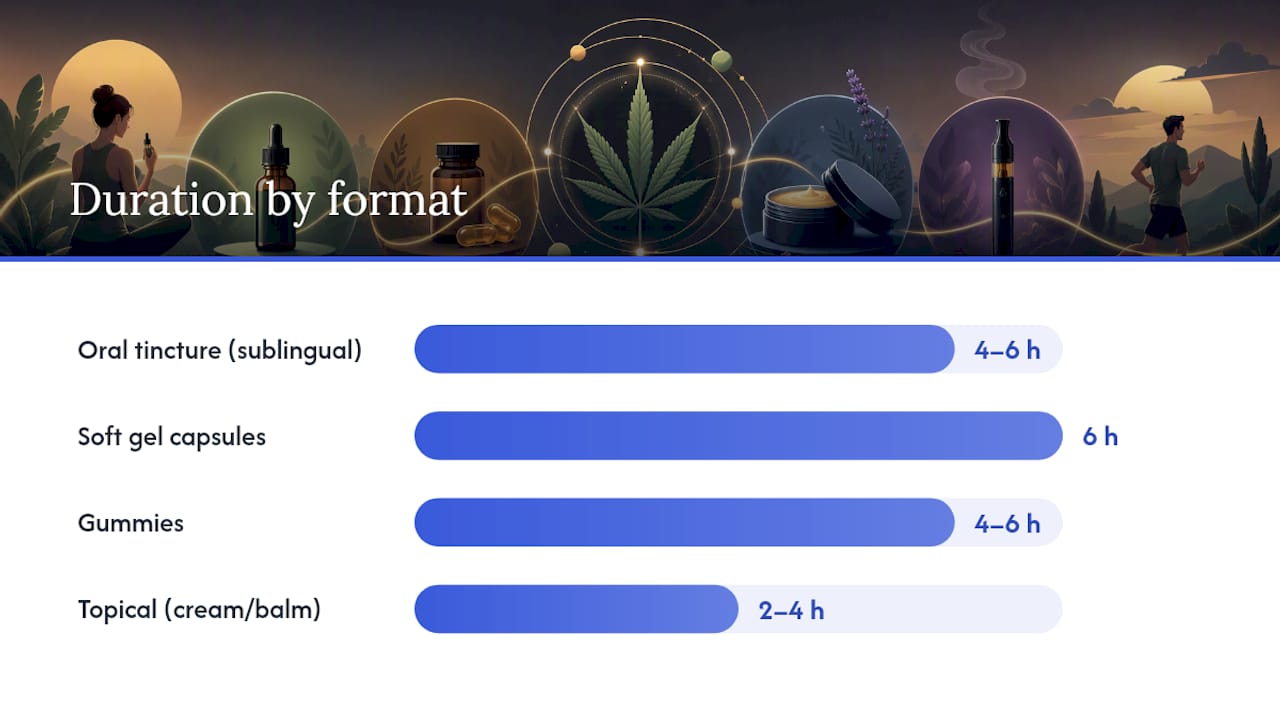
| Format | Onset time | Duration | Best for | Notes |
|---|---|---|---|---|
| Oral tincture (sublingual) | 30 minutes | 4–6 hours | Morning focus, pre-workout, evening wind-down | Fastest oral onset; easy to adjust dose |
| Soft gel capsules | 60–90 minutes | 6 hours | Consistent daily dosing, sleep support | Convenient; slower onset means plan ahead |
| Gummies | 30–90 minutes | 4–6 hours | Daytime routines, stress management | Palatable; pre-measured dose |
| Topical (cream/balm) | 30 minutes (local) | 2–4 hours | Post-workout muscle recovery | Localised effect; no systemic absorption |
For a step-by-step sleep routine, taking a capsule or tincture 60–90 minutes before bed gives the compound time to work before you want to feel its effects. For a morning focus routine, a lower-dose tincture taken after breakfast may support clarity without tipping into drowsiness. Post-workout, a topical applied to sore muscles alongside a standard oral dose addresses both local discomfort and systemic recovery.
Observational reports and smaller trials suggest that people who use CBD consistently alongside wellness habit efforts report improved adherence and lower perceived effort, though these findings are preliminary and largely self-reported. Treat them as encouraging signals, not clinical proof.
Side effects, drug interactions, and when to see your GP
CBD is generally well tolerated, but it is not without risks, and some of those risks are clinically significant.
Common side effects include drowsiness, dry mouth, reduced appetite, diarrhoea, and fatigue. Most are dose-dependent and resolve when the dose is lowered. Drowsiness is worth taking seriously if you drive or operate machinery.
The most clinically important risk is CBD’s interaction with cytochrome P450 (CYP450) liver enzymes, the same mechanism by which grapefruit affects certain medications. Harvard Health explains that CBD can inhibit these enzymes, altering how your body processes other drugs and potentially raising or lowering their effective concentration in your bloodstream.
Drug classes that warrant particular caution include anticoagulants (such as warfarin), certain antiepileptic medicines, and statins. If you take any regular prescription medication, speak to your GP or pharmacist before starting CBD. This is not a formality; it is a genuine safety step.
The NCBI Bookshelf recommends liver function monitoring for people using CBD at higher doses or over extended periods, particularly in medical contexts. For everyday wellness use at lower doses, the risk is lower, but it is worth being aware of if you have a pre-existing liver condition.
Special populations. Pregnant and breastfeeding women should avoid CBD; the evidence on foetal and infant safety is insufficient to recommend use. CBD is not recommended for children outside of prescribed medical contexts. Older adults metabolise CBD more slowly and may be more sensitive to its effects.
Pro Tip: If you take warfarin or any anticoagulant, do not start CBD without a GP conversation first. The interaction can shift your INR meaningfully, which carries real bleeding risk.
The Merck Manual reinforces that while CBD’s therapeutic potential is real, its side effects and interactions mean it should be approached with the same care as any active supplement.
This article provides general information, not medical advice. Confirm current guidance with your GP, pharmacist, or a qualified healthcare professional before starting CBD, especially if you take regular medication.
Is CBD itself habit-forming?
CBD has low to no addictive potential pharmacologically. It does not produce the dopamine surge associated with addictive substances, and there is no established withdrawal syndrome for CBD at typical consumer doses.
That said, any pleasant ritual can become a psychological routine. If a morning gummy becomes the cue that signals “stress relief is coming,” the ritual itself can feel necessary even when the compound’s effect is modest. That is behavioural reliance, not physiological addiction, but it is worth being aware of.
- Physiological dependence: Not established at consumer doses; no recognised withdrawal syndrome for CBD alone.
- Psychological routine: Possible with any consistent ritual; the act of taking CBD can become a cue in its own right.
- Tolerance: Some users report needing slightly higher doses over time, though the evidence for CBD tolerance in humans is limited.
Practical safeguards to keep CBD in its proper place:
- Rotate your supportive strategies: combine CBD with breathwork, movement, sleep hygiene, and journalling rather than relying on it as the sole stress tool.
- Take occasional breaks (a week off every two to three months) to confirm you are not relying on the ritual more than the compound.
- Monitor your use honestly. If you feel anxious at the thought of skipping a dose, that is a signal to reassess.
Pro Tip: Think of CBD as one instrument in an orchestra, not the conductor. The habit-formation techniques, cues, and rewards are the structure; CBD supports the conditions in which that structure can work.
How to pick a high-quality CBD product in the UK
Not all CBD products are equal, and the gap between a well-made product and a poorly labelled one can be significant. Use this checklist before buying.
What to check on the certificate of analysis (COA)
| COA element | What to look for |
|---|---|
| Testing laboratory | Accredited; independent from the manufacturer |
| Batch/lot number | Matches the product batch you are buying |
| Cannabinoid profile | Full panel including CBD, CBG, CBN, and THC |
| THC result | Below legal limit; zero for broad-spectrum claims |
| Pesticide screen | Pass result with named compounds tested |
| Heavy metal panel | Pass result (lead, mercury, cadmium, arsenic) |
| Solvent residues | Pass result for extraction solvents |
| Date of testing | Within the product’s shelf life |
Pro Tip: If a supplier cannot provide a COA on request, or if the COA is undated and lacks a batch number, treat that as a red flag and look elsewhere.
Smokocbd publishes third-party lab reports for its broad-spectrum products, confirming zero THC and full cannabinoid profiles. Product pages include dosing guidance and ingredient lists, which is the baseline transparency you should expect from any reputable UK supplier. Check the CBD wellness checklist for a fuller breakdown of what to look for before purchasing.
Storage matters too. CBD degrades with heat, light, and air exposure. Keep products in a cool, dark place with the lid sealed. Most tinctures have a shelf life of 12–24 months unopened; check the batch date on the COA against the product’s best-before date.
Key takeaways
CBD can support habit formation by reducing the biological friction that stops routines from sticking, but it works best as part of a broader behaviour-change approach, not as a replacement for one.
| Point | Details |
|---|---|
| CBD as a supportive tool | CBD may reduce anxiety, improve sleep, and ease pain, lowering the effort needed to start and repeat new routines. |
| Evidence is mixed | Strong clinical evidence exists only for prescription CBD in epilepsy; anxiety, sleep, and habit outcomes have limited or mixed trial data. |
| Safety and interactions | CBD inhibits CYP450 liver enzymes; consult a GP or pharmacist before starting if you take regular prescription medication. |
| UK legal requirements | Products must meet THC limits and FSA novel food requirements; always verify with a third-party COA before buying. |
| Smokocbd’s offering | Smokocbd provides broad-spectrum, zero-THC CBD tinctures, gummies, and capsules with third-party lab reports, suitable for UK adults building daily wellness routines. |
A practical note on using CBD with intention
The most common mistake people make with CBD and habit formation is expecting it to do the heavy lifting. It will not. What it can do, when used consistently and at the right time, is lower the background noise enough that your behaviour-change efforts have a better chance of taking hold.
The evidence base is still developing, and that is worth being honest about. The preclinical data is genuinely interesting; the human trial data is thinner than the marketing suggests. That does not mean CBD is not worth trying. It means you should try it with clear expectations, a simple measurement approach, and a willingness to stop if it is not working for you.
Pair it with one concrete technique: habit-stacking, a sleep log, a consistent morning cue. Track for 30 days. Adjust based on what you observe, not on what you hope to feel. And if you are on any regular medication, please do have that conversation with your GP first. It takes five minutes and could matter considerably.
Smokocbd broad-spectrum CBD: a UK-made option worth considering
Zero-THC, third-party tested, and made in the UK: that is the short version of what Smokocbd offers adults who want to trial CBD as part of a wellness routine without the uncertainty of unverified products.
The 2000mg broad-spectrum CBD tincture is a practical starting point for anyone building a morning focus or evening wind-down routine. It uses organically grown hemp, publishes full cannabinoid profiles from accredited labs, and comes with clear per-drop dosing guidance so you are not guessing. Gummies and soft gel capsules cover the same broad-spectrum formulation in formats that suit daytime use or consistent nightly dosing. Every batch is tested for THC, pesticides, and heavy metals, giving you the transparency the FSA expects and that you should demand from any UK supplier. Browse the full range at smokocbd.com and find the format that fits the routine you are building.
Selected sources and further reading
The following sources underpin the key claims in this guide. Each is linked to the specific area it supports.
- CBD products are everywhere. But do they work? - Harvard Health
- CBD: Safe and effective? - Mayo Clinic
- Cannabidiol — NCBI Bookshelf
- Cannabidiol pharmacology review — PMC5877694
- Frontiers review: CBD pharmacology and receptor interactions
- Umbrella review on CBD and substance use disorders - Wiley Online Library
- Cannabidiol (CBD) — Merck Manual
- Using CBD for positive habit formation | CBDMagic