Current evidence does not support CBD as a proven treatment for restless legs syndrome. Case reports and small surveys often describe symptom relief, but controlled analyses have sometimes found no difference from placebo. If you’re considering CBD for restless legs, treat it as an experimental option to discuss with a clinician, not a replacement for established RLS treatment.
TL;DR:
- Current studies suggest that CBD offers no consistent benefit for restless legs syndrome, with controlled trials showing no significant improvement over placebo.
- Uncontrolled reports indicate some patients perceive relief, but these anecdotal accounts lack the scientific rigor to confirm efficacy.
- Ongoing large-scale, placebo-controlled trials are expected to provide clearer evidence on CBD’s true effectiveness once completed by 2026.
- CBD’s safety profile is generally acceptable, but it can cause side effects and interact with medications metabolized through liver enzymes, necessitating medical consultation.
- If trying CBD, use verified, third-party tested products with zero THC, start with low doses, and track symptoms carefully over two to four weeks.
Table of Contents
- Does CBD help restless legs? What the clinical evidence says
- How might CBD affect restless legs symptoms?
- Is CBD safe to try for restless legs?
- How to try CBD for restless legs safely
- Mike’s take: cautious optimism, not false promises
- Try SMOKO CBD’s lab-tested tincture for your RLS trial
- Sources
Does CBD help restless legs? What the clinical evidence says
The honest answer is: we don’t know yet, and the studies we have point in different directions. That’s not a dodge. It’s what happens when you look closely at a small, uneven body of research rather than the marketing copy built on top of it.
A scoping review of cannabinoid use for restless leg symptoms found the evidence base leans heavily on case reports and observational studies, with real methodological inconsistency between them. The review’s authors called explicitly for proper randomised controlled trials before anyone draws firm conclusions.
Where controlled data does exist, it’s mixed at best. A post-hoc analysis within a Parkinson’s disease trial tested CBD doses in a small study of 18 patients with RLS/Willis-Ekbom disease showed no meaningful difference versus placebo. That’s a small sample studying a specific patient group, so it can’t rule CBD out for the wider RLS population, but it’s a genuine data point against uncritical optimism.
Meanwhile, uncontrolled reports tell a different story. Some patients using smoked cannabis or topical CBD have reported relief from RLS symptoms, though without a placebo arm or blinding, these accounts can’t separate a real drug effect from expectation, timing, or coincidence.
What might settle the question is already in motion. A registered randomised, placebo-controlled trial of a high-CBD botanical extract for idiopathic RLS is scheduled to run through 2025 and 2026, and researchers running similar work expect that larger, better-designed trials will finally give a clearer answer, given how individual RLS responses tend to be.
What the current evidence adds up to:
- Case reports and surveys: relief reported, but uncontrolled and hard to interpret
- Small trial post-hoc analysis: no benefit found versus placebo in 18 patients
- Scoping review conclusion: evidence is mixed and generally low quality
- Registered RCT (NCT07224932): results expected once the trial concludes
None of this means CBD does nothing for RLS. It means nobody can currently say with confidence that it does.
How might CBD affect restless legs symptoms?
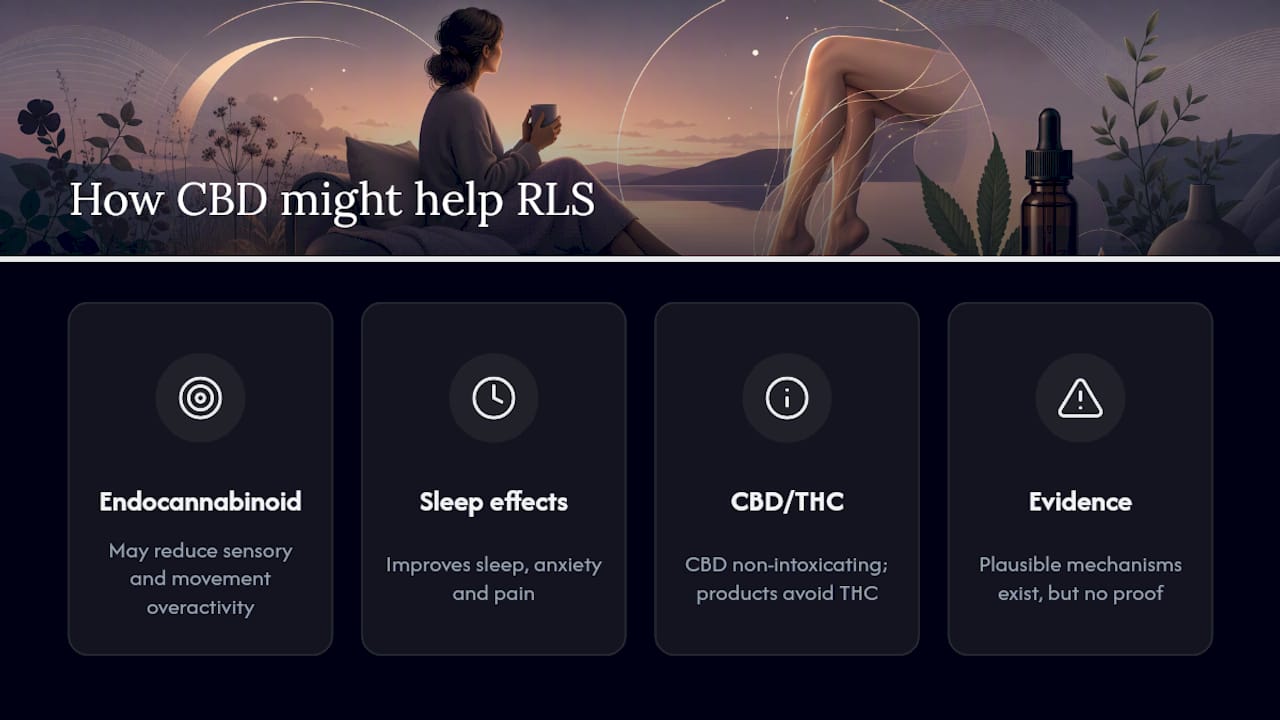
CBD interacts with the endocannabinoid system, a signalling network involved in regulating sensory processing, sleep architecture, and movement control, the same territory where RLS causes its trouble. In theory, if CBD can tone down overactive sensory signalling or ramp up the body’s own calming pathways, that could translate into fewer of the crawling, tingling urges that define RLS.
CBD is also widely studied for its effects on sleep quality, anxiety, and pain perception, all relevant here because RLS symptoms worsen at rest and at night, disrupting sleep in a way that compounds the discomfort. Better sleep regulation might ease that cycle indirectly, even without CBD touching the underlying cause of RLS itself.
It’s worth being precise about which cannabinoid we’re discussing. CBD does not produce the intoxicating effects associated with THC, and products used for RLS exploration are typically broad-spectrum or CBD-isolate formulations specifically to avoid that. But plausible mechanism is not proof. Biology offering a reasonable explanation for why something might work is a different thing entirely from a trial demonstrating that it does.
Is CBD safe to try for restless legs?
Reviews of CBD’s safety profile report generally acceptable tolerability, but not a clean bill of health. Common side effects noted across trials assessing CBD safety and tolerability include tiredness, drowsiness, dizziness, and nausea, plus diarrhoea and appetite changes reported elsewhere in the literature. None of these are usually dangerous, but they’re worth knowing before you start.
The bigger safety concern is drug interactions. CBD is metabolised via the liver’s CYP450 enzyme pathway, the same system responsible for processing many prescription medications, including blood thinners and some anti-seizure drugs. This matters more for RLS specifically, because RLS treatment sometimes overlaps with medications like dopamine agonists or iron supplements, so checking with the prescribing clinician before adding CBD isn’t optional caution, it’s basic safety.
On dosing, there’s no universal figure to reach for. Reported study doses range enormously, from around 10 mg up to figures well over 800 mg daily depending on the condition studied, which tells you dosing hasn’t been standardised for RLS at all.
A pragmatic checklist before you buy anything:
- Confirm the product carries a current third-party lab report (a Certificate of Analysis)
- Check THC content sits at trace levels or genuinely zero, not just “low”
- Match the batch number on the packaging to the one on the lab report
- Start at the lowest sensible dose and increase gradually, never the reverse
- Flag the product to your GP or pharmacist if you take any prescribed medication
Pro Tip: Keep the lab certificate (or a screenshot of it) somewhere you can find it. If you ever need to discuss the product with a doctor or pharmacist, having the exact cannabinoid and THC figures to hand speeds that conversation up considerably.
How to try CBD for restless legs safely
If you decide to trial CBD, structure matters more than enthusiasm. Oral tinctures and soft gel capsules tend to work better than topical products for consistent dosing, since you know precisely how many milligrams you’re taking each time, something a cream or balm can’t guarantee. Topical CBD has some anecdotal support, but the research overwhelmingly covers oral, systemic use, so treat topicals as the lower-evidence choice.
Before buying, read the lab certificate properly:
- CBD potency should match what’s stated on the label, within a reasonable margin
- THC should read as “not detected” or below trace legal limits
- Contaminants (heavy metals, pesticides, residual solvents) should show as passed or absent
A sensible trial runs for two to four weeks at a low starting dose, commonly around 20 to 40 mg daily, tracked with a simple symptom diary or a standard RLS severity score so you’re comparing against your own baseline rather than guessing. If symptoms worsen, if you notice concerning side effects, or if four weeks brings no change at all, that’s your cue to stop and speak to a clinician rather than escalating the dose indefinitely. A structured sleep routine built around consistent timing can make it easier to spot genuine changes versus noise.
Mike’s take: cautious optimism, not false promises
Here’s what frustrates me about how CBD gets discussed online: sites either dismiss it entirely or oversell it as a cure. Neither is honest. The scoping reviews are clear that evidence is mixed and low quality, and the one controlled analysis we have found no benefit in a small Parkinson’s cohort. That’s not nothing, but it’s not a green light either.
What I’d actually recommend is treating CBD as a possible adjunct once reversible causes like iron deficiency have been ruled out by a doctor, never as a first move. If you do trial it, product quality is where you have real control. Smokocbd’s broad-spectrum tinctures are third-party lab tested and verified THC-free, which at least removes the guesswork from the product itself, even while the clinical guesswork continues. Record what you notice. Tell your doctor. Give the upcoming trial data time to catch up.
— Mike
Try SMOKO CBD’s lab-tested tincture for your RLS trial
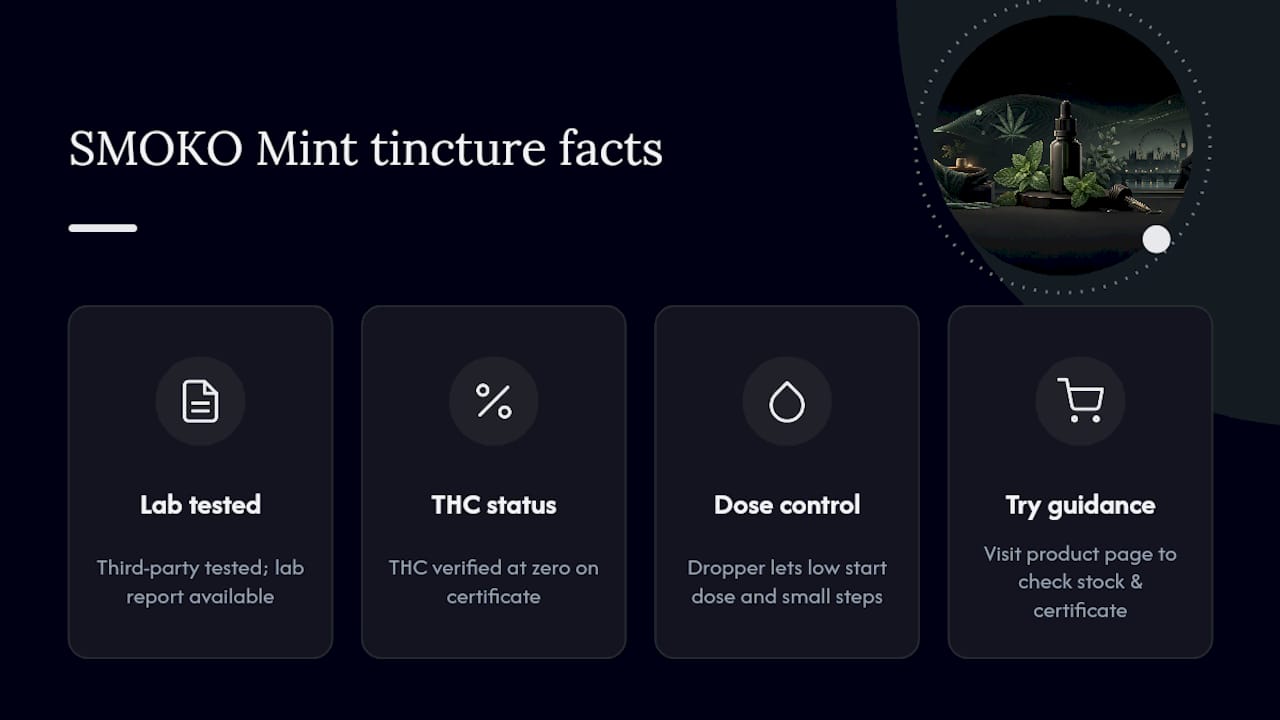
If you’ve read this far, you know the safety checklist by heart: a current lab report, verified zero THC, a clear starting dose. The SMOKO CBD Mint 2000 mg Broad Spectrum Tincture is built around exactly that standard.
It’s a broad-spectrum oral tincture, made in the UK, third-party lab tested with THC verified at zero, so the product itself isn’t the variable you need to worry about while you’re tracking symptoms. The dropper format also makes it straightforward to measure a low starting dose and adjust in small, deliberate steps, which matters far more here than with most supplements. For a night-time routine, pairing it with a consistent sleep schedule tends to make any changes easier to notice.
This article is educational, and the product link above is a genuine commercial recommendation from Smokocbd. If restless legs are disrupting your nights, visit the Mint 2000 mg tincture page to check current stock, review the lab certificate, and decide whether a cautious, tracked trial makes sense for you.
This article is general information, not a substitute for advice from a qualified doctor. Consult a qualified healthcare professional about your own circumstances before acting on anything here.
Sources
- The effect of cannabidiol for restless legs syndrome/Willis-Ekbom disease in Parkinson’s patients — Cannabis and Cannabinoid Research
- Effect of cannabinoids use on symptoms of restless legs — Annals of Indian Academy of Neurology
- Clinicaltrials
- CBD dosage: how much should you take? — Healthline