The best available trials do not prove that standard oral CBD relieves knee osteoarthritis pain better than a placebo, though small topical studies and plenty of anecdotal reports suggest some people find real relief when it’s applied directly to the joint. If you’re going to try it, start with a topical product, use a low dose consistently for two to four weeks, and track your symptoms. Always check for interactions with any medicines you already take before you start.
TL;DR:
- Oral CBD at high doses has shown no proven benefit for knee osteoarthritis pain in the two strongest clinical trials, and may cause adverse effects.
- Small topical studies suggest some pain relief from applying CBD directly to affected joints, but these findings are preliminary and lack standardisation or long-term data.
- Topical CBD is pharmacologically more rational for joint pain, as it interacts locally with receptors, bypassing first-pass metabolism and potentially improving efficacy.
- Effective dosing typically starts with a low dose, such as 5-10 mg sublingually or a pea-sized topical amount, followed by gradual increases over several weeks while tracking symptoms.
- Always verify product quality with third-party lab reports, and consult a healthcare professional before combining CBD with existing medications to avoid interactions.
Table of Contents
- What does the clinical evidence say about CBD for knee osteoarthritis?
- How might CBD actually reduce pain and inflammation?
- Which CBD products work best for knee pain?
- How much CBD should you take for knee discomfort?
- What should you check before buying a CBD product for joint pain?
- Behind SMOKO CBD’s quality checks and customer support
- Do real users actually notice a difference?
- Is CBD for knee pain legal where you live?
- How does CBD compare with NSAIDs, physiotherapy, and joint supplements?
- Does CBD work differently for a sudden injury versus long-term joint pain?
- When I’d actually suggest giving CBD a try
- Choosing a SMOKO CBD product to trial for knee pain
- Where this article’s evidence comes from
- Sources
What does the clinical evidence say about CBD for knee osteoarthritis?
The honest answer is: less than the marketing suggests. The two most rigorous trials to date, both randomised, double-blind, and placebo-controlled, found that oral CBD did not outperform placebo for knee osteoarthritis pain.
The first gave patients 600 mg of oral CBD daily, added to paracetamol, over eight weeks. The CBD arm showed no meaningful improvement on the WOMAC pain subscale compared with placebo. Worse, participants taking CBD reported more adverse events and, in some cases, elevated liver enzymes. This matters because 600 mg is a high dose by consumer standards. Most over-the-counter oils sold in the UK deliver much smaller amounts per serving.
The second trial, known as CANOA, tested a CBD-rich Cannabis sativa oil at roughly 45 mg daily for 60 days. Again, no significant difference emerged versus placebo on WOMAC or VAS pain scores, though the oil was well tolerated with a favourable safety profile.
Both trials, taken together, are the strongest signal we have that oral CBD alone is unlikely to be a reliable fix for chronic knee osteoarthritis pain.
The picture shifts slightly with topical products. Small pilot studies looking at peripheral joint conditions, including thumb basal joint osteoarthritis and peripheral neuropathy, have reported pain reductions with topical CBD applied directly to the affected area. These studies are encouraging but far from conclusive:
- Sample sizes were small, often fewer than 30 participants.
- Follow-up periods were short, typically weeks rather than months.
- Product formulations varied wildly between studies, making direct comparison difficult.
- Placebo effects in pain trials are notoriously strong, and few topical CBD studies have controlled for this rigorously.
Systematic reviews of cannabinoids for pain broadly agree: the evidence is suggestive but not definitive, and researchers consistently call for larger, longer, better-standardised trials before anyone can make firm claims. Several new trials, including topical and sublingual formulations for knee osteoarthritis, are currently under way, so this evidence base is likely to shift in the coming years. For now, treat CBD as a plausible complementary option rather than a proven treatment.
How might CBD actually reduce pain and inflammation?
CBD interacts with the body’s endocannabinoid system, a network of receptors involved in regulating pain signalling, immune response, and inflammation. Preclinical studies (largely in animal models rather than humans) suggest CBD can dial down inflammatory signalling and modulate how pain messages travel through nerve pathways. Think of it as turning a dial rather than flipping a switch: it may tone down the volume of inflammatory activity rather than switching it off entirely.

Applied topically, CBD works locally. Rather than travelling through the bloodstream, it interacts with receptors in the skin and underlying tissue near the joint. This matters pharmacologically because oral CBD undergoes what’s called first-pass metabolism: the liver processes it before much reaches your bloodstream, which significantly reduces its bioavailability. Topical application sidesteps that liver detour entirely, which may explain why some people notice more from a cream rubbed into the knee than from a dropper under the tongue.
You’ll often see broad-spectrum or full-spectrum products marketed around the “entourage effect”, the idea that cannabinoids and terpenes work better together than any single compound in isolation. It’s a reasonable hypothesis, but clinical comparisons between spectrum types remain scarce, and full-spectrum products carry trace THC that isolate products don’t.
Three things worth remembering about mechanism:
- Plausible biology does not equal proven clinical benefit, particularly for knee osteoarthritis specifically.
- Local, topical delivery has a clearer pharmacokinetic rationale than swallowing a capsule for joint-specific pain.
- Inflammation reduction in a petri dish or a mouse model doesn’t always translate into a noticeable change in your knee.
Which CBD products work best for knee pain?
Not all CBD formats are created equal for joint pain, and the format you choose should match what you’re actually trying to achieve.
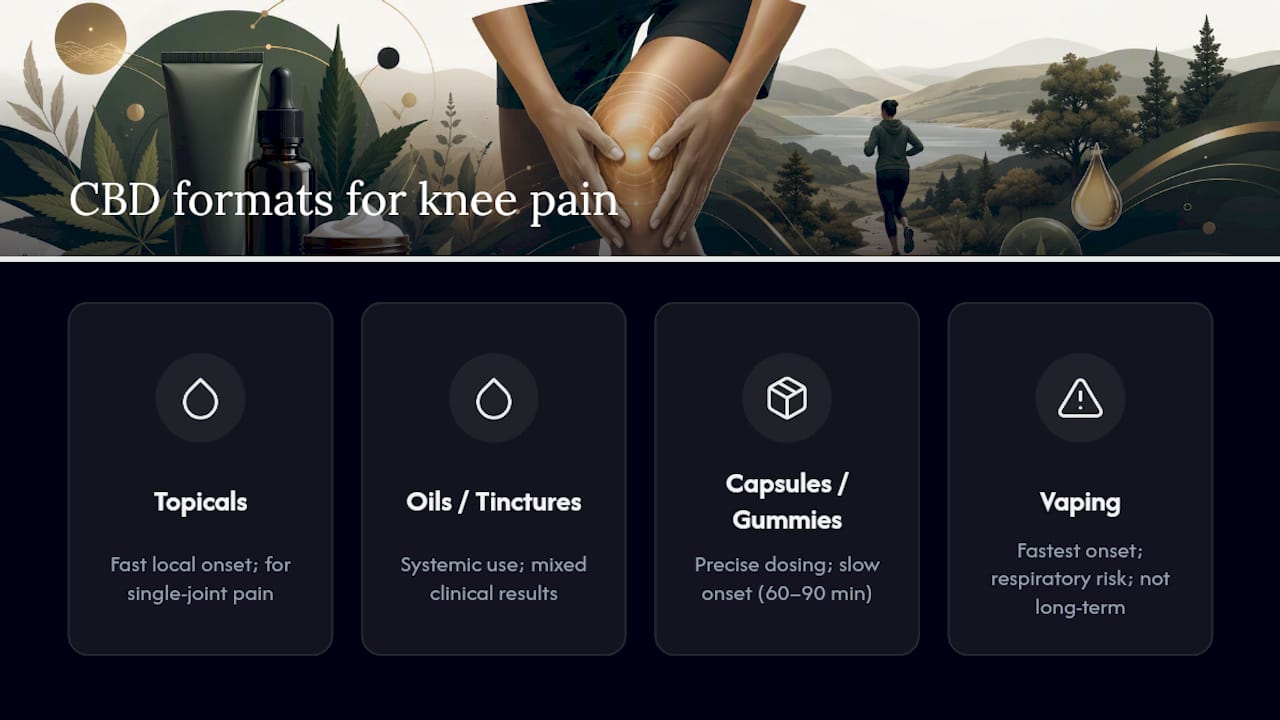
Topicals (creams, balms, gels, and transdermal patches) are the format with the most direct evidence for localised joint pain. They’re rubbed straight onto the skin over the knee, giving faster local onset than anything you swallow. Formulation matters here: products may need a delivery vehicle such as castor oil or a transdermal enhancer to actually penetrate to deeper tissue rather than sitting on the skin’s surface.
Oils and tinctures work systemically, absorbed sublingually before entering the bloodstream. They suit people dealing with pain in multiple joints or broader inflammation, not just one knee, though bioavailability remains a limiting factor and trial results for oral use have been mixed at best.
Capsules and gummies offer the most precise, repeatable dosing since each one contains a fixed amount. The trade-off is slower onset, often 60 to 90 minutes, because the CBD has to pass through digestion first, and absorption can vary from person to person.
Vaping delivers CBD fastest of all, but it comes with respiratory risks that make it unsuitable as a long-term strategy for managing chronic joint pain.
When comparing products, check the label for milligrams of CBD per dose (not per bottle), the carrier oil used (commonly MCT oil, hemp seed oil, or olive oil), and the total concentration. A detailed breakdown of joint-specific product evidence can help you match format to your specific pain pattern.
Pro Tip: If your knee pain is localised to one joint rather than widespread, a topical product applied twice daily for two to four weeks gives you the clearest read on whether CBD is doing anything at all, before you invest in a systemic tincture regime.
How much CBD should you take for knee discomfort?
There’s no officially standardised medical dose for knee pain, which is exactly why “start low, go slow” is the guidance repeated across clinical dosing literature. Individual responses vary considerably, and creeping up gradually lets you find your own effective dose without overshooting into side-effect territory.
A practical approach looks like this:
- Topical route: apply a small, pea-sized amount to the knee twice daily for the first week, then reassess.
- Sublingual/oral route: start at 5 to 10 mg twice daily, holding the dose under the tongue for 60 seconds before swallowing.
- Adjust gradually: if you notice no change after a week, increase by 5 to 10 mg every three to seven days, keeping a simple log of pain levels and stiffness.
- Set a review point: give any dose two to four weeks before deciding whether it’s working, since short trials can be misleading due to placebo response.
On safety, the trial data gives genuine reason for caution at higher doses. In the 600 mg oral trial, participants on CBD experienced more adverse events and liver enzyme elevations than those on placebo. This is not a reason to panic at consumer-level doses of 10 to 30 mg, but it is a reason to avoid casually escalating into high triple-digit milligram territory without medical guidance.
CBD is metabolised by cytochrome P450 liver enzymes, the same pathway responsible for breaking down a huge range of prescription medicines. That creates real potential for interaction, particularly with:
- Blood thinners such as warfarin
- Certain antidepressants
- Some anti-seizure medications
- Immunosuppressants
If you take any prescription medicine regularly, ask your GP or pharmacist before starting CBD, not after. Finally, full-spectrum products contain trace THC. Because THC is measured by weight rather than per dose, regular high-volume use can build up meaningful total THC exposure, which matters enormously if you’re subject to workplace drug testing.
What should you check before buying a CBD product for joint pain?
A good CBD product tells you exactly what’s in it, and a vague one should raise flags immediately.
Start with the certificate of analysis (COA), an independent lab report confirming exact CBD milligrams per dose, THC content, and screening for residual solvents, pesticides, and heavy metals. Reputable brands publish these openly rather than making you request them.
- Confirm the COA batch number matches the batch number on your actual product, not just the product line generally.
- Decide between broad-spectrum (zero THC, most cannabinoids retained) and isolate (pure CBD only) if workplace drug testing is a concern.
- Compare cost per milligram of CBD rather than price per bottle, since concentrations vary hugely between brands.
- Check the carrier oil, serving size, and expiry date before committing to a larger bottle.
- Avoid sweet, candy-like, or juice-like products in homes with children, and store all CBD products securely out of reach.
| Check | Why it matters |
|---|---|
| Third-party COA | Confirms actual CBD content and THC level match the label |
| Batch number match | Ensures the lab report applies to your specific product |
| Cost per mg | Reveals true value versus flashy packaging or bottle size |
| Carrier oil listed | Affects absorption and suitability if you have allergies |
| Broad-spectrum vs isolate | Determines THC exposure risk for drug testing |
Behind SMOKO CBD’s quality checks and customer support
Smokocbd builds its broad-spectrum range, tinctures, soft gel capsules, and gummies, around organically grown hemp sourced from the USA, with every batch independently lab-tested to confirm zero THC.
- Every product line carries third-party lab testing results, so you can verify CBD content and THC status before buying rather than taking a label’s word for it.
- The broad-spectrum format across tinctures and soft gels means you get the wider cannabinoid profile associated with the entourage effect, without the THC exposure risk that concerns workplace-tested readers.
- Educational articles on joint pain and pain relief more broadly give UK readers dosing and safety context specific to their situation.
- Customer support channels are available directly through the SMOKO CBD website for questions about COAs, dosing, or product selection.
This piece is written by Mike, drawing on the clinical evidence summarised throughout the article. If you have a question about a specific product batch or COA, SMOKO’s customer support team can pull the relevant lab report for you directly.
Do real users actually notice a difference?
Anecdotal reports from CBD users with knee pain vary widely, and that inconsistency is itself informative. Some describe meaningful relief from a topical balm within days, particularly for stiffness after activity. Others notice nothing detectable over several weeks, even at doses well above the entry-level range.

This scattered pattern lines up with what the trial data shows: a real but modest and inconsistent effect for some people, no measurable effect for others, and a strong placebo component running through most pain research generally. Arthritis organisations reflect this caution in their own guidance. They don’t endorse CBD as a proven therapy, but generally agree that a carefully monitored, short trial is a reasonable thing for some patients to attempt, provided expectations stay realistic and medical interactions are checked first.
What separates a useful anecdote from a false hope is measurement. If you’re going to trust your own experience as a data point, track it properly: note your pain level on a simple 0 to 10 scale each morning, log how long you can walk comfortably, and time how long stairs take you. Two weeks of consistent tracking tells you far more than a vague sense of “feeling a bit better”, which is exactly the kind of impression placebo response is best at creating.
If you try a product and see no change in your tracked numbers after a full month at a reasonable dose, that’s a meaningful data point too. It’s telling you to stop, reassess, and talk to your GP about other options rather than escalating the dose indefinitely on hope alone.
Is CBD for knee pain legal where you live?
CBD’s legal status depends entirely on THC content and where you’re buying it, not on the CBD itself.
In the UK, CBD products are legal to sell and possess provided they contain no controlled levels of THC and are derived from an industrial hemp strain approved under UK regulations. Products must not make unauthorised medicinal claims, which is part of why you’ll see cautious language like “may support” rather than “treats” or “cures” on reputable UK product pages.
Rules differ elsewhere. Within the European Union, regulations vary by member state, with some treating CBD as a novel food requiring separate authorisation.
If you’re travelling with a CBD product, particularly a full-spectrum one containing trace THC, check the destination country’s rules before you pack it. Airport security and customs in some countries treat any THC content, however small, as a controlled substance regardless of the overall CBD framing. When in doubt, an isolate or verified zero-THC broad-spectrum product, backed by a clear COA, is the safer choice for crossing borders.
How does CBD compare with NSAIDs, physiotherapy, and joint supplements?
CBD isn’t competing directly with established knee pain treatments so much as sitting alongside them, and the evidence quality gap between them is stark.
NSAIDs like ibuprofen and naproxen have decades of robust trial data confirming meaningful pain and inflammation reduction for osteoarthritis, but carry well-documented risks with long-term use, including gastrointestinal bleeding and kidney strain. Physiotherapy and targeted exercise programmes have some of the strongest evidence of any knee osteoarthritis intervention, improving both pain and function by strengthening the muscles that support the joint, with none of the systemic drug risk.
Common joint supplements such as glucosamine and chondroitin sit in a similarly uncertain evidence zone to CBD: some trials show modest benefit, others show none, and effect sizes are generally small.
CBD’s current evidence base is thinner than NSAIDs’ and thinner than physiotherapy’s, roughly comparable in strength to the mixed supplement literature. That doesn’t make it worthless, but it does mean CBD works best as a possible addition to first-line treatments like exercise and weight management, not a replacement for them. Anyone relying on CBD alone while skipping physiotherapy or ignoring persistent swelling is very likely leaving effective treatment on the table.
Does CBD work differently for a sudden injury versus long-term joint pain?
Acute knee pain, a fresh sports injury or a sudden flare, and chronic osteoarthritis pain are different problems, and CBD’s evidence base treats them differently too.
For acute injuries, the priority is usually reducing swelling and protecting the joint through rest, ice, compression, and elevation in the first 48 to 72 hours. A topical CBD product applied alongside standard first aid isn’t likely to cause harm, and some users report it takes the edge off discomfort, but there’s limited trial data specifically on CBD for acute sports injuries, most research to date focuses on chronic conditions like osteoarthritis. Treat it as a possible complement to standard injury care, not a replacement for proper assessment if swelling or instability persists.
For chronic knee osteoarthritis, the picture is the one covered throughout this article: modest, inconsistent signals from small topical trials, and clear null results from the two best oral RCTs available. Chronic pain also gives you more room to properly trial and track CBD over weeks, since there’s no urgent injury to manage first.
The practical limitation cuts both ways. In acute cases, you may not have weeks to wait and see if CBD helps, medical assessment matters more. In chronic cases, the temptation is to expect too much from a modest intervention rather than pairing it with the physiotherapy and lifestyle changes that carry stronger evidence.
When I’d actually suggest giving CBD a try
I’d consider a CBD trial reasonable for persistent, focal knee pain that hasn’t responded well to first-line measures like physiotherapy and basic pain relief, and only when you’re not on medicines that interact with it. That’s a narrower group than the marketing implies, but it’s the group most likely to notice something real.
Give any product a genuine four-week trial at a consistent dose before judging it. Track pain on a simple 0 to 10 scale daily, note how far you can comfortably walk, and time stair climbing weekly. Numbers beat impressions every time with something this prone to placebo response.
Stop and see your GP if pain worsens, swelling increases, or you notice new symptoms. CBD is not a substitute for proper diagnosis of ongoing joint problems.
— Mike
Choosing a SMOKO CBD product to trial for knee pain
If you’ve decided a topical-first approach makes sense, start there and keep the systemic route in reserve. Smokocbd’s broad-spectrum range gives you both options from a single, transparently tested source, which matters when you’re trying to isolate what’s actually working.
For a systemic strategy, the SMOKO CBD Mint 2000mg Broad Spectrum Tincture gives you a higher-strength option with precise dropper dosing, useful if you’re starting low at 5 to 10 mg and want room to titrate upward gradually. If dose consistency matters more to you than flexibility, the SMOKO CBD Broad Spectrum 750mg Soft Gel Capsules deliver a fixed amount every time, no measuring, no guesswork about how much you’ve taken.
Both product pages link directly to their third-party lab certificates, so you can check exact CBD content and confirm zero THC before you buy, not after. If you’re unsure which format suits your situation, SMOKO’s customer support team can talk you through starter doses based on the guidance in this article. Head to the product pages to check current batch COAs and place an order when you’re ready to begin your trial.
Where this article’s evidence comes from
The clinical claims throughout this piece draw on peer-reviewed randomised trials and systematic reviews rather than marketing material.
- Oral CBD 600mg RCT for knee osteoarthritis — the primary high-dose oral trial showing no benefit over placebo
- CANOA trial: CBD-rich oil for knee osteoarthritis — a 2025 randomised trial with null results and good tolerability
- Topical CBD trial summaries for joint conditions — small positive signals from peripheral joint pain studies
- Cannabidiol pharmacokinetics and bioavailability — explains oral versus topical absorption differences
- Arthritis Foundation guidance on CBD dosing and interactions — practical safety and interaction advice
- Ongoing clinical trial registry for topical CBD in knee OA — active research you can follow for future data
Sources
- Oral cannabidiol (CBD) as add-on to paracetamol for painful chronic osteoarthritis of the knee: a randomized, double-blind, placebo-controlled clinical trial
- Effects and safety of a CBD-rich Cannabis sativa oil in knee osteoarthritis: a double-blind, randomized, placebo-controlled trial – CANOA
- Review and small trial reports summarising topical CBD outcomes
- Pharmacokinetics and bioavailability of cannabidiol
- CBD for arthritis pain: what you should know — Arthritis Foundation