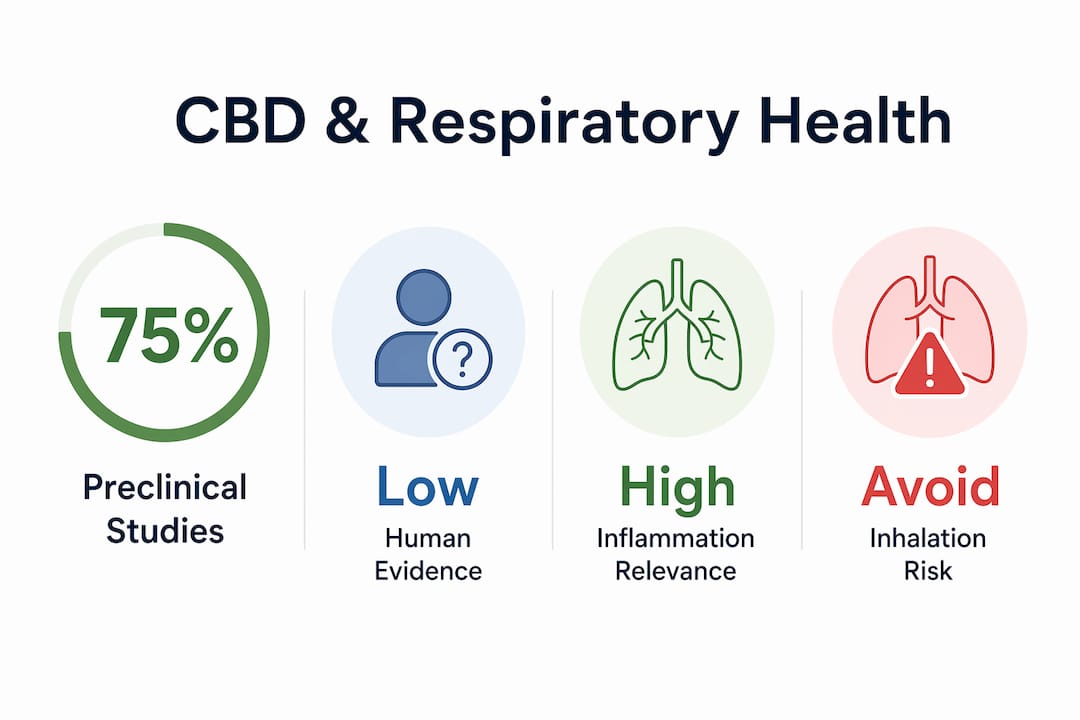
CBD shows anti-inflammatory effects in preclinical studies, but human clinical trials are insufficient to recommend it as a respiratory treatment at this stage. Here is what that means in practice:
- Animal vs human evidence: Lab and animal studies show real promise, including bronchodilator and anti-inflammatory signals, but these findings have not yet been replicated in robust human randomised controlled trials (RCTs).
- Inhalation risks: Vaping or smoking CBD is particularly risky for lung health and should be avoided if respiratory wellness is your goal.
- Consult your clinician: CBD can interact with prescribed medications and must not replace any existing respiratory therapy.
Practical takeaway: If you decide to try CBD, choose a non-inhaled form (oral tincture, capsule, or gummy) from a brand that provides a third-party Certificate of Analysis (COA), and discuss it with your GP first.
Table of Contents
- What does the research on CBD and respiratory health actually show?
- Condition-specific notes: asthma, COPD, pulmonary hypertension, and chronic cough
- Which route of administration is safest for your lungs?
- Side effects, drug interactions, and who should avoid CBD
- How to choose quality CBD products in the UK
- How to use CBD safely if you decide to try it for respiratory wellness
- What strong quality control looks like for a UK CBD brand
- Key takeaways
- The gap between what CBD promises and what the evidence actually supports
- Smokocbd’s non-inhaled, batch-tested CBD products
- Useful sources and further reading
What does the research on CBD and respiratory health actually show?
The science here is genuinely interesting, but it needs careful reading. Preclinical work, meaning studies in animals and cell cultures, consistently points to CBD as an anti-inflammatory agent with real potential for respiratory conditions. A PMC-published study found that cannabinoids including CBD demonstrate anti-inflammatory and bronchodilator effects in animal models. Separately, a high-CBD extract (CBD-X) was shown in a murine asthma model to reduce leukocyte and eosinophil counts in lung tissue by 51% and 58% respectively, alongside significant reductions in pro-asthmatic cytokines IL-4, IL-5, and IL-13.
The mechanism behind this involves the endocannabinoid system, which is present throughout the lungs and airways. CBD appears to modulate inflammatory pathways by reducing cytokine production, impairing the migration of immune cells into inflamed tissue, and toning down the kind of overactive immune response that drives conditions like asthma. Think of it as CBD helping to turn down the volume on an immune system that has been turned up too loud.
The human picture is far thinner. Robust RCTs in people with respiratory conditions are scarce, and the clinical significance of animal findings in humans has not been established. Medical experts have described the current CBD market as a “cottage industry” with many unsupported health claims, urging consumers to be sceptical of products marketed as cures.
“High-quality human randomised controlled trials are needed before CBD can be recommended as a respiratory therapy. Animal model results, however promising, do not translate automatically to clinical benefit in people.” — Researchers reviewing cannabinoids in asthma treatment, PMC
The honest summary: the preclinical signal is real and worth watching. The human evidence is not yet there. Explore the potential health benefits of CBD with that context firmly in mind.
Condition-specific notes: asthma, COPD, pulmonary hypertension, and chronic cough
Asthma
Preclinical findings are the most developed here. CBD-X extract has been shown to inhibit Th2 cell differentiation and reduce secretion of IL-5 and IL-13, cytokines central to allergic asthma. In animal models, airway inflammation, mucus hypersecretion, and bronchial hyperreactivity all showed measurable improvement. However, recreational cannabis use is associated with increased asthma risk in humans, partly due to the irritant effects of smoke and partly due to THC. CBD alone is a different matter, but the human data remains thin.

Clinical recommendation: Not recommended as a replacement for inhaled corticosteroids or bronchodilators. Discuss any interest in CBD with your respiratory clinician before making changes.
COPD
Anti-inflammatory signals from preclinical work are relevant here too, given that COPD is driven by chronic airway inflammation. Reviews note CBD’s anti-inflammatory properties and potential for symptom relief in preclinical COPD models, but standardised human dosing data does not exist, and no clinical trial has established efficacy. CBD cannot replace inhalers, pulmonary rehabilitation, or other prescribed COPD therapies.
Clinical recommendation: Do not substitute standard COPD medications. Speak to your clinician before adding CBD, particularly if you are on multiple medications.
Pulmonary hypertension
This is the most speculative area. A preclinical study using monocrotaline-induced pulmonary hypertension models found that CBD may inhibit vascular proliferation and reduce right ventricular systolic pressure in animals. Human applicability is entirely unproven.
Clinical recommendation: No human evidence exists. Do not use CBD as a treatment for pulmonary hypertension without specialist guidance.
Chronic cough
Antitussive signals have appeared in preclinical studies and isolated case reports, but the evidence base is very limited. No clinical trial has assessed CBD specifically for chronic cough management.
Clinical recommendation: Persistent cough warrants medical investigation. CBD is not a substitute for that process.
Quick reference:
- Asthma: promising animal data; no human RCTs; do not replace prescribed inhalers
- COPD: anti-inflammatory preclinical signals; no dosing data; standard therapies must continue
- Pulmonary hypertension: animal-only data; no clinical evidence; specialist input required
- Chronic cough: very limited evidence; investigate the underlying cause first
Which route of administration is safest for your lungs?
If lung wellness is your goal, how you take CBD matters as much as whether you take it. Not all routes carry the same risk.
A Thorax-published study found that acute inhalation of vaporised CBD produced greater pulmonary inflammation and lung injury markers in animal and in-vitro models than nicotine aerosols, with CBD aerosol showing higher toxicity to human airway cells. This is a striking finding. Vaping CBD is not a neutral act for the lungs, and contamination risks such as vitamin E acetate (historically linked to EVALI, a severe lung injury syndrome) compound the concern.
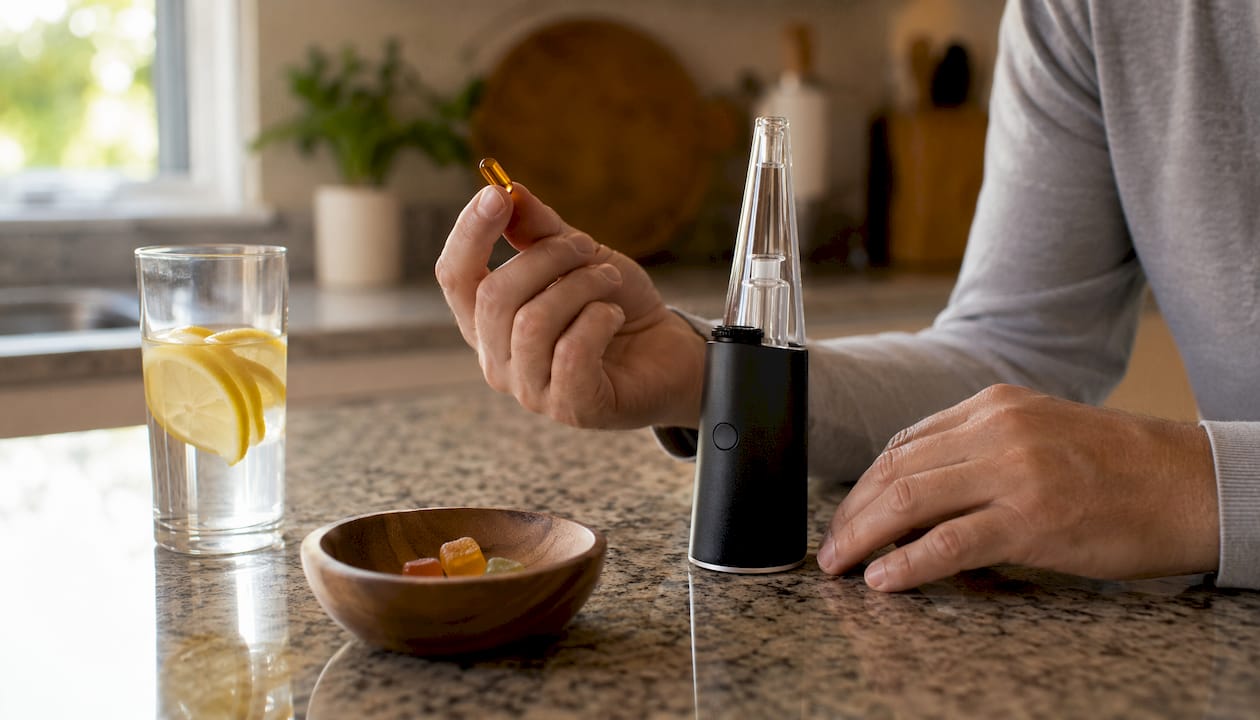
Oral and sublingual routes sidestep pulmonary exposure entirely. Onset is slower (typically 30–90 minutes for edibles, 15–45 minutes for sublingual tinctures), but dose control is far more reliable and there is no direct lung exposure.
| Route | Respiratory risk | Dose control | Onset |
|---|---|---|---|
| Vaping / inhalation | High — inflammatory lung response, contaminant risk | Difficult | Fast (minutes) |
| Smoking | Very high — combustion products, irritants | Very difficult | Fast (minutes) |
| Sublingual tincture | None — no lung exposure | Good | 15–45 minutes |
| Oral capsule / soft gel | None — no lung exposure | Very good | 30–90 minutes |
| Edible (gummy) | None — no lung exposure | Good | 30–90 minutes |
The practical conclusion is straightforward: for anyone focused on respiratory wellness, inhaled forms are the wrong choice. Sublingual tinctures, capsules, and edibles are the safer options, and they also allow you to track your dose more accurately.
Side effects, drug interactions, and who should avoid CBD
CBD is generally well tolerated, but “generally” is doing real work in that sentence. Common side effects include drowsiness, diarrhoea, dry mouth, and changes in appetite. From a respiratory perspective, there are no well-documented direct adverse effects from oral CBD on lung function, but the picture changes significantly when interactions and individual health status are considered.
Drug interactions via CYP450 are the most clinically significant concern. CBD inhibits certain liver enzymes in the CYP450 family, the same mechanism that makes grapefruit a problem with certain medications. This means CBD can raise or lower blood levels of drugs metabolised by those enzymes. The interaction risk is particularly relevant for people taking:
- Anticoagulants such as warfarin (raised blood levels increase bleeding risk)
- Anti-epileptic drugs (e.g. clobazam, valproate)
- Immunosuppressants (e.g. tacrolimus, ciclosporin)
- Certain antidepressants and antipsychotics
- Some cardiovascular medications
Who should avoid CBD or seek specialist advice first:
- Pregnant or breastfeeding women
- People with liver or kidney impairment
- Those on immunosuppressive therapy
- Anyone with unstable or severe respiratory disease
- Children and adolescents (outside of specific licensed medicines)
Stop CBD and seek urgent medical attention if you experience: worsening breathlessness, new or severe chest pain, a significant increase in cough, or any sign of allergic reaction. These symptoms need clinical assessment, not a higher CBD dose.
How to choose quality CBD products in the UK
The UK regulatory position on CBD is specific. CBD products are legal to sell as food supplements provided they meet the Food Standards Agency’s (FSA) novel food requirements and contain THC below the legal threshold (typically below 1mg per container for finished products, though this is subject to ongoing regulatory review). Medical claims are not permitted without authorisation from the Medicines and Healthcare products Regulatory Agency (MHRA). If a product promises to “treat” or “cure” a respiratory condition, that is a red flag, not a selling point.
What to look for when buying:
- Certificate of Analysis (COA): A third-party lab report confirming cannabinoid content and screening for contaminants including heavy metals, pesticides, residual solvents, and microbial impurities. This is non-negotiable.
- Batch number: Allows you to match the product to its specific COA. No batch number means no traceability.
- Accurate CBD per dose: The label should state milligrams per serving, not just per bottle. Vague potency claims (“high strength”, “premium”) without a specific figure are a warning sign.
- THC content: Should be confirmed as below legal thresholds and verified by the COA, not just stated on the label.
- Lab URL or QR code: Reputable brands make it easy to access the full lab report. If there is no way to verify the COA independently, treat the product with caution.
How to read a COA: Look for the cannabinoid profile (CBD, CBG, CBN, THC), the contaminant screening results (pass/fail or below detection limit), the testing date, and the accreditation of the lab. If a COA only shows CBD content and nothing else, it is incomplete.
Pro Tip: Ask the brand directly for the COA for the specific batch you are purchasing. A trustworthy company will provide it without hesitation. If they cannot or will not, shop elsewhere.
How to use CBD safely if you decide to try it for respiratory wellness
There is no universal CBD dose for respiratory conditions. The right approach is cautious, monitored, and always discussed with your GP first, particularly if you take any prescribed medication.
- Consult your GP or respiratory clinician before starting. Share the product you intend to use, including its COA, and list all current medications to check for interactions.
- Start with a low dose. A sensible starting point for most adults is around 10–20mg of CBD per day from a non-inhaled source. The UK dosage guidance recommends staying within the FSA’s suggested daily limit of 70mg for healthy adults.
- Choose a non-inhaled product with a COA. Oral tinctures, capsules, or edibles from a batch-tested brand are the appropriate choice for anyone with respiratory concerns.
- Keep a symptom diary. Track breathlessness (using a simple 0–10 scale), cough frequency, sleep quality, and any side effects. Note the dose and timing of each serving.
- Review after four weeks. Assess whether you have noticed any change, positive or negative. Share your diary with your clinician at this point.
- Do not reduce or stop prescribed respiratory medications without explicit clinical advice, regardless of how you feel.
- Stop CBD and contact your GP if you notice worsening breathlessness, new chest symptoms, or any side effect that concerns you.
Pro Tip: Keep a note of the product batch number, COA reference, and dose in your symptom diary. If your clinician needs to review your CBD use alongside a medication change, this record is genuinely useful.
For further guidance on safe CBD use alongside chronic conditions, the CBD for managing chronic conditions guide covers the key considerations in plain terms.
What strong quality control looks like for a UK CBD brand
Not all CBD brands operate to the same standard, and the gap between a well-tested product and a poorly labelled one can be significant. Here is what genuinely rigorous quality control involves:
- Third-party COAs for every batch: Testing carried out by an independent, accredited laboratory, not an in-house one. The COA should cover the full cannabinoid profile and screen for heavy metals, pesticides, residual solvents, and microbial contaminants.
- Zero-THC verification: For broad-spectrum products, THC should be confirmed as non-detectable on the COA, not merely claimed on the label.
- Clear hemp origin: Organically grown hemp with documented sourcing is a meaningful quality indicator. Pesticide residues in the raw plant material can end up in the finished product if testing is not thorough.
- Good Manufacturing Practice (GMP) or equivalent standards: Production in a facility that follows documented quality management processes reduces the risk of contamination and mislabelling.
- Accessible customer support: A brand that answers questions about its lab reports and sourcing is one that stands behind its products.
Smokocbd’s broad-spectrum CBD products are made in the UK using organically grown hemp, with zero THC verified by third-party lab testing. Batch testing is standard practice, and COAs are available to customers. This is the kind of transparency that a responsible CBD purchase should involve, and it is the baseline you should expect from any brand you consider.
To verify any brand’s claims, ask for the COA for your specific batch, check the lab’s accreditation independently, and request the full cannabinoid profile rather than a summary figure.
Key takeaways
CBD’s preclinical anti-inflammatory signals are real, but the absence of robust human RCTs means it cannot be recommended as a respiratory treatment, and non-inhaled forms with verified COAs are the only responsible choice for lung-focused use.
| Point | Details |
|---|---|
| Evidence gap | Animal studies show anti-inflammatory and bronchodilator effects; human RCTs are scarce and insufficient to support clinical recommendations. |
| Avoid inhalation | Vaping CBD can cause greater pulmonary inflammation than nicotine aerosols; choose oral or sublingual forms for respiratory wellness. |
| Drug interactions | CBD inhibits CYP450 enzymes and can affect levels of warfarin, immunosuppressants, and other medications; always consult your GP first. |
| Check the COA | Only buy from brands that provide third-party batch COAs covering cannabinoid content and contaminant screening. |
| Smokocbd’s approach | Smokocbd offers broad-spectrum oral tinctures with zero-THC verification and third-party COAs, meeting the quality standards discussed in this guide. |
The gap between what CBD promises and what the evidence actually supports
There is a pattern worth naming in the CBD and respiratory wellness space. Preclinical findings get amplified into consumer-facing claims that outrun the evidence by several years, sometimes by several decades. The animal data on CBD and asthma is genuinely interesting. A high-CBD extract reducing eosinophil counts in lung tissue by over half in a murine model is not nothing. But the distance between a mouse model and a clinical recommendation for a person with moderate persistent asthma is enormous, and responsible communication requires saying so plainly.
What concerns me more than the evidence gap itself is the way inhalation risks tend to be minimised in CBD marketing. Vaping is often presented as a fast, convenient delivery route, with the lung health angle quietly ignored. The Thorax data on CBD aerosol toxicity to human airway cells deserves far more prominence in any honest guide to CBD and respiratory wellness. If you are reading this because you have asthma or COPD, the route of administration is not a secondary consideration. It is the first one.
The right stance is neither dismissal nor uncritical enthusiasm. CBD may yet prove to be a useful complementary tool for certain respiratory conditions once human trials catch up with the preclinical work. Until then, the responsible approach is to use non-inhaled, well-tested products, keep your clinician informed, and treat any product marketed as a respiratory cure with healthy scepticism.
Smokocbd’s non-inhaled, batch-tested CBD products
If you have read this far, you already know what to look for: non-inhaled forms, third-party COAs, zero-THC verification, and transparent sourcing. Smokocbd’s broad-spectrum CBD tinctures are made in the UK from organically grown hemp, with every batch tested by an independent laboratory to confirm cannabinoid content and verify that THC is non-detectable.
For adults considering CBD as part of a general wellness approach, the 1000mg broad-spectrum CBD tincture offers a measured starting point, taken sublingually with no pulmonary exposure. Those looking to titrate upward can consider the 2000mg tincture, which allows more flexibility within the FSA’s recommended daily limit. Both products come with COAs available on request. If you have questions about lab reports or want to check a specific batch before purchasing, the customer support team is there to help. Visit smokocbd.com to browse the full range and request your COA.
This article is for general information only and does not constitute medical advice. Always consult a qualified healthcare professional before starting CBD, particularly if you have a respiratory condition or take prescribed medication.
Useful sources and further reading
- Is There a Place for Cannabinoids in Asthma Treatment? (PMC) — Peer-reviewed systematic review covering animal and human evidence for cannabinoids in asthma; the primary source for the animal vs human evidence distinction in this guide.
- High-CBD Extract (CBD-X) in Asthma Management (PMC) — Detailed study on CBD-X effects on Th2 cells, neutrophils, and murine asthma models; the source for the eosinophil and leukocyte reduction figures cited above.
- Cannabidiol Modulates Cytokine Storm in Acute Respiratory Distress (PMC) — Covers CBD’s role in modulating cytokine responses in acute respiratory contexts; useful background on the anti-inflammatory mechanism.
- Not all vaping is the same: differential pulmonary effects of vaping CBD versus nicotine (Thorax/BMJ) — The key study on CBD aerosol toxicity to human airway cells; essential reading for anyone considering inhaled CBD.
- Cannabidiol inhibits lung proliferation in monocrotaline-induced pulmonary hypertension (ScienceDirect) — Preclinical data on CBD and pulmonary hypertension; animal-only findings, but the most relevant source on this specific condition.
- Lung Disease: Can CBD Help? (WebMD) — Consumer-facing summary with input from medical experts; useful for the “cottage industry” caution and the scarcity of human evidence.
- CBD Vaping: Safety, Side Effects and Alternatives (Forbes Health) — Practical public-facing safety guidance on vaping risks including EVALI and contaminant concerns.
How to use these sources: prioritise the PMC and BMJ links for peer-reviewed evidence. When reading any study, check whether it used human participants or animal/cell models before drawing conclusions. For product decisions, read the COA rather than relying on marketing copy.