CBD may ease menstrual pain for some people, largely through its effects on inflammation and pain signalling, but the human evidence remains thin and no large randomised trial has yet confirmed it works reliably. Treat it as a cautious, low-risk trial alongside proven basics, not a replacement for medical care. If your pain is severe, unusual, or worsening, see your GP before reaching for anything else.
TL;DR:
- Most current evidence is observational and weak, so CBD should only be considered a low-risk supplement, not a proven treatment for menstrual pain.
- The effective dosing remains unclear, but starting with 5 to 10 mg daily and adjusting slowly based on response is recommended, with monitoring for side effects.
- Topical and vaginal CBD routes have limited research, so oral products with verified CBD content and third-party testing are the safest options.
- CBD interacts with liver enzymes affecting medication metabolism, so consult a healthcare professional before combining it with prescription drugs.
- Always choose high-quality products with clear labeling, proper third-party certification, and THC below legal limits to ensure safety and accurately gauge effects.
Table of Contents
- What causes period pain and why it matters for CBD
- What CBD is and how it might affect pain and inflammation
- Does CBD help period cramps? What the studies actually found
- How do people actually use CBD for period pain?
- What’s a safe CBD dosage for period pain?
- Is CBD safe? Side effects and interactions to know
- How to choose a quality CBD product in the UK
- SMOKO CBD’s approach: testing, formulation and support
- A cautious yes, but keep records and talk to your GP
- Try SMOKO CBD’s range as your starting point
- Sources
- FAQ
What causes period pain and why it matters for CBD
Most period pain, known clinically as dysmenorrhoea, falls into two categories, and the distinction changes what you should try first. Primary dysmenorrhoea is cramping with no underlying pelvic disease, driven by the uterus itself. Secondary dysmenorrhoea stems from a condition such as endometriosis or fibroids, and it needs proper diagnosis rather than symptom management alone.
The NHS explains that period pain is commonly caused by prostaglandins, hormone-like compounds that trigger the uterine muscle to contract and shed its lining. Higher prostaglandin levels tend to mean stronger contractions, more inflammation, and sharper pain. Over time, repeated pain signals can also sensitise the nervous system, a process called central sensitisation, which is part of why period pain can feel disproportionate to what’s actually happening in the uterus.
This matters for CBD because its plausible targets sit exactly in this chain: inflammation, nerve signalling, and muscle tension. Whether it moves the needle enough to matter is a separate question, covered later, but the theoretical mechanism at least lines up with the problem.
Before trying any supplement, it’s worth knowing what already has a track record for cramps:
- Heat (a hot water bottle or heat patch) relaxes uterine muscle and improves blood flow.
- Over-the-counter NSAIDs like ibuprofen directly block prostaglandin production.
- Light exercise and stretching can reduce cramping intensity for some people.
- Magnesium and omega-3 supplementation have modest supporting evidence for symptom reduction.
- Stress reduction and sleep quality both influence how pain is perceived and tolerated.
CBD sits alongside these as a complementary option rather than a frontline treatment, and the NHS advises seeing a GP if pain is severe, doesn’t respond to standard painkillers, or changes pattern unexpectedly.
What CBD is and how it might affect pain and inflammation
CBD, short for cannabidiol, is one of over a hundred compounds found in the cannabis plant, but it doesn’t cause a high. That’s the job of THC, a different cannabinoid entirely. Products sold as CBD in the UK are formulated to contain negligible or zero THC, which is what keeps them non-intoxicating and legally available as food supplements.
CBD interacts with the body’s endocannabinoid system, a network of receptors involved in regulating pain, mood, sleep, and immune response. Rather than binding tightly to the main cannabinoid receptors the way THC does, CBD appears to work more indirectly, influencing how the body processes its own natural cannabinoids and modulating inflammatory signalling. Think of it less like a key turning a lock and more like a dial that nudges other systems up or down.
Preclinical research backs up part of this story. Studies on Cannabis sativa extracts in animal models of dysmenorrhoea found reduced abdominal contractions and lower inflammatory markers at certain doses. That’s animal data, not proof it works the same way in a human uterus, but it does support the biological plausibility of the mechanism.
When you’re shopping for a product, the label terminology matters more than most buyers realise:
- CBD isolate contains only CBD, with everything else stripped out, useful if you want zero-THC certainty.
- Broad-spectrum CBD includes other cannabinoids and terpenes but has THC removed, aiming to keep some of the so-called entourage effect without the intoxicating compound.
- Full-spectrum CBD retains trace THC (legally capped at very low levels), which some believe enhances effectiveness but which also carries more legal and drug-testing risk.
Whichever type you choose, a third-party certificate of analysis (COA) is non-negotiable. It’s the only way to confirm what’s actually in the bottle matches what’s on the label, and that THC hasn’t crept above legal limits.
Does CBD help period cramps? What the studies actually found
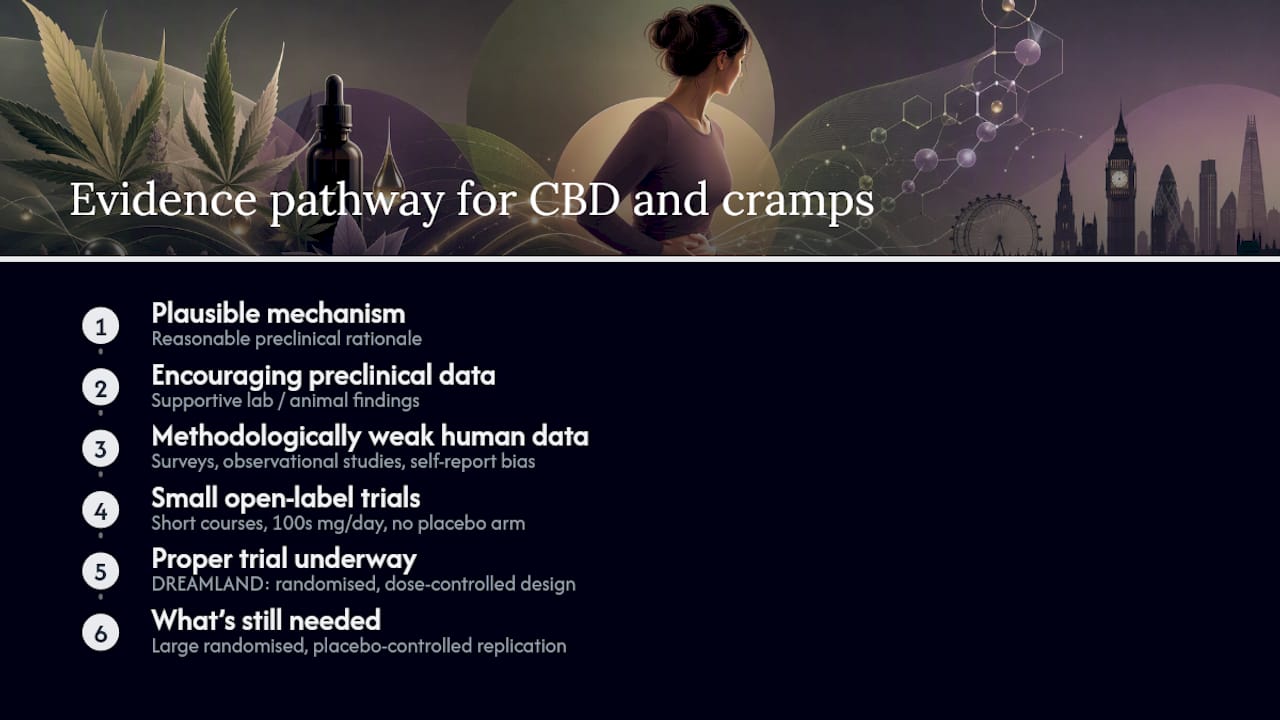
The honest answer is that the evidence base is still being built, not finished. A clinical review examining medicinal cannabis for dysmenorrhoea concluded that while preclinical rationale is reasonably strong, human trial data remains limited, and researchers explicitly called for more high-quality studies before anyone can make firm claims.
That gap is exactly why the DREAMLAND trial, registered to test oral CBD for pelvic pain in endometriosis, matters. This is precisely the kind of randomised, dose-controlled design the field has been missing, and its results, once published, should meaningfully sharpen what we know.
Evidence snapshot: In a cross-sectional study of women with chronic pelvic pain, many current CBD users reported pain improvement on self-report. That figure sounds compelling, but it’s observational data with no placebo comparison, meaning expectation and other lifestyle factors could easily be doing some of the work.
Beyond that headline figure, the same body of survey and observational research shows a consistent pattern: people using CBD for pelvic and menstrual-related pain often report benefit, but almost none of these studies use blinding or a control group. Self-report bias is a real limitation here. Someone who has spent money on a product and expects it to help is statistically more likely to report that it did, regardless of what’s happening biologically.
Smaller open-label trials add a bit more texture. One report on CBD softgels for menstrual-related symptoms used short courses in a moderate to high dose range in the low hundreds of milligrams per day and found preliminary symptom improvements, but the sample sizes were small and there was no placebo arm to rule out expectation effects.
Put it all together and the honest evidence grade is: plausible mechanism, encouraging preclinical data, promising but methodologically weak human data, and one properly designed trial currently underway. That’s not nothing, but it’s a long way from settled science. A definitive answer will need randomised, placebo-controlled trials at meaningful scale, ideally replicating something close to the DREAMLAND design across a broader population of people with primary dysmenorrhoea rather than endometriosis alone.
How do people actually use CBD for period pain?
Choosing a format matters almost as much as choosing a dose, because how CBD enters your body changes both how fast it works and how long it lasts.
- Oral tinctures are absorbed under the tongue and tend to act within 15 to 45 minutes, making them useful when cramps have already started. Bioavailability is better than swallowing a capsule outright, since sublingual absorption partly bypasses the digestive system.
- Capsules and soft gels pass through the gut first, so onset is slower, typically 45 to 90 minutes, but the effect tends to last longer and the dosing is more consistent from one unit to the next.
- Gummies work on a similar timeline to capsules, digested rather than absorbed sublingually, and their appeal is largely about convenience and taste rather than faster action.
- Topical products, such as balms or creams, are applied directly to the lower abdomen or lower back and are intended for localised muscle tension rather than systemic effect. Evidence for topical CBD specifically in menstrual pain is very thin, and most of what we know is extrapolated from general topical pain research.
- Vaginal suppositories are an emerging format aimed at delivering CBD closer to the site of uterine cramping, but human evidence for this route is especially limited and availability varies considerably between retailers and markets.
Timing strategy is where a lot of people go wrong; understanding the optimal CBD timing for energy and sleep quality can help maximize its benefits. Starting CBD only once pain has peaked gives it less chance to build up any meaningful effect, particularly with oral formats that take time to reach steady levels in the body. A more considered approach is starting a low dose two to three days before your period is expected, based on your own cycle tracking, and continuing through the first day or two of bleeding when prostaglandin levels are highest.
Some people prefer a short, targeted course rather than daily use across the month, taking CBD only during the days pain is expected and stopping once symptoms ease. Others who also use CBD for sleep or anxiety, common companions to period-related discomfort, take a lower daily dose year-round and simply notice if cramping days feel more manageable. There’s no single right answer here; it depends on your symptom pattern and how sensitive you are to any drowsiness.
Pro Tip: If you’re new to CBD, test your very first dose on a day when you don’t need to drive or concentrate heavily. Drowsiness is one of the most commonly reported effects, and you want to learn how your body responds before relying on it during a working day.
Topical and vaginal routes are plausible for localised pelvic discomfort specifically because the delivery targets the area directly rather than relying on systemic absorption, but the human research supporting either route for menstrual pain specifically is genuinely sparse. Oral routes, by contrast, have the most trial-based dosing data behind them, which is partly why the next section focuses there.
What’s a safe CBD dosage for period pain?
There’s no single confirmed dose for menstrual pain because no large trial has finished and published results yet. What exists instead are dosing patterns from trials on related conditions, which give a reasonable starting framework even though they weren’t designed for period pain specifically.
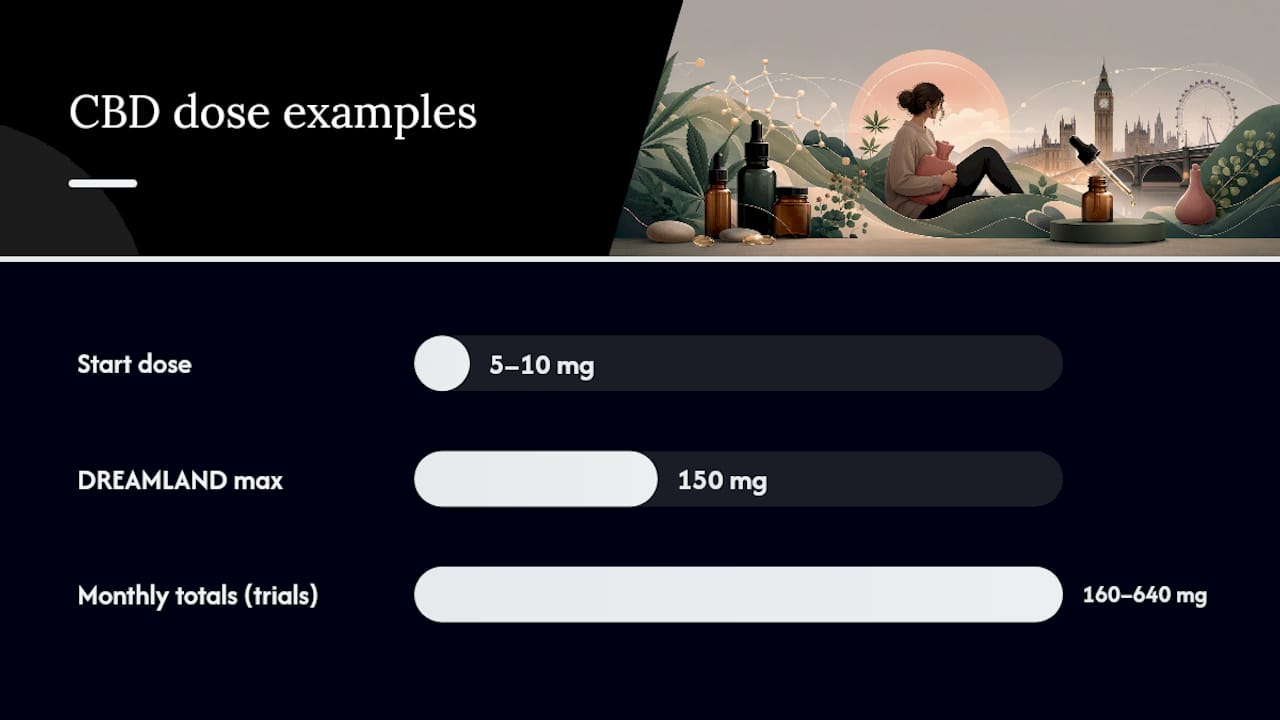
The DREAMLAND protocol for endometriosis-related pelvic pain starts participants at 10 mg of CBD daily, up-titrated to 150 mg per day over nine weeks under clinical supervision. Other consumer-facing studies on menstrual-related symptoms have used short courses in the a moderate to high dose range in the low hundreds of milligrams per day, sometimes extrapolated to monthly totals closer to 160 to 640 mg depending on course length. These are trial doses, run with monitoring, and they shouldn’t be read as a target to reach on your own without guidance.
Dosing reality check: Higher end trial doses were administered under clinical supervision with monitoring for side effects. That is a meaningfully different context to buying a bottle online and self-titrating without any check-ins, so treat the upper figures as context, not as an everyday goal.
A more sensible starting point for most UK adults new to CBD is a low, non-sedating dose, somewhere around 5 to 10 mg once daily, taken consistently for the first few days before judging anything. From there:
- Increase gradually, roughly every three to five days, only if you’re seeing no benefit and no side effects.
- Track your pain daily using a simple 0 to 10 scale alongside notes on sleep and mood, since improvements in those areas can sometimes accompany, or even explain, perceived pain relief.
- Give any single dose level a fair trial across at least one full cycle before deciding it isn’t working, since menstrual symptoms vary month to month regardless of what you’re taking.
- Stop and speak to a GP or pharmacist if you notice persistent drowsiness, digestive upset, or no improvement after a reasonable trial period.
For a closer look at how these dosing patterns compare across other pain conditions, SMOKO CBD’s guide to CBD for pain relief walks through UK-specific safety considerations in more depth, and the PMS-focused dosing breakdown covers routes and starting doses relevant to the broader menstrual cycle rather than pain alone.
Is CBD safe? Side effects and interactions to know
CBD is generally well tolerated, but “generally well tolerated” doesn’t mean risk-free, and a few specific issues deserve attention before you start.
Drowsiness is consistently the most commonly reported side effect. One analysis of CBD use in women with chronic pelvic pain found drowsiness reported by a notable share of participants in some samples, which is a meaningful proportion. Gastrointestinal upset, including nausea or changes in appetite, is the other frequently mentioned effect, usually at higher doses.
The interaction risk that matters most involves liver enzymes. CBD is metabolised by cytochrome P450 (CYP) enzymes in the liver, the same enzyme family responsible for breaking down a wide range of prescription medications. The CDC’s overview of CBD flags this as a genuine safety consideration, since CBD can slow how quickly certain drugs are cleared from the body, potentially raising their effective levels.
This matters most for:
- Blood thinners like warfarin, where altered clearance could change bleeding risk.
- Anti-epileptic medications, some of which are already known to interact with cannabinoids.
- Certain antidepressants and anxiety medications, where sedation effects could compound.
- Immunosuppressants, where drug levels need to stay within a tight therapeutic window.
If you take any regular prescription medicine, particularly anything metabolised by the liver, check with your GP or pharmacist before starting CBD. A clinical pharmacology team can assess the likely scale of interaction for your specific medication and advise on monitoring.
Pro Tip: Bring the actual CBD product packaging, or its COA, to your pharmacist rather than just naming the brand. The declared mg strength and extraction type both affect how a pharmacist assesses interaction risk.
Pregnancy and breastfeeding deserve their own clear line: CBD should be avoided unless specifically advised otherwise by a clinician. There’s insufficient safety data in these groups to make any other recommendation responsibly. And regardless of what you’re taking for period pain, seek medical help promptly if pain is sudden and severe, accompanied by fever, or unlike anything you’ve experienced before, since these can signal something beyond typical dysmenorrhoea.
How to choose a quality CBD product in the UK
Product quality in the CBD market varies enormously, and the label alone rarely tells you enough. A batch-specific third-party certificate of analysis is the single most useful document you can check, since it confirms the actual CBD content matches the label and verifies THC sits within the legal threshold, generally below 0.2% in UK-relevant frameworks.
Beyond the COA, a few checks separate reliable products from guesswork:
- Look for clear mg-per-unit labelling, such as mg per ml for tinctures or mg per gummy, rather than vague strength descriptions.
- Avoid any product making explicit medical claims on packaging, such as promising to cure or treat a named condition; legitimate UK sellers stick to general wellness language for good reason.
- Decide between broad-spectrum and isolate based on how strongly you want zero-THC assurance, since even trace THC carries some risk for drug testing or sensitivity.
- Compare cost per mg of CBD, not the headline bottle price, since a cheaper-looking product with a weak concentration can cost more per effective dose than a pricier, stronger one.
- Check that customer support is genuinely reachable, since questions about batch testing or dosing guidance are common and a responsive team is a reasonable quality signal.
None of this guarantees a product will work for your particular pain, but it does rule out the products most likely to disappoint or, worse, contain something undeclared.
SMOKO CBD’s approach: testing, formulation and support
There are broad-spectrum CBD tinctures, gummy bears, and soft gel capsules formulated with organically grown hemp sourced from the USA. Some products undergo third-party lab testing to verify THC levels, which is important considering interaction and legal considerations.
This article’s editorial content is guided by Mike, whose focus is on translating clinical trial data and public health guidance into practical, UK-relevant advice for readers navigating CBD for the first time. The brand’s educational content, including trial-informed dosing frameworks referenced throughout this piece, draws on the same evidence base cited here rather than marketing claims alone.
If you have questions about which strength or format suits your symptoms, SMOKO CBD’s customer support team is reachable through the website and can talk through product specifics, including COA details, before you buy. That kind of direct access matters more in a market where labelling inconsistency is still common.
A cautious yes, but keep records and talk to your GP
The honest position on CBD for period pain is cautious optimism, not endorsement. The mechanism is plausible, the preclinical data is genuinely interesting, and the observational reports from real users are encouraging enough to justify a careful, low-risk trial for most healthy adults. What it isn’t yet is proven, and pretending otherwise does readers a disservice.
What I’d actually encourage is treating your own trial like a small experiment. Start low, keep a simple pain log across at least one full cycle, and be honest with yourself about whether the effect is real or just welcome. If you’re on medication, loop in your GP or pharmacist first rather than after. And if something about your pain feels different this month, sharper, longer, unfamiliar, don’t let a CBD trial delay getting it looked at properly.
— Mike
Try SMOKO CBD’s range as your starting point
If you’ve read this far, you already understand why a careless choice of CBD product, vague labelling, unclear strength, no COA in sight, makes any self-trial harder to interpret. SMOKO CBD’s collection of tinctures, gummy bears, and soft gels is built around the opposite: broad-spectrum formulations with third-party testing behind every batch, so the dose you read on the label is the dose you’re actually taking.
For a first attempt, a low-strength format is the sensible entry point. If you’d rather count doses precisely, the SMOKO CBD Gummy Bears at 25mg per gummy let you start at a modest, non-sedating level and adjust up gradually using the titration approach covered earlier in this guide. Tincture users who prefer flexibility can measure smaller increments drop by drop. Whichever you choose, check the product’s COA before your first dose, follow the same slow, cycle-by-cycle titration outlined above, and reach out to SMOKO CBD’s customer support team if you want guidance matched to your specific symptoms before you commit to a bottle.
This article is general information, not a substitute for advice from a qualified doctor. Consult a qualified healthcare professional about your own circumstances before acting on anything here.
Sources
- Period pain - NHS
- Dysmenorrhoea: Can Medicinal Cannabis Bring New Hope for a Collective Group of Women Suffering in Pain, Globally?
- Clinicaltrials
FAQ
How many mg of CBD should I take for period cramps?
There’s no confirmed effective dose specifically for period cramps, but a sensible starting point is 5 to 10 mg once daily, increasing gradually every three to five days if needed. Trial protocols for related pelvic pain, such as DREAMLAND, have gone as high as 150 mg per day, but that was under clinical supervision and isn’t a target for unsupervised self-dosing.
Is there a downside to taking CBD?
Yes, the most common downside is drowsiness, reported by a notable share of participants in some studies, alongside occasional digestive upset. CBD can also interact with medications metabolised by liver enzymes, so anyone on regular prescriptions should check with a GP or pharmacist first.
What can I take for excruciating period pain?
Excruciating or unusual pain warrants a GP visit rather than self-management, since it may signal a condition beyond typical dysmenorrhoea. The NHS recommends starting with appropriate analgesia like NSAIDs and heat, with CBD considered, if at all, as a complementary option once serious causes are ruled out.
Can CBD help with cramping?
CBD may help some people with menstrual cramping by influencing inflammation and pain signalling, and observational research shows many users report improvement, but robust randomised trial evidence isn’t yet available. The ongoing DREAMLAND trial should provide clearer answers once results are published.
Is CBD legal to buy in the UK for period pain?
Yes, CBD products sold as food supplements are legal in the UK provided THC content stays below the legal threshold, generally under 0.2%. Always check a product’s third-party COA to confirm both CBD content and THC compliance before buying.