Start at 5 to 10 mg once or twice daily, then increase slowly. Most people managing pain settle in a moderate daily dose range suitable for their condition, though your own effective dose depends on body weight, pain type, and how your metabolism handles cannabinoids. If you take other medicines, have liver disease, or notice anything unusual, check with a GP or pharmacist before pushing the dose higher.
TL;DR:
- Most people find effective CBD pain relief within a dose range of 20 to 300 mg daily, depending on individual factors and condition.
- Safe titration involves starting with low doses, such as 5 mg twice daily, and gradually increasing based on pain response and personal tolerance.
- Accurate dose calculation requires understanding product concentration and dropper output, with oils and capsules offering the most precise dosing.
- Higher doses above 60 mg may cause side effects like fatigue or gastrointestinal upset, and high doses can impact liver enzymes, warranting medical supervision.
- Consistent product lab testing and detailed logging of doses, pain scores, and side effects enhance the chances of effective, personalized CBD pain management.
Table of Contents
- What does the evidence actually say about CBD dosage for pain?
- How do you titrate CBD safely for chronic pain?
- How do you calculate your actual CBD mg per dose?
- What are the safety risks and drug interactions with CBD?
- How do you build a home titration log that actually works?
- What’s the practical next step for managing pain with CBD?
- Why the “just take more” instinct gets CBD dosage wrong
- Where to find lab-tested CBD products for titration
- Sources
What does the evidence actually say about CBD dosage for pain?
The honest answer is that CBD dosage for pain doesn’t follow one fixed number, because the research itself spans a huge range. Some trials on the safety and efficacy of low oral doses of cannabidiol report meaningful pain relief at doses as low as 20 to 30 mg a day, while other reviews document doses running into the hundreds of milligrams for different conditions. That spread isn’t a flaw in the science. It reflects how differently people respond depending on pain type, body composition, and years of use.
Clinicians have tried to bring order to that variability. A Delphi consensus of pain specialists developed structured titration protocols precisely because trial data alone couldn’t tell doctors what to recommend to an individual patient. These protocols split into routine, conservative, and rapid approaches, each starting low and building gradually rather than jumping to a “typical” dose.
A few things worth flagging before you reach for a bottle:
- Low-dose studies exist, but they’re not the whole picture. Some research shows benefit at low doses, yet broader literature reports patient use across a wide dosage range depending on the condition.
- THC-containing products show more consistent pain benefit in many reviews. CBD-alone evidence for pain is genuinely mixed, which is why some protocols leave room for adding low-dose THC later.
- UK regulators are watching this space closely. The Food Standards Agency and Food Standards Scotland have both issued updated consumer advice on CBD product standards and labelling accuracy.
Statistic to note: patient-reported audits cited in the Delphi consensus show variable dosing for pain, with no consistent dose-response pattern across pain subtypes. That range alone tells you why titration, not a fixed chart, is the only sensible approach.
How do you titrate CBD safely for chronic pain?
Titration simply means adjusting your dose in small, deliberate steps while watching how your body responds. The Delphi consensus guidelines outline three distinct approaches, and which one applies to you depends largely on how urgent your pain is and how sensitive your system might be to new substances.
- Routine protocol. Start at a low dose, such as 5 mg twice daily, increasing gradually every few days towards a moderate daily dose, then pause and reassess how your pain score has moved before going further.
- Conservative protocol. Suited to older adults, frailer patients, or anyone on multiple medications. Start at a very low dose, increasing slowly every several days, to allow a safer approach in vulnerable patients. Slower, but far safer when polypharmacy is a factor.
- Rapid protocol. Reserved for severe pain under clinical supervision, often using a balanced THC:CBD product with small, frequent increments rather than CBD alone. This is not a DIY approach; it needs a prescriber involved.
Once someone has worked through the routine or conservative protocol without adequate relief, some clinicians consider adding low-dose THC. This step carries its own cautions around drowsiness, cognitive effects, and interaction with driving or work, so it belongs in conversation with a prescriber, not a self-directed jump. Guidance on combining CBD with THC safely covers this transition in more depth if you want to understand the trade-offs before that conversation.
Pro Tip: Keep each increase to one variable at a time. If you change dose and product strength in the same week, you won’t know which adjustment caused the difference in your pain score.
How do you calculate your actual CBD mg per dose?
Product labels rarely make dosing obvious at a glance, which is exactly where most people miscalculate. A bottle might state “1000 mg CBD” on the front, but that’s total content across the whole bottle, not per dose. You need the concentration, usually written as mg per ml, then divide by the number of drops per ml your dropper delivers, which typically sits around 20 drops.
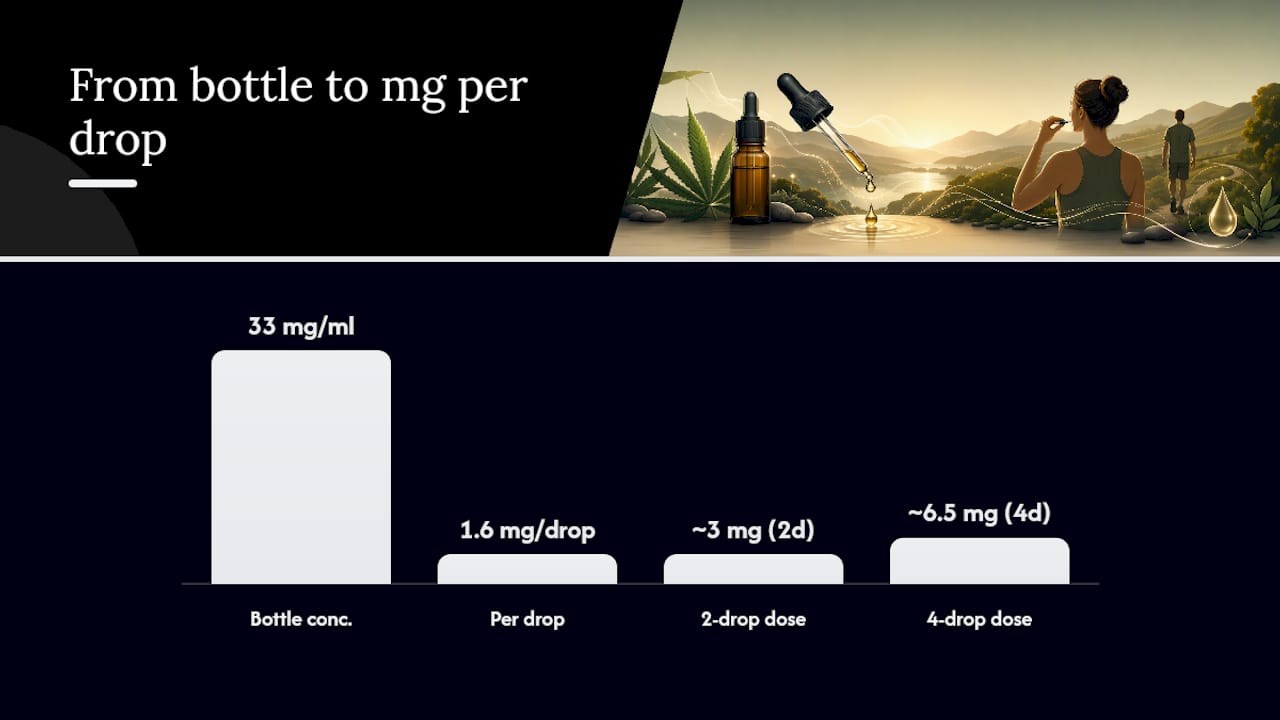
Take a 30 ml bottle containing 1000 mg of CBD. That works out to roughly 33 mg per ml. If your dropper gives 20 drops per ml, each drop delivers about 1.6 mg. Two drops would land you close to a standard 3 mg starting measure, four drops closer to 6.5 mg. Working out how many drops sit in 1 ml of tincture is worth doing once properly rather than guessing every time.
Form matters here too:
- Oils and capsules give the most reproducible dosing for chronic pain, since each drop or capsule delivers a known quantity consistently.
- Inhaled products act faster, useful for breakthrough pain, but the effect fades sooner and dosing is far less precise.
- Same product, same time, ideally with food keeps absorption steady enough that your pain log actually reflects the dose, not random daily variation.
What are the safety risks and drug interactions with CBD?
Most people tolerate CBD reasonably well at moderate doses, but side effects do climb with dose size. Lethargy, diarrhoea, and mild stomach upset are the most commonly reported issues, and they tend to appear more often as daily intake rises past the 40 to 60 mg range.
Statistic to note: the Delphi consensus guidelines flag transaminitis, a rise in liver enzymes, as a dose-related risk observed in some reports at very high intakes. Anyone using high doses regularly should discuss periodic liver-enzyme checks with a GP.
Interactions are the other piece people underestimate:
- CBD affects CYP enzymes in the liver, the same pathway many common drugs rely on for metabolism.
- Statins, anticoagulants like warfarin, and some antiepileptic medicines are particularly sensitive to this interaction and need prescriber input before starting CBD.
- Full detail on CBD drug interactions worth knowing is worth reading if you’re on any regular prescription.
Stop and seek medical advice if you notice severe gastrointestinal symptoms, yellowing of the skin or eyes, unusual bleeding, or significant mood changes.
How do you build a home titration log that actually works?
A simple daily log turns guesswork into evidence you can act on. Record date, time, product used, dose in mg, pain score from 0 to 10, any side effects, and brief notes on activity or sleep that night.
- Days 3 to 7: check whether your pain score has moved at all before increasing the dose.
- Week 2: reassess whether the current dose is holding steady or needs another small step up.
- Week 4: decide with a clinician whether to hold, increase further, or consider a THC adjunct.
When choosing a product, check its third-party lab report for CBD potency, batch number, THC result, and contaminant screening. Pro Tip: File each lab report by batch number alongside your log entries, so if a new batch feels different, you can check whether the potency actually changed.
What’s the practical next step for managing pain with CBD?
Start low, increase slowly, and let your pain log guide every decision rather than impatience. Pick one consistent product and strength, follow the protocol that matches your situation, and flag any prescription medicines to your GP before increasing beyond a modest starting dose. From there, it’s a matter of tracking results over a few weeks and adjusting with evidence, not guesswork.
Why the “just take more” instinct gets CBD dosage wrong
The biggest misconception in CBD pain management is that a bigger dose automatically means better relief. Everything in the Delphi consensus data points the other way. Patient audits show people using anywhere from 30 to 300 mg/day with no consistent dose response pattern across pain types, which means the person taking 250 mg isn’t necessarily getting more relief than the person on 40 mg. They might just be spending more.
Conventional wellness advice tends to skip the titration step entirely, pushing readers straight to a “recommended” dose as though pain responds uniformly. It doesn’t. Your metabolism, pain type, and tolerance shape the number far more than any generic chart can.
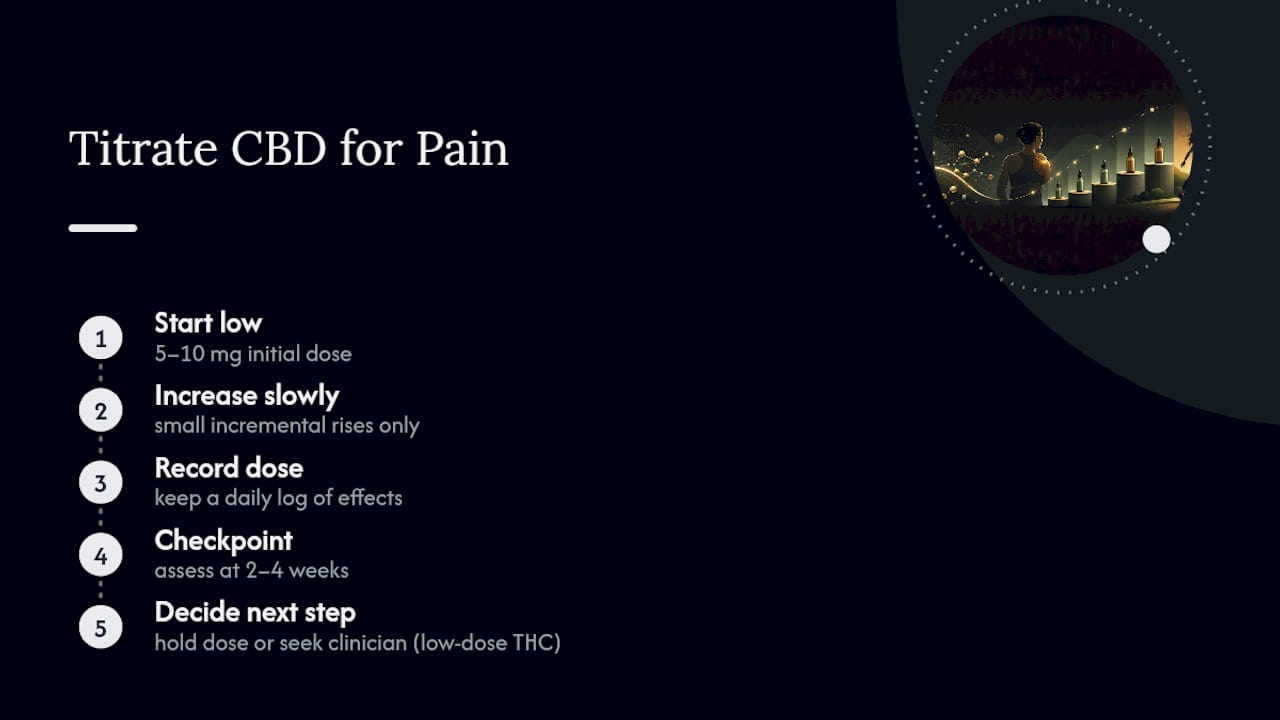
What the research actually supports is patience: small increments, a log, and a clear checkpoint at two to four weeks to decide whether to hold steady or seek clinical input for something like low-dose THC. That’s less exciting than a bold headline number, but it’s what the clinical protocols were built on. Readers who prioritise measurement over speed get there with fewer side effects and a lot less wasted product.
— Mike
Where to find lab-tested CBD products for titration
Once you know your starting dose, the next challenge is finding a product whose strength actually matches the protocol you’ve chosen, rather than forcing awkward drop counts to hit an odd number. There are broad-spectrum tinctures, gummies, and soft gel capsules available made from organically grown hemp, with some batches checked by third-party lab testing to confirm potency and verify zero THC content.
That lab verification matters directly for the calculations covered earlier: a tincture with a clearly stated mg per ml concentration lets you work out drop values precisely instead of estimating, and capsules with a fixed mg count remove the maths altogether if you’d rather not measure drops each time. For anyone starting the conservative protocol at 5 mg, a lower-strength tincture keeps early increments small and manageable; those working towards 40 mg/day may prefer a higher concentration bottle to avoid needing dozens of drops per dose. Customer support teams and educational articles can help you match a strength to your stage of titration. Browse the full product range to find a starting point that fits your protocol and check current batch lab reports before you order.
Sources
This article is general information, not a substitute for advice from a qualified doctor. Consult a qualified healthcare professional about your own circumstances before acting on anything here.