Occasional low-dose use of CBD and ibuprofen together is often low risk for otherwise healthy adults, but it is not risk-free. Both compounds pass through the same liver enzyme pathway, and CBD can slow the breakdown of ibuprofen, raising its levels in your blood. If you take other medicines, or have liver, kidney, or bleeding concerns, speak to your GP or pharmacist before combining them regularly.
TL;DR:
- Combining CBD and ibuprofen is generally low risk for healthy adults taking occasional, low doses, but regular or higher use increases the chance of adverse effects.
- People with liver or kidney disease, older adults, or those on blood thinners should avoid routine combination without medical advice due to heightened bleeding, liver, or kidney risks.
- CBD inhibits liver enzymes that metabolize ibuprofen, potentially raising blood levels and amplifying side effects like gastrointestinal irritation or liver strain.
- The interaction is classified as moderate, meaning it warrants caution, especially at higher doses or prolonged use, with professional guidance recommended.
- Topical CBD products pose less interaction risk than oral formulations, which undergo liver processing and are more likely to affect ibuprofen metabolism.
Table of Contents
- Who is likely safe and who is at higher risk when combining CBD and ibuprofen
- How ibuprofen and CBD act in the body and why interactions can occur
- What clinical studies, systematic reviews and interaction databases report
- Concrete interaction risks: liver, gut, kidneys and bleeding
- How to reduce risk if you intend to use both
- Does topical or formulation choice change interaction risk?
- Regulator and health-body positions and the limits of current knowledge
- How age and chronic pain conditions change the risk picture
- Could CBD make ibuprofen work better, or worse?
- Summary of known side effects when combining CBD with ibuprofen
- What the evidence actually tells us to prioritise
- Choosing a tested tincture if you decide CBD is right for you
- Primary sources and where to read further
- Sources
Who is likely safe and who is at higher risk when combining CBD and ibuprofen
The risk calculation changes enormously depending on who you are and how you use each substance. A healthy adult reaching for one or two ibuprofen tablets for a headache, alongside a modest CBD dose taken occasionally, sits at the low end of the risk spectrum. The body clears both compounds without much trouble in that scenario, and the CYP450 enzyme competition that worries pharmacists rarely becomes clinically meaningful at such low, infrequent doses.
The picture shifts once you introduce regularity or higher amounts of either substance. Chronic daily ibuprofen use, the kind some people fall into for arthritis or long-term back pain, already carries its own risks around the gut and kidneys according to NHS guidance on ibuprofen for adults. Layer in CBD doses above roughly 150 to 300mg a day, and you are asking a stressed metabolic pathway to do more work than it is built for.
Certain groups need to be genuinely cautious rather than merely careful:
- Anyone with existing liver or kidney disease, since both organs are already doing the heavy lifting for these compounds.
- People on anticoagulants or antiplatelet medication, where added bleeding risk from ibuprofen becomes more concerning if CBD alters drug clearance.
- Older adults, who often metabolise drugs more slowly to begin with.
- Anyone taking multiple daily medications, where the CYP450 system is already juggling several competing substrates.
If you fall into any of these categories, the sensible move is straightforward: avoid alcohol while using both, check every other medicine you take against a proper interaction checker, and have a conversation with a pharmacist before making this combination a habit rather than a one-off.
How ibuprofen and CBD act in the body and why interactions can occur
Ibuprofen works by blocking two enzymes called COX-1 and COX-2, which your body uses to produce prostaglandins, the chemical messengers behind pain, swelling, and fever. Knock those enzymes down and the inflammatory signal quietens fast. That is why ibuprofen tends to act within 30 to 60 minutes and keeps working for around four to six hours. Once absorbed, it is broken down almost entirely by a liver enzyme called CYP2C9, a detail that matters enormously for anything else competing for the same enzyme.
CBD works through a completely different route. Rather than blocking a single enzyme pair, it interacts with the endocannabinoid system, a network of receptors and signalling molecules that helps regulate pain perception, mood, and immune activity. Think of it less like a targeted switch and more like a dial that can turn certain inflammatory and pain signals up or down depending on dose and context. CBD also happens to inhibit several liver enzymes in the CYP450 family, most notably CYP2C9 and CYP3A4, the very enzymes responsible for clearing a huge range of common medications, ibuprofen included.
This is where the interaction risk actually originates, and it is worth being precise about the mechanism:
- CBD occupies and partially blocks CYP2C9, slowing its ability to metabolise ibuprofen.
- Slower metabolism means ibuprofen can linger longer in the bloodstream than expected.
- Higher and more prolonged blood levels of ibuprofen raise the odds of side effects that are dose-related, particularly around the stomach and kidneys.
- The effect is dose-dependent on the CBD side, meaning a few milligrams behaves very differently to several hundred.
Pro Tip: Enzyme inhibition is not an on/off switch. A small evening dose of CBD alongside an occasional daytime ibuprofen tablet behaves very differently from daily high-dose CBD stacked on top of daily NSAID use.
Drug-interaction databases have looked at this exact mechanism and settled on a working classification worth knowing before you combine the two.
Drug-interaction checkers classify the interaction between CBD and ibuprofen as moderate, noting that CBD may increase blood levels of drugs metabolized by the enzyme CYP2C9, which includes ibuprofen, according to Drugs.
That “moderate” label sits deliberately between minor (rarely worth changing your behaviour) and major (avoid the combination outright). It signals a real, documented mechanism that usually will not cause harm at typical doses, but one that deserves attention if either substance is used at higher amounts or for longer stretches.
What clinical studies, systematic reviews and interaction databases report
Interaction databases give you the mechanism-level warning, but the clinical evidence tells a more complicated story about whether CBD even delivers meaningful pain relief in the first place, which matters when you are weighing whether combining it with ibuprofen is worth the theoretical risk at all.
A systematic review of cannabidiol for chronic pain found the picture genuinely mixed, with many trials either small, poorly controlled, or simply negative when compared against placebo, according to the PubMed-listed systematic review. That is a meaningfully different message from the one CBD marketing often implies. CBD is not a proven, rapid-acting analgesic in the way ibuprofen demonstrably is; it is a compound with a plausible mechanism and inconsistent trial results.
A 2026 randomised controlled trial in rheumatoid arthritis and ankylosing spondylitis illustrates this well. Over 12 weeks, low-dose CBD failed to outperform placebo for pain control, though an exploratory arm using CBD alongside THC showed some signal in patients who had not responded to standard treatment, per the trial published via Springer. That single study will not settle the debate, but it fits the wider pattern: CBD alone, especially at conservative doses, often underperforms expectations for acute inflammatory pain.
Harvard Health’s review of the evidence lands on a similarly measured note, describing CBD’s pain-relief potential as promising in places but genuinely limited by the current data, while explicitly flagging that CBD “can interact with other medications” through liver enzyme pathways, warranting a conversation with a physician before regular use, according to Harvard Health’s analysis.
A few things are worth pulling together from the evidence base as it stands:
- Route and dose matter more than most marketing suggests. A 2026 review of variables shaping CBD’s analgesic effects found stronger, more consistent signals in chronic neuropathic pain contexts with repeated dosing, and much weaker signals for acute inflammatory pain, the kind ibuprofen is typically reached for, according to the Frontiers review on CBD analgesia variables.
- Human pharmacokinetic data on the ibuprofen interaction specifically is still thin. Much of the caution comes from the known CYP2C9 mechanism rather than a large body of dedicated human trials measuring ibuprofen blood levels after CBD co-administration.
- Clinical pharmacist commentary consistently lands on the side of caution for regular use. Resources aimed at pharmacists describe the same moderate classification and generally recommend professional review for anyone using both substances beyond the occasional dose, per HelloPharmacist’s interaction summary.
None of this means the combination is dangerous for most people using it sensibly. It means the honest, evidence-first answer sits well short of either “totally safe” or “obviously risky”, and closer to “usually fine at sensible doses, worth professional input if you are doing this regularly.”
Concrete interaction risks: liver, gut, kidneys and bleeding
If the enzyme competition between CBD and ibuprofen does push ibuprofen levels higher than intended, the consequences tend to show up in a handful of predictable places. None of these are exotic risks unique to this combination; they are the same risks NSAIDs already carry, just potentially amplified.
- Gastrointestinal irritation and bleeding. Ibuprofen already irritates the stomach lining by reducing protective prostaglandins. Higher-than-expected blood levels raise the odds of stomach pain, ulceration, or in more serious cases, gastrointestinal bleeding, particularly with prolonged use.
- Liver enzyme elevation. Some CBD studies at higher doses, particularly the doses used in the epilepsy medicine Epidiolex, have reported elevated liver enzymes on blood tests. Combining that with a drug already metabolised by the liver adds a second variable worth watching, especially for anyone using either substance for weeks or months rather than days.
- Kidney strain. NSAIDs reduce blood flow to the kidneys through their effect on prostaglandins, and this becomes more relevant with frequent or high-dose use. Anyone with pre-existing kidney concerns should treat regular NSAID use, CBD combination or not, as something to discuss with a clinician.
- Additive bleeding risk with blood thinners. Ibuprofen itself has mild antiplatelet effects. Combine that with anticoagulant medication and, potentially, altered clearance from CBD, and the bleeding risk stacks in a way that deserves genuine caution rather than casual dismissal.
A useful number to hold onto: liver function test monitoring becomes a reasonable conversation to have with a GP for anyone using CBD daily above the low-dose range alongside regular NSAID use, precisely because the enzyme pathway they share is the same one your liver relies on to flag problems early.
Certain other medications widen the risk further. Other CYP2C9 or CYP3A4 inhibitors, some antidepressants, and other anticoagulants all compete for the same metabolic real estate, and stacking several of them alongside CBD and ibuprofen is exactly the scenario where “moderate interaction” tips toward “worth a pharmacist review before you start.”
How to reduce risk if you intend to use both
If you have decided, sensibly, that occasional co-use fits your situation, a handful of practical rules bring the risk down considerably without requiring you to abandon either substance.
Start with dosing discipline on the ibuprofen side. NHS guidance on ibuprofen recommends using the lowest effective dose for the shortest possible duration, which is good general NSAID practice regardless of CBD, but becomes especially relevant when another compound might be extending how long ibuprofen stays active in your system. Reaching for it for genuine acute need rather than as a daily default matters here.
On the CBD side, start low and increase gradually rather than assuming more equals better relief. A titration approach, beginning with a modest dose and giving your body several days to respond before increasing, gives you a much clearer picture of how the combination actually affects you.
Some people ask about spacing doses apart, taking CBD an hour or two away from ibuprofen, on the theory that separating peak absorption times reduces overlap. It is a reasonable precaution and costs nothing to try, but be realistic about its limits: CBD’s inhibitory effect on liver enzymes does not switch off the moment absorption peaks. Spacing reduces some overlap in blood concentration curves; it does not eliminate the underlying metabolic competition.
Watch for specific warning signs rather than vague unease:
- Unusual stomach pain, dark stools, or vomiting that looks like coffee grounds (a sign of GI bleeding).
- Unexplained fatigue, yellowing skin or eyes, or dark urine (possible liver signals).
- Reduced urination or swelling in the legs (possible kidney strain).
- Unusual bruising or bleeding that takes longer than normal to stop.
Any of those warrants stopping both substances and contacting a GP promptly rather than waiting to see if it resolves.
Before combining them regularly, a short list of questions to bring to your pharmacist or GP saves considerable guesswork: What other medications am I taking that share this liver pathway? Given my kidney and liver history, is regular NSAID use even advisable? Should I have liver function tests done if I am using CBD daily? Is there a non-NSAID alternative worth trying instead for my specific pain? For more detail on how CBD behaves alongside other common medicines, SMOKO CBD’s guide to CBD drug interactions covers several other combinations worth knowing about.
Does topical or formulation choice change interaction risk?
Not all CBD reaches your bloodstream the same way, and that distinction changes the interaction calculation considerably. A CBD balm rubbed onto a sore knee behaves nothing like a CBD tincture swallowed and absorbed through the gut.
- Topical CBD applied to the skin has minimal systemic absorption, meaning very little of it reaches the liver enzymes that ibuprofen depends on for clearance. If your main goal is localised joint or muscle relief, a topical product carries meaningfully lower interaction risk than an oral one.
- Oral or sublingual CBD, tinctures, capsules, gummies, absorbs into the bloodstream and travels through the liver, which is exactly where the CYP2C9 competition with ibuprofen happens. This route carries the greatest interaction potential of the common formats.
- Full-spectrum products, which retain trace amounts of THC alongside other cannabinoids, may carry a somewhat higher interaction burden than broad-spectrum or isolate products, since THC itself also interacts with liver enzymes. Readers interested in how THC changes the equation can find more detail in Nature of Spirit’s guide to combining CBD and THC.
- Isolate and broad-spectrum products without THC simplify the picture somewhat, though CBD itself remains the active enzyme inhibitor regardless of what else is or is not present.
Consistency matters as much as format. Product quality varies enormously across the CBD market, and inconsistent dosing between batches makes it far harder to judge how your body actually responds. Independent reviews of commercial CBD products have found real variation in labelled versus actual content, and occasional contamination concerns, which is precisely why third-party lab testing matters more here than in most supplement categories: you cannot manage a dose-dependent interaction risk if you do not actually know your dose.
Regulator and health-body positions and the limits of current knowledge
The NHS’s position on ibuprofen is detailed and specific: it lists clear adult dosing ranges, cautions around stomach ulcers, asthma, kidney disease, and pregnancy, and flags that it should be used at the lowest effective dose for the shortest time needed. That guidance predates any CBD consideration and stands on its own regardless of what else you take alongside it.
CBD’s regulatory position is far less settled. The one CBD-derived medicine with genuine regulatory approval, Epidiolex, is licensed specifically for rare forms of epilepsy, not for pain or inflammation. General consumer CBD products, tinctures, gummies, capsules, sit in a different regulatory category entirely and are not approved by any medicines regulator as treatments for pain.
That gap matters for how you should read any pain-relief claim about CBD, including on this site. A few honest caveats worth holding onto:
- Evidence for CBD easing most types of pain remains limited, mixed, and often built on small trial numbers.
- Because the evidence base is thin, conservative combination advice, checking with a clinician before regular co-use, is the sensible default rather than an overcautious one.
- The theoretical CYP450 interaction is well-documented mechanistically, even where large-scale human trials measuring the ibuprofen interaction specifically remain limited.
How age and chronic pain conditions change the risk picture
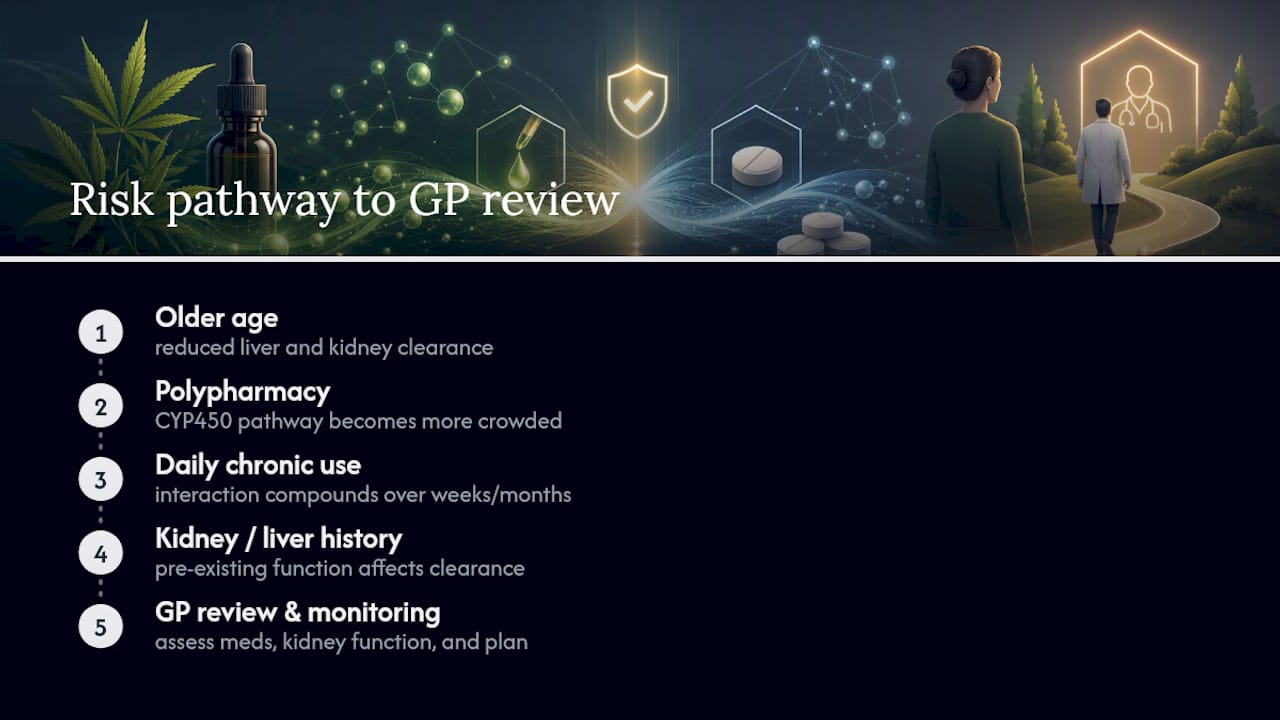
Older adults typically clear medications more slowly than younger adults, partly due to reduced liver and kidney function that comes with age. That slower clearance means any enzyme competition between CBD and ibuprofen has more time to matter, since ibuprofen already lingers longer before it is broken down. Combine that with the fact that older adults are statistically more likely to be on multiple daily medications, and the CYP450 pathway becomes considerably more crowded.
People managing chronic pain conditions, arthritis, fibromyalgia, long-term back pain, face a different but related problem. The temptation with chronic pain is to reach for both substances daily rather than occasionally, and daily use is exactly where a moderate interaction has the most opportunity to compound over weeks and months rather than a single afternoon.
This does not mean either group should avoid the combination entirely. It means the calculus shifts from “generally low risk” toward “worth a specific conversation with a GP about your individual medication list, kidney function, and pain management plan.” Someone managing rheumatoid arthritis with a stable medication regimen and regular blood monitoring is in a very different position from someone self-managing chronic pain without any clinical oversight at all. If chronic pain is your situation, that clinical relationship is worth building before you settle into a long-term combination routine, not after side effects appear.
Could CBD make ibuprofen work better, or worse?
Here is the genuinely counterintuitive part: raising ibuprofen’s blood levels through enzyme inhibition does not automatically mean better pain relief. It means more ibuprofen circulating for longer, which can just as easily tip toward side effects as toward improved efficacy, since ibuprofen’s pain-relieving ceiling does not rise indefinitely with higher blood concentration.
There is no strong evidence that CBD meaningfully boosts ibuprofen’s actual analgesic effect through its own separate mechanism, the endocannabinoid pathway, working alongside COX inhibition. The interaction is pharmacokinetic (how much drug is in your blood and for how long) rather than pharmacodynamic (a genuine synergy between two different pain-relief mechanisms working together).
Practically, this means you should not expect CBD to make your ibuprofen “stronger” in a useful way, and you should not use CBD as a reason to take a higher ibuprofen dose than you otherwise would. If anything, the safer assumption is the reverse: because CBD may extend how long ibuprofen stays active, sticking to the lowest effective ibuprofen dose becomes more important, not less, when CBD is in the picture.
Summary of known side effects when combining CBD with ibuprofen
Most people using both occasionally at sensible doses report no unusual side effects beyond what either substance might cause alone. CBD’s own side effect profile, when used by itself, tends to include mild fatigue, dry mouth, appetite changes, and occasionally digestive upset. Ibuprofen’s known side effects, taken alone, centre on stomach irritation, and less commonly kidney strain or elevated blood pressure with regular use.
When combined, the concern is less about new side effects appearing and more about existing ibuprofen side effects becoming somewhat more likely or pronounced, because of the enzyme-driven rise in blood levels discussed earlier. Stomach discomfort, in particular, is the symptom most worth monitoring, since it is both the most common ibuprofen side effect and the most sensitive to dose and duration.
Elevated liver enzymes, seen in some CBD studies at higher doses, represent the other side effect worth taking seriously, particularly for anyone using both substances daily over an extended period rather than as an occasional pairing. This is not a symptom you will necessarily feel; it typically shows up only on a blood test, which is precisely why clinicians sometimes recommend liver function monitoring for regular higher-dose CBD users, regardless of what else they are taking.
What the evidence actually tells us to prioritise
The conventional advice on this topic tends to swing to one of two unhelpful extremes: either a blanket “never combine these” warning that ignores how mild the risk usually is at sensible doses, or a breezy “CBD is natural, so it’s fine” dismissal that ignores a genuinely documented liver enzyme mechanism. Neither extreme serves you well.
What the evidence actually supports is something more useful: the interaction is real but modest for most people, the bigger unresolved question is whether CBD even delivers reliable pain relief in the first place, and the sensible response to both facts is the same, moderate the doses, watch for symptoms, and loop in a pharmacist if you are using either substance beyond the occasional day. Where routine advice falls short is in treating CBD as a drop-in ibuprofen substitute. The clinical trial record does not support that framing yet, particularly for acute inflammatory pain. Prioritise getting your ibuprofen dosing right first; treat CBD as a separate, cautiously tested addition rather than a replacement.
— Mike
Choosing a tested tincture if you decide CBD is right for you
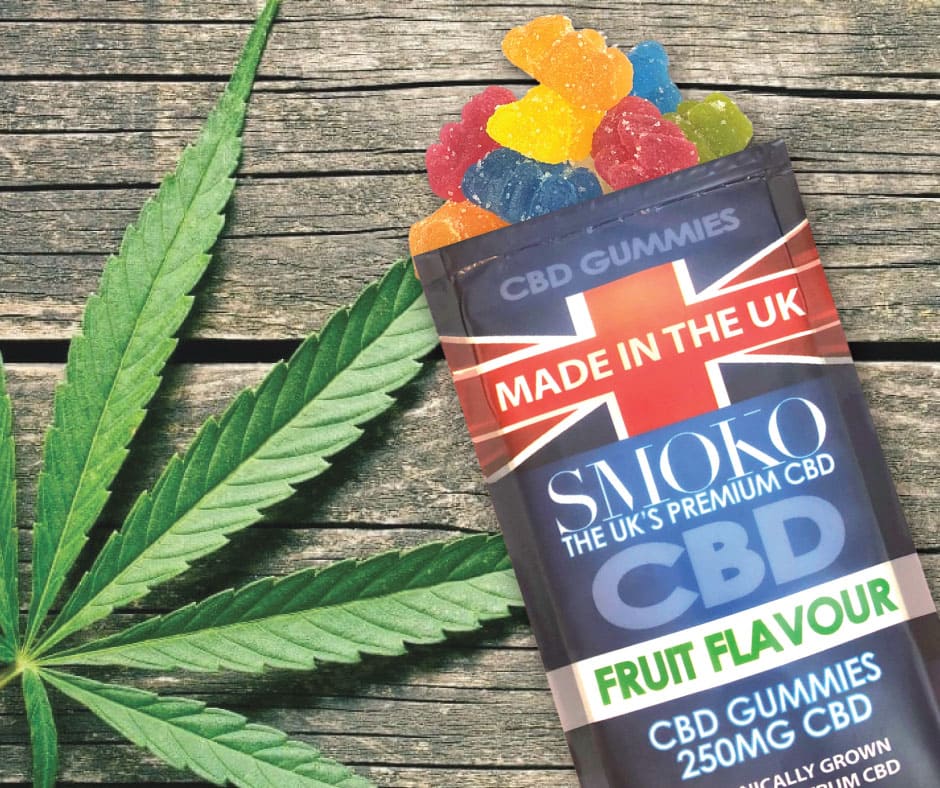
If you have weighed the evidence and want to try CBD alongside your existing pain management routine, product quality is where most of the real-world risk actually lives, not the theoretical enzyme interaction itself. SMOKO CBD’s Mint 2000mg broad-spectrum tincture is made in the UK from organically grown hemp and third-party lab tested to verify zero THC content, so what is on the label matches what is in the bottle.
That verified consistency matters enormously once you understand how dose-dependent the CBD to ibuprofen interaction actually is: you cannot manage a risk you cannot measure. The tincture format lets you start with a small, precise dose and adjust gradually, which is exactly the titration approach worth following if you are introducing CBD alongside occasional ibuprofen use. It suits adults who want a broad-spectrum option with clear dosing rather than a guessing game, though it remains sensible to speak with your GP or pharmacist first if you take other regular medication, have liver or kidney concerns, or use blood thinners. Head to the product page to check current strength options and place an order when you are ready to start low and build from there.
Primary sources and where to read further
The NHS ibuprofen guidance sets out standard dosing and cautions for adults and remains the most reliable UK reference for NSAID use generally. drugs.com’s interaction checker supplies the moderate-interaction classification cited throughout this guide, drawn from documented CYP2C9 mechanisms. Harvard Health’s review of CBD for pain offers a balanced clinical summary of both CBD’s potential and its interaction risks. The systematic review on PubMed gives the fullest picture of how mixed the trial evidence for CBD as an analgesic actually is, and remains essential reading for anyone tempted to treat CBD as a proven ibuprofen alternative.
This article is general information, not a substitute for advice from a qualified doctor. Consult a qualified healthcare professional about your own circumstances before acting on anything here.
Sources
- Can you take Cannabidiol with Ibuprofen? - Interactions
- Ibuprofen for adults - NHS
- Can CBD oil help manage pain? — Harvard Health
- Effectiveness of Cannabidiol to Manage Chronic Pain: A Systematic Review (PubMed listing)