CBD can interact with warfarin, and the honest verdict is: don’t guess. Cannabidiol may raise warfarin levels in your blood by slowing down the enzymes that clear it, which can push your INR higher than intended. If you’re on warfarin and considering CBD (or already taking it), tell your anticoagulation clinician now and arrange an INR check when you start, stop, or change the dose. The evidence is limited, but it’s consistent enough that casual self-management isn’t a safe option.
TL;DR:
- CBD can increase warfarin levels by inhibiting liver enzymes, which may lead to dangerously high INR or bleeding risks in some patients.
- Documented case reports show INR rises ranging from minor to severe, with at least one case requiring clinical treatment for hemorrhage.
- Patients on warfarin should disclose CBD use to healthcare providers before starting, and avoid adjusting doses without medical advice.
- Frequent INR monitoring is essential when adding or stopping CBD, since individual responses vary significantly and dose adjustments are common.
- The risk of interaction is highest with warfarin due to its reliance on CYP2C9, while other blood thinners may pose a lower but still present risk.
Table of Contents
- What do studies and case reports say about CBD and warfarin?
- Why does CBD put warfarin patients at risk?
- How should CBD use be managed if you’re on warfarin?
- Does the risk differ between warfarin and other blood thinners?
- What should you actually say to your clinician about CBD?
- Why product quality matters when CBD meets warfarin
- An editorial take on CBD and warfarin safety
- Sources
What do studies and case reports say about CBD and warfarin?
The clearest signal in the research comes from a 2023 systematic review of anticoagulant drug interactions with cannabinoids, which found that documented interaction cases centre almost entirely on warfarin rather than other blood thinners. Of seven case reports analysed, six showed a rise in INR after cannabinoid exposure, and one included an actual bleeding event.
The scale of INR change varied enormously between patients:
- Reported INR increases ranged from small amounts up to a strikingly high increase in one case.
- One case report resulted in haemorrhage requiring clinical attention.
- Some patients needed no dose change at all, while others required their warfarin dose lowered substantially once CBD entered the picture.
A consistent but small signal: six of seven documented case reports linked CBD or other cannabinoids to a measurable INR rise, according to the Wayne State University pharmacy practice review. That’s not a large dataset, but it’s not noise either.
A widely cited case report published on PMC described a patient whose INR climbed after starting cannabidiol, prompting the authors to recommend INR monitoring whenever cannabinoids are introduced to a warfarin regimen. The quality caveats matter here: these are small numbers of patients, taking varying CBD doses, using different formulations (oils, capsules, vapes), with no controlled interaction trials to pin down a dose-response curve. Clinicians reviewing this evidence, including guidance highlighted in pharmacy practice literature, treat it as a reason for caution rather than a settled statistic.
Why does CBD put warfarin patients at risk?
Warfarin is actually a mix of two mirror-image molecules, R-warfarin and S-warfarin, and S-warfarin does most of the heavy lifting on blood-thinning effect. It’s broken down almost entirely by a liver enzyme called CYP2C9. When something blocks that enzyme, S-warfarin builds up in the blood faster than the body can clear it, and INR climbs.
That’s exactly the mechanism researchers point to with CBD. Evidence reviewed alongside the systematic review’s pharmacology data suggests CBD inhibits CYP2C9, and may also affect CYP3A4 and CYP2C19, the enzymes involved in metabolising a wide range of medicines.
Two secondary mechanisms are worth knowing about, even though they’re less studied:
- P-glycoprotein inhibition, a transport protein that helps shuttle drugs out of cells, may be affected by CBD, altering how warfarin moves through the body.
- Protein-binding displacement is possible too. Warfarin travels through the bloodstream mostly bound to protein, and any compound that knocks it loose increases the “free” (active) drug available.
Pro Tip: Think of CYP2C9 as a warfarin exit door. CBD doesn’t stop warfarin working, it just narrows the door so less gets out per hour, and the drug backs up in your system.
How should CBD use be managed if you’re on warfarin?
Managing this interaction is a clinical process, not a personal experiment. Here’s the sequence that pharmacy guidance and medicines-information resources point towards:
- Disclose CBD use to your anticoagulation team before you start, including the product, strength, and how often you plan to take it.
- Never adjust your own warfarin dose in response to CBD, even if you feel fine.
- Get a baseline INR reading before introducing CBD, so any change afterwards has a clear reference point.
- Repeat INR checks after starting CBD, after any dose change, and again if you stop it. Pharmacy literature recommends this cadence specifically because CBD’s effect can shift over days to weeks.
- Expect possible dose adjustment. Case reports in the systematic review documented warfarin dose reductions of a moderate percentage in some patients as CBD dose increased, though this reflects individual clinical responses, not a fixed formula.
Some patients needed no change whatsoever. Others required a meaningful warfarin dose cut once CBD entered their routine, underlining how unpredictable the individual response can be.
Watch for red flags that require urgent attention rather than a routine appointment: unusual bruising, bleeding gums, blood in urine or stool, prolonged nosebleeds, or any sudden headache with confusion. If you’ve recently changed your warfarin dose or started CBD and notice any of these, seek medical care immediately rather than waiting for your next scheduled INR test. Medicines-information resources list this combination at “monitor” level precisely because the risk, while real, is manageable with the right checks in place.
Does the risk differ between warfarin and other blood thinners?
Not all anticoagulants carry the same exposure to this interaction, and the difference comes down to how each drug is broken down.
- Warfarin carries the highest documented concern. Its dependence on CYP2C9 and its narrow therapeutic window (the gap between too little and too much) make it the drug where CBD’s enzyme-inhibiting effect matters most.
- DOACs like apixaban and rivaroxaban are partly metabolised through CYP3A4 and are affected by P-glycoprotein, so a theoretical interaction with CBD exists. The case-report evidence here is much thinner than for warfarin.
- Dabigatran and edoxaban have different metabolic profiles that don’t rely heavily on CYP2C9, which may make them lower risk for this specific interaction, though that’s not a guarantee of safety with CBD.
None of this means switching anticoagulants to dodge a CBD interaction is something to decide alone. That’s a clinical call, weighing your stroke or clotting risk, kidney function, and other medicines, not a workaround to try without your prescriber.
What should you actually say to your clinician about CBD?
Walking into an appointment with specifics speeds things up enormously. A short disclosure script works well: “I’m taking (or considering) CBD, product name X, in the form of oil/capsule, at roughly Y mg per day, sourced from Z.” Bring the product’s certificate of analysis if you have one, since clinicians need that to judge composition and strength.
If your clinician gives the go-ahead, a few habits reduce risk:
- Start at the lowest available dose, rather than jumping to a strength you’ve seen recommended online.
- Keep timing and food intake consistent day to day. Our guide on how food affects CBD absorption explains why erratic timing makes blood levels harder to predict.
- Choose products with third-party lab certificates and clear CBD-per-serving labelling, and be aware that full-spectrum, broad-spectrum, and isolate products aren’t interchangeable in strength or composition.
Pro Tip: Never increase your CBD dose and your warfarin dose in the same week. Change one variable at a time so any INR shift can actually be traced to its cause. For a broader look at how CBD behaves alongside other prescriptions, our piece on CBD drug interactions to know covers similar ground for other medicine classes, and the logic mirrors what we’ve covered for CBD and statins.
Why product quality matters when CBD meets warfarin
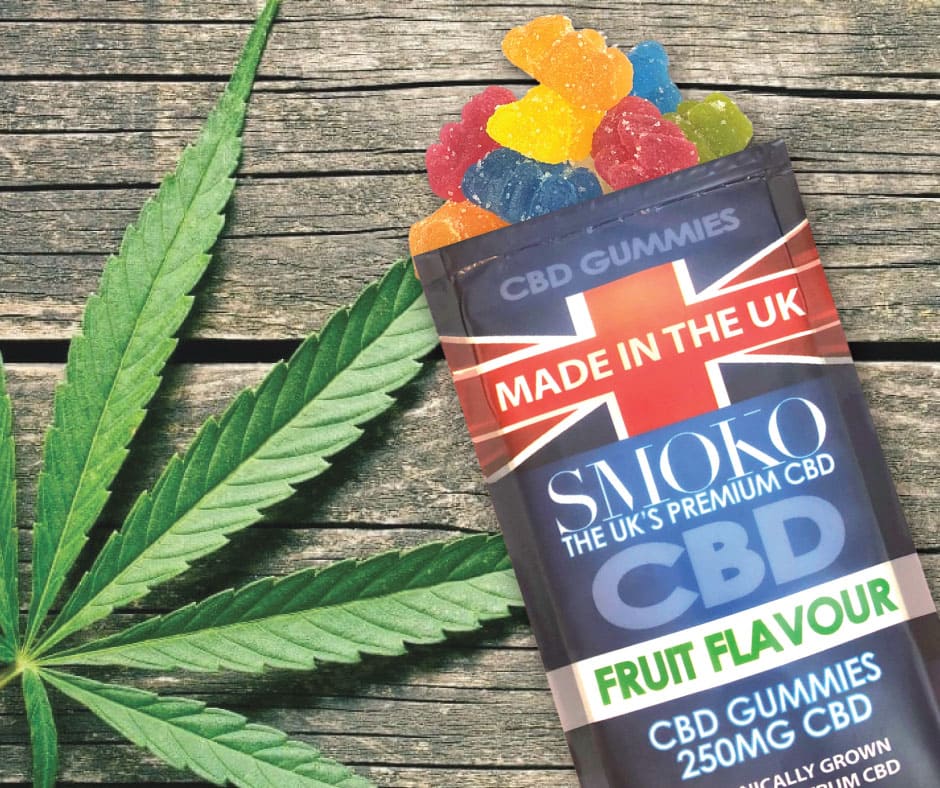
Uncertainty about what’s actually in a CBD product makes an already tricky interaction harder to manage. Some broad-spectrum tinctures, gummies, and soft gels are made with organically grown hemp and go through third-party lab testing to confirm zero THC and to verify actual cannabinoid content.
That matters clinically, not just as a quality claim:
- A certificate of analysis tells your prescriber exactly how much CBD is in each dose, rather than a vague label estimate.
- Consistent broad-spectrum formulation reduces the chance that unlabelled cannabinoids are contributing to enzyme inhibition alongside CBD itself.
- Detailed product descriptions make it easier to give your clinician the exact numbers they need for the disclosure conversation above.
None of this replaces medical advice. It simply means that if you and your clinician decide CBD is appropriate, a product like the 2000mg broad-spectrum CBD tincture gives you a documented starting point rather than a guess.
An editorial take on CBD and warfarin safety
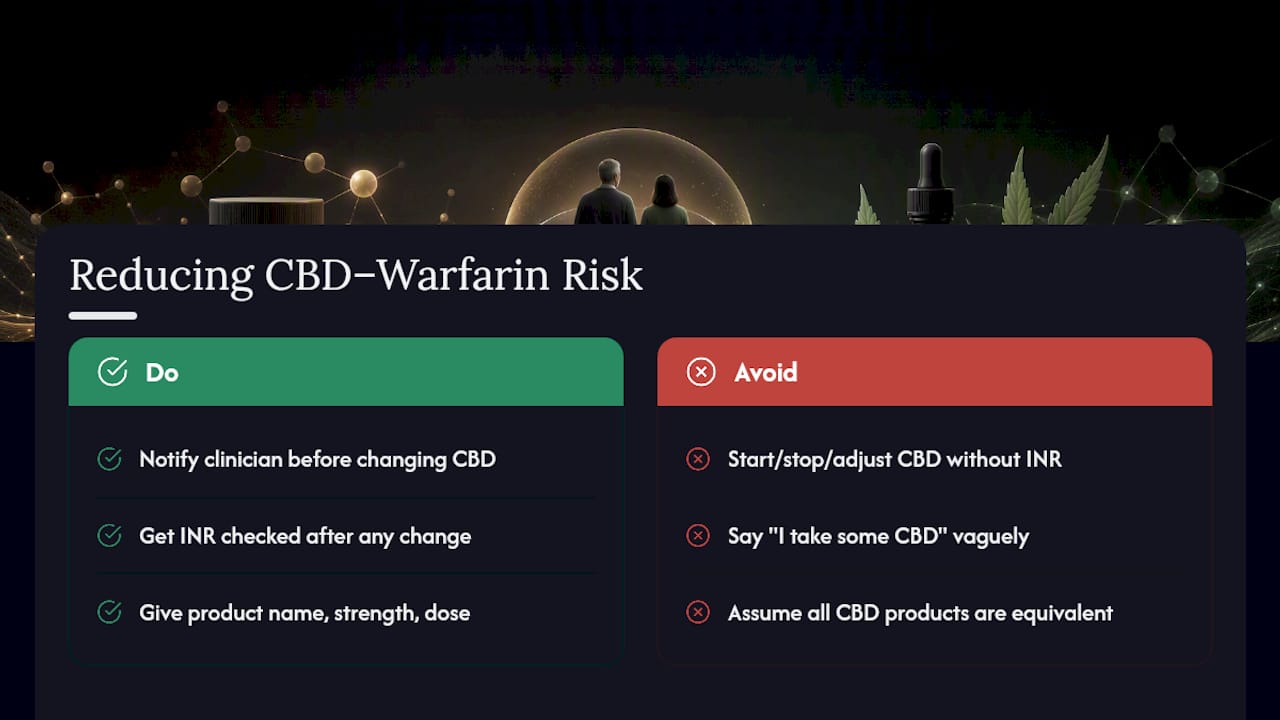
The conventional advice on this topic tends to swing between two extremes: blanket warnings that treat CBD as dangerous, or wellness marketing that glosses over the interaction entirely. Neither serves patients well. The actual evidence, thin as it is, supports a narrower and more useful conclusion: CBD’s risk with warfarin isn’t about the substance being inherently unsafe, it’s about unmanaged change. The moment you start, stop, or adjust CBD without a corresponding INR check is the moment risk appears.
What’s underrated is how much product inconsistency compounds the problem. A patient taking an unlabelled online tincture and a patient taking a lab-verified 2000mg tincture aren’t taking comparable risks, even at the same nominal dose. If there’s one thing worth prioritising above all else, it’s giving your clinician real numbers, product name, strength, dosing frequency, rather than a vague “I take some CBD.” That single habit turns an unpredictable interaction into a manageable one.
— Mike
This article is general information, not a substitute for advice from a qualified doctor. Consult a qualified healthcare professional about your own circumstances before acting on anything here.
Sources
- Anticoagulant drug–drug interactions with cannabinoids: A systematic review
- An interaction between warfarin and cannabidiol, a case report
- Cannabidiol with warfarin — drug interaction overview