Yes, you can fly with CBD from the UK in most cases, provided your product stays within legal THC limits and you follow airport liquid rules. The two constraints that decide everything are THC content and the 100ml hand-luggage limit. Beyond that, it’s your responsibility to check the laws of wherever you’re landing, because CBD’s legal status shifts dramatically once you leave UK airspace.
TL;DR:
- Most CBD products are travel-approved in the UK if they contain THC below legal limits and are packed within 100ml liquid restrictions.
- Lab-verified products with clear batch numbers, manufacturer details, and third-party testing ease security checks and reduce confiscation risks.
- Capsules, gummies, and soft gels avoid liquid restrictions entirely, making them the simplest formats to pack for air travel.
- Always verify destination country laws before departure, as some countries treat any CBD possession as illegal regardless of THC levels.
- Carrying documentation such as a certificate of analysis, purchase receipt, and a GP letter for medical use can facilitate smoother customs and security interactions.
Table of Contents
- UK legal requirements for travel-ready CBD
- How to pack CBD for flights without losing it at security
- Documents and evidence worth carrying
- Checking destination rules before you fly
- What happens if you’re stopped at security or customs
- How compliant CBD brands show they’re travel-ready
- The travel checklist most guides get wrong
- Travel-friendly CBD formats worth packing
- Sources
- FAQ
UK legal requirements for travel-ready CBD
CBD itself isn’t controlled in the UK, but the products carrying it are subject to specific limits. The government’s drug licensing factsheet confirms that legal CBD products must sit under strict THC thresholds, and anything exceeding those limits is treated as a controlled cannabis product, not a wellness supplement.
Callout: Why THC content is the number that matters most. Airport staff and customs officers don’t care about your CBD strength in milligrams. They care whether the THC level tips the product from “food supplement” into “controlled substance” territory, which is precisely why lab-verified zero-THC products travel with far less friction.
Most reputable UK brands sell CBD as a food supplement rather than a medicine, which keeps it outside stricter Medicines and Healthcare products Regulatory Agency pathways, but this classification only holds if the product genuinely meets Food Standards Agency Novel Food expectations. Before you pack anything, check the label for:
- The exact CBD concentration in milligrams
- A batch number that matches the certificate of analysis (COA)
- The manufacturer’s name and UK contact details
- Confirmation of third-party lab testing, not just an in-house claim
Independent testing matters because it’s the only way to verify what’s actually in the bottle, a point echoed in reviews of CBD pharmacology and regulatory practice. Skip this check and you’re relying on trust alone.
How to pack CBD for flights without losing it at security
Packing CBD correctly is mostly about treating it like any other liquid, with a couple of CBD-specific tweaks.
- Check the volume. Any CBD oil or tincture in hand luggage must be 100ml or under, sealed in a clear resealable bag alongside your other liquids, per gov.uk hand-luggage guidance.
- Consider hold luggage for larger bottles. There’s no liquid-volume cap in the hold, so a bigger tincture can travel there instead, though you’ll want to wrap it well.
- Cushion against pressure changes. Cabin and hold pressure shifts can cause leaks, so wrap bottles in a sealed sandwich bag inside a sock or padded pouch.
- Choose capsules or gummies where possible. Neither counts as a liquid, so they sidestep the 100ml rule entirely and pack as easily as any other snack or supplement.
- Mind vape batteries separately. If you’re travelling with a CBD vape device, the battery must go in hand luggage, never hold luggage, under standard aviation lithium battery rules.
Pro Tip: Pack your CBD oil in the outer pocket of your hand luggage, not buried at the bottom. If security asks you to remove liquids for inspection, you don’t want to be unpacking your entire bag on the belt.
Format genuinely changes your travel experience here. A soft gel capsule or a gummy bear is dull to pack and dull to explain, which is exactly what you want at an airport queue.
Documents and evidence worth carrying
The single best thing you can do before flying is build a small evidence file, digital and physical, that proves your CBD is legal.
A certificate of analysis is your strongest card. Check it shows the THC percentage within UK legal limits, the name of the testing laboratory, and a batch number that matches what’s printed on your product. Without those three details, a COA is close to worthless if you’re questioned.
Practical steps that cost nothing and save time:
- Save the COA as a PDF on your phone, not just a photo in your gallery
- Print a paper copy and keep it with your travel documents
- Keep your purchase receipt or order confirmation email
- Bookmark the manufacturer’s product page in case an officer wants to verify sourcing
If you use CBD for a diagnosed condition and have a prescription or letter from a GP, bring it. It won’t override foreign law, but it demonstrates intent and can smooth conversations with UK security or customs staff.
Checking destination rules before you fly
UK legality doesn’t travel with you. Some countries criminalise CBD outright regardless of THC content, and that’s the single biggest risk factor in this entire process.
Callout: The rule that catches people out. A product that’s completely legal to buy on the high street in Britain can be treated as a controlled drug the moment you land somewhere else. Travel guidance on CBD flags several Middle Eastern and Asian jurisdictions where possession, regardless of dose, can lead to confiscation, heavy fines, or detention.
Before booking, or at the very least before packing, check:
- Your destination country’s official government or customs website
- Your embassy’s travel advice page for cannabis-related products
- The airline’s own policy, since carriers can apply stricter rules than the destination itself
If you can’t get a clear answer, the safest move is to leave the product at home and consider buying a zero-THC alternative locally, or simply going without for the trip. It’s not worth risking a holiday over a bottle of oil.
What happens if you’re stopped at security or customs
Within the UK and most of the EU, a CBD stop is rarely dramatic. Expect routine questioning and a possible inspection, not confiscation, especially if your paperwork is in order.
- Stay calm and answer questions directly. Most airport interactions are just standard liquid checks.
- Present your COA and receipt straight away rather than waiting to be asked twice.
- If the product is seized, ask for a written receipt or reference number before you leave the desk.
- If you’re detained abroad, contact the nearest UK consular service as soon as possible.
- Document everything, photos, timestamps, officer names, in case you need to dispute the incident later.
Confiscation at UK airports is unusual when THC limits and labelling are correct, according to travel-focused security guidance. Abroad, outcomes vary far more widely.
How compliant CBD brands show they’re travel-ready
A trustworthy supplier makes your job at security dramatically easier, because the paperwork is already sorted before you even pack. Some broad-spectrum CBD products are made in the UK from organically grown hemp and go through independent third-party lab testing to verify zero THC, which is the kind of documentation trail worth having in your travel folder.
When reading any lab report, whether from Smokocbd or another supplier, look for the same three fields every time:
- THC percentage, confirming the product sits within legal limits
- Batch ID, matching the number printed on your product packaging
- Testing laboratory name, so the result can be independently verified
For travel specifically, capsules, soft gels, and gummies sidestep the 100ml liquid rule altogether, making them the simplest formats to pack without a second thought.
Pro Tip: If you do prefer oil, buy the smallest bottle size available. A compact tincture is easier to seal in your liquids bag and far less likely to trigger a closer look.
The travel checklist most guides get wrong
Most CBD travel advice treats government rules and packing logistics as separate problems, when they’re really the same problem viewed from two angles. Knowing the THC threshold means nothing if your bottle is 150ml and gets pulled at the tray. Having perfect packaging means nothing if you’re landing somewhere CBD is outright banned.
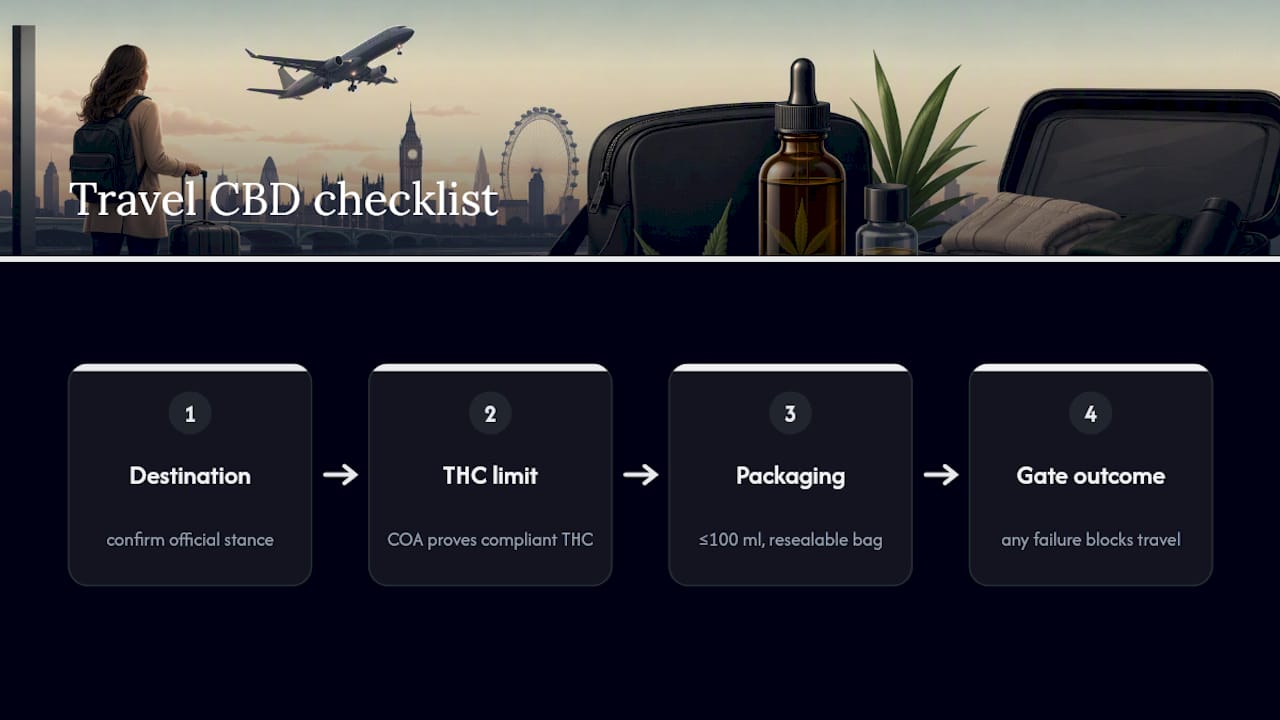
What gets underrated is the destination check. Travellers spend far more energy worrying about UK airport security, which is genuinely low-risk, than they do researching the country they’re actually flying to, which carries the real legal exposure. That imbalance is backwards.
If you’re prioritising one thing before a trip, make it this: confirm your destination’s stance on CBD through an official source, not a forum post or a fellow traveller’s assumption. Everything else, the COA, the resealable bag, the batch number, is supporting evidence for a decision you should have already made with confidence. Formats matter too; anyone who’s fumbled with a leaking tincture at a departure gate will tell you a gummy or a soft gel saves a surprising amount of hassle.
— Mike
Travel-friendly CBD formats worth packing
One advantage for travellers is straightforward: broad-spectrum products verified at zero THC by independent lab testing, made in the UK, in formats built to survive an airport without drama. If oils are your preference, a small tincture under 100ml fits neatly into your liquids bag alongside the COA you’ve already saved to your phone.
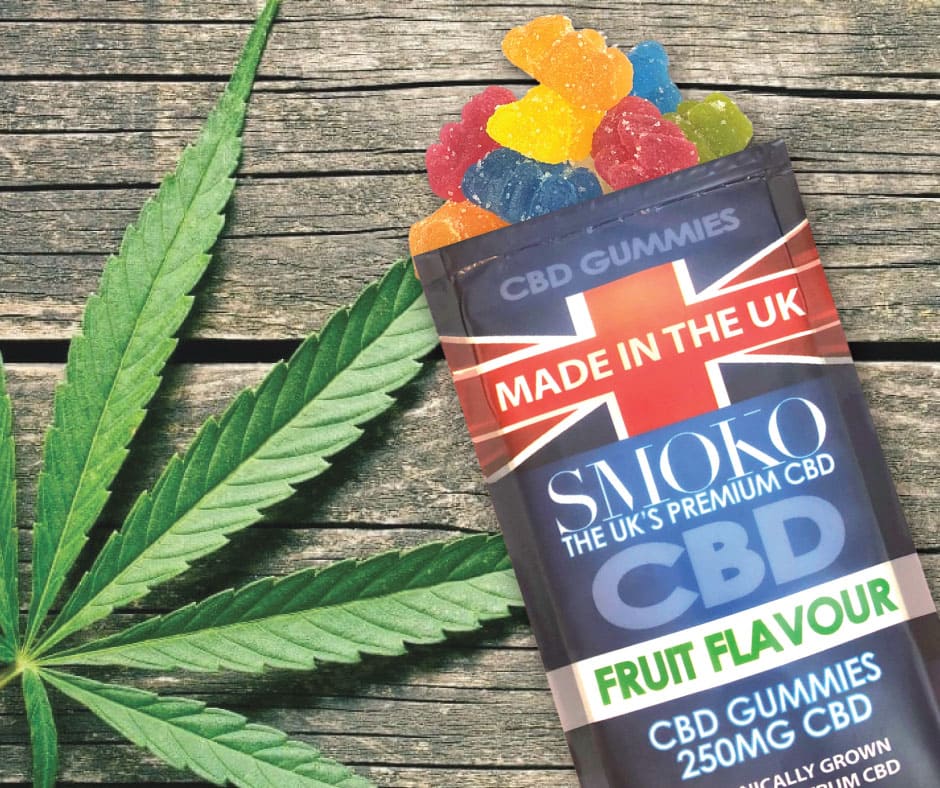
For anyone who’d rather skip the liquid rule altogether, CBD Gummy Bears travel as easily as any other sweet in your hand luggage, with no volume restriction to think about. The full range, tinctures, gummies, and soft gels, sits on the Smokocbd collection page, with free UK shipping on orders over £30. Whichever format you choose, buy before you fly, pack your COA with it, and still check your destination’s own laws once you’ve placed the order. Legal at home doesn’t always mean legal on arrival.
Sources
- Cannabis, CBD and other cannabinoids: drug licensing factsheet
- Review article on cannabidiol: pharmacology and regulatory issues
- Can You Take CBD Oil on a Plane? UK Travel Guide (2026)
Save both as offline bookmarks before departure.
This article is general information, not a substitute for advice from a qualified doctor. Consult a qualified healthcare professional about your own circumstances before acting on anything here.
FAQ
Is CBD legal in the United Kingdom?
Yes, CBD is legal in the UK as long as the product stays within the THC limits set out in the government’s drug licensing factsheet and is sold as a food supplement rather than an unlicensed medicine.
Is CBD oil legal in the UK for anxiety?
CBD oil is legal to buy and use in the UK generally, but it isn’t licensed as a medicine for anxiety specifically, so brands can only market it as a wellness supplement rather than a treatment.
Can you take CBD oil on a plane from the UK?
Yes, provided the bottle is 100ml or under for hand luggage and the product meets UK THC limits; larger bottles can go in hold luggage instead, per gov.uk hand-luggage rules.
Do I need to declare CBD at airport security?
You don’t need to formally declare CBD at UK security, but keeping your COA and receipt to hand speeds up any questions if your liquids bag is checked.
Are CBD gummies easier to travel with than CBD oil?
Yes, gummies and soft gels aren’t classed as liquids, so they avoid the 100ml restriction entirely and pack as simply as any other snack or supplement, such as some CBD gummy bears.