Oral CBD shows a modest, consistent effect on itch in pooled research, but no oral CBD product has been shown to repair the skin barrier or lower disease severity scores in a way that would let it replace standard eczema care. Think of it as a possible adjunct for symptom relief, not a substitute for dermatology treatment, and speak to a clinician first if your eczema is moderate to severe.
TL;DR:
- Oral CBD shows only a modest, consistent reduction in itch without evidence of repairing skin barrier or reducing disease severity scores.
- Most research supporting cannabinoids for skin health is topical, with very limited data on oral formulations and their long-term safety.
- Trial sizes are small, formulations vary, and studies are short, making it hard to draw firm conclusions about oral CBD’s effectiveness for eczema.
- A cautious trial could be appropriate for those with persistent itch despite topical treatment or for individuals already tolerant of CBD, but not for pregnant, breastfeeding, or severely affected patients.
- Long-term safety remains uncertain, especially regarding liver function and drug interactions, so always consult a clinician before starting and choose products with verified third-party testing.
Table of Contents
- What does the clinical evidence on CBD for eczema actually show?
- Who should consider trying oral CBD for eczema, and who shouldn’t?
- How should you dose and monitor an oral CBD trial safely?
- How do you choose a trustworthy oral CBD product?
- What are the long-term risks of taking oral CBD for eczema?
- How does oral CBD compare with standard eczema treatments?
- Is oral CBD legal to buy and use for eczema?
- Mike’s take: running a sensible four-week CBD trial
- Ready to try oral CBD? Here’s where to start
- Sources
What does the clinical evidence on CBD for eczema actually show?
Most of what we know about cannabinoids and skin comes from research that leans heavily topical, which matters because it means the case for oral CBD specifically is thinner than headlines suggest.
A 2023 systematic review pooling 18 studies and 1,090 patients looked at cannabinoids across a range of inflammatory and hair/scalp/skin conditions. Topical formulations dominated the literature, which means most of the encouraging findings you’ll read about cannabinoids and skin were not generated using oral products at all.
A more recent 2025 meta-analysis narrows the picture further for atopic dermatitis specifically. The one bright spot: a small but consistent antipruritic (itch-relieving) signal turned up across the pooled analyses.
What the numbers say: Across 17 pooled studies, cannabinoids showed effect sizes near zero for objective skin barrier and severity measures, but a small, statistically detectable reduction in itch intensity.
That split result (no change in disease markers, some change in itch) is the single most important thing to understand before spending money on an oral CBD product for eczema. A few structural weaknesses explain why the picture is still fuzzy:
- Small trial sizes. Many of the underlying studies involve a few dozen participants at most, which limits statistical power.
- Heterogenous formulations. Full-spectrum extracts, isolates, and synthetic cannabinoids like dronabinol get lumped together despite behaving differently in the body.
- Short trial durations. Few studies run long enough to say anything about sustained remission.
- Topical dominance. Because oral and topical routes work through different mechanisms, positive topical results can’t simply be assumed to transfer to a gummy or tincture.
Preclinical work does offer a plausible reason CBD might help at all. The skin runs its own endocannabinoid signalling network, sometimes called the cutaneous cannabinoid system, which influences barrier function, immune response, and itch pathways. That biological plausibility is genuine, documented in reviews of cutaneous cannabinoid signalling, but a plausible mechanism is not the same as a proven clinical effect. The practical takeaway: oral CBD may take the edge off itching for some adults, but treat any claim about “healing” the skin barrier or reversing eczema with real scepticism until the trial data catches up.
Who should consider trying oral CBD for eczema, and who shouldn’t?
Oral CBD sits best as an adjunct trial for a specific type of person, not a universal fix. You’re a reasonable candidate for a cautious trial if you fit one of these profiles:
- You have persistent itch despite following your prescribed topical steroid or emollient routine.
- You want a systemic, whole-body option alongside topical care rather than instead of it.
- You’ve used CBD before for something else (sleep, anxiety) and tolerated it well, and want to see whether it helps your eczema symptoms too.
Other people should hold off, or only proceed with medical guidance:
- Pregnant or breastfeeding people, where cannabinoid safety data is essentially absent.
- Anyone with significant liver disease, since CBD is metabolised hepatically.
- Anyone on multiple medications, given the interaction risk covered below.
- Anyone with severe, widespread, or visibly infected eczema.
Certain symptoms are a signal to stop self-managing and see a clinician promptly: a rapidly spreading rash, fever, weeping or crusting that suggests secondary infection, or any systemic symptoms like fatigue and swollen glands. Dermatology commentary, including guidance from the National Eczema Association, consistently recommends discussing CBD with a healthcare provider first precisely because the underlying studies are small and the formulations vary so much.
How should you dose and monitor an oral CBD trial safely?
There’s no agreed, standardised dose of oral CBD for eczema. No regulator or dermatology body has published a target milligram range specifically for atopic itch, which means any dosing advice here is a sensible starting framework, not a prescription.
A conservative approach works best:
- Start low. For tinctures, begin around 5 to 15 mg of CBD once daily. For gummies or soft gels, a similar 5 to 25 mg once-daily starting point is reasonable given the fixed-dose format.
- Hold steady for a week. Don’t judge results after a single dose. Give your body time to respond.
- Titrate gradually. If you notice no benefit and no side effects, increase in small increments every 7 to 14 days.
- Track weekly. Log itch intensity on a simple 0 to 10 scale, sleep disruption, topical steroid use, and any side effects.
- Reassess at four weeks. A steady four-week window is generally needed before you can fairly judge whether oral CBD is doing anything for you.
The most commonly reported side effects in oral cannabinoid trials are gastrointestinal upset, drowsiness, and appetite changes, with one pooled review citing GI symptoms in as many as 59.5% of participants in certain oral cannabinoid trial groups. Serious adverse events are rare in short trials, but long-term safety data for daily use simply doesn’t exist yet in any robust form.
CBD is metabolised through the liver’s CYP450 enzyme pathway, the same system that processes many common medications, including some blood thinners, antiepileptics, and immunosuppressants. That creates a genuine interaction risk. If you take any regular prescription medicine, check with a pharmacist or your GP before starting.
Pro Tip: Ask if clinically relevant for a baseline liver-function check before you start, especially if you’re already taking medication metabolised by the liver. It costs little and rules out a rare but real concern.
How do you choose a trustworthy oral CBD product?
Not every bottle on the shelf deserves your trust, and eczema-prone skin is not the place to gamble on a mystery formulation. A short checklist filters out most of the poor-quality options:
- Demand a third-party Certificate of Analysis (COA). It should confirm CBD potency and, if you need zero-THC, confirm THC wasn’t detected.
- Match the batch number. The COA should correspond to the exact batch number printed on your product’s packaging, not a generic reference sample.
- Check the mg-per-dose labelling. Clear per-gummy or per-millilitre dosing beats vague “CBD-rich” marketing every time.
- Know your carrier and allergens. MCT oil, gelatine, and sugar are common in tinctures, gummies, and soft gels; check these if you have sensitivities.
- Decide broad-spectrum versus isolate. Broad-spectrum keeps other hemp compounds without detectable THC; isolate strips everything but CBD, useful if you want maximum certainty on THC content.
- Watch for unnecessary additives. Added sugars or alcohol don’t help your trial and can complicate side-effect tracking.
Look for brands that make lab reports easy to find, explain how CBD works with the endocannabinoid system in plain language, and offer responsive customer support if you have questions about a specific batch, which is exactly the kind of transparency SMOKO CBD builds into its product pages.
What are the long-term risks of taking oral CBD for eczema?
Long-term human data on daily oral CBD use is thin, and that gap is the honest headline here. Most trials run for weeks, not years, so nobody can currently say with confidence what happens after twelve months of continuous use.
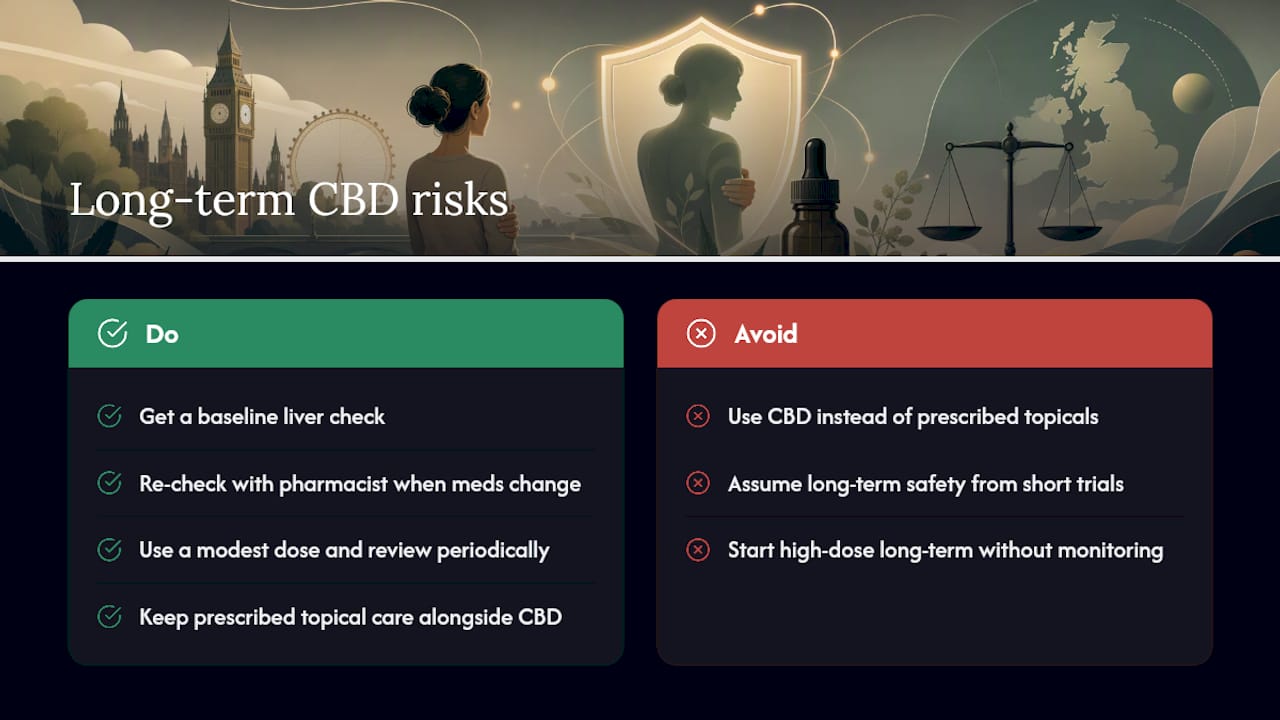
The clearest documented long-term concern is liver enzyme elevation, seen in higher-dose pharmaceutical CBD trials for other conditions, which is why a baseline liver check matters more the longer you plan to continue. Cumulative interaction risk is the second concern: if you start new medications while already taking CBD, the CYP450 interaction picture changes each time, so it’s worth re-checking with a pharmacist whenever your prescriptions change, not just once at the start.
There’s also an opportunity cost worth naming plainly. If oral CBD only ever delivers a mild antipruritic effect, relying on it as your main strategy while skipping prescribed topical treatment could let underlying inflammation and barrier damage continue unchecked. That’s the real risk, not a dramatic side effect, but a quiet one: mistaking itch relief for disease control.
None of this means long-term use is unsafe. It means the safety margin is currently defined by short-term trials extrapolated forward, and a sensible trial stays modest in dose, reviewed periodically, and never used as a replacement for dermatologist-directed care.
How does oral CBD compare with standard eczema treatments?
Topical corticosteroids and calcineurin inhibitors remain the backbone of eczema management because they act directly at the site of inflammation, with decades of trial data behind them. Emollients maintain barrier hydration daily. Oral CBD sits in a different category entirely: a systemic, adjunctive option with a much shorter evidence trail and, so far, no proof it affects disease severity scores the way prescribed treatments do.
The practical distinction is mechanism. Topical treatments concentrate active molecules exactly where the skin is damaged and avoid first-pass liver metabolism, which is one reason topical formulations often show clearer benefit than oral cannabinoids in the research so far. Oral CBD, by contrast, has to survive digestion and liver processing before reaching the bloodstream, diluting whatever effect reaches the skin.
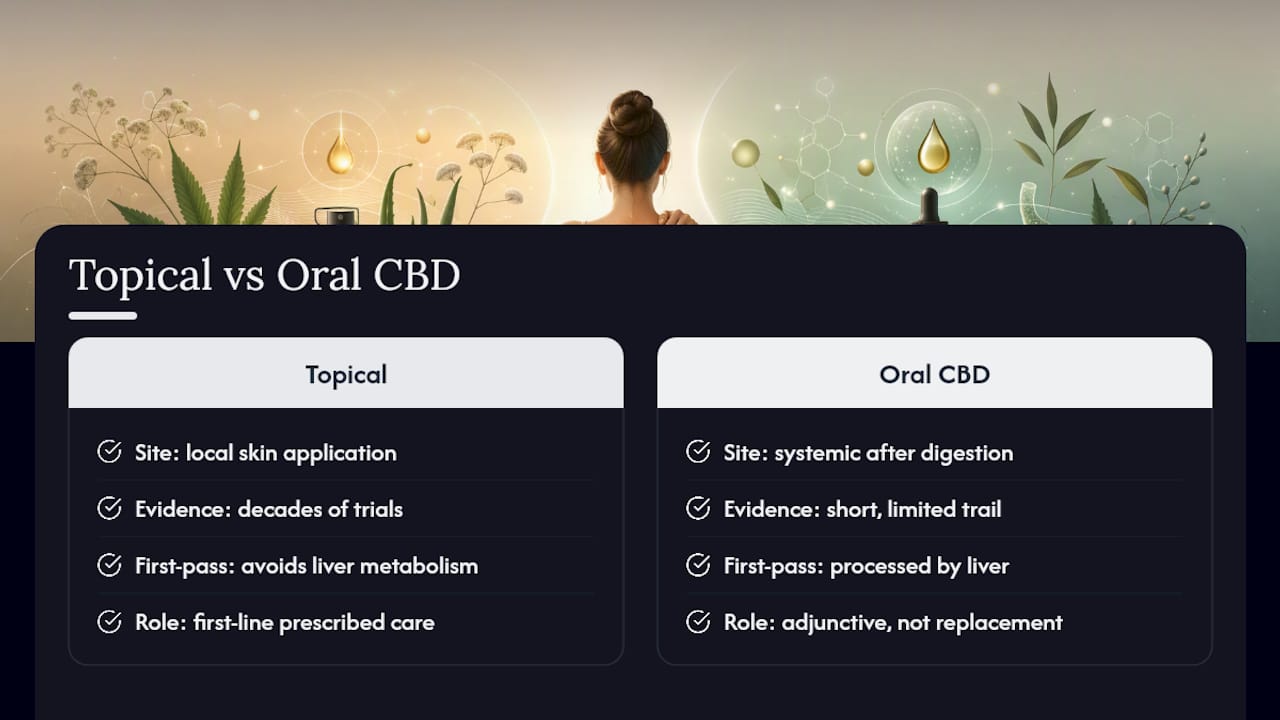
That’s not a reason to dismiss oral CBD outright. It’s a reason to position it correctly: alongside your existing regimen, not instead of it. If you’re weighing lifestyle-level options against a CBD trial, it’s worth comparing anti-inflammatory dietary approaches against cannabinoid interventions too, since both sit in the same adjunctive tier rather than the first-line tier occupied by prescribed dermatological treatment.
Is oral CBD legal to buy and use for eczema?
Broad-spectrum CBD tinctures, gummies, and soft gels are legally available to buy in the UK provided they meet the country’s controlled cannabinoid content limits and come from a hemp source compliant with UK regulations. That’s a product-composition question, not a medical-claims question, and the two get confused constantly.
What matters practically for eczema patients is twofold. First, buy from a seller who publishes third-party lab testing confirming THC compliance and accurate CBD content, since mislabelled products are a genuine market problem. Second, understand that no oral CBD product is licensed as a medicine for eczema in the UK, which means retailers cannot legally claim it treats, cures, or prevents the condition. Any language you see about “relief” or “support” is a wellness claim, not a medical one, and that distinction should shape how much weight you put on marketing copy versus the clinical evidence covered earlier in this article.
If you’re on prescribed medication, checking with a pharmacist isn’t a legal requirement, but it is the practical equivalent of one, given the CYP450 interaction risk already discussed. Buying a compliant, well-tested product solves the legal question. It doesn’t solve the clinical-evidence question, and the two shouldn’t be conflated when deciding whether a trial makes sense for you.
Mike’s take: running a sensible four-week CBD trial
If you want to test oral CBD for eczema-related itch, keep it simple: pick one product type, one starting dose, and track it weekly for four weeks against a 0 to 10 itch score, sleep quality, and any side effects. Don’t chase strength increases before week two. Don’t stop your prescribed topical treatment to “give CBD a fair shot,” that’s a false trade-off, not a scientific one. Look for a supplier that makes its lab testing genuinely easy to find, not buried three clicks deep. And if anything about your skin changes for the worse during the trial, that’s your cue to call a dermatologist, not to increase the dose.
— Mike
Ready to try oral CBD? Here’s where to start
If you’ve read this far and decided a cautious trial makes sense for you, there are straightforward starting points rather than a shelf of confusing options when choosing oral CBD products. Broad-spectrum tinctures, gummies, and soft gels often claim to be made from organically grown hemp, with third-party lab testing to verify THC status and confirm CBD potency.
For a first trial, the 2000mg Mint Broad Spectrum CBD Tincture makes dose control easy, since a dropper lets you measure your starting range precisely rather than relying on a fixed gummy or soft gel amount. Check the product page for the current Certificate of Analysis, and if you want to see the batch-specific COA before you buy, Smokocbd’s customer support team can pull it up for you directly. Pick your strength, confirm the lab report matches the batch number on the bottle, and start your four-week trial with a proper baseline itch score already logged.
Sources
- Cannabinoids for the Treatment of Hair, Scalp, and Skin Disorders: A Systematic Review
- Cannabis and cannabinoids in dermatology: a systematic review and meta-analysis of quantitative outcomes