TL;DR:
- Cannabinoid oil in the UK mainly refers to CBD-rich extracts derived from hemp, not hemp seed oil. Legal products must contain less than 0.2% THC, verified by independent lab certificates, and buyers should scrutinize batch-specific COAs. Clinical evidence on cannabinoids’ benefits is mixed, with patient reports often positive but trials showing limited effects for anxiety and PTSD.
Cannabinoid oil UK searches have surged over the past few years, and it’s not difficult to understand why. Adults across Britain are turning to CBD oil and other cannabinoid products hoping to find relief from chronic pain, anxiety, and disrupted sleep, often after conventional options have left them frustrated. But the conversation around cannabinoid oil is more complicated than most product pages suggest. Some claims are backed by real clinical data, others are not. Understanding that distinction before you spend your money is exactly what this article is here to help you do.
Table of Contents
- Key takeaways
- What is cannabinoid oil?
- Health benefits: what the evidence actually shows
- Legal standards and quality assurance
- How to choose, dose, and use cannabinoid oil
- My honest take on the evidence gap
- Find quality cannabinoid oil from Smokocbd
- FAQ
Key takeaways
| Point | Details |
|---|---|
| Terminology matters | Cannabinoid oil, CBD oil, and hemp oil are not the same product; knowing the difference protects your purchase. |
| Clinical evidence is mixed | Patient reports are often positive, but randomised controlled trials show limited benefits for anxiety and PTSD. |
| Legal compliance is non-negotiable | UK law requires THC content below 0.2%; always check batch-specific lab certificates before buying. |
| Start with a low dose | UK guidance recommends beginning at 5–10mg CBD and adjusting gradually based on your response. |
| Quality signals to seek | Third-party lab testing, transparent COAs, and clear hemp sourcing separate trustworthy products from risky ones. |
What is cannabinoid oil?
This question sounds simple, but the terminology in this market is genuinely confusing, and that confusion costs people money. The term “cannabinoid oil” is a broad label covering oils derived from the cannabis plant that contain one or more active cannabinoid compounds, most commonly cannabidiol (CBD). When people say CBD oil UK, they are generally referring to a product where CBD is the primary active compound, suspended in a carrier oil such as MCT coconut oil.
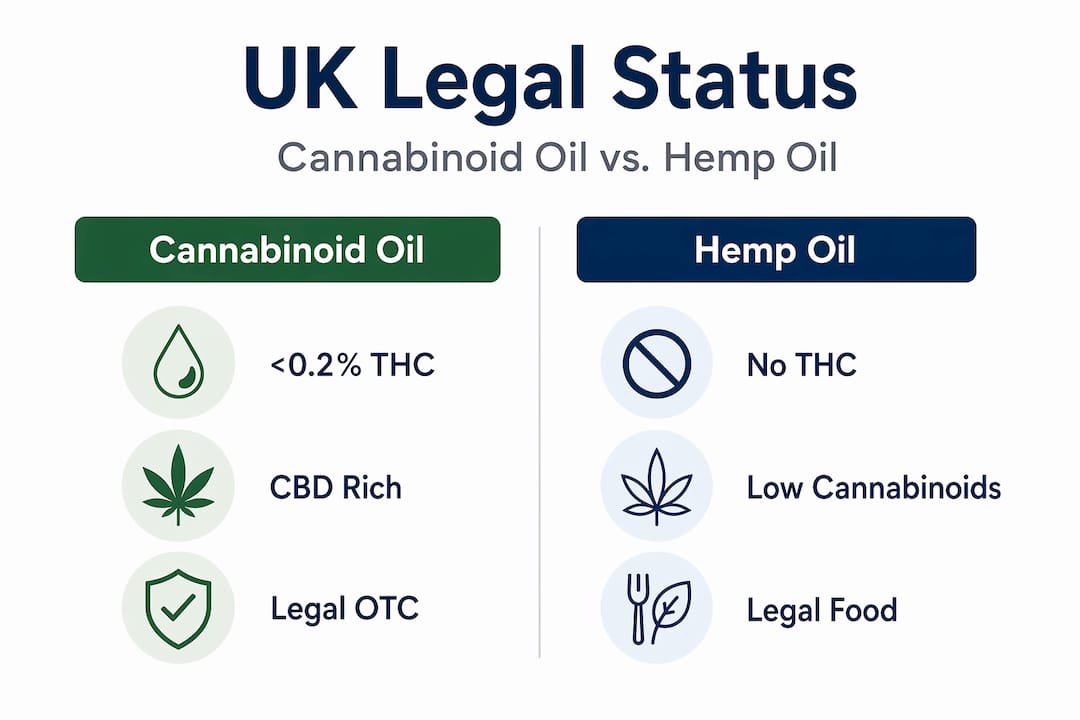
Hemp oil is different. It is cold-pressed from hemp seeds and contains very little to no CBD or other cannabinoids. It has genuine nutritional value, rich in omega fatty acids, but it will not interact with your endocannabinoid system the way a cannabinoid-rich extract does. You can read a detailed breakdown of the distinction in this cannabinoid oil vs hemp oil guide from Smokocbd.
Then there is medical cannabis, which is a completely separate category. UK law differentiates over-the-counter CBD products from prescription-only medical cannabis, each governed by distinct regulatory frameworks. Medical cannabis can contain significant levels of THC and requires a specialist prescription. Over-the-counter CBD products are legal precisely because they contain less than 0.2% THC and are derived from approved hemp strains.
Here is a quick comparison to make it clearer:
| Product type | Contains CBD? | Contains THC? | Legal status in UK |
|---|---|---|---|
| Hemp seed oil | No | No | Legal, sold as food supplement |
| CBD oil (OTC) | Yes | Trace (under 0.2%) | Legal, sold as supplement |
| Medical cannabis | Yes (often) | Yes (variable) | Prescription only |
The regulatory context matters because UK law requires THC content below 0.2% in any product sold over the counter, with independent lab certificates to confirm compliance. Products without this documentation sit in a legal and safety grey area, regardless of what the label says.
Health benefits: what the evidence actually shows
This is where the picture becomes genuinely interesting, and genuinely complicated. Patient reports and clinical trial data often point in very different directions.
On the clinical side, a 2026 systematic review in The Lancet Psychiatry00015-5/fulltext) examined 54 randomised controlled trials involving 2,477 participants and found no significant evidence that cannabinoids effectively treat anxiety, PTSD, or ADHD. That is a sobering finding, given how frequently these are cited as cannabinoid oil uses in marketing materials. The same review did find improvements for cannabis withdrawal symptoms and insomnia, which aligns with anecdotal reports many UK users share.
Patient experience tells a different story. A survey of 6,282 patients across six UK clinics found 97.6% of those with anxiety, depression, or PTSD reported symptom improvement with medical cannabis. Over 90% also reported better sleep and day-to-day functioning, with the majority reducing their use of other medications. The divergence between these figures and RCT outcomes is not necessarily a sign that patients are imagining benefits. It may reflect the limitations of how clinical trials are designed, or the complexity of individual responses to cannabinoids.
That said, risks are real and should not be minimised. Cannabinoid oils can trigger increased anxiety, paranoia, or psychosis, particularly in people with a personal or family history of mental health conditions. Warnings from leading clinicians, including Prof. Owen Bowden-Jones and the Medical Cannabis Clinicians Society, emphasise that careful clinical oversight matters. The idea that cannabinoids are inherently gentle and without consequence is one of the more dangerous myths in this space.
Here is a summary of what current evidence suggests:
- Pain relief: Some evidence from observational studies, but RCT data remains inconsistent across different pain types.
- Sleep: One of the more supported uses; improvements noted in both clinical reviews and patient reports.
- Anxiety: Widely reported by users, but clinical trials show no significant benefit00015-5/fulltext) for anxiety disorders in RCTs to date.
- Inflammation: Preliminary data looks promising, particularly for inflammatory pain, though large human trials are lacking.
- Mental health risks: Real and documented, especially for those with predisposing conditions.
The gap between what patients report and what trials confirm is one of the most important conversations in UK cannabinoid research right now. Neither side of that gap should be ignored.
Pro Tip: If you are using cannabinoid oil alongside prescription medication, especially antidepressants or anticoagulants, speak to your GP first. CBD can affect how your liver metabolises certain drugs.
Legal standards and quality assurance
Buying cannabinoid oil UK legally and safely comes down to one thing more than anything else: documentation. Anyone can put a professional-looking label on a bottle. What separates a quality product from a risky one is the presence of a batch-specific Certificate of Analysis (COA) from an independent third-party laboratory.
Here is what to check before you buy:
- The COA must be batch-specific. A single lab test published on a website tells you very little about the bottle in your hands right now. Look for a QR code or lot number on the packaging that links to a COA for that specific batch.
- Check THC content explicitly. The COA should show THC at or below 0.2%. If THC is not listed separately, that is a red flag.
- Review the full cannabinoid profile. A reputable broad-spectrum product will show measurable CBD, often additional cannabinoids like CBG or CBN, and zero or trace THC. This gives you confidence about what you are actually consuming.
- Confirm the hemp source. Organically grown hemp from regulated farms in the USA or Europe is generally a safer choice than unverified sources with no clear origin.
- Check for contaminants. Quality COAs also test for pesticides, heavy metals, and microbial contamination. These results should be available on request.
High-quality UK cannabinoid products provide transparent COAs and clear home delivery options, making it easier than ever to verify what you are purchasing before it arrives. If a brand makes it difficult to access this information, shop elsewhere.
Pro Tip: Download or screenshot the COA at the time of purchase. If you ever have a reaction or question about a product, having the batch documentation on hand makes it much easier to investigate.
How to choose, dose, and use cannabinoid oil
Once you have found a quality, legally compliant product, the next question is how to actually use it. Several factors shape the right choice for you.

Full-spectrum versus broad-spectrum is the first decision. Full-spectrum oils contain trace amounts of THC alongside CBD and other cannabinoids. The theory, sometimes called the entourage effect, is that these compounds work better together. Broad-spectrum oils retain multiple cannabinoids but with THC removed entirely, making them the safer legal choice for most UK consumers. If you want to understand more about the distinction and why it matters for wellness, the CBD vs THC guide on Smokocbd breaks it down clearly.
Dosing is where many new users go wrong by expecting immediate results from too low a starting point, or by jumping to high doses and experiencing unwanted effects. UK guidance recommends starting at 5 to 10mg CBD and gradually increasing, paying attention to how your body responds over several days before adjusting. This “start low, go slow” approach reduces the risk of side effects and gives you useful information about what actually works for you.
Administration matters too. Sublingual use (holding the oil under your tongue for 60 to 90 seconds before swallowing) delivers cannabinoids more efficiently than simply swallowing. Absorption through the mucous membranes bypasses first-pass digestion, meaning more of the active compound reaches your bloodstream. Capsules and gummies take longer to act but offer more precise, consistent dosing, which suits people who prefer not to measure drops.
A few practical points to keep in mind:
- Consistency matters more than quantity. Daily use over several weeks tends to produce more noticeable effects than occasional high doses.
- Track your response. Keep a brief daily note on dose, time, and how you feel. This is the single most useful thing you can do to optimise your experience.
- Set realistic expectations. Cannabinoid oil is not a treatment for any condition. It is a wellness supplement, and results vary widely between individuals.
- When to see a professional. If you are managing a diagnosed condition, always discuss cannabinoid oil with your GP or specialist before starting. This is especially true for anxiety, where clinical trial findings00015-5/fulltext) suggest caution.
My honest take on the evidence gap
I’ve spent considerable time looking at how cannabinoid oil is discussed in the UK, both in clinical literature and in everyday wellness communities. And what strikes me most is how rarely either side of the conversation gives the other its due.
The clinical community points, rightly, to weak RCT evidence and genuine mental health risks. The wellness community points, also rightly, to thousands of patients whose lives have measurably improved. Both of these things are true. The challenge is that the science of cannabinoids is genuinely young, and randomised controlled trials are expensive, difficult to blind (cannabis has a distinctive effect profile), and often underpowered. That does not mean the trials are wrong. It means we should be careful about concluding that absence of evidence equals evidence of absence.
What I find most concerning is the gap in NHS access. Medical cannabis access in the UK is primarily available through private clinics, at significant cost, which means the people who might benefit most are often priced out. Over-the-counter CBD offers a lower-barrier route, but without the clinical oversight that serious conditions warrant.
My advice: stay genuinely curious, read the actual research (not just the headlines), consult a healthcare professional if you have a diagnosed condition, and be honest with yourself about what you are trying to achieve. Hope is not a strategy, but neither is reflexive scepticism.
— Mike
Find quality cannabinoid oil from Smokocbd
If you are ready to try cannabinoid oil and want a product you can trust, Smokocbd makes it straightforward. Their broad-spectrum CBD tinctures are made from organically grown hemp, third-party lab tested to confirm zero THC, and backed by batch-specific COAs so you know exactly what is in every bottle.
Their 1000mg mint CBD tincture is a popular choice for those who want a balanced potency with a clean, refreshing flavour. For those just starting out, the 500mg citrus tincture offers a gentler introduction at a lighter dose. All products ship with fast UK delivery and are supported by a responsive customer service team. Smokocbd does not just sell CBD. It provides the transparency and documentation that responsible cannabinoid oil use requires.
FAQ
What is cannabinoid oil?
Cannabinoid oil is a plant-derived extract containing one or more active cannabinoid compounds, most commonly CBD, suspended in a carrier oil. It is distinct from hemp seed oil, which contains no significant cannabinoid content.
Is cannabinoid oil legal in the UK?
Yes, provided it contains less than 0.2% THC and is derived from approved hemp strains. Products sold over the counter must meet these standards and ideally carry a third-party Certificate of Analysis to confirm compliance.
Does cannabinoid oil help with anxiety?
Patient surveys show high rates of self-reported improvement, but a 2026 Lancet Psychiatry review00015-5/fulltext) of 54 RCTs found no significant clinical benefit for anxiety disorders. Consulting a GP before use for a diagnosed condition is advisable.
How much cannabinoid oil should I take?
UK dosing guidance recommends starting at 5 to 10mg of CBD and increasing gradually, monitoring your response before adjusting the dose upward.
What is the difference between CBD oil and hemp oil?
CBD oil contains active cannabinoid compounds extracted from hemp flowers and leaves. Hemp oil is cold-pressed from hemp seeds and contains very little to no CBD, making the two products quite different in terms of potential wellness effects.