TL;DR:
- Biotin and collagen drops can support hair, skin, and nails when used correctly with consistent daily dosing over several weeks. Proper measurement, routine integration, and product quality are crucial for effective results, while safety considerations include avoiding interference with blood tests. Regular, long-term use combined with overall healthy habits maximizes potential benefits from these supplements.
If you’ve picked up a bottle of biotin or collagen drops and found yourself staring at the dropper wondering exactly what you’re supposed to do with it, you’re not alone. Understanding biotin and collagen drops how to use them correctly is genuinely confusing, mainly because products vary so much in concentration, serving size, and instructions. Get it right, though, and these liquid supplements can play a real supporting role in your hair, skin, and nail health. This guide cuts through the confusion with clear dosage guidance, step-by-step routines, and honest expectations about what these supplements can and cannot do.
Table of Contents
- Key takeaways
- What biotin and collagen drops actually are
- Dosages and timing for drops
- Step-by-step guide to using biotin and collagen drops
- Monitoring results and troubleshooting issues
- My honest take on supplement consistency
- Add Smokocbd to your wellness routine
- FAQ
Key takeaways
| Point | Details |
|---|---|
| Dosage matters | Typical biotin drop servings range from 0.5 ml to 1 ml daily; collagen doses vary by goal from 2.5g to 15g. |
| Consistency beats timing | Taking drops at a fixed point in your day matters far more than the exact hour you choose. |
| Results take weeks | Visible hair and skin improvements typically appear after 8 to 12 weeks of daily use. |
| Safety awareness needed | Biotin can interfere with blood test results; always disclose use to your GP before lab work. |
| Quality over quantity | Choose third-party tested products to confirm accurate dosing and ingredient safety. |
What biotin and collagen drops actually are
Before worrying about routines, it helps to understand what you’re putting into your body and why the liquid format makes a difference.
Biotin is a B vitamin (B7) that your body uses to metabolise fats, carbohydrates, and amino acids. It plays a supporting role in keratin production, which is the structural protein that makes up your hair, skin, and nails. Biotin is water-soluble, meaning your body excretes what it doesn’t use, which is why true deficiency is rare in adults eating a balanced diet. The drops format simply delivers biotin in liquid form for faster absorption and easier dosing.
Collagen is the most abundant protein in the human body, forming the scaffolding beneath your skin and supporting hair follicle structure, nail beds, and joint tissue. As you age, your body produces less of it, and that’s where supplementation becomes relevant. Collagen drops and liquid supplements typically contain hydrolysed collagen peptides, which are pre-broken-down fragments that your gut absorbs more readily than whole collagen protein.
Here’s what makes drops different from tablets or powders:
- Absorption speed. Liquids bypass the breakdown stage that capsules require, so the nutrients reach your bloodstream more quickly.
- Dosing flexibility. You can adjust your dose to the nearest drop rather than taking a fixed-size capsule.
- Mixing potential. Liquid forms blend easily into drinks, smoothies, or even coffee without altering taste significantly.
- Convenience for those with swallowing difficulties. Drops are a practical alternative to large supplement tablets.
One important note: the benefits of collagen drops depend on consistent daily use over weeks, not a single serving. Think of it less like a medicine and more like watering a plant.
Dosages and timing for drops
Getting the collagen supplement dosage and biotin amount right is where most people slip up. Too little and you may not see any effect. Too much adds no extra benefit and wastes money.
Biotin drop dosage
Serving sizes for biotin drops typically range from 0.5 ml to 1 ml per day, which translates to roughly 5 to 15 drops depending on the dropper size. Concentrations vary significantly between brands, with some containing 15,000 to 20,000 mcg of biotin per serving. Check your specific product label carefully because a “standard” dose on one bottle may be triple the amount on another.
Collagen supplement dosage by goal
| Goal | Daily collagen dose | Expected timeline |
|---|---|---|
| Skin hydration and elasticity | 2.5 to 10g | 8 to 12 weeks |
| Hair strength and thickness | 5 to 10g | 8 to 12 weeks |
| Nail health and hardness | 2.5 to 5g | Up to 24 weeks |
| Joint and muscle support | 10 to 15g | 12 to 24 weeks |
Research supports collagen doses of 2.5 to 10g daily for skin, with higher amounts for joints and muscles. Nail health is notably the slowest to respond, sometimes taking up to 24 weeks of consistent supplementation before visible changes appear.
When to take them
Timing matters less than consistency. Whether you take your drops in the morning with breakfast or at night before bed, the body processes and uses these nutrients over the full day. Pick a time that fits naturally into your existing routine and stick to it.

Vitamin C is worth mentioning here because it actively supports collagen synthesis in the body. Taking your collagen drops alongside a glass of orange juice or a vitamin C supplement gives your body the tools it needs to make the most of what you’ve taken.
Pro Tip: If you’re new to collagen drops, start at the lower end of the dosage range for your goal and work upward over two weeks. This gives your digestive system time to adjust and helps you identify the minimum effective dose for your body.
Some people find that supplementation cycles of 2 to 3 months followed by a short break work well, although continuous use is generally considered safe for most healthy adults.
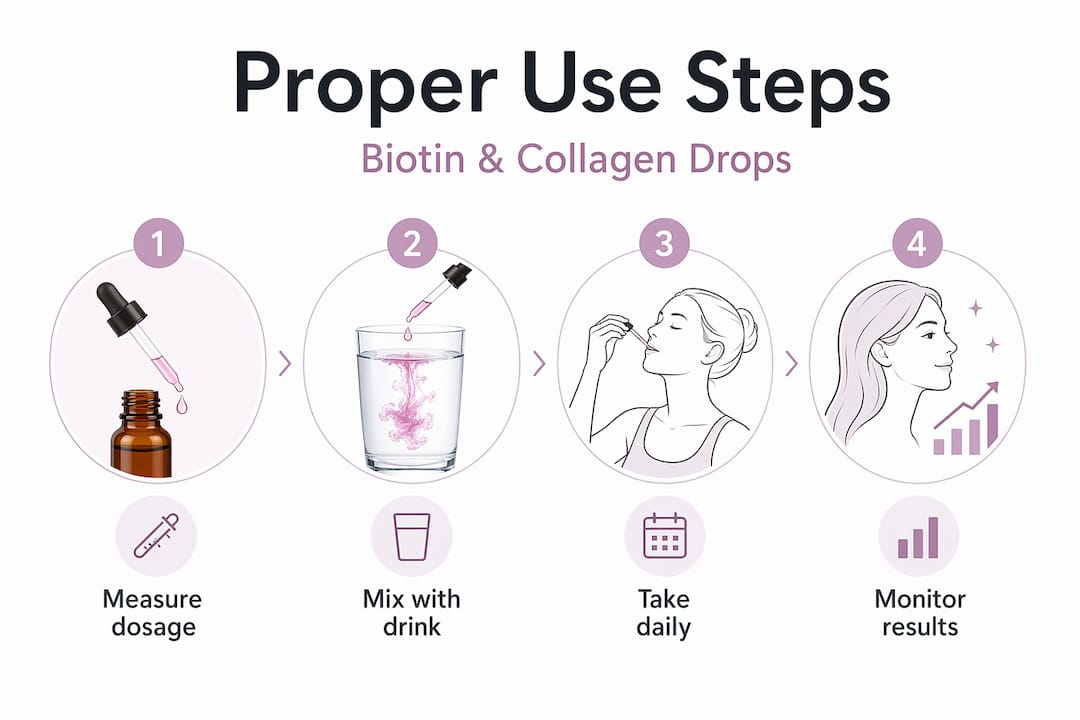
Step-by-step guide to using biotin and collagen drops
Here is a simple, repeatable process for making drops part of your daily routine. These biotin drops instructions apply broadly across most liquid supplement products.
-
Shake the bottle well before each use. Ingredients can settle, particularly in collagen products that contain peptides alongside other nutrients. A quick ten-second shake redistributes everything evenly.
-
Measure your dose carefully. Use the dropper that comes with the product. Place it under your tongue for sublingual absorption (common with biotin drops) or squeeze the drops directly into a drink.
-
Choose your vehicle. Collagen peptides dissolve well in coffee, tea, smoothies, and even porridge without affecting taste. Biotin drops mixed into water or juice work just as effectively as taking them neat.
-
Avoid taking on an empty stomach if you’re sensitive. Some people experience mild nausea from biotin drops when taken without food. Taking them alongside a light meal or snack removes this issue entirely.
-
Take your drops at the same time each day. Daily habit integration is the single biggest predictor of supplement success. Pairing your drops with an existing habit, such as your morning coffee or evening skincare routine, removes the need for willpower.
-
Refrigerate after opening. Many liquid collagen and biotin products should be refrigerated once opened to preserve potency and prevent bacterial growth. Check the label and follow the storage guidance.
-
Track your progress. Take a photo of your hair, skin, or nails on day one and at four-week intervals. Gradual improvements are easy to miss without a visual reference.
Pro Tip: Can you mix biotin and collagen in the same drink? Yes, in most cases. Unless your specific product advises otherwise, combining both drops in a glass of water or juice is perfectly fine and saves you from managing two separate routines.
A common mistake is stopping after two or three weeks because you haven’t noticed a change. Biotin and collagen work on a biological timeline, not an immediate one. Give it at least eight weeks before reassessing.
Monitoring results and troubleshooting issues
Knowing what to expect and when to expect it helps you stay the course without second-guessing yourself.
Realistic timelines for visible improvements:
- Skin hydration improvements may appear within four to six weeks for some people, though structural changes to collagen density typically take closer to twelve weeks.
- Hair thickness and reduced breakage are usually noticeable at the eight to twelve week mark when using collagen consistently.
- Nail changes are the slowest. Harder, less brittle nails may not show until after three to six months.
Signs supplementation may not be working for you:
- No change after twelve weeks of consistent daily use at the correct dose.
- Ongoing hair loss that is heavy or sudden. Hair loss is often driven by hormonal or genetic factors, not biotin deficiency, and drops will not address those underlying causes.
- Digestive discomfort that persists beyond the first week.
Side effects and safety:
Collagen is generally well tolerated, but individuals with kidney conditions, protein restrictions, or those who are pregnant should consult a healthcare provider before starting collagen supplementation, as the type and source of collagen matters in these situations.
Biotin’s most significant safety concern is its effect on laboratory tests. Biotin interferes with thyroid, cardiac, and hormone tests, potentially causing false results. If you have blood work scheduled, discontinue biotin 3 to 5 days before testing and let your GP or nurse know you have been taking it. This is not optional guidance. It is a genuine patient safety issue that is frequently overlooked.
For general wellness support and hormone balance that complements hair and skin health, consider looking at your broader lifestyle habits alongside supplementation.
My honest take on supplement consistency
I’ve observed a consistent pattern across all beauty supplement discussions: people obsess over which product to buy, what time of day to take it, and whether sublingual drops beat capsules. What they consistently underestimate is how often they actually take it.
Skipping doses slows progress significantly because collagen and biotin replenish gradually in the body. There is no catch-up mechanism. A missed day is simply a missed day. What I’ve found genuinely works is what the research on daily habit integration confirms: anchor your supplement to something you already do every single morning without thinking, and adherence stops being an issue.
I’m also sceptical of miracle claims. Biotin is effective when deficiency is the actual problem. For most adults eating reasonably well, it’s a modest contributor to hair and nail health, not a transformation catalyst. Collagen has stronger evidence behind it for skin hydration and elasticity, but again, it works slowly and alongside, not instead of, good nutrition, hydration, sleep, and sun protection.
What I’d always look for in any supplement is third-party testing. Products that publish their lab test results give you confidence that what’s on the label is what’s in the bottle. That applies as much to biotin and collagen as it does to any other supplement.
The bottom line: buy a quality product, take it every day, give it three months, and focus on the rest of your health at the same time. That’s genuinely it.
— Mike
Add Smokocbd to your wellness routine

If you’re building a daily routine around biotin and collagen drops, it’s worth considering what else supports your overall wellbeing from within. Smokocbd’s broad-spectrum CBD tinctures are designed with the same philosophy: natural, quality-tested, and simple to integrate into your existing habits. Many Smokocbd customers find that pairing CBD with their supplement routine helps them manage stress, sleep more consistently, and feel more balanced day-to-day, all of which are factors that genuinely influence skin condition and hair health. The Smokocbd 1000mg CBD mint tincture works easily alongside your morning drops routine, and for those who prefer a no-fuss option, the 750mg soft gel capsules slot neatly into any supplement schedule. All Smokocbd products are third-party lab tested with zero THC. You can also explore how to build a consistent daily routine with CBD and other wellness supplements on the Smokocbd blog.
FAQ
How many drops of biotin should I take per day?
Most biotin liquid supplements recommend 0.5 ml to 1 ml daily, equivalent to roughly 5 to 15 drops depending on the dropper. Always check your specific product label as concentrations vary widely between brands.
Can you mix biotin and collagen drops together?
Yes. In most cases, combining both drops into the same drink is safe and practical. Unless your product label advises otherwise, mixing them in water, juice, or a smoothie is a simple way to manage both in one step.
How long does it take to see results from collagen drops?
Skin and hair improvements typically appear after 8 to 12 weeks of consistent daily use. Nail hardness can take up to 24 weeks. Results depend heavily on maintaining your dose every day without significant gaps.
Do I need to refrigerate biotin and collagen drops after opening?
Many liquid supplements, particularly collagen drops, require refrigeration after opening to maintain potency and prevent deterioration. Check the storage instructions on your specific product before assuming room temperature storage is fine.
Does biotin affect blood test results?
Yes. Biotin can interfere with a range of clinical lab tests including thyroid and cardiac markers, potentially causing inaccurate readings. Stop taking biotin at least 3 to 5 days before any blood tests and inform your GP or healthcare provider that you have been supplementing.