TL;DR:
- Keeping a simple daily journal helps identify effective CBD routines through consistent tracking and small dose adjustments. Starting at 10-25 mg per day and holding for two weeks allows subtle effects to become noticeable, while recording specific data enhances reliability. Small, measured dose changes and careful monitoring ensure safe, gradual progress toward wellness goals.
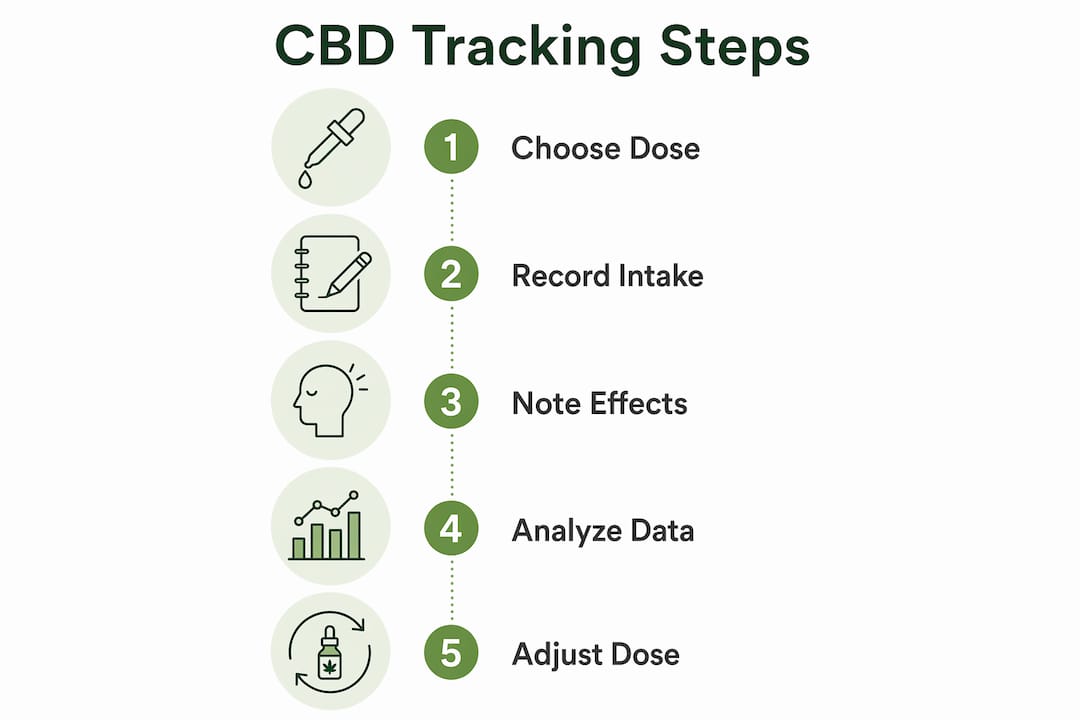
The most reliable way to find a working CBD routine is to keep a simple daily journal, start on a low dose (typically 10–25 mg per day is recommended as a starting window), hold it steady for two weeks before judging effectiveness, and only then adjust by 5–10 mg at a time. That single principle, applied consistently, turns a guessing game into something you can actually learn from.
Here is what to do right now:
- Pick your product and dose. Choose one format (tincture, capsule, or gummy) and set your starting dose at 10–25 mg per day.
- Set a fixed time. Morning, evening, or split — it does not matter which, as long as it stays the same every day.
- Open a journal. A phone note, a notebook, or a printed template all work equally well.
Pro Tip: Never change your dose, timing, and product format at the same time. Altering multiple variables at once makes it impossible to know which change produced any effect you notice. Change one thing, observe for at least two weeks, then consider the next adjustment.
The CBD daily effects diary approach works because it converts vague impressions into reliable evidence. Without notes, most people rely on memory alone, which is a poor tool for detecting gradual, cumulative changes.

Table of Contents
- How to choose a safe starting dose and calculate mg per serving
- How to set up a daily tracking plan that actually works
- How to read your data and make safe dose adjustments
- How method and timing change what you record
- Safety, side effects, and UK product-quality checks
- Key takeaways
- Why most people give up too early (and how not to)
- Smokocbd makes it easier to start with known strengths
- Useful sources and further reading
How to choose a safe starting dose and calculate mg per serving
The ‘start low, go slow’ principle
A common low starting dose is 10–25 mg per day, held steady for two weeks, which gives your endocannabinoid system time to respond without the risk of overshooting a dose that works. CBD does not produce an immediate, obvious effect for most people. The changes tend to be subtle: a slight easing of tension, a marginally better night’s sleep, a mood that feels a little more even. Starting low protects you from dismissing CBD too quickly because an unnecessarily high dose caused drowsiness or digestive discomfort.
Calculating mg per serving
The maths is straightforward once you know your product’s total CBD content and volume.
| Product format | Example | Calculation | Approx. mg per serving |
|---|---|---|---|
| Tincture (10 ml) | Smokocbd 1000 mg | 1000 mg ÷ 200 drops = 5 mg per drop | 5 mg per drop |
| Tincture (10 ml) | Smokocbd 2000 mg | 2000 mg ÷ 200 drops = 10 mg per drop | 10 mg per drop |
| Soft gel capsule | Smokocbd 750 mg (30 caps) | 750 mg ÷ 30 = 25 mg per capsule | 25 mg per capsule |
| Gummy bear | Varies by brand | Total mg ÷ number of gummies | Check packaging |
A standard 10 ml dropper holds roughly 200 drops, so dividing total milligrams by 200 gives you the per-drop value. For a 1000 mg tincture, that is 5 mg per drop; for a 2000 mg tincture, 10 mg per drop. Capsules and gummies are simpler because each unit contains a fixed amount.
In your journal, record the total daily milligrams rather than just “one dropper” or “two gummies.” That precision is what makes your entries comparable week on week.
Pro Tip: Taking CBD with food, particularly a meal containing healthy fats, can improve absorption. If you notice no effect after two weeks on an empty stomach, try taking your dose with breakfast or dinner before increasing the amount.
How to set up a daily tracking plan that actually works
What to record each day
Consistent daily notes convert subjective sensations into data you can act on. Each entry needs only a minute or two. Record:
- Date and time of dose
- Product name and format (tincture, capsule, gummy)
- Total mg taken (and whether split or single dose)
- Context (taken with food or fasted, before bed or on waking)
- Sleep quality (1–5 scale, or simply poor/fair/good)
- Mood (1–5 scale)
- Physical comfort or pain level (1–5 scale)
- Notable events (stressful day, poor sleep the night before, alcohol)
- Free-text notes (anything that does not fit the scales)
A sample journal entry
Date: Tuesday 14 January | Time: 07:30 Product: Smokocbd 1000 mg tincture (mint) | Dose: 4 drops = 20 mg Context: Taken with breakfast (porridge) Sleep: 3/5 | Mood: 3/5 | Physical comfort: 3/5 Notes: Slight tension in shoulders by afternoon. No drowsiness. Felt marginally calmer by evening but nothing dramatic.
That is all it needs to be. A 7-day trial diary shows that subtle cumulative changes across mood, sleep, and tension become visible only when you compare day 7 with day 1, not when you rely on how you feel in the moment.
How long to track before drawing conclusions
Hold the same dose for a minimum of two weeks (with 10–25 mg per day as a common starting range) before deciding whether it is working. A 14-day trial diary format is a practical, low-effort protocol: give the same dose twice daily and note observed signs. If patterns align by week two, CBD is likely contributing. Wellness tracking tools recommend daily logging for at least 2–3 weeks and a regular review to spot what is changing.
Pro Tip: Track at the same time each day, in the same environment where possible. Scoring your sleep at 7 AM before you check your phone gives a more consistent reading than scoring it mid-afternoon when the day has already coloured your memory.
How to read your data and make safe dose adjustments
Decision rules by week
By the end of week two, look at your scores. Are any of your 1–5 metrics trending upward, even slightly? If yes, hold the dose for another two weeks and keep recording. If scores are flat across all metrics and you have noticed nothing at all, a small increase is reasonable. By week four, you should have enough data to make a confident decision.
Increasing in steps of 5–10 mg is the standard guidance, with each new dose held steady for at least two weeks before any further change. Jumping by larger amounts makes it harder to find the minimum effective dose, which is the goal.
Decision table
| What your data shows | Action |
|---|---|
| Scores improving, even modestly | Hold current dose for another 2 weeks |
| Scores flat after 4 weeks | Increase by 5–10 mg; hold for 2 weeks |
| Improvement, but effects wear off by evening | Try splitting dose (morning + evening) |
| Drowsiness or digestive discomfort | Reduce dose by 5 mg or switch timing |
| No change after several weeks at a reasonable dose | Consider changing format or consult a GP |
| Any concerning symptom | Stop and seek medical advice promptly |
Pro Tip: When you increase your dose, note it clearly in your journal with a line or marker. That visual break makes it much easier to compare “before” and “after” periods when you review your data at the end of the month.
How method and timing change what you record
The format you choose directly affects when effects begin and how long they last, which in turn shapes what your journal entries should capture.
| Format | Typical onset | Typical duration | Tracking note |
|---|---|---|---|
| Sublingual oil (held under tongue 60–90 sec) | 15 minutes | 4 hours | Record effects within 1 hour of dose |
| Soft gel capsule | 45 minutes | 6 hours | Record at 2 hours and again at 6 hours |
| Gummy / edible | 30 minutes | 4 hours | Food in stomach affects onset; note meal timing |
| Topical (cream, balm) | 15 minutes (local) | 2–4 hours | Record localised comfort only; no systemic effect |
Sublingual oils are often the preferred starting format for tracking because the onset is relatively quick and the dose is adjustable drop by drop. Soft gel capsules offer a fixed, pre-measured dose, which removes calculation from the daily routine and suits people who prefer simplicity.
A few practical points on timing:
- Split dosing (morning and evening) can help maintain steadier cannabinoid levels throughout the day, particularly for sleep or sustained mood support.
- Taking CBD with food improves absorption; a fatty meal can increase bioavailability meaningfully.
- For sleep-related goals, an evening dose 1–2 hours before bed is a sensible starting point. Record sleep quality the following morning.
Understanding how long CBD effects last by format helps you time your journal entries correctly, so you are not scoring effects before they have had a chance to build.
Safety, side effects, and UK product-quality checks
Side effects to log
Most people tolerate CBD well, but mild side effects do occur and are worth recording in your journal rather than ignoring. Common ones include drowsiness, dry mouth, and mild digestive changes such as loose stools or reduced appetite. Log these alongside your wellness scores so you can see whether they ease as your body adjusts or persist at a given dose.
Red flags that warrant stopping and seeking medical advice include significant dizziness, marked changes in mood, or any symptom that feels out of the ordinary. The FSA’s guidance recommends that healthy adults limit their CBD consumption to a recommended safety threshold per day. If you are pregnant, breastfeeding, or have a liver condition, consult a doctor before starting.
Drug interactions: consult your GP or pharmacist
CBD is metabolised by the cytochrome P450 enzyme system in the liver, the same pathway used by many common medicines. This means CBD can affect how quickly certain drugs are broken down, potentially raising or lowering their levels in the blood. Anyone taking blood thinners (such as warfarin), antiepileptics, antidepressants, or immunosuppressants should speak to their GP or pharmacist before using CBD.
This is not a reason to avoid CBD, but it is a reason to have a brief conversation with a healthcare professional first. A pharmacist can check your current medicines against known interaction data in a few minutes. For a broader overview of safe daily dosing in the UK context, Smokocbd’s dosing guide covers the key thresholds.
UK product-quality checks
In the UK, CBD products sold as food supplements fall under FSA novel food regulations and must appear on the FSA’s validated products list to be legally sold. Before you start tracking, verify your product meets these standards:
| Quality check | What to look for |
|---|---|
| Third-party Certificate of Analysis (COA) | Lab report from an independent, accredited laboratory |
| THC content | Must be very low or zero, as with broad-spectrum products |
| CBD content accuracy | Lab result should match the label claim within a reasonable margin |
| FSA novel food status | Product or brand should appear on the FSA validated products list |
| Batch-specific testing | COA should reference the specific batch number on your product |
Smokocbd’s broad-spectrum products are third-party tested to verify zero THC, and COAs are available on product pages. Starting your tracking routine with a lab-verified product means your journal data reflects the CBD itself, not an unknown variable in the product’s composition.
This article is general information, not medical advice. Always confirm current regulations and your personal suitability with the FSA, MHRA, or a qualified healthcare professional.
Key takeaways
Tracking CBD daily effects works best when you commit to a fixed low dose in the 10–25 mg per day range, a consistent time, and a simple journal for a minimum of two weeks before drawing any conclusions.
| Point | Details |
|---|---|
| Start low | Begin at a dose of 10–25 mg per day and hold that dose for at least two weeks before judging effectiveness. |
| Change one variable at a time | Altering dose, timing, and format simultaneously makes it impossible to identify what is working. |
| Increase in small steps | If no effect after several weeks, raise the dose by a small amount and hold for another period before reassessing. |
| Consult a GP or pharmacist | Anyone on prescription medicines, especially blood thinners or antiepileptics, should check for interactions first. |
| Smokocbd for verified products | Smokocbd’s broad-spectrum tinctures and soft gels are third-party tested and available with batch-specific COAs. |
Why most people give up too early (and how not to)
The most common reason new users abandon CBD is not that it failed them. It is that they had no way to know whether it was working. Without a record, a subtle improvement in sleep quality over ten days is invisible. You feel roughly the same as you did last week, so you conclude nothing is happening. That conclusion is often wrong.
The goal of tracking is not to find a dramatic, immediate effect. Practitioners note that the aim is to identify a stabilising “sweet spot” dose for baseline wellness, not to chase an acute sensation. CBD is not that kind of compound. What you are looking for is a gradual, cumulative shift: a sleep score that moves from 2/5 to 3/5 over a fortnight, a tension level that is consistently lower by the third week. Those changes are real, but they are only visible in a record.
Habit formation matters here too. Anchoring your CBD dose and your journal entry to an existing routine, such as morning coffee or brushing your teeth at night, dramatically improves consistency. A single short note per day is all it takes. Long essays are not the point; consistent daily entries that take 60 seconds are. On a busy day, write three words: dose, time, and one score. That is enough to preserve the data thread.
Realistic expectations also reduce drop-out. A 7-day experiment typically reveals subtle cumulative changes rather than a single turning point. Week one is often unremarkable. Week two is where patterns begin to emerge. Knowing that in advance stops you from quitting on day five.
Smokocbd makes it easier to start with known strengths
Knowing your exact dose from day one is half the battle in any tracking routine. Smokocbd’s broad-spectrum CBD products are made in the UK, third-party tested for zero THC, and available in clearly labelled strengths so your journal entries are precise from the first drop.

For tincture users, the 1000 mg mint tincture delivers 5 mg per drop, making it straightforward to start at 20 mg (four drops) and increase in clean 5 mg steps. The 2000 mg tincture suits those who reach a higher maintenance dose without needing a large volume of oil. If you prefer a fixed, pre-measured format, the 750 mg soft gel capsules deliver 25 mg per capsule with no calculation required. Each product page includes the relevant COA and a dosing chart so you can cross-reference your journal entries against verified lab data. Browse the full range at smokocbd.com and order your starter product today.
Useful sources and further reading
The resources below are a mix of official UK regulatory guidance and educational posts from Smokocbd. The regulatory sources carry the highest authority for legal and safety questions; the Smokocbd posts expand on practical tracking and dosing topics covered in this guide.
Official and regulatory:
- FSA: Cannabidiol (CBD) business guidance — novel food status, validated products list, and the 70 mg daily limit for healthy adults
- GOV.UK: Drug licensing factsheet — cannabis, CBD and other cannabinoids — MHRA licensing context for CBD products in the UK
Research and clinical background:
- PMC: Cannabidiol as a potential treatment for anxiety disorders — peer-reviewed overview of CBD’s effects on anxiety
- PMC: An update on safety and side effects of cannabidiol — clinical summary of known side effects and tolerability
Smokocbd educational posts:
- CBD cumulative effects explained — how effects build over weeks of consistent use
- CBD dosage chart — worked examples for common product strengths
- How much CBD is too much? UK safety guide — UK-specific upper limits and safety thresholds