Five habits reliably restore a natural sleep cycle for most adults: morning bright light, a fixed wake time, daytime activity, consistent meal timing, and evening dimming with a proper wind-down routine. Research from Yale School of Medicine shows that light exposure is the strongest external cue for resetting your body clock, but it works best combined with regular meals and daytime movement, not alone.
Here’s a mini-plan you can start tonight:
- Get outside within an hour of waking, even on a cloudy day.
- Pick one wake time and hold it, weekends included.
- Dim lights and put screens away 60 minutes before bed.
Most people notice small improvements within days. A stable shift usually takes some weeks of consistent effort, according to Harvard Health.
Key Takeaways
A natural sleep cycle restores reliably when morning light, a fixed wake time, daytime activity, and evening dimming are applied together and held consistently for two to three weeks.
| Point | Details |
|---|---|
| Morning light first | Get outdoors within 30 to 60 minutes of waking to anchor your circadian clock. |
| Hold one wake time | Keep the same wake time daily, including weekends, to prevent drift. |
| Protect the evening window | Dim lights and screens an hour before bed; avoid alcohol and heavy late meals. |
| Give it two to three weeks | Expect early improvement within days, but a stable shift takes longer. |
| See a GP for red flags | Loud snoring, breathing pauses, or insomnia past three months need medical review. |
| Consider a tested tincture | Smokocbd’s broad-spectrum, zero-THC tincture can support the wind-down routine once anchors are in place. |
Table of Contents
- Why these natural sleep cycle restoration tips actually work
- Step-by-step habits to restore your sleep cycle
- Do supplements actually help restore a sleep cycle?
- How long does it take to reset your sleep, and when should you see a doctor?
- What makes this natural sleep cycle advice trustworthy?
- Frequently asked questions
- Sources
Why these natural sleep cycle restoration tips actually work
Your body runs on a master clock called the suprachiasmatic nucleus, sitting in the hypothalamus. It responds primarily to light hitting your eyes, using that signal to time the release of melatonin, the hormone that makes you feel sleepy. Morning light suppresses melatonin and raises cortisol, helping you feel alert; evening darkness lets melatonin rise again. Artificial light late at night confuses that signal and can delay sleep onset, according to NIH/NHLBI research on the sleep-wake cycle.
Sleep itself moves through cycles lasting about an hour and a half, alternating between non-REM stages and REM sleep. Deep non-REM sleep clusters earlier in the night and drives physical restoration, while REM, more common towards morning, supports memory and mood. A review in a major sleep and recovery journal confirms that regular schedules and light management improve the way these stages distribute across the night, not just how long you sleep overall.
That’s why:
- Morning light is treated as the primary anchor, not an afterthought.
- Consistency matters more than any single “perfect” night.
- Fragmented sleep undermines deep sleep even when total hours look fine.
Step-by-step habits to restore your sleep cycle
Rebuilding a natural sleep cycle works best as a daily sequence rather than a single evening ritual. Follow this order and give it two to three weeks before judging results.
- Get morning light within 30 to 60 minutes of waking. Ten to twenty minutes outdoors, even under cloud cover, works far better than a lamp indoors.
- Fix your wake time and defend it. Choose a time you can sustain seven days a week, including weekends. Yale’s guidance on circadian resets stresses that multimodal timing cues work better than isolated tips.
- Move your body during the day. A brisk walk, a gym session, or even gardening in daylight reinforces the wake signal your clock needs.
- Eat on a consistent schedule. Keep your last large meal two to three hours before bed; irregular eating times can blur the boundary between “day” and “night” for your metabolism.
- Cut caffeine by mid-afternoon. Caffeine’s half-life means a 3pm coffee can still be active in your system at 9pm.
- Cap naps at 20 minutes, before 3pm. Longer or later naps eat into the sleep pressure you need at bedtime.
- Dim lights and screens an hour before bed. Lower brightness, switch to warmer tones, and avoid scrolling in bed.
- Run a proper wind-down routine. Ten minutes of slow breathing, a short body scan, or light stretching signals to your nervous system that sleep is coming.
Your bedroom itself does a lot of the work. Keep it cool, ideally around 16 to 19°C, fully dark with blackout curtains if streetlight is an issue, and quiet, using white noise or earplugs if needed. Remove phones and tablets from the room entirely if you can. The Sleep Foundation’s guidance on healthy sleep habits lists environment control alongside routine and nap timing as the first-line self-help measures, and it’s the easiest one to fix in a single weekend.
If you’re still awake after some time, get up. Do something low-stimulation in dim light, reading a physical book, gentle stretching, then return only when you feel sleepy. Lying there frustrated teaches your brain to associate the bed with wakefulness, a pattern that Mayo Clinic’s sleep guidance specifically warns against.

A few things consistently undo this progress: a nightcap of alcohol, which fragments sleep and cuts REM even though it feels sedating at first; heavy meals eaten late; and vigorous exercise within two hours of bed, which raises core temperature and delays melatonin release.
Pro Tip: Pair your new wake time with a fixed morning action, like opening the curtains and making coffee in the same order every day. The routine itself becomes a cue, which matters more than willpower once the first week gets difficult.
Weekend lie-ins are the single biggest saboteur of a restored cycle. Shift workers face a tougher version of the same problem; the same five anchors still apply, just shifted to match your actual “night.” Social events that push bedtime late occasionally won’t undo weeks of consistency, but making them a habit will.
Do supplements actually help restore a sleep cycle?
Supplements can support the process, but they work as an adjunct, not a substitute for the anchors above. Melatonin is the most studied option for shifting sleep timing, and reviews of circadian research note it’s most effective when paired with consistent light exposure and wake times rather than used on its own. Typical over-the-counter doses run low, often 0.5 to 3mg taken a few hours before your target bedtime, though anyone on other medication or with an existing health condition should check with a GP or pharmacist first, particularly older adults, who metabolise melatonin more slowly.
Other natural options tend to support relaxation rather than shift your clock directly:
- Magnesium may ease physical tension before bed.
- Valerian root has mild sedative use in some traditional and modern preparations.
- Chamomile tea offers a low-risk wind-down ritual more than a pharmacological effect.
- Slow breathing or progressive muscle relaxation costs nothing and works the same night you try it.
Whichever product you choose, quality matters, and understanding the benefits of full spectrum gummies for anxiety and sleep can help you select effective options. Look for third-party lab testing and, for CBD products specifically, a verified zero-THC result, since potency and purity vary considerably between brands.
How long does it take to reset your sleep, and when should you see a doctor?
Most people notice lighter improvements, easier waking, fewer 3am stirs, within the first week of consistent anchors. A genuinely stable shift in your circadian rhythm typically takes two to three weeks, matching the timeframe Harvard Health associates with sleep hygiene changes becoming durable rather than temporary.
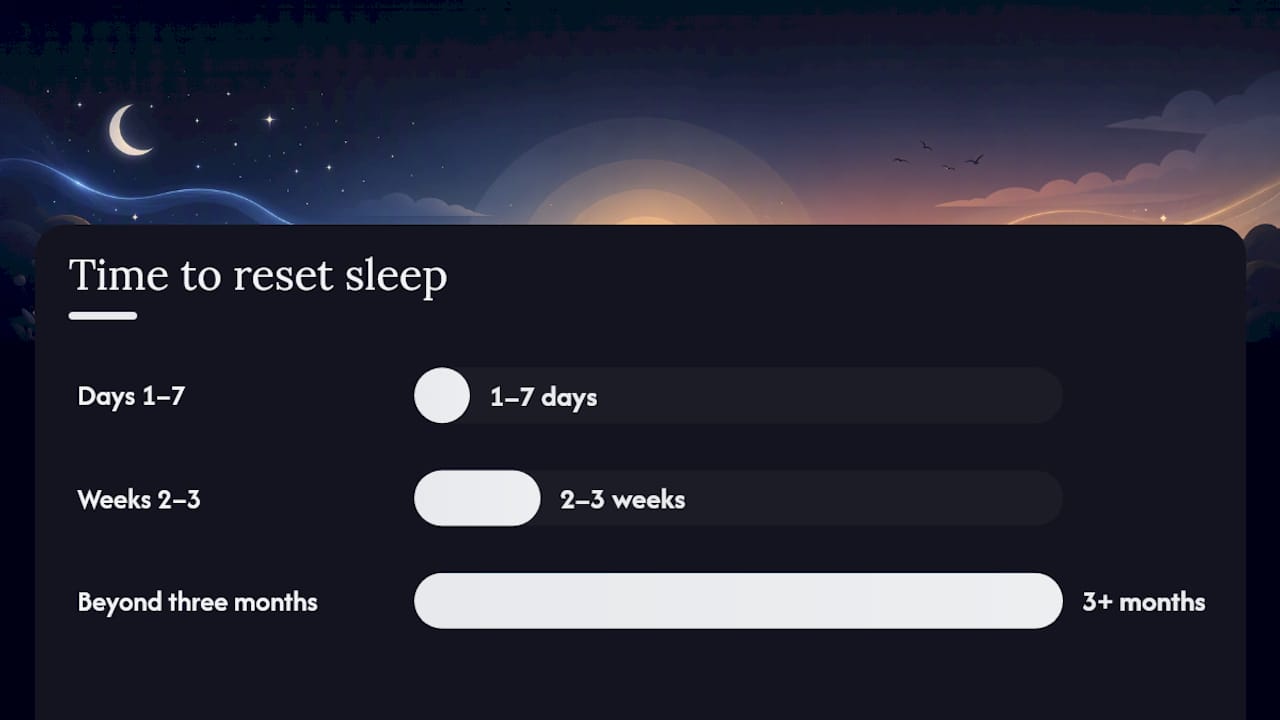
Days 1 to 7: expect variable results and some initial grogginess if you’re shifting your wake time. Weeks 2 to 3: sleep onset should shorten and night waking should ease if you’ve held the routine. Beyond three months, or sooner if red flags appear: it’s time to speak to a GP.
Watch for these warning signs:
- Ongoing daytime impairment despite consistent effort.
- Loud snoring, gasping, or witnessed pauses in breathing, possible signs of sleep apnoea.
- Insomnia lasting more than three months.
- Noticeable mood or cognitive decline alongside poor sleep.
Keep a two-week sleep diary, noting bed and wake times, naps, caffeine and alcohol, before your GP appointment; it makes referral for cognitive behavioural therapy for insomnia (CBT-i) or a sleep study far more targeted.
What makes this natural sleep cycle advice trustworthy?
This guidance rests on circadian science from Yale and Harvard, not anecdote. Where CBD is mentioned, Smokocbd’s own tinctures, gummies, and soft gels are made with organically grown hemp and independently lab-tested to confirm zero THC, a baseline worth checking with any CBD brand you consider.
- Third-party lab testing verifies potency and confirms zero THC.
- UK-based e-commerce with a full product range: tinctures, soft gels, gummies.
- Educational content explaining how to use CBD in a sleep routine rather than as a one-off fix.
Pro Tip: If you try a CBD tincture, take it at the same point in your wind-down routine each night. Consistency in timing matters as much for a supplement as it does for your wake time.
A realistic view on staying consistent
Habit change rarely goes in a straight line. You’ll oversleep, skip the morning walk, or cave to a late coffee, and that’s normal, not failure. Treat the first three weeks as an experiment with milestones rather than a test you can fail. Anchoring your new wake time to a fixed daily cue, and telling a partner or friend what you’re doing, makes the awkward first week far easier to survive.
A quality tincture can support your wind-down, once the basics are in place
Behavioural anchors do the heavy lifting here; a supplement only earns its place once light, timing, and routine are already working. For readers who want a natural option to fold into that evening wind-down, the SMOKO CBD Mint 2000mg Broad Spectrum Tincture is broad-spectrum, third-party lab tested, and confirmed zero THC, with clear dosing guidance so you’re not guessing how many drops to use.
Unlike picking a random bottle off a shelf, you get a documented lab result behind every batch. Add it to the same ten-minute wind-down slot each night, alongside dimmed lights and slower breathing, rather than reaching for it only on bad nights. If you’d like to see how it fits into a full evening routine first, the step-by-step CBD sleep routine guide walks through timing and dosage in more detail. Either way, the tincture page has full lab results and dosing information if you’re ready to try it tonight.
Frequently asked questions
How long does it take to restore a natural sleep cycle? Most people notice small improvements within a week; a stable shift typically takes two to three weeks of consistent light exposure, fixed wake times, and evening dimming.
What is the fastest natural way to reset my sleep schedule?
Can melatonin alone fix a disrupted sleep cycle? Melatonin can help shift sleep onset, but reviews suggest it works best alongside behavioural anchors like consistent light and wake times, not as a standalone fix.
When should I see a doctor about ongoing sleep problems? See a GP if insomnia lasts beyond three months, or if you notice loud snoring, breathing pauses, or daytime impairment that doesn’t improve with consistent sleep hygiene.
Does CBD help with sleep cycle restoration? CBD may support relaxation as part of an evening wind-down routine, but it works as a supportive aid alongside light and schedule anchors, not a replacement for them.
Sources
- How To Reset Your Circadian Rhythm | Yale School of Medicine
- Exploring the Role of Circadian Rhythms in Sleep and Recovery: A Review Article - PMC
- Sleep hygiene: Simple practices for better rest - Harvard Health
- How to Sleep Better - Sleep Foundation
- Sleep-wake cycle - NHLBI/NIH