TL;DR:
- Cannabigerol (CBG) is a non-intoxicating cannabinoid with strong preclinical evidence for reducing inflammation associated with chronic pain. Its primary mechanism involves anti-inflammatory pathways targeting CB2, TRP, and PPARγ receptors, which may alleviate inflammatory conditions like arthritis. Human clinical data is limited, and more dedicated trials are needed to confirm its efficacy and safety for pain management.
Cannabigerol (CBG) is a non-intoxicating cannabinoid with documented preclinical evidence of reducing inflammation, making it one of the more compelling natural options for adults managing chronic pain. Unlike THC, CBG does not produce a psychoactive effect. Unlike CBD, it targets a distinct set of receptors, including CB2, TRP channels, and PPARγ, giving it a unique pharmacological profile. The interest in CBG pain relief has grown sharply as more people seek alternatives to long-term NSAID or opioid use, and early research suggests the mechanism is real, even if the clinical picture is still developing.
How does CBG relieve pain? Mechanisms and evidence
CBG’s pain-relieving potential is not a direct analgesic effect in the way that morphine or ibuprofen works. Its primary route is anti-inflammatory, and that distinction matters enormously for understanding what CBG can and cannot do.

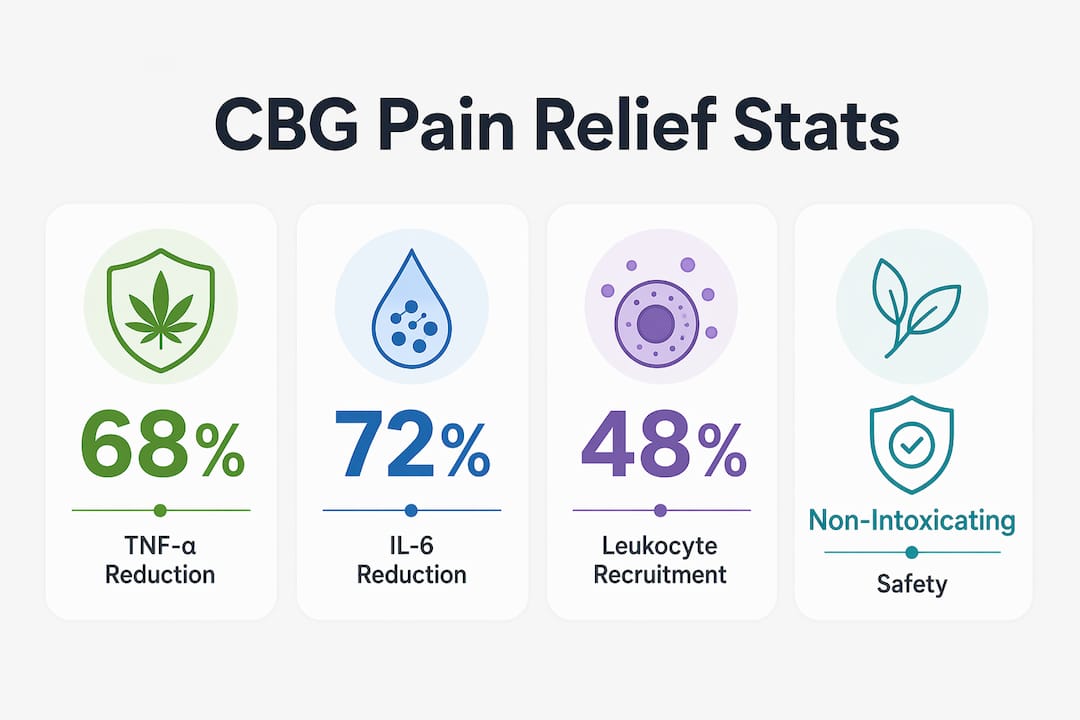
Preclinical research shows that CBG reduces TNF-α by 68% and IL-6 by 72% in human neutrophils. TNF-α and IL-6 are two of the most destructive pro-inflammatory cytokines involved in conditions like rheumatoid arthritis and fibromyalgia, so reducing them meaningfully could translate to less joint swelling, less tissue damage, and ultimately less pain.
The same research found that CBG reduced leukocyte recruitment to inflamed joints by 48% and inflammatory cytokine levels by up to 98% in a preclinical rheumatoid arthritis model. That is a striking figure, and it points to CBG acting as a broad modulator of the inflammatory cascade rather than a single-target drug.
CBG achieves this through several receptor pathways:
- CB2 receptors: Found primarily in immune tissue, CB2 activation tones down immune overactivation without the psychoactive effects associated with CB1 (the receptor THC targets).
- TRP channels: These ion channels are involved in pain and temperature sensation. CBG’s interaction here may reduce the intensity of pain signals reaching the brain.
- PPARγ: A nuclear receptor that regulates genes controlling inflammation. CBG’s activation of PPARγ suppresses the NF-κB and MAPK signalling pathways, both of which drive chronic inflammatory states.
The key insight from this mechanistic picture is that CBG’s anti-inflammatory action is largely mediated through neutrophil signalling modulation. Pain relief follows from reduced inflammation, not from CBG directly blocking pain receptors.
Pro Tip: If you are considering CBG for inflammatory pain conditions such as arthritis or fibromyalgia, the preclinical evidence is more relevant to your situation than for neuropathic or injury-related pain, where the mechanism is less well understood.
What does clinical research say about CBG for chronic pain?
The honest answer is that human clinical data on CBG for chronic pain is still limited, and it is worth being clear about what the current evidence does and does not show.
A 12-week real-world study involving 164 adults using cannabinoid capsules that included CBG reported meaningful improvements in pain intensity, sleep quality, and mood across conditions including fibromyalgia, rheumatoid arthritis, and osteoarthritis. That is encouraging. However, the capsules contained multiple cannabinoids, so attributing the benefit specifically to CBG is not possible from this data alone.
A separate real-world evidence study covering the same three chronic pain categories found similar positive associations with cannabinoid formulations including CBG over 12 weeks. Again, the CBG doses were small and embedded within multi-cannabinoid products, which limits any isolated conclusion about CBG’s contribution.
The most controlled human data available comes from a different angle entirely. A placebo-controlled study found that 20 mg of CBG reduced anxiety in healthy adults without causing intoxication. This confirms CBG is safe and non-psychoactive at therapeutic doses, but it does not confirm analgesic efficacy in chronic pain populations. The research gap is real.
Here is what the current clinical picture means in practical terms:
- Combination products show promise. Adults using multi-cannabinoid formulations that include CBG report better pain outcomes than baseline, but isolating CBG’s specific contribution requires dedicated trials.
- Pure CBG trials for pain do not yet exist. No large, controlled study has tested CBG alone against a placebo for chronic pain. This is the most significant gap in the evidence base.
- Safety data is reassuring but incomplete. CBG appears well-tolerated in short-term studies, but long-term safety evaluation for extended use, particularly alongside prescription medications, is not yet fully established.
- Dose-ranging studies are needed. Nobody currently knows the optimal dose of CBG for pain management in humans. The 20 mg used in the anxiety trial is a starting reference point, not a clinical recommendation.
Pro Tip: When reading about CBG for chronic pain, check whether the study used pure CBG or a combination product. Most positive human outcomes come from multi-cannabinoid formulations, which makes it difficult to credit CBG alone.
CBG vs CBD for pain: how do they compare?
Understanding where CBG sits relative to CBD and THC helps you make a more informed choice about natural pain management. You can read more about CBD for pain relief and the evidence behind it, but here is a direct comparison of the three main cannabinoids discussed in pain research.
| Cannabinoid | Mechanism for pain | Psychoactive? | Clinical evidence for pain | Best suited for |
|---|---|---|---|---|
| CBG | Anti-inflammatory via CB2, TRP, PPARγ | No | Preclinical strong; human data limited | Inflammatory pain conditions |
| CBD | Anti-inflammatory, endocannabinoid modulation | No | Stronger human evidence base | Broad pain and anxiety |
| THC | Direct analgesic via CB1 receptors | Yes | Established but limited by side effects | Severe or neuropathic pain |
CBD currently has the better-established human evidence base for pain and inflammation. Studies on CBD for conditions like multiple sclerosis-related spasticity and neuropathic pain are more numerous and more controlled than anything available for CBG. That does not make CBG inferior, but it does mean CBG is at an earlier stage of clinical validation.
THC delivers direct analgesic effects through CB1 receptor activation, which is why it remains effective for severe pain. The trade-off is its psychoactive profile, which makes it unsuitable for many people, particularly those who need to remain alert during the day or who are sensitive to its effects. You can explore what non-intoxicating cannabinoids mean in practice and how they differ from THC-containing formulations.
CBG’s advantage is its distinct receptor targets. Where CBD primarily modulates the endocannabinoid system indirectly, CBG acts more directly on CB2 and TRP channels. This means the two cannabinoids may work better together than either does alone, which is the rationale behind broad-spectrum formulations that include both. For adults with inflammatory pain conditions, a full spectrum CBG product combining multiple cannabinoids may offer more than a single-cannabinoid approach.
What should adults consider before using CBG for pain?
Practical decisions about CBG products require more than reading the label. The format you choose, the medications you take, and the quality of the product all affect both safety and outcome.
Choosing the right format
- Oral tinctures and capsules offer consistent dosing and are the most studied formats. Capsules in particular are convenient for daily use in chronic pain management.
- Topical CBG products are marketed for localised pain relief, but topical application can still result in plasma detection, meaning systemic absorption occurs even when you apply it to the skin. This affects both efficacy expectations and potential interactions.
- Inhaled formats deliver cannabinoids quickly but are not recommended for adults with respiratory conditions or those seeking long-term pain management.
Drug interactions and safety
CBG is metabolised through the liver’s CYP enzyme pathways, the same system that processes many common prescription medications including blood thinners, antidepressants, and statins. Non-intoxicating cannabinoids do not guarantee the absence of drug interactions, and combining CBG with existing prescriptions without medical advice carries real risk. You can find a detailed overview of CBD drug interactions that applies equally to CBG.
Selecting quality products
- Look for products with third-party lab testing that confirms cannabinoid content and the absence of contaminants.
- Check whether the product is broad-spectrum (containing multiple cannabinoids including CBG) or a CBG isolate.
- Be cautious of label claims that promise specific pain outcomes. Regulatory standards for cannabinoid health claims in the UK require careful wording, and overstated claims are a red flag for product quality.
Pro Tip: Always inform your GP or pharmacist before adding CBG to your routine, particularly if you take any prescription medication. The interaction risk is real even though CBG does not make you feel intoxicated.
Key takeaways
CBG relieves pain primarily through anti-inflammatory mechanisms, targeting CB2 receptors, TRP channels, and PPARγ, with strong preclinical evidence but limited human clinical trials for chronic pain specifically.
| Point | Details |
|---|---|
| CBG works via inflammation | Pain relief comes from reducing cytokines like TNF-α and IL-6, not from direct analgesic receptor action. |
| Human evidence is promising but early | A 12-week study with 164 adults showed improved pain outcomes, but CBG was used in multi-cannabinoid formulations. |
| CBG differs meaningfully from CBD and THC | CBG targets CB2 and TRP channels directly; CBD works more indirectly; THC is psychoactive with stronger analgesic data. |
| Drug interactions are a real concern | CBG is metabolised via CYP liver enzymes and may interact with common prescriptions despite being non-intoxicating. |
| Product format affects absorption | Topical CBG can still enter the bloodstream, so systemic effects and interactions apply regardless of application method. |
Why I think CBG deserves more attention, and more caution
I have watched the conversation around cannabinoids for pain shift considerably over the past few years. CBG has gone from an obscure minor cannabinoid to a headline ingredient in a short time, and that speed brings both opportunity and risk.
The preclinical data on CBG is genuinely impressive. A 68% reduction in TNF-α and a 48% reduction in leukocyte recruitment to inflamed joints are not trivial numbers. If those effects translate meaningfully to humans, CBG could become a serious tool for managing inflammatory pain conditions. The problem is that we are not there yet, and I think it is important to say that plainly rather than let enthusiasm outrun the evidence.
What concerns me most is the tendency to treat CBG as interchangeable with CBD or as a natural version of a painkiller. It is neither. Its mechanism is specific, its clinical validation is incomplete, and its interactions with prescription drugs are underappreciated. Adults who are already managing chronic conditions with medication need to approach CBG with the same care they would give any new substance entering their routine.
That said, I am genuinely optimistic about where this research is heading. The combination product data from 2026 is encouraging, and the first placebo-controlled human trial on CBG, even though it focused on anxiety, confirmed safety and tolerability. The next step is dedicated pain trials with dose-ranging data, and those cannot come soon enough. In the meantime, broad-spectrum products that include CBG alongside CBD offer the most evidence-supported route for adults who want to explore cannabinoids for pain relief, provided they do so with professional guidance and realistic expectations.
— Mike
Explore Smokocbd’s broad-spectrum products for natural relief
If you are considering cannabinoids as part of your pain management approach, Smokocbd offers a range of high-quality, broad-spectrum products made from organically grown hemp and verified by third-party lab testing.
The 1000mg CBD tincture delivers a consistent daily dose in a convenient mint-flavoured oil, ideal for those who prefer a straightforward routine. For something more discreet, the broad-spectrum soft gel capsules provide 750mg per pack with zero THC, making them a practical choice for managing daily discomfort. All Smokocbd products are available for UK delivery and are designed for adults who want a natural, evidence-informed approach to wellness.
FAQ
What is CBG and how does it differ from CBD?
CBG (cannabigerol) is a non-intoxicating cannabinoid that targets CB2 receptors, TRP channels, and PPARγ directly, whereas CBD works more indirectly through the endocannabinoid system. Both are non-psychoactive, but their receptor profiles and mechanisms differ meaningfully.
Is there clinical proof that CBG works for chronic pain?
No large controlled trial has tested pure CBG against a placebo for chronic pain. A 12-week real-world study with 164 adults using multi-cannabinoid formulations including CBG showed improved pain outcomes, but isolating CBG’s specific contribution is not yet possible from available data.
Can CBG interact with prescription medications?
Yes. CBG is metabolised via the liver’s CYP enzyme pathways, which also process many common prescription drugs. Non-intoxicating cannabinoids can still cause clinically relevant drug interactions, so consulting a GP or pharmacist before use is strongly advised.
What type of CBG product is best for pain relief?
Oral formats such as tinctures and capsules offer the most consistent dosing and are the most studied. Topical products may still result in systemic absorption, so they are not purely localised in effect. Broad-spectrum products combining CBG with CBD are currently the most evidence-supported option.
Is CBG safe to use long-term?
Short-term studies indicate CBG is well-tolerated and non-intoxicating, but long-term safety data in humans is not yet fully established. Adults with existing health conditions or those taking prescription medications should seek professional advice before committing to extended use.