Most adults do best starting at 5 to 20 mg of CBD once or twice daily, then adjusting in small steps every few days until anxiety eases without unwanted grogginess. Clinical trials testing genuine anxiolytic effects use far higher single doses, often 300 to 600 mg, but those are supervised research protocols, not a template for home use. Check your medications first, and give any regimen several weeks before judging it.
TL;DR:
- Starting CBD at 5 to 10 mg daily and increasing by small increments every few days is recommended to find an effective, personalized dose for anxiety.
- Clinical research shows the strongest anxiolytic effects at doses around 300 mg, with effects diminishing at higher doses due to the inverted U-shaped dose response.
- Most consumer products list total CBD content per bottle, but precise dosing requires converting this to milligrams per drop or capsule, with oils offering better control during titration.
- Individuals on medication or with severe health conditions should consult a healthcare professional before increasing doses beyond 50 mg daily or using high-strength CBD products.
- Tracking daily doses, anxiety levels, side effects, and other factors over at least two weeks is essential to confidently identify the optimal dose and avoid overshooting the therapeutic window.
Table of Contents
- Finding your CBD strength for anxiety: the starting dose and titration plan
- What the research actually shows about effective CBD dosage for anxiety
- Reading the label: converting CBD strength into an actual dose
- Safety, side effects, and drug interactions to check before you start
- Three worked plans and a tracking template you can copy
- What I’d tell a friend starting CBD for anxiety
- Editorial take: why the conventional CBD dosing advice falls short
- Why the SMOKO CBD Mint tincture suits a titration plan
- Sources
Finding your CBD strength for anxiety: the starting dose and titration plan
Working out the right CBD strength for anxiety is less about hitting a magic number and more about a process. Your endocannabinoid system doesn’t respond the same way to CBD as your neighbour’s does, so the sensible move is to start low, watch closely, and nudge upward only when you have evidence it’s needed.
Here’s the practical sequence:
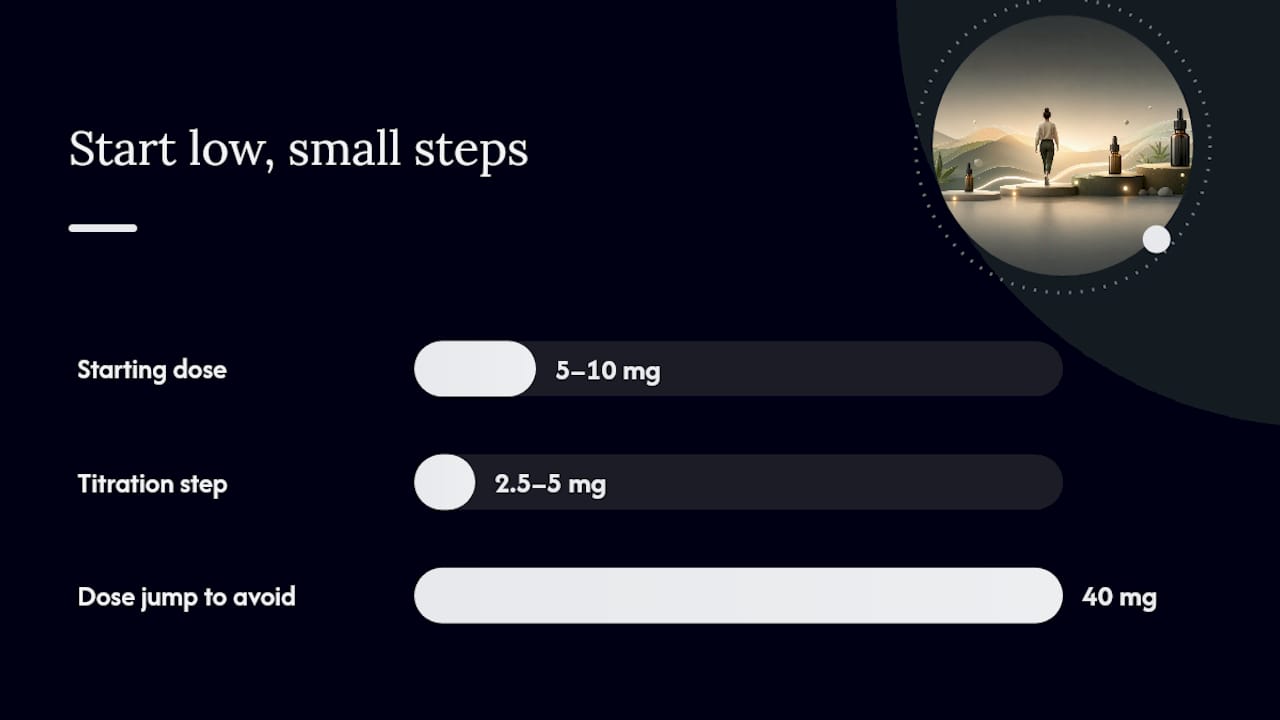
- Start at 5 to 10 mg once daily, ideally with food, and stay there for three to five days. This gives you a genuine baseline reading of how your body responds before any changes muddy the picture.
- Increase in 2.5 to 5 mg steps every three to seven days if you’re not noticing meaningful calm. Small increments matter here. Jumping from 10 mg to 40 mg skips the very range where many people find their effective dose.
- Log everything you notice, not just anxiety levels, but sleep quality, appetite, and mood, so patterns become visible rather than guessed at.
- Hold steady once you notice a benefit. Resist the urge to keep climbing “just in case” a higher dose works better; the evidence below explains exactly why that instinct can backfire.
A few format notes worth bearing in mind as you titrate:
- Oils and tinctures allow the finest control because you can adjust by the drop, making them the natural choice during the early titration phase.
- Capsules and gummies suit the maintenance phase once you know your effective dose, since each unit delivers a fixed, predictable amount.
- Sublingual absorption (holding oil under the tongue for 60 to 90 seconds) tends to act faster than swallowing a capsule, which passes through digestion first.
Watch for grogginess, dry mouth, or digestive upset as signs to pause and hold your current dose rather than pushing higher. If anxiety worsens, or you notice unusual heart rate changes, stop and speak to a GP or pharmacist before restarting.
Pro Tip: Take your CBD at the same time each day and keep a two-minute note on your phone rather than a separate journal. Titration plans fail more often from inconsistent tracking than from choosing the wrong starting dose.
What the research actually shows about effective CBD dosage for anxiety
The clinical picture is more nuanced than “more CBD equals more calm,” and understanding why changes how you should approach your own dosing.
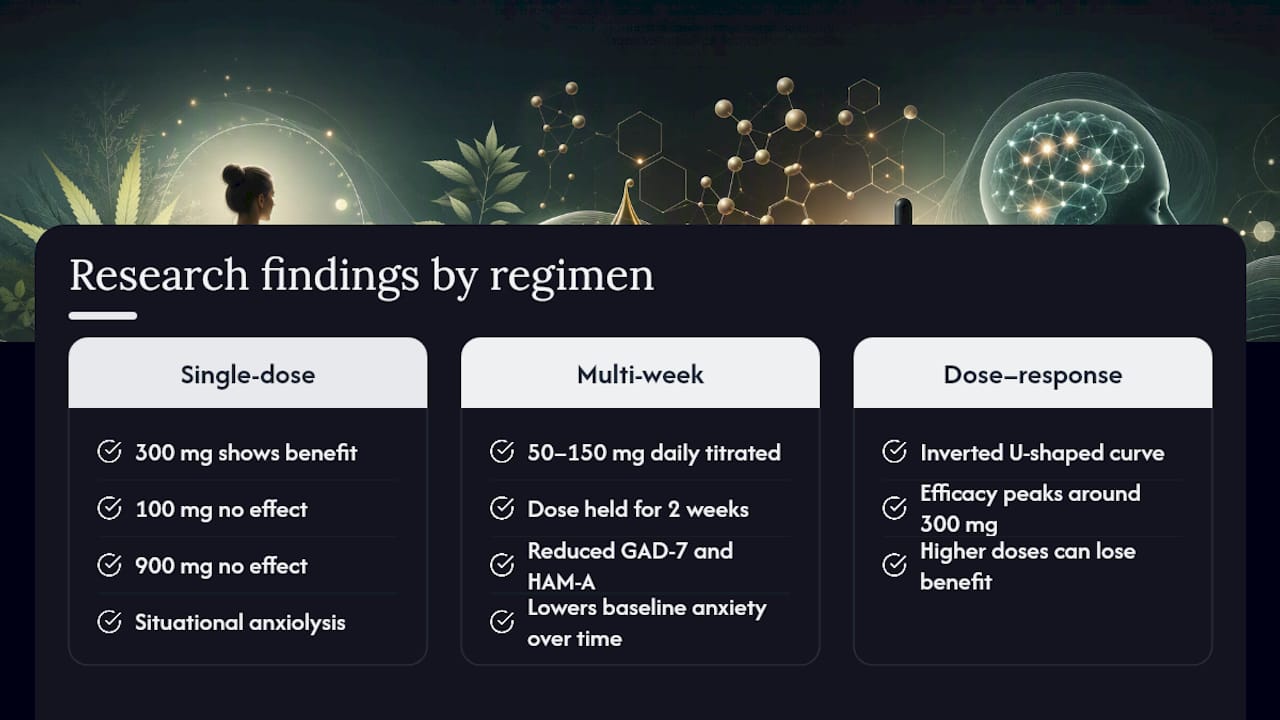
Systematic reviews of human trials report the most consistent anxiolytic signals at single doses around 300 mg, with several studies finding benefit across a 300 to 600 mg range. That’s a dose most people would never reach through a consumer product taken sensibly, and it’s worth sitting with that gap for a moment.
Key data point: A controlled trial giving participants 100 mg, 300 mg, or 900 mg of CBD before a public speaking test found anxiolytic effects only at 300 mg, the lowest and highest doses showed no meaningful benefit.
That result describes an inverted U-shaped dose–response curve, where efficacy rises with dose up to a point, then falls away again at higher amounts. It’s a pattern well documented in the same research, and it directly undercuts the assumption that a stronger tincture or a higher-strength capsule will always work better. Overshoot the sweet spot and you may lose the benefit you had at a lower dose, not just fail to gain more.
Separately, ongoing trial work is testing something closer to real-world use: a registered study is titrating 50 to 150 mg daily over two weeks, then holding that dose for a further two weeks to measure sustained effect. This distinction matters practically. Acute high-dose studies (300mg+) are testing situational anxiolysis, the kind of dose you might take before a single stressful event, while multi-week regimens test whether a lower daily dose can lower baseline anxiety over time. A separate randomised trial using a nanodispersible CBD oral solution found statistically significant reductions in both GAD-7 and HAM-A anxiety scores over a multi-week treatment period, reinforcing that consistency over weeks can matter more than the size of any single dose.
The practical takeaway: don’t chase the study doses used in acute research. Use them to understand that CBD has genuine anxiolytic potential at the right amount, then find your own sweet spot through careful titration rather than by matching a clinical trial’s headline number.
Reading the label: converting CBD strength into an actual dose
Product labels list total milligrams per bottle, not per drop or serving, and that gap causes more dosing confusion than almost anything else in this category.
Here’s the conversion, step by step:
- Find the total CBD content and bottle size. A tincture labelled 2000 mg in a 10 ml bottle, such as the SMOKO CBD Mint 2000mg tincture, gives you the two numbers you need.
- Divide total mg by bottle volume to get mg per ml. In this example: 2000 mg ÷ 10 ml = 200 mg per ml.
- Divide mg per ml by drops per ml (most droppers deliver roughly 20 drops per ml, though this varies slightly by dropper design) to reach mg per drop. That’s 200 mg ÷ 20 = 10 mg per drop.
- Match drops to your titration step. A single drop of a 2000 mg/10 ml tincture already delivers a full starting dose, which makes fine control genuinely achievable rather than theoretical.
This is exactly why concentration matters as much as total strength when you’re choosing a product. A weaker oil at the same bottle size forces you to take several millilitres to reach an effective dose, which is clumsy and inconsistent. A higher-concentration oil like the 2000 mg option lets you move in small, accurate drop-based increments, which suits the titration approach described earlier far better than guessing with a dropper full of a diluted product.
Capsules and gummies remove the maths entirely once you know your number, each one is a fixed dose, which suits people who’ve already found their effective strength and want consistency without measuring. Oils remain the better tool during the finding phase, when small, repeatable adjustments are what actually let you locate your personal sweet spot.
Safety, side effects, and drug interactions to check before you start
CBD is generally well tolerated across a wide dose range in short-term studies, even up to levels far above typical consumer use, but “well tolerated” doesn’t mean risk-free, and a few groups need to check with a clinician before starting.
Common side effects to watch for include:
- Dry mouth
- Mild drowsiness or fatigue
- Changes in appetite
- Digestive upset, particularly at higher doses
- Rare reports of liver enzyme changes, which is why anyone on long-term medication should have this checked
CBD is metabolised through the liver’s CYP450 enzyme pathway, the same route many prescription medications use, which means it can raise or lower their effective levels in your blood. This matters most for three drug classes:
- Antidepressants and anxiety medications, including SSRIs, where interaction risk is directly relevant to the person this article is written for.
- Anticoagulants such as warfarin, where CBD can alter blood-thinning effects.
- Antiepileptic drugs, where interactions are well documented in clinical literature.
Anyone taking medication in these categories should check for interactions with a GP or pharmacist before adding CBD, not after starting. The NHS’s own guidance is candid that evidence remains limited and consistently points patients toward that conversation rather than self-directed use.
Pregnant or breastfeeding women, anyone with severe liver disease, and under-18s should avoid CBD without direct medical supervision. And when choosing a product at all, lab-tested, zero-THC verification isn’t a marketing flourish, it’s the only way to know what you’re actually titrating. UK guidance from the Food Standards Agency treats accurate labelling and third-party testing as a baseline expectation, not a bonus feature.
Pro Tip: Photograph your product’s lab certificate (often called a Certificate of Analysis) before you open the bottle. If you ever need to discuss dosing with a clinician, having the exact cannabinoid breakdown to hand speeds up that conversation considerably.
Three worked plans and a tracking template you can copy
Real dosing plans look different depending on how cautious you want to be and whether a clinician is involved.
- The starter plan. Begin at 5 mg once daily for five days. If no effect, move to 10 mg for another five days. Run this phase for two to three weeks minimum before deciding whether it’s working, single-day judgements are unreliable.
- The moderate plan. For those with more persistent daily anxiety, start at 10 mg twice daily, increasing by 5 mg per dose every week, capping around 40 to 50 mg daily unless a clinician advises otherwise. Give this four to six weeks before a full assessment.
- The clinician-guided plan. Anyone considering doses beyond 50 mg daily, or anyone on interacting medication, should map out titration with a GP, mirroring the structured approach used in registered clinical titration trials.
A simple tracking log makes any of these plans far easier to judge honestly. Record, each day:
- Date and time of dose
- Dose taken (mg)
- Anxiety rating before, on a simple 1 to 10 scale
- Anxiety rating two to three hours after
- Any side effects noted
- General notes (sleep, stress events, other factors)
Reviewing two weeks of this log tells you more than any single day’s reaction ever could.
What I’d tell a friend starting CBD for anxiety
Mike here. If someone I knew was starting this process, I’d tell them the single biggest mistake is treating higher strength as automatically better. The inverted U-shaped curve isn’t a footnote, it’s the whole reason a careful titration plan beats guesswork. I’d also be upfront that consumer guidance, including this article, has real limits: it can’t replace a GP conversation if you’re on medication or dealing with severe anxiety.
What I can point to with confidence is what sits behind a product like SMOKO CBD’s tinctures: third-party lab testing verifying zero THC, and customer support available if you’re unsure how a specific bottle translates into your daily dose.
Start smaller than feels necessary, track properly, and treat the first month as data collection, not a verdict.
— Mike
Editorial take: why the conventional CBD dosing advice falls short
Most generic dosing charts you’ll find online repeat the same flawed logic, more anxiety means more milligrams, as though CBD works like paracetamol. The research doesn’t support that. The 300 mg peak with no benefit at 900 mg should be the headline of every dosing guide, yet it rarely gets mentioned outside the studies themselves.
The bigger gap in conventional advice is timeframe. Most guidance treats CBD as an instant intervention, take it, feel calmer within the hour. Multi-week trial data tells a different story, where sustained daily dosing at moderate levels outperforms single acute doses for ongoing anxiety. If I had to name one priority for readers, it’s this: judge your regimen after weeks, not doses. Everything else, the exact starting mg, the format, the brand, matters less than giving your chosen strength a fair, patient trial.
Why the SMOKO CBD Mint tincture suits a titration plan
A tincture only helps your titration plan if you can actually control the dose, and that’s where concentration does the real work. SMOKO CBD’s 2000 mg mint tincture delivers roughly 10 mg per drop, which means a single drop already sits inside the sensible starter range covered earlier, no diluted oil, no guessing with a full dropper to reach an effective amount.
Every batch carries third-party lab testing confirming zero THC, so you’re titrating a known quantity rather than hoping the label matches the bottle. If you’re ready to put the starting dose and titration steps from this guide into practice, the SMOKO CBD Mint 2000mg tincture gives you the precision to do it properly, and support is available if you want help mapping out your own plan before you order.
Sources
For anyone who wants to verify the claims above directly, these are worth your time:
- Evaluation of the efficacy, safety, and pharmacokinetics of nanodispersible cannabidiol oral solution (150 mg/mL) versus placebo in mild to moderate anxiety subjects
- Inverted U-shaped dose-response curve of the anxiolytic effect of cannabidiol
- Systematic review summarising clinical studies of CBD dosing and effects
- Clinicaltrials
- Cannabidiol (CBD) — Food Standards Agency guidance
Discuss any regimen change with a GP or pharmacist, particularly if you take other medication.
This article is general information, not a substitute for advice from a qualified doctor. Consult a qualified healthcare professional about your own circumstances before acting on anything here.