Clinical trials show CBD can lower blood pressure in specific settings, most clearly with a single high dose and during moments of stress, but it isn’t an approved treatment for hypertension. The strongest evidence comes from a 600 mg single-dose study; the biggest caveat is how CBD interacts with common medicines, including some blood pressure drugs. Below, you’ll find what the trials actually measured, why the effect fades with repeated dosing, and how to approach this safely if you’re already on treatment.
TL;DR:
- Single high doses of CBD, such as 600 mg, can reduce resting systolic blood pressure by about 6 mmHg in healthy individuals, primarily in stress situations.
- The blood pressure lowering effect diminishes with repeated daily dosing over a week, though stress-related reductions can persist alongside improved vascular flexibility.
- Modest 3 to 5 mmHg reductions in 24-hour ambulatory blood pressure have been observed in hypertensive patients using longer-term CBD treatments.
- CBD’s potential mechanisms include supporting endothelial function, reducing inflammation, and modulating stress responses via autonomic pathways, but evidence remains indirect.
- Caution is advised for people on blood pressure medication, especially those metabolized by liver enzymes, due to possible drug interactions and additive blood pressure lowering effects.
Table of Contents
- CBD and blood pressure: what the human trials actually show
- How might CBD affect blood pressure? The proposed mechanisms
- Is CBD safe with blood pressure medication?
- Trial doses versus what’s actually in the bottle
- A safer way to approach trying CBD
- What we still don’t know about CBD and blood pressure
- Why the stress angle matters more than most people realise
- Trying a lab-tested tincture after talking to your GP
- Sources
CBD and blood pressure: what the human trials actually show
The headline figure comes from a 2017 randomised crossover trial: a single 600 mg oral dose of CBD reduced resting systolic blood pressure by around 6 mmHg in healthy volunteers, and blunted the usual rise in blood pressure during a stress test. That’s a meaningful drop for one dose of anything, comparable to what you’d see from some lifestyle interventions, and it’s the figure most subsequent research has tried to replicate or explain.
What happened next is where the story gets more interesting. A follow-up trial gave the same 600 mg dose daily for seven days and found something researchers hadn’t fully expected: the resting hypotensive effect from day one largely disappeared by day seven. The body seemed to adapt. But the stress-related blood pressure reduction stuck around, alongside modest improvements in arterial stiffness and endothelial function, markers of how well blood vessels relax and constrict on demand.
That distinction between resting and stress-response effects turns up again and again in the literature, and it reframes the whole question. CBD may do less for your everyday resting blood pressure than for the spikes you get when you’re anxious, under pressure, or struggling to sleep.
A separate study in people who actually have hypertension, the HYPER-H21-4 trial, looked at chronic oral dosing over a longer period and measured 24-hour ambulatory blood pressure rather than a single office reading. It found modest reductions in mean, systolic and diastolic pressure, in the region of 3 to 5 mmHg in the reported ranges. That’s smaller than the single 600 mg dose effect, but it’s arguably more clinically relevant, since it was measured in people the treatment would actually target and over a realistic daily-use timeframe.
A 2024–2026 systematic review pulled these findings together and drew a fairly cautious conclusion: oral CBD may reduce blood pressure, particularly at higher acute doses and under stress or during sleep, but the trials feeding into that conclusion are small and use inconsistent dosing protocols. That heterogeneity matters. A 600 mg single dose in a healthy volunteer and a lower daily dose in a hypertensive patient over weeks are not the same intervention, even though both get filed under “CBD and blood pressure” in casual discussion.
Here’s how the key trials stack up against each other:
| Trial | Dose | Population | Main blood pressure outcome | Notable side effects |
|---|---|---|---|---|
| 2017 single-dose RCT | 600 mg, one dose | Healthy male volunteers | ~6 mmHg drop in resting systolic BP; blunted stress response | None serious reported |
| seven-day dosing RCT | 600 mg/day for 7 days | Healthy men | Acute MAP drop; tolerance at rest by day 7; stress-BP reduction persisted | Mild, transient |
| HYPER-H21-4 | Chronic oral dosing | Patients with hypertension | 24h ambulatory BP reduced modestly (approx. 3–5 mmHg) | Mild-moderate, non-serious |
| Systematic review synthesis | 225–600 mg/day across studies | Mixed (healthy and hypertensive) | Dose-dependent effect; strongest at higher acute doses and under stress/sleep | Nausea, diarrhoea, fatigue |
A few points worth pulling out from that table:
- No trial synthesised in the review reported serious cardiovascular adverse events, which is reassuring given how directly the topic touches heart health.
- The strongest single effect size, the 6 mmHg resting drop, came from the smallest and shortest study design, a single dose in healthy volunteers, not the population most people care about.
- Effects on stress-induced blood pressure spikes were more consistent across trials than effects on baseline resting pressure.
- Sample sizes across all four RCTs remain small, which limits how confidently any of these numbers can be generalised.
If you’re weighing up the benefits of CBD for blood pressure, the honest summary is: real signal, modest magnitude, strongest under stress, and not yet proven at scale in people who actually have hypertension.
How might CBD affect blood pressure? The proposed mechanisms
Three biological pathways come up repeatedly when researchers try to explain why CBD might move the needle on blood pressure. None of them is fully proven in humans at a clinical-outcomes level, but together they offer a coherent picture.
Vasodilation and endothelial function. Blood vessels have an inner lining, the endothelium, that controls how easily they widen or narrow. The seven-day dosing trial found modest improvements in arterial stiffness and endothelial markers alongside the sustained stress-response benefit, suggesting CBD may support healthier vessel relaxation rather than acting like a conventional vasodilator drug.
Anti-inflammatory and antioxidant activity. Chronic low-grade inflammation is a known contributor to vascular damage over time. CBD’s anti-inflammatory properties, studied mostly in preclinical models, are thought to support vascular health indirectly rather than lower pressure on contact.
Autonomic modulation. This is probably the most compelling mechanism for the stress-specific effect. CBD interacts with serotonin 5-HT1A receptors and appears to modulate the sympatho-chromaffin axis, the system that drives your “fight or flight” surge in heart rate and blood pressure. Think of it less as a brake pedal on blood pressure generally, and more as a hand steadying the surge when your nervous system tries to floor the accelerator.
- Vasodilation: linked to improved endothelial function in repeated-dosing trials.
- Anti-inflammatory action: plausible contributor to long-term vascular health, mostly preclinical evidence.
- Autonomic modulation: best explains the consistent stress-response finding across multiple trials.
- Translation gap: most mechanistic data come from surrogate markers (arterial stiffness, endothelial function tests) rather than hard clinical outcomes like stroke or heart attack rates.
Pro Tip: If stress is the main driver of your blood pressure spikes, rather than a constantly elevated baseline, that’s the scenario where the current evidence is most encouraging, and where CBD and cardiovascular health research is most consistent.
Is CBD safe with blood pressure medication?
The trials themselves report a fairly mild safety profile. Nausea, diarrhoea and fatigue show up as the most common side effects, and none of the RCTs feeding into the systematic review recorded serious cardiovascular events. That’s a reasonably clean record for a compound getting this much clinical attention.
The bigger concern isn’t CBD in isolation. It’s what happens when CBD meets other medicines in your system.
CBD is broken down mainly by liver enzymes called CYP3A4, CYP2C9 and CYP2C19, along with UGT1A9 and UGT2B7. These are the same enzyme families responsible for metabolising a huge share of prescription drugs, including many used for blood pressure and heart conditions. When CBD competes for these enzymes, it can raise or lower the blood levels of medicines that share the same metabolic pathway, sometimes significantly.
For blood pressure medication and CBD specifically, there’s a second, more direct risk: additive effects. If CBD lowers your pressure a little on its own, and your prescribed antihypertensive is also doing its job, the combined effect could push your blood pressure lower than intended, raising the risk of dizziness, fainting, or falls, particularly in older adults or anyone already on multiple drugs.
That overlap is exactly why the interaction question matters more here than in almost any other CBD use case.
A short checklist of who should be especially cautious, or avoid CBD without medical advice entirely:
- Anyone taking blood pressure medication, particularly calcium channel blockers or beta-blockers metabolised via CYP3A4.
- People on multiple prescription medicines (polypharmacy), where interaction risk compounds.
- Anyone with existing liver disease, since CBD is processed through the liver.
- Pregnant or breastfeeding women, for whom no reliable safety data exists.
- Anyone due for surgery, since CBD can interact with anaesthetics and other perioperative drugs.
If none of those apply to you and you’re simply curious, that’s a very different starting point than if you’re managing hypertension medication and CBD together, and the second scenario always warrants a conversation with a GP or pharmacist first.
Trial doses versus what’s actually in the bottle
Here’s where a lot of the confusion around CBD oil for heart health comes from: the doses used in clinical trials bear almost no resemblance to what most people take day to day.
The RCTs behind the blood pressure findings used doses ranging from 225 mg to 600 mg per day, with the most striking single-dose effect appearing at 600 mg. That’s a substantial amount of CBD, administered under controlled conditions with standardised formulations designed to ensure consistent absorption. Consumer products, by contrast, are typically taken in doses of 10 to 50 mg, sometimes less.
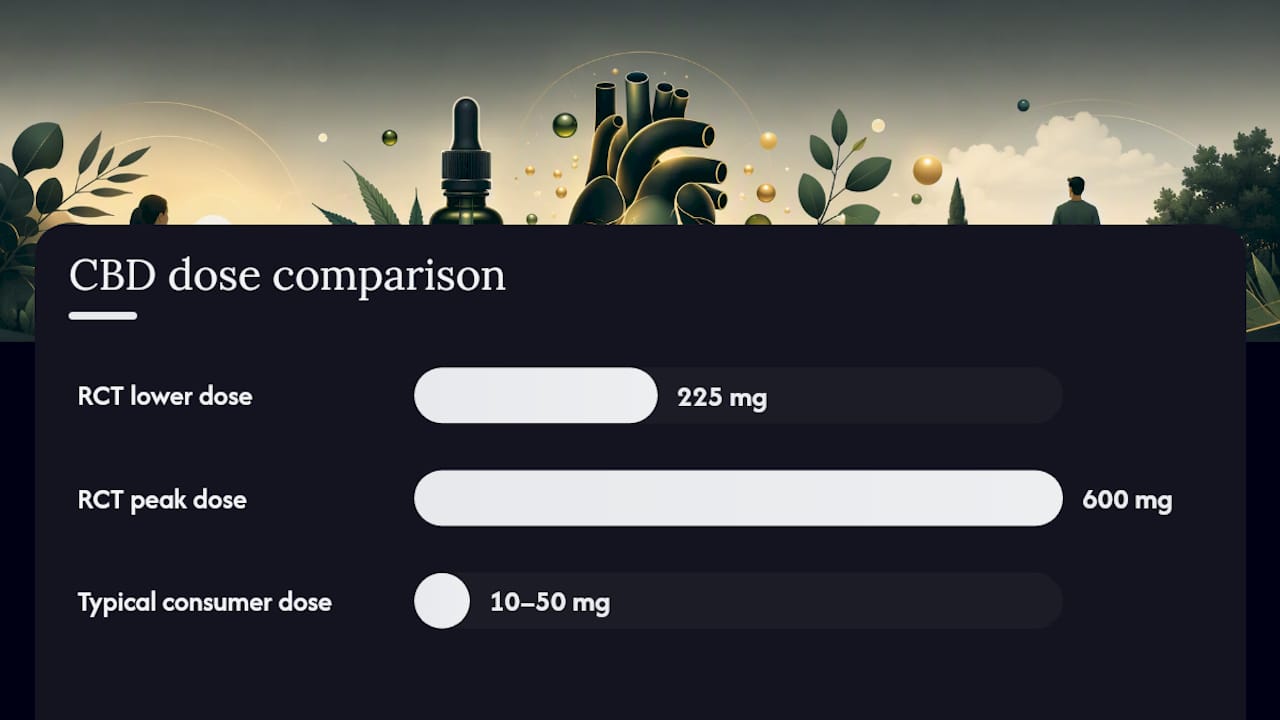
This gap matters for two reasons. First, most people are nowhere near the exposure level that produced the 6 mmHg drop in the original 2017 trial, so expecting that specific effect from a standard bottle is unrealistic. Second, bioavailability varies enormously by product type. An oil or tincture held under the tongue absorbs differently, and generally faster, than a capsule swallowed whole, which passes through digestion first and loses more of its potency before it reaches the bloodstream.
When you’re reading a product label, two numbers matter far more than the marketing headline:
- Total mg per bottle tells you the overall strength, but it’s not the number that affects you in one sitting.
- Mg per dose (per dropper, per gummy, per capsule) is the figure that actually corresponds to what the trials measured, so compare doses like for like.
- Third-party lab reports confirm that what’s on the label matches what’s in the bottle, and that THC content is genuinely negligible or zero.
- Formulation type affects absorption speed and completeness, so a tincture and a capsule with identical mg content won’t necessarily produce the same effect.
None of the trials above tested a typical over-the-counter tincture at consumer dosing, so treat the clinical data as evidence of biological plausibility, not a guarantee of what a standard bottle will do for your own reading.
A safer way to approach trying CBD
If you’ve spoken to a clinician and decided to explore CBD alongside your existing treatment, a structured approach beats guesswork.
- Check your starting point. Note your current medications, baseline blood pressure readings over a few days, and what you actually want to achieve, whether that’s easing stress spikes or general wellbeing support.
- Start low and go slow. Begin with a modest dose, well below trial-level exposure, and don’t increase it without checking in with a clinician first, especially if you take antihypertensives.
- Track it properly. Keep a simple log of home blood pressure readings alongside a symptom diary, noting energy, sleep, mood and any side effects.
- Reassess regularly. If your GP has recommended liver function monitoring due to other medications, mention CBD use so it can be factored in.
- Never substitute. CBD should sit alongside prescribed treatment, not replace it. Stopping or reducing antihypertensive medication based on how you feel, rather than a clinician’s guidance, is a genuine red flag.
Pro Tip: If you notice dizziness, lightheadedness on standing, or unusually low home readings after starting CBD, stop and speak to your GP promptly rather than waiting to see if it settles.
Watch for warning signs like fainting, unusual fatigue, or blood pressure readings dropping well below your normal range, and treat any of those as a reason to pause and get medical input, not push through.
What we still don’t know about CBD and blood pressure
The honest gap in this evidence base is scale. Every trial discussed above involves relatively small groups, ranging from a handful of volunteers to modest hypertensive cohorts, over short durations measured in days or weeks rather than months or years. Formulations differ between studies too, which makes direct comparison harder than it should be.
What would move this from “promising signal” to “established treatment option” is straightforward, if not yet available:
- Larger randomised trials specifically in people diagnosed with hypertension, not just healthy volunteers.
- Standardised formulations and dosing across studies, so results can be compared apples to apples.
- Proper pharmacokinetic data showing how different product types translate trial doses into real-world exposure.
- Long-term safety data, particularly around liver function and drug interactions over months or years of use.
Until that evidence arrives, the most useful things to watch in new research are ambulatory blood pressure results (rather than single office readings), clinically meaningful mmHg thresholds rather than statistically significant but tiny shifts, and liver safety data from longer trials.
Why the stress angle matters more than most people realise
The evidence keeps pointing to the same conclusion, and it’s not the one most headlines lead with. CBD’s most reliable effect isn’t lowering your resting blood pressure day after day. It’s blunting the spike you get when something stresses you out, and that distinction changes how you should think about using it.
If your blood pressure is consistently high at rest, CBD is not a substitute for the treatment your GP has prescribed, and the evidence doesn’t support treating it that way. But if your readings climb specifically under pressure, before a big meeting, after a bad night’s sleep, during a stretch of poor sleep, the mechanism data on autonomic modulation offers a genuinely plausible explanation for why some people notice a difference. That’s a narrower claim than “CBD lowers blood pressure,” but it’s a more defensible one, and it’s the claim the trials actually support.
Third-party lab testing exists precisely so you’re not guessing what you’re taking. Smokocbd publishes lab reports for its broad-spectrum range, and that transparency is the baseline anyone should expect before trying any CBD product for anything beyond curiosity.
— Mike
Trying a lab-tested tincture after talking to your GP
If your clinician has given you the go-ahead to explore CBD alongside your existing care, the SMOKO CBD Mint 2000mg Broad Spectrum Tincture is worth knowing about. It’s a broad-spectrum oil made in the UK from organically grown hemp, third-party lab tested to confirm zero THC, with results available for anyone who wants to check exactly what’s in the bottle before they start.
Remember the distinction between bottle strength and per-dose exposure covered earlier: 2000 mg is the total bottle strength, not what you take in one sitting, so start with a small dropper amount and build a picture of how it affects you before adjusting anything. If you’re managing blood pressure medication, that conversation with your GP or pharmacist should happen before the first drop, not after. You can check the lab reports and full product details on the tincture’s page, and reach out to Smokocbd’s customer support team directly if you have questions about strength or formulation before you order.
Sources
- A single dose of cannabidiol reduces blood pressure in healthy volunteers in a randomized crossover study
- The effects of acute and sustained cannabidiol dosing for seven days on the haemodynamics in healthy men: A randomised controlled trial
- Chronic effects of oral cannabidiol delivery on 24‑h ambulatory blood pressure in patients with hypertension (HYPER‑H21‑4)
- The effects of oral cannabidiol supplementation on blood pressure in adults: a systematic review of randomised controlled trials
- Delta-9-Tetrahydrocannabinol and cannabidiol drug–drug interactions (Karger review PDF)