Dealing with social anxiety isn’t about flipping a switch; it’s about building a toolkit of practical skills. We’ll look at in-the-moment coping techniques, strategies for long-term thought reframing, and the supportive lifestyle changes that make everything else easier. This guide is your roadmap to managing that intense fear of judgement, showing you that proven strategies can genuinely make a difference.
Understanding What Social Anxiety Really Feels Like

First things first: what you're going through is real and valid. Social anxiety is so much more than just "being a bit shy." It's an intense, persistent fear of being scrutinised or judged harshly by others, and it can turn everyday interactions into something you dread.
This fear isn't just a fleeting worry. It's a powerful force that can dictate your choices, from the career you pursue to the relationships you build. For many, learning how to deal with social anxiety begins by simply acknowledging its profound impact. It’s not just about hating parties; it’s the racing heart when you’re asked to speak in a meeting, the sweaty palms before making a phone call, or that all-consuming dread before a simple coffee catch-up.
This experience is becoming alarmingly common. The Big Mental Health Report 2025 revealed that one in five adults in England (20.2%) is grappling with common mental health problems, a category that includes social anxiety. The numbers are even starker for young people. Among those aged 16-24, prevalence has shot up from 17.5% in 2007 to 25.8% in 2023-24, a rise partly fuelled by post-pandemic isolation and the pressures of digital life. You can explore more of these mental health trends in the UK from the Centre for Mental Health and Mind.
A Relatable Scenario
Picture this: you walk into a work event. Your internal monologue immediately goes into overdrive. “Everyone here already knows each other. I look so awkward just standing here. What if I say something stupid?”
Physically, your chest might tighten. You feel your face flush and your hands start to tremble. You grab a drink just to have something to hold, then spend the next hour glued to a corner, scrolling on your phone to look busy. The goal is no longer to network or enjoy yourself—it’s just to survive without being noticed. This cycle of fear, avoidance, and self-criticism is the absolute hallmark of social anxiety.
The core challenge of social anxiety isn't the social situation itself, but the internal battle against your own perceived flaws and the crippling fear that others will see them too.
Your Roadmap to Gaining Control
This guide is built on a practical, three-pronged approach to help you navigate these challenges. We’re moving beyond generic advice to focus on actionable strategies you can start using today. This framework is all about empowerment, giving you tools for both immediate relief and long-term resilience.
Here’s a quick overview of what we’ll cover. Think of it as your strategic plan.
Your Three-Pronged Approach to Managing Social Anxiety
| Strategy Type | What It Involves | Best For |
|---|---|---|
| In-the-Moment Skills | Quick grounding and breathing exercises to use discreetly during an anxiety spike. | Immediately calming physical symptoms and regaining a sense of control in overwhelming situations. |
| Thought Reframing | CBT-based techniques to identify, challenge, and change negative thought patterns. | Breaking the long-term cycle of anxiety by addressing its root cognitive causes. |
| Lifestyle Support | Adjustments to sleep, nutrition, and exercise to build a more resilient baseline. | Creating a foundation of well-being that makes it easier to manage anxiety day-to-day. |
By tackling social anxiety from these three angles, you create a comprehensive support system for yourself—one that works in the heat of the moment and also builds a stronger, more confident you over time.
In-the-Moment Techniques to Calm Your Nerves

When a wave of social anxiety hits, it feels like a sudden storm you can't escape. Long-term strategies are great, but you need something that works right now. Telling yourself to "just relax" is completely useless when your heart is pounding and your palms are sweating. What you really need are a few discreet, practical tools to get your feet back on solid ground.
These techniques are all about pulling you out of that frantic spiral of thoughts and anchoring you in the present moment. They work by shifting your focus away from the fear of being judged and onto real, tangible sensations. This gives your overloaded nervous system a much-needed chance to calm down.
The 5-4-3-2-1 Grounding Method
One of the most effective ways to slam the brakes on an anxiety spike is to get in touch with your senses. The 5-4-3-2-1 technique is a simple, structured way to do this, and the best part is you can do it anywhere without anyone even noticing. It forces your focus away from your internal panic and onto your external surroundings.
Picture this: you're at a work event, and that familiar feeling of being overwhelmed and exposed starts to creep in. Slip away to a quiet corner and mentally run through these steps:
- 5 Things You Can See: Look around and name five objects. Don't just list them; really see them. Notice the dark grain of the wooden table, a flash of blue in a painting, the intricate pattern on the carpet, or a scuff mark on your shoe.
- 4 Things You Can Feel: Turn your attention to physical sensations. It could be the coolness of the glass in your hand, the texture of your jacket sleeve, the solid feeling of the floor beneath your feet, or the slight draught from a vent.
- 3 Things You Can Hear: Tune in to three distinct sounds. Maybe it's the distant murmur of a conversation, the low hum of the air conditioning, or the faint clinking of glasses.
- 2 Things You Can Smell: This one can be a bit trickier, but give it a go. Can you pick up the aroma of coffee, or the subtle scent of someone's perfume as they pass by?
- 1 Thing You Can Taste: Focus on a single taste. Take a sip of water and notice its clean flavour, or just become aware of the taste in your mouth.
This exercise gives your brain a different job to do. It switches from abstract worrying to processing concrete sensory information, which can dial down the intensity of your anxiety in minutes.
Master Discreet Diaphragmatic Breathing
When you're anxious, your breathing gets shallow and fast, which just screams "panic!" to your brain. Diaphragmatic breathing—or belly breathing—is the perfect antidote. It activates the vagus nerve, a key player in slowing your heart rate and bringing on a state of calm.
And you don't need to make a big show of it. You can practise this subtly while standing or sitting in the middle of a conversation.
- Casually rest a hand on your stomach. You can even do this by putting a hand in your pocket and letting your thumb rest on your belly.
- Breathe in slowly and deeply through your nose for a count of four. Focus on feeling your stomach expand, not your chest.
- Hold that breath for just a count or two.
- Exhale slowly and completely through your mouth or nose for a count of six, feeling your stomach gently fall.
Key Insight: The magic here is in the longer exhale. A slow, extended out-breath sends a powerful message to your nervous system that it’s safe to relax. No one will have a clue you're doing anything but listening intently.
These breathing and grounding exercises are your first line of defence. If you want to dive deeper, our guide on how to calm your nervous system has even more strategies that work brilliantly alongside these.
Anchor Yourself with a Sensory Focus
Sometimes, the simplest tricks are the most effective. This involves picking one single sensory detail and pouring all of your attention into it. It's less structured than the 5-4-3-2-1 method but can be just as powerful when you need a quick reset.
For instance, if you're holding a cold drink, focus everything on that sensation. Notice its exact temperature, the feel of condensation on the glass, its weight in your hand. By getting lost in a single, neutral physical feeling, you create a mental "safe spot" that elbows anxious thoughts out of the way.
This works with almost anything. Run your thumb over the seam of your trousers. Feel the texture of a paper napkin. Focus on the warmth of a cup of tea. The goal is to let one simple, real-world detail completely absorb your attention until that wave of anxiety starts to recede.
How to Rewire Anxious Thoughts with CBT
In-the-moment techniques are your first line of defence, but to really get a handle on social anxiety for the long run, we need to go deeper. We have to get to the very source of the fear: the anxious thoughts themselves. This is where Cognitive Behavioural Therapy (CBT) becomes an incredibly powerful tool.
CBT is a practical, evidence-based approach that helps you understand and change the unhelpful thinking patterns that fuel your anxiety. It’s not about ignoring negative feelings, but about questioning the thoughts that create them. In fact, CBT boasts success rates of up to 60-70% in reducing symptoms precisely because it challenges those irrational fears. Recent UK studies, like this one on the impact of mental health support, highlight just how effective these structured approaches can be.
At its core, CBT is built on a simple but profound idea known as the Cognitive Triangle. This concept shows how your thoughts, feelings, and behaviours are all tangled up, influencing one another in a continuous loop.
- Thoughts: Your interpretation of a situation (e.g., "I'm going to say something stupid.")
- Feelings: The emotions that arise from that thought (e.g., anxiety, shame, fear.)
- Behaviours: The actions you take because of those feelings (e.g., avoiding eye contact, leaving early.)
Picture this: you get a last-minute invitation to a party. An anxious thought immediately pops into your head: "They're just inviting me out of pity." This single thought triggers feelings of inadequacy and dread, which then leads to the behaviour of declining the invitation. This whole cycle then reinforces your original belief, making the anxiety even stronger for next time. Our mission is to break this cycle.
Identifying Your Negative Automatic Thoughts
The first real step is to become a detective of your own mind. We all have Negative Automatic Thoughts (NATs)—those quick, reflexive judgements that pop into our heads without any conscious effort. For someone with social anxiety, these NATs almost always revolve around themes of judgement, embarrassment, and not being good enough.
They sound a lot like this:
- "Everyone can see how nervous I am."
- "They think I'm boring and have nothing interesting to say."
- "If I blush, they'll all think I'm weird."
In the heat of the moment, these thoughts feel like absolute facts, but they're rarely based on any real evidence. Learning to spot them is the crucial first move. Start paying attention to your internal monologue before, during, and after social situations. What is your mind actually telling you?
Key Takeaway: Your thoughts are not facts. Realising this separation is the first and most liberating step in regaining control from social anxiety.
Once you can identify these NATs, the next stage is to challenge them. Think of it as putting your anxious thoughts on trial and examining the evidence for and against them. It's a skill that takes practice, but it's one of the most effective ways to rewire your brain's response to social triggers. This mental work is essential, and for more tips on managing a racing mind, check out our guide on how to stop overthinking for a calmer mind.
Challenging and Reframing Your Thoughts
Challenging your NATs isn't about pretending everything is perfect or forcing toxic positivity. It's about finding a more balanced and realistic perspective. When an anxious thought arises, grab a journal or open a notes app and put it through this questioning process.
Let's walk through a real-world example. The Situation: You're in a team meeting at work. The Anxious Thought: "I can't speak up. Everyone will think my idea is stupid, and I'll make a fool of myself."
Now, let's put that thought on trial with a few pointed questions:
-
What is the evidence for this thought?
- Maybe once, a long time ago, I suggested something that wasn't well-received.
-
What is the evidence against this thought?
- My colleagues are generally respectful people.
- I've contributed good ideas in the past that were actually used.
- No one else is judged this harshly when they speak up.
- I've done my research and know what I'm talking about.
-
What is a more balanced, alternative thought?
- "It's possible not everyone will agree with my idea, and that's okay. Contributing is part of my job, and my perspective is valuable, even if it's not perfect. I can't read their minds, but I can control whether I participate."
This structured approach forces you out of emotional reasoning and into logical analysis. Over time, this process becomes more natural and automatic. You begin to build an inner voice that sounds more like a supportive coach than a harsh critic, which is the cornerstone of managing social anxiety for good.
Building Social Confidence with Gradual Exposure
Dealing with anxious thoughts is a huge part of the puzzle, but building real, lasting social confidence means getting out there and taking action. It’s so tempting to just avoid the situations that make you nervous. While that feels safer in the moment, every time you back away, you’re basically telling your brain, "See? That was dangerous." This only tightens anxiety’s grip.
The best way to break this cycle is through a gentle, step-by-step process called graded exposure. It’s all about facing your fears, but doing it entirely on your own terms. Forget diving into the deep end; this is about starting with small, low-stakes challenges and slowly working your way up.
Creating Your Fear Ladder
The main tool for this is what’s known as a ‘fear ladder’. It’s simply a list of social situations you find scary, ranked from the least intimidating to the absolute most terrifying. The whole idea is to start on the bottom rung and only move up once you feel pretty comfortable where you are.
Think of it like training for a marathon. You wouldn't just go out and try to run 26 miles on your first day. You’d start with a short jog around the block and build up your stamina over time. Your fear ladder is the exact same principle applied to social interactions, which makes the whole thing feel way less overwhelming.
Here’s an example of what a fear ladder might look like, just to give you an idea:
- Rung 1 (Low Anxiety): Make eye contact and smile at a cashier.
- Rung 2: Ask a barista for their name when you order your coffee.
- Rung 3: Give a stranger a simple compliment (e.g., "I like your coat").
- Rung 4: Call a shop to ask about its opening hours.
- Rung 5: Ask a colleague a casual question about their weekend.
- Rung 6 (High Anxiety): Share an opinion in a small team meeting.
Of course, your ladder will be completely unique to you. The key is to be brutally honest with yourself about what scares you and to break down bigger fears into smaller, more manageable steps.
Navigating Each Rung of the Ladder
Success with graded exposure isn't about giving a flawless, Oscar-worthy performance. The real win is simply staying in the situation long enough for your anxiety to naturally peak and then recede. This proves to your brain that the reality is rarely as bad as your fear predicted.
Before you take on a step, set a tiny, specific goal. Instead of a vague plan like "talk to someone at the party," make it concrete: "ask one person what they thought of the music." Once you’re in the moment, try to shift your focus outwards. Rather than constantly checking in on how nervous you feel, really listen to what the other person is saying.
Afterwards, fight the urge to mentally replay every tiny thing you think you did wrong. Instead, just give yourself credit for facing a fear. What did you learn? You probably discovered the catastrophic outcome you were dreading never happened. This process is a direct assault on that negative loop of thoughts, feelings, and behaviours.
This cycle shows how our thoughts trigger feelings, which then drive our behaviours, creating a loop that can be hard to escape.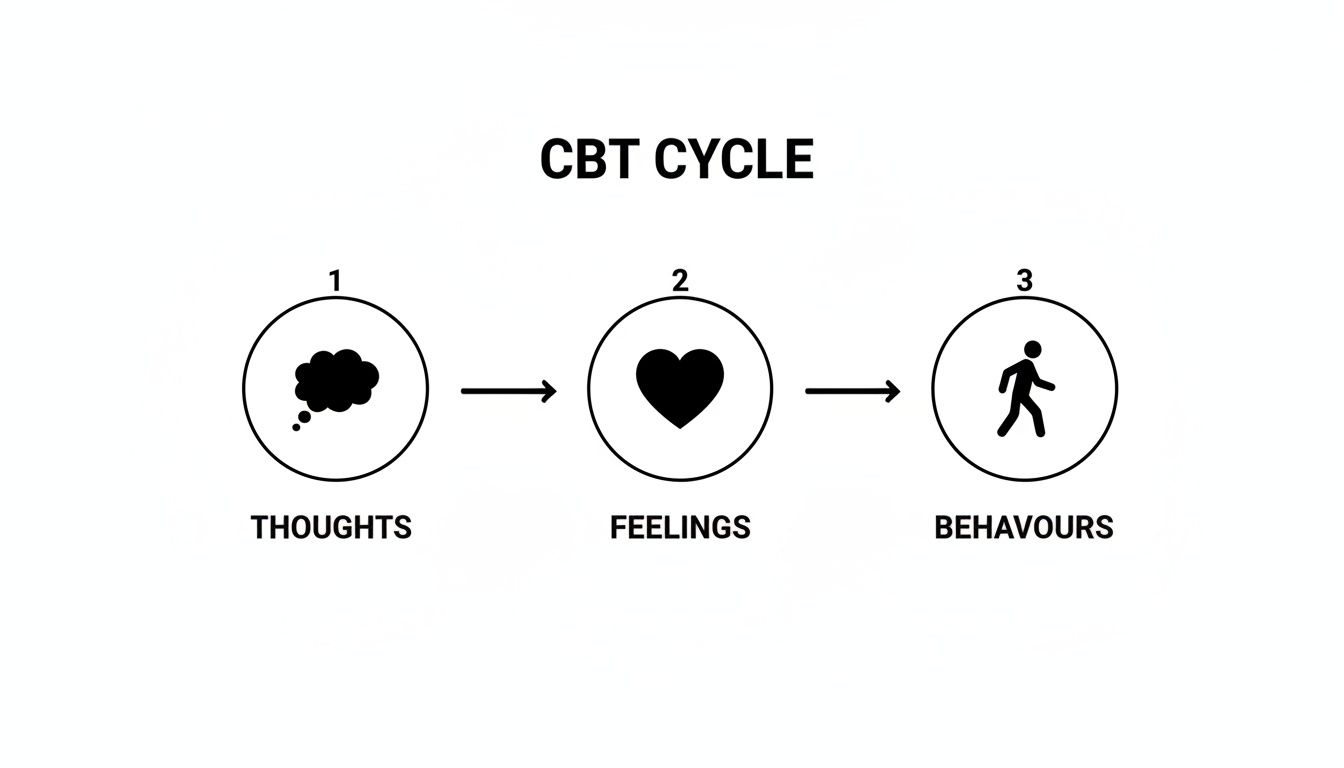 Graded exposure works by deliberately changing your behaviour (avoiding) to prove your initial anxious thought was overblown.
The point of exposure isn't to get rid of anxiety entirely. It's to teach your brain that you can handle the feeling without needing to run away. True confidence is built by experiencing anxiety and realising you can get through it.
This strategy is incredibly powerful. Evidence-based approaches like graded exposure, often recommended by the NHS, have been shown to reduce symptoms in around 75% of cases in as little as 12 weeks. You can discover more insights about anxiety statistics to get a better sense of its impact and how effective treatments can be.
Every single rung you climb on your ladder gives you powerful, first-hand proof that you are more capable than your anxiety wants you to believe. This is how you take back control, one small victory at a time.
Lifestyle Changes That Support a Calmer Mind
While knowing how to handle anxiety in the moment is crucial, the real game-changer is the foundation you build day-to-day. Your mental and physical health are completely intertwined. By making a few conscious lifestyle choices, you can create a much calmer baseline, making it far easier to manage social anxiety when it does flare up.
Think of it this way: if your nervous system is already frayed from poor sleep and a diet of junk food, it's going to overreact to the slightest social trigger. Supporting your body with the right fuel, rest, and movement gives you a much stronger, more resilient starting point from which to face your fears.
The Foundational Role of Sleep
We’ve all felt irritable and on edge after a bad night's sleep. For someone dealing with social anxiety, that feeling is magnified tenfold. A lack of quality sleep messes with your prefrontal cortex—the part of your brain that keeps emotions in check—while sending your amygdala, the brain's fear centre, into overdrive.
This means you’re not just tired; your brain chemistry is literally primed for a bigger anxiety response. Prioritising 7-9 hours of quality sleep isn't a luxury; it's a non-negotiable part of managing anxiety. Simple sleep hygiene habits, like ditching screens an hour before bed and keeping your room cool and dark, can make a phenomenal difference.
Fuel Your Brain for Calm
What you eat directly impacts your mood and anxiety. A diet loaded with processed foods, sugar, and caffeine can lead to energy crashes and inflammation, both of which can make anxiety symptoms feel so much worse. On the flip side, a balanced diet rich in whole foods gives your brain the nutrients it needs to stay stable.
Try to consciously incorporate foods that support your nervous system. A few key players include:
- Magnesium-Rich Foods: Think leafy greens like spinach and kale, nuts, seeds, and even a bit of dark chocolate. Magnesium is brilliant for regulating neurotransmitters that promote a sense of calm.
- Omega-3 Fatty Acids: Found in oily fish like salmon and mackerel, these healthy fats are vital for brain health and have been shown to help dial down anxiety.
- Complex Carbohydrates: Oats, brown rice, and quinoa give you a steady release of energy. This helps you avoid the blood sugar spikes and crashes that can easily trigger anxious feelings.
A well-nourished brain is a more resilient brain. Simple dietary swaps can create a profound shift in your baseline level of calm, making social challenges feel more manageable.
To dig deeper into how specific foods can help create a more stable mood, check out our guide on the best food for anxiety.
Exploring Natural Wellness Aids
Beyond diet and sleep, some people find that natural wellness aids offer that extra bit of support. One option that's getting a lot of attention is CBD (cannabidiol). It's really important to be clear: CBD is not a cure for social anxiety. Instead, think of it as a potential tool that may help support a sense of calm as part of a wider wellness routine.
CBD works by interacting with the body's endocannabinoid system, a complex network that helps regulate things like mood, sleep, and our response to stress. Unlike THC, the compound in marijuana, CBD is non-intoxicating, which means it won't produce a "high."
For those curious about a multi-faceted approach, products like broad-spectrum, UK-manufactured CBD tinctures and gummies might be worth considering. Many users report that these aids help take the edge off pre-social event nerves, a feeling that aligns with early studies into CBD's potential for anxiety. If you choose to explore this path, always start with a low dose and only buy from reputable brands that provide third-party lab testing.
When and How to Find Professional Support
Deciding to get some professional support is a massive, proactive step forward. It's not a sign of failure—far from it. While the self-help strategies we’ve covered are genuinely effective, sometimes you just need an expert guide to help you navigate the tricky bits.
Knowing when to make that call is crucial. Is social anxiety constantly tripping you up at work? Is it putting a strain on your relationships? Does it feel like your world is shrinking? If you're nodding along, it’s a solid sign that professional help could be a game-changer. You don't have to wait until you hit rock bottom to reach out.
Speaking to Your GP
For most people in the UK, the first port of call is their local GP. I know it can feel incredibly daunting, but remember, GPs are trained to handle mental health conversations. They’re the main gateway to getting support through the NHS.
To make the conversation a little easier, it helps to scribble down a few notes before your appointment. Try to include:
- Specific Symptoms: Describe the physical sensations (like a racing heart or sweating) and the actual anxious thoughts that run through your mind.
- Real-World Impact: Explain exactly how it’s affecting your life. Be direct. For example, "I have to turn down every work social," or "I find it impossible to make phone calls, even to friends."
- What You’ve Tried: Let them know about any self-help techniques you’ve already been using.
Being prepared helps you get your point across clearly and makes sure you get the most out of the short time you have. Your GP can then talk you through the options, which often means a referral for talking therapies like CBT via local NHS services. It's so important to keep using your self-help tools while you wait; research shows that over one in three people find their mental health gets worse during this waiting period. You can read the full research about these findings for more detail.
Seeking help is an act of taking control. It's about equipping yourself with the best possible tools and expertise to overcome the challenges you're facing.
Exploring Private Therapy Options
If you're in a position to go private, it can open up more choices and drastically cut down on waiting times. The most important thing here is to find a properly qualified professional who can provide safe and effective treatment.
You’ll want to look for therapists accredited by reputable UK bodies. These organisations ensure their members are held to high standards for training and ethical practice. The two main ones to look for are:
- The British Association for Counselling and Psychotherapy (BACP): A huge professional body for counsellors and psychotherapists across the UK.
- The UK Council for Psychotherapy (UKCP): This council holds a national register of psychotherapists and psychotherapeutic counsellors.
Both of their websites have searchable directories that let you find accredited therapists in your area who specialise in anxiety. Taking that first step gives you the power and the confidence to start moving forward.
Common Questions About Managing Social Anxiety
When you're trying to get a handle on social anxiety, it’s completely normal for a lot of questions to pop up. Getting clear, practical answers can make a huge difference, giving you the confidence that you’re on the right track. Let’s tackle some of the most frequent ones I hear.
Is This Social Anxiety or Just Shyness?
This is a big one, and it's easy to confuse the two. Think of it this way: shyness is more of a personality trait. You might feel a bit awkward or hesitant in new situations, but it doesn't usually stop you from doing things.
Social anxiety, on the other hand, is a much more intense and persistent fear. It’s driven by a deep-seated worry about being judged or scrutinised by others. This fear can be so powerful that it makes you avoid social situations altogether, causing real distress in your day-to-day life.
Can I Overcome This on My Own?
Absolutely, many people make huge strides on their own. Self-help strategies, especially things like cognitive behavioural techniques and gradual exposure exercises, can significantly dial down the symptoms. You can definitely build your own toolkit for managing these feelings.
However, if you feel like the anxiety is really getting in the way of your work, relationships, or just your ability to enjoy life, reaching out for professional support is an incredibly powerful step. Often, the most lasting changes come from a combination of self-help and working with a therapist.
What Should I Avoid Eating or Drinking?
While there's no "anxiety-curing" diet, certain things can definitely make your symptoms worse. It's smart to be mindful of what you're consuming, especially before a social event.
High caffeine intake is a common culprit; it can speed up your heart rate and make you feel jittery, which is a lot like the physical symptoms of panic. Similarly, a sugar binge can lead to a crash later on, leaving your mood unstable and making you feel more vulnerable. As part of a well-rounded approach, you might also be interested in learning how CBD oil may help with anxiety.
At SMOKO CBD, we're committed to supporting your wellness journey with high-quality, UK-made products designed to help you find your calm. Explore our range of CBD oils and edibles today at https://smokocbd.com.