That nagging ache creeping up the left side of your back can be a real worry. Is it something I did? Is it serious? More often than not, it’s down to something simple like a muscle strain from lifting awkwardly or even just sleeping in a funny position. Think of it less as an alarm bell and more as a specific tap on the shoulder from your body, letting you know something needs your attention.
Decoding the Pain on Your Left Side

When the pain is concentrated on just one side of your back, it feels personal. It’s a signal that can be anything from a dull, persistent annoyance to a sharp ache that stops you in your tracks, making it tough to work, sleep, or just get on with your day. If this sounds familiar, you're definitely not alone; back pain is an incredibly common problem right across the UK.
This guide is here to help you make sense of what that left-sided pain might be trying to tell you. We'll walk through the usual suspects—from straightforward mechanical issues in your muscles and spine—to the less common signals that might actually be coming from your internal organs. Getting a handle on the potential causes is the first step to figuring out your symptoms and finding the right path to relief.
Why Your Body Sends One-Sided Signals
Your spine is the central pillar holding everything together, with a complex network of muscles, ligaments, and nerves all connected to it. When one bit of this system gets irritated or injured, the pain doesn't always spread out evenly. It often camps out on one side for a few key reasons:
- Asymmetrical Strain: Maybe you lifted a heavy shopping bag while twisting to the left. That single motion can easily strain the muscles on that side only.
- Nerve Compression: A slipped disc can bulge out to one side, pinching a nerve root that serves the left side of your body.
- Internal Organ Location: Organs like your left kidney or parts of your colon aren't in the centre of your body. If they have a problem, they can "refer" pain to your back on the same side.
This one-sidedness is a vital clue. It helps you and your doctor narrow down the possibilities from a vague "back problem" to a much more specific area of concern.
It's worth remembering just how common this is. An estimated 9 million people in England live with back pain. For a huge chunk of them—between 85% and 95%—the symptoms are "non-specific," which means there's no single, obvious cause found on a scan. This just goes to show how often the discomfort is down to everyday lifestyle factors or minor strains.
Navigating Your Pain Journey
Back pain is a massive health issue in the UK, impacting millions of people's daily lives and their ability to work. It tends to hit adults between 35 and 55 the hardest, partly due to natural age-related changes in our muscles and bones.
Yet, despite how widespread it is, around 27% of sufferers never seek any kind of treatment. You can find more facts about the prevalence of back pain in the UK if you want to dig deeper. Our aim here is to give you the knowledge to confidently tackle your pain, whether that means trying a few things at home or knowing when it’s the right time to have a chat with a healthcare professional.
Muscles, Bones and Nerves: The Usual Suspects

More often than not, when you feel that nagging ache or sudden, sharp twinge in your left side, the cause is mechanical. Think of your back as an incredible piece of biological machinery. It’s a complex structure of interlocking muscles, bones, and nerves all working in harmony. When just one of those components gets knocked out of alignment, it can throw the entire system off balance, leading to pain focused on one side.
The most frequent culprits behind left-sided back pain are these sorts of musculoskeletal issues. This is the kind of pain that usually has a clear trigger – maybe you overdid it in the garden, lifted a heavy box with a twist, or even just spent too long hunched over your desk. These actions place uneven stress on your body, causing a very specific, localised problem.
The Common Culprit: Muscle Strain
By a long shot, the most common reason for back pain on the left side is a simple muscle strain or sprain. This is what happens when the muscle fibres or ligaments in your back are stretched too far, or even torn. It might show up as a sudden, sharp pain after an awkward movement, or it could be a dull ache that builds up slowly from repetitive strain.
Picture the muscles in your back as a network of elastic bands that support your spine. If you suddenly yank one side too hard or keep it stretched in an awkward position, those fibres can get damaged. This leads to inflammation, stiffness, and pain that typically feels worse when you move and eases up when you rest.
Back pain is a massive health and economic challenge here in the UK. Between 2018 and 2019, workplace-related musculoskeletal issues affected about 498,000 UK workers, and a hefty 20% of those cases were specifically low back pain. The financial hit is immense, too, costing the economy an estimated £12.3 billion a year and leading to nearly 31 million lost workdays back in 2016.
When a Disc Is to Blame
Moving a little deeper into the spine, we find the intervertebral discs. These are the soft, gel-filled cushions that sit between your vertebrae, acting like natural shock absorbers. Sometimes, whether from an injury or just age-related wear and tear, the soft centre of a disc can push out through its tougher exterior. This is what's known as a herniated disc – you might have heard it called a "slipped disc."
If this bulge happens on the left, it can press directly on the nerves branching off the spinal cord on that side. It’s this nerve compression that causes the pain. A herniated disc often creates a deeper, more persistent ache than a muscle strain and may not get better as quickly with simple rest.
Think of a herniated disc like a tyre with a bulge in its sidewall. The tyre itself might still work, but the bulge creates pressure where it shouldn't, affecting everything around it. Similarly, the disc's bulge puts direct pressure on sensitive nerve roots, creating a very targeted pain signal.
The Sciatica Connection
When a herniated disc in your lower back presses on the sciatic nerve, it can trigger a very specific type of radiating pain called sciatica. The sciatic nerve is the longest in your body, running all the way from your lower back, down through your buttocks, and into each leg. Because you have a sciatic nerve on both your left and right sides, a problem on the left side of your spine will cause symptoms down your left side.
This isn't your average backache. Sciatica is known for a sharp, shooting, or burning pain that travels along the nerve's path. You might feel it start in your left lower back, then travel down into your buttock, the back of your thigh, and even into your calf or foot. It can also bring numbness, tingling, or weakness in the leg with it. For those dealing with this type of debilitating discomfort, looking into natural remedies for nerve pain can be a helpful part of a broader management plan.
Comparing Common Musculoskeletal Causes
It can be tricky to tell these common conditions apart, as they can feel similar at first. This table breaks down the key differences in how the pain typically presents itself.
| Condition | Primary Pain Type | Common Triggers | Pain Location Pattern |
|---|---|---|---|
| Muscle Strain | Dull ache, soreness, stiffness | Overuse, sudden awkward movements, heavy lifting | Localised to the muscle area, often worse with specific movements |
| Herniated Disc | Deep, sharp, persistent ache | Injury, age-related wear, lifting with a twist | Focused near the spine, can be constant |
| Sciatica | Sharp, shooting, burning, "electric" | Herniated disc, spinal stenosis (narrowing of the spine) | Radiates from the lower back, down the buttock, and into the leg |
Understanding these patterns can give you a better idea of what might be going on, which is the first step toward finding the right way to manage the pain and get back to feeling yourself.
When Pain Signals an Internal Issue
While most aches and pains in your left back are down to muscles and bones, sometimes the real culprit is hiding deeper inside. Your body is a complicated piece of kit, and an issue with an internal organ can sometimes send out a distress signal that your brain reads as back pain. This is what doctors call referred pain.
Think of it like dodgy wiring in your house. A problem with the fuse box in the garage might make a light flicker upstairs. It's a similar idea with your body. Organs on your left side share nerve pathways with muscles in your back. When one of those organs is inflamed or unhappy, it shoots pain signals up those shared nerves, and your brain gets its wires crossed, thinking the pain is coming from your back.
This is exactly why it's so important to look at the whole picture. A simple muscle strain won't usually give you a fever or make you feel sick, but those extra symptoms can be massive clues that the problem isn't your back at all. Knowing this isn't about scaremongering; it's about giving you the knowledge to have a better, more informed chat with your doctor.
When Your Kidneys Sound the Alarm
Your left kidney is tucked away just behind your lower ribs, which makes it a prime suspect for referred pain in your left flank and back. But unlike muscle pain that gets better or worse when you move, kidney pain is usually a deep, relentless, and often severe ache. Shifting your position or having a lie-down won't make a blind bit of difference.
Kidney pain rarely shows up on its own. It usually brings a few friends along that help distinguish it from a simple pulled muscle.
- Sharp, Severe Pain: This can feel like it's coming in waves and can be incredibly intense, especially if a kidney stone is the cause.
- Fever and Chills: A high temperature is a classic calling card of a kidney infection (pyelonephritis).
- Nausea and Vomiting: Feeling sick to your stomach is another common sign of kidney trouble.
- Changes When You Wee: Keep an eye out for pain or a burning feeling, cloudy or smelly urine, or feeling like you need to go more often.
If your left-sided back pain comes with any of these other symptoms, it’s a clear sign you should get it checked out by a doctor sharpish to rule out a kidney problem.
A key way to tell the difference is how the pain behaves. If bending over or twisting sends a shooting pain up your back, it’s probably muscular. If it’s a deep, nagging ache that doesn’t change no matter what you do, it’s time to think about an internal cause.
Pancreatitis and Other Digestive Issues
Another organ on your left side, nestled behind your stomach, is the pancreas. When it gets inflamed – a condition called pancreatitis – it can trigger a severe, constant pain that starts in your upper belly and often bores straight through to your back.
The pain from pancreatitis is often described as a 'boring' pain that gets worse after you eat, particularly if you've had something fatty. Just like with kidney pain, it’s usually joined by other obvious symptoms:
- Intense upper abdominal pain that feels like it’s wrapping around to your back.
- Nausea and vomiting.
- A fever and a racing pulse.
- Tenderness if you press on your abdomen.
Other gut-related problems can also refer pain to your back. Issues in the colon, like diverticulitis, can sometimes show up as left-sided discomfort. For anyone looking into how gut health affects the rest of the body, seeing the link between a happy digestive system and overall comfort is key. You can find some useful info on how CBD might play a role in digestive wellness by learning more about CBD for gut health. Taking this wider view helps connect the dots between what’s happening inside and the symptoms, like back pain, you feel on the outside.
Recognizing Red Flags and When to Call a Doctor
Most of the time, that nagging pain on your left side is a mechanical issue—something that will get better with a bit of rest and common sense home care. But it's crucial to know when that pain is trying to tell you something more serious. Think of these symptoms as your body's alarm system – they’re loud, clear, and you shouldn't hit the snooze button on them.
Certain signs, often called 'red flags' by doctors, suggest your back pain could be linked to a significant underlying condition. If you experience any of the following, it’s time to stop self-treating and get in touch with your GP or seek urgent medical advice.
Urgent Symptoms to Watch For
Knowing what to look for can help you act quickly when it really matters. Pay close attention if your left-sided back pain shows up with any of these companions:
- Loss of Bladder or Bowel Control: This is a major red flag. It could point to a serious nerve compression issue called cauda equina syndrome, which needs immediate medical intervention.
- Numbness Around the Groin or Buttocks: Often called "saddle anaesthesia," this loss of feeling is another key signal of severe nerve problems.
- High Fever: Pain that comes with a fever (over 38°C), chills, or unexplained sweats could mean a serious infection in the spine or even a kidney.
- Unexplained Weight Loss: If you're shedding pounds without trying and your back won't stop aching, it’s a clear sign you need a proper medical evaluation.
- Pain After a Serious Accident: Any significant back pain after a fall, car crash, or other major trauma needs to be checked out by a professional.
This simple decision tree can help you quickly distinguish between different types of back pain on your left side.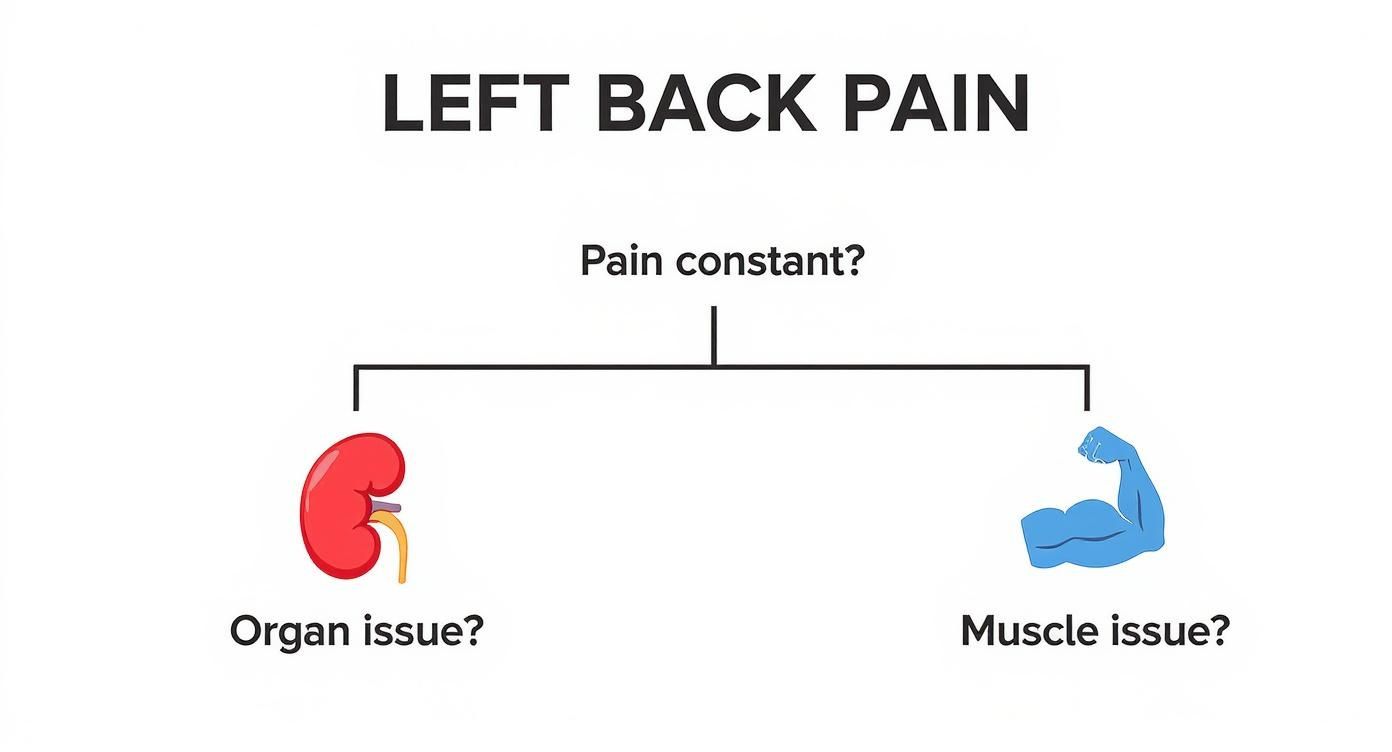 As the flowchart shows, if your pain is constant and won't let up, it's more likely to be an internal issue. Pain that comes and goes often points back to a muscular cause.
Preparing for Your Doctor's Visit
Knowing what to expect can make your appointment much more effective. Your GP will want to get a good history of your pain, so be ready to describe when it started, what it feels like (is it sharp, dull, or burning?), what makes it worse, and if anything at all makes it better. They’ll likely do a physical exam too, checking your range of motion, reflexes, and muscle strength.
Musculoskeletal pain is incredibly common, especially among older adults in the UK. Studies show that between 20% and 50% of people over 50 report having episodes of it, with women experiencing it more than men. You can read more about musculoskeletal pain in the UK population on pmc.ncbi.nlm.nih.gov.
Key Takeaway: While most back pain isn't an emergency, being able to spot the red flags is essential. Trust your gut—if the pain feels severe, different, or comes with other worrying symptoms, getting professional medical advice is always the right call.
Before trying any new supplements or treatments for your pain, it's smart to chat with your doctor, especially if you're already taking other medications. To get you ready for that conversation, have a look at our guide on CBD drug interactions to know about for safe use.
Practical Relief Strategies You Can Start Today

When you’re hit with that nagging (or screaming) pain in your left-side back, it's easy to feel a bit helpless. But you’re not. There are plenty of effective, practical things you can start doing right now, in your own home, to get some control back. The goal here is simple: calm things down, get moving again, and stop this from turning into a long-term saga.
The first thing most of us want to do is curl up and not move a muscle. While a bit of rest right after an injury makes sense, staying in bed for days on end is a recipe for disaster. It can actually make your muscles weaker and stiffer. The modern thinking is all about gentle, smart movement to get blood flowing to the area and kickstart the healing process.
Think of this section as your toolkit. We’ll walk through what to do the moment pain strikes, and then cover when it’s time to call in the professionals.
Immediate At-Home Care Techniques
That first twinge of pain is your cue to act. Getting on top of it quickly with some simple, targeted care can make a world of difference. It's all about soothing the inflammation and easing that muscle tension to give yourself some much-needed relief.
One of the biggest questions is always: ice or heat? The answer really depends on how fresh the pain is.
- Ice for New Injuries: If you’ve just injured yourself, for the first 48-72 hours, ice is your best friend. Wrap a cold pack in a tea towel (never put it directly on your skin) and apply it to the sore spot for 15-20 minutes at a time. This helps shrink the blood vessels, which is fantastic for reducing swelling and inflammation.
- Heat for Chronic Aches: If the pain is more of a dull, persistent muscular ache that's been around for a while, heat is the way to go. A warm bath or a heating pad helps relax those bunched-up muscles and boosts circulation, which can ease stiffness beautifully.
Over-the-counter pain relief can also be a big help. Things like ibuprofen are nonsteroidal anti-inflammatory drugs (NSAIDs), meaning they tackle both the pain signals and the inflammation itself. Just be sure to follow the instructions on the packet and have a quick chat with your pharmacist or GP if you have any other health conditions.
The Role of Professional Help
If that back pain is still hanging around after a week or two, or if it's severe enough to really disrupt your life, it’s time to get some professional advice. Your GP is the right first port of call here in the UK. They can help figure out what’s going on and map out a treatment plan.
Often, your GP might refer you to a physiotherapist, either through the NHS or privately. Physiotherapy is really the cornerstone of treating back pain. It’s not just about getting a massage; it's an active approach using specific exercises and hands-on therapies to build strength, fix your posture, and get you moving properly again.
A good physiotherapist does more than just treat the sore spot. They become a bit of a detective, working with you to uncover the root cause of your left-sided back pain. The real goal is to give you the tools and knowledge to manage it yourself and prevent it from coming back.
Depending on your situation, your doctor might also bring up options like chiropractic care or osteopathy. These are hands-on therapies that focus specifically on the spine and musculoskeletal system, using careful adjustments to improve how everything is aligned and functioning.
Exploring Topical Solutions for Localised Relief
Alongside everything else, creams and rubs that you apply directly to your skin can offer fantastic, targeted comfort right where you need it. It’s a great way to get relief to a specific muscle without having to take a pill.
Lots of people find real solace in balms that use natural ingredients to soothe sore muscles. These can be a game-changer for muscular back pain on the left side, letting you apply them with pinpoint accuracy. For anyone curious about plant-based options, a CBD muscle rub can be a brilliant addition to your pain management routine. It provides a soothing sensation that works wonderfully alongside other treatments like gentle stretching and heat therapy.
Frequently Asked Questions About Left Side Back Pain
Even after a deep dive into what causes and fixes back pain on the left side, you might still have a few questions rattling around. This section is here to tackle those common queries, giving you quick, clear answers. Think of it as a final check-in to make sure you're feeling confident and in the know.
We'll cover everything from how stress sneaks up on your back muscles to the best way to get a decent night's sleep when your back is screaming at you. Let's clear up any last bits of confusion.
Can Stress Cause Back Pain on the Left Side?
Yes, absolutely. When you're stressed, your body flips into 'fight or flight' mode. This floods you with hormones like cortisol, which tells your muscles to tense up, ready for action. If you already have a slight muscle imbalance or just unconsciously favour one side, this constant tension can easily zero in on the left side of your back, leaving you with a nagging, dull ache.
On top of that, stress is known to actually lower your pain threshold. This means that a minor twinge you might otherwise ignore can suddenly feel a lot more intense and disruptive. Bringing some simple stress-management techniques into your day—like deep breathing, a quick walk, or mindfulness—can be a surprisingly powerful way to ease this kind of back pain.
How Do I Know If It Is My Kidney or a Muscle?
Figuring out whether it's your kidney or a muscle acting up usually comes down to paying attention to a few key clues. The type of pain and how it behaves are the biggest giveaways.
- Muscle Pain: This usually feels like a specific ache, soreness, or even a spasm. It tends to get worse when you do certain things like bending or lifting, and feels a bit better when you rest.
- Kidney Pain: This is typically a deeper, sharper pain that feels more constant. You'll feel it higher up in your back, just under your rib cage. Critically, it won't change whether you're sitting, standing, or moving, and it often comes with other symptoms.
If your back pain is joined by other signs like a fever, feeling sick, or pain when you urinate, that's a massive red flag that it's not just a muscle. In this situation, it's really important to see a doctor to rule out any kidney problems.
What Is the Best Way to Sleep with Left Side Back Pain?
How you sleep can make a world of difference, either making your pain worse or helping you recover faster. The main goal is to keep your spine in a neutral, happy position.
For anyone dealing with pain on the left side, the best bet is often to sleep on your right side. Stick a firm pillow between your knees. This simple trick helps to line up your spine, hips, and pelvis, which takes a lot of pressure off the muscles in your lower back.
If you're a back-sleeper, slide a small pillow or a rolled-up towel under your knees to maintain the natural curve in your lower spine. The one position you should avoid like the plague is sleeping on your stomach. It flattens your spinal curve and makes you twist your head, putting a huge strain on both your back and neck.
Should I Use Ice or Heat for My Pain?
The whole ice versus heat debate comes down to what caused the pain and how long you've had it.
- Use Ice for New Injuries: If you've just tweaked something (within the first 48 hours), ice is your best friend. A cold pack wrapped in a towel, applied for 15-20 minutes at a time, will help calm down inflammation and numb the area.
- Use Heat for Chronic Soreness: For that ongoing muscle tightness or soreness where there's no swelling, heat is usually the winner. A heating pad or a warm bath helps relax those tight muscles, boosts blood flow to the area, and soothes the ache.
Just remember never to put intense heat or ice straight onto your skin, as you could end up with burns or skin damage. Always wrap it in a towel first.
Finding the right support on your wellness journey is crucial for managing pain and getting your quality of life back. At SMOKO CBD, we offer a range of premium, UK-made CBD products designed to help you find calm and support your body's natural recovery. Check out our lab-tested CBD oils and topicals to find a natural addition to your self-care routine at https://smokocbd.com.